NCA Pre-Conference: Analyzing Health, Digital, and Intercultural Discourse (USA)

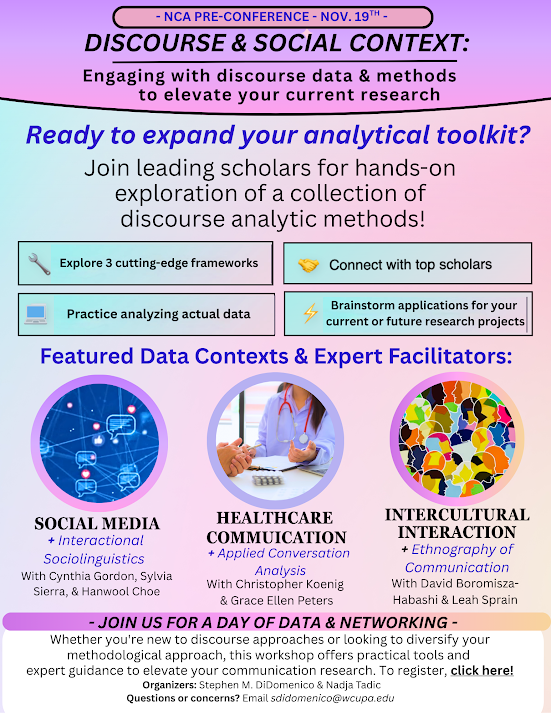
ConferencesPre-Conference: Discourse & Social Context – Engaging with Discourse Data & Methods to Elevate your Current Research, National Communication Association, Denver, CO, 19 November 2025. (preregistration appreciated but not required)

Join a team of leading scholars from the Language & Social Interaction (LSI) Division of the National Communication Association for a special 1 day Pre-Conference: “Discourse & Social Context – Engaging with Discourse Data & Methods to Elevate your Current Research.” Registration information about the pre-conference (and main conference) can be found here. The day’s activities will occur from 9am to 5:30pm at the Gaylord Rockies Resort and Convention Center in Aurora, Colorado.

The pre-conference is centered around a series of data-focused workshops, where participants from a variety of experience levels – from beginner all the way to advanced – can deepen their skills. Our primary focus will be hands-on application using a variety of methodological and analytical tools inspired by the LSI research tradition.

NCA Pre-conference 2025The agenda for the day:
• 9:00-9:30am Welcome and introductions – Stephen M. DiDomenico (West Chester U.) and Nadja Tadic (Georgetown U.)
• 9:30-10:15am Presentation on discourse analysis as an umbrella term for different LSI methods and analytic tools
• 10:15-11:45am Workshop 1: Interactional Sociolinguistics for social media
o Cynthia Gordon (Georgetown U.), Sylvia Sierra (Syracuse U.), and Hanwool Choe (U- Hong Kong)
• 11:45am-1:30pm Lunch & Networking
• 1:30-3:00pm Workshop 2: Conversation Analysis for health communication
o Christopher Koenig (San Francisco State U.) and Grace Ellen Peters (Colorado Christian U.)
• 3:15-4:45pm Workshop 3: Ethnography of Communication for intercultural communication analysis
o David Boromisza-Habashi (U-Colorado, Boulder) and Leah Sprain (U-Colorado, Boulder)
• 4:45-5:30pm Making connections & closing discussion

CFP Communication as Social Construction Division for NCA 2025

Conferences

Call for submissions: Communication as Social Construction Division, National Communication Association, 20-23 November 2025, Denver, CO, USA. Deadline: 31 March 2025.

 The Communication as Social Construction (CASC) Division invites inquiries that explicitly cite social construction literature and use social construction approaches to study face-to-face, cultural, and mediated communication. Referencing foundational texts of social construction is highly encouraged. Some influential scholars may include, but are not limited to the following: Burr, V.; Blumer, H.; Chen, V.; Davis, K.E.; Galanes, G.; Gergen, K.J.; Gergen, M.; Leeds-Hurwitz, W.; Littlejohn, S.W.; Pearce, W.B.; Spano, S.; and Tomm, K.

The Communication as Social Construction division encourages submissions that explore how we communicate in ways that may elevate (1) the communicative construction of identity and relationships within any socially significant context; (2) the communicative construction of context itself; (3) the social construction of discord and the potential of communication to transform conflict into more harmonious relationships; (4) the social construction of regard, concern and esteem; (5) metatheoretical, theoretical, and methodological developments relevant to constructionist research, teaching, and application; (6) examinations of similarities and differences between social construction and other approaches to communication studies and practices, and (7) comparative analyses of approaches to communication as social construction across cultures or across levels of analysis.

Members of the Communication as Social Construction (CASC) Division are committed to promoting conversation and community among scholars whose work advances the idea that we create and recreate social worlds through interaction. CASC scholars take a Communication Perspective to acknowledge communication processes as central to academic inquiry and practice with recognition of the transformative potential of communication teaching and research. The division is interested in topics related to social constructions of identity and relationships, discord and transformative conflict, and social constructions of the contexts we live in today. Examples of socially constructed contexts to examine may include relationships, media, technology, health, organizations, the classroom, and culture.

CFP International & Intercultural Communication Division for NCA 2025

Conferences

Call for submissions: International and Intercultural Communication Division, National Communication Association, 20-23 November 2025, Denver, CO, USA. Deadline: 31 March 2025.

The International and Intercultural Communication Division (IICD) of the National Communication Association is committed to promoting works that explore different issues using intercultural communication frameworks. We understand culture broadly, not as a preexisting phenomenon but as a contested terrain of meaning-making, making it central to social interactions and human existence itself.

The year 2025 has brought severe sociopolitical turmoil in its wake. Given this context, the division seeks submissions from scholars, teachers, practitioners, and performers, among others, that related to the 2025 convention theme, “Communicate to Elevate,” introduced by NCA’s First Vice-President, Dr. Tina Harris. Specifically, they invite works that engage this theme in ways that illuminate the theoretical and political potential of intercultural communication in being an agent of social change. Which voices, projects, analytics, and geopolitical contexts and perspectives, among others, are elevated in communication studies in general and intercultural communication in particular? Conversely, which issues remain elided and to what effect? Are there voices that remain subdued despite (performative) attempts to the contrary and why? Furthermore, when is it prudent to not elevate certain voices or analytics (as their strength derives from their ability to evade mainstream attention)? What are the implications of trying to “communicate” and “elevate” in times of rampant misinformation and in a political context that is hostile to investigations of socioeconomic and other inequities? Is it possible to elevate historically marginalized voices without hoping for substantial structural changes? What trends or interdisciplinary collaborations are emergent in intercultural communication that help elevate human well-being? These are a few provocations offered for your consideration.

CFP NCA Peace & Conflict Division High Density Panel 2025

Conferences

Call for submissions: Healing Divides and Elevating Connections Within Conflict & Peacebuilding, National Communication Association, 20-23 November 2025, Denver, CO, USA. Deadline: 15 March 2025.

In 2024, the Peace and Conflict Communication Division came together and explored how to find a balance between self-regard and greater regard in conflict. They welcomed nearly 20 scholars and many more audience participants to engage in this discussion as part of our 12th annual high-density panel. Last year’s theme encouraged us to examine the balance between empathy and compromise for others (greater regard) and maintaining self-regard, fostering meaningful dialogue and reconciliation through an awareness of individual, social, and cultural positionalities. By addressing these complexities, they highlighted pathways for navigating conflicts with both authenticity and mutual respect.

Building upon our conversations last year, they are excited to introduce the 13th annual high-density panel theme for the 2025 National Communication Association annual Conference: Healing Divides and Elevating Connections Within Conflict & Peacebuilding. Conflict presents a significant challenge to the stability of interpersonal, intergroup, and international relationships. A central concern lies in understanding how individuals and groups can navigate the often difficult, sensitive, and inherently unpleasant dynamics of conflict while preserving their shared connections. This inquiry calls for a reimagining of conflict, not merely as a problem-solving process aimed at achieving mutual agreement but as an opportunity to restore and heal relationships. Furthermore, this perspective emphasizes the potential for conflict to serve as a transformative process, fostering the elevation and deepening of shared connections across interpersonal, organizational, and international contexts.

Aligned with this year’s thematic focus—Communication to Elevate—this exploration seeks to illuminate the role of communication in healing and strengthening relational bonds during the conflict process. Specifically, we aim to examine how conflict and communication can transcend its traditional functions and become a vehicle for fostering relational resilience, growth, and elevated connection.

Several overarching questions emerge from this endeavor, cutting across diverse conflict scenarios: How can communication serve to elevate and deepen shared connections during moments of conflict? What communicative patterns and strategies threaten the stability and integrity of these connections? Lastly, how can stakeholders across various domains be encouraged to reconceptualize conflict in ways that prioritize and value the preservation and enrichment of shared relational bonds? By addressing these critical questions, we aim to contribute to a more nuanced understanding of the interplay between communication and conflict, highlighting pathways for relational healing, elevation, and transformation.

NOTE: There is also a call for general submissions to this division; these often explore topics in conflict management, negotiation, mediation, and bullying. Peace and Conflict Communication scholars study processes and effects of communication using a variety of research methods, concepts, and pedagogical or andragogical approaches to understand and promote peace in personal, organizational, local community, national, and global contexts. They ask that submissions to the PCCD closely align with the overarching conference theme. The deadline for general submissions is 31 March 2025.

Call for Nominations: NCA’s Global Communication Award Committee Member (USA)

Professional OpportunitiesCall for Nominations: Global Communication Award Committee member, National Communication Association, Washington, DC, USA. Deadline: 1 October 2024.

The Global Communication Award recognizes communication scholars who have demonstrated outstanding scholarship and notable service in the areas of global communication. Specifically, the recipient will be recognized for distinguished communication scholarship that: 1. De-Westernizes way of knowing and doing, 2. Focuses on regions, communities, or spaces outside of the United States and Europe Integrates and cities international, and global scholars, theories, approaches, and/or methodologies in their scholarship, 3. Amplifies the global ecologies of knowledge.

Committee members review, evaluate, deliberate, and select a winner as prescribed by the individual award guidelines. Committee chair is responsible for coordinating the work of the selection committee and ensuring all deadlines are met. The chair is the third-year member of the committee. The selection committee reviews nomination materials electronically from June to August for an average of 2-3 hours per month. The time commitment for selection committee members is dependent on the number of nominations.

Nominees should be at the mid-career stage or beyond and focused on teaching and/or researching in global communication. NOTE: At least one member must a scholar residing or working outside of the United States.

Nominees must be members of NCA at the time of submitting materials and possess:

  • A willingness to collaborate with other committee members as needed.
  • The ability to think comprehensively about Global Communication research.
  • An understanding of the vision and mission of NCA.
  • The willingness to set aside professional affiliations/friendships reviewing nomination materials.
  • A commitment to adhere to confidentiality when required.

This is for a 3 year term, starting January 2025.

NCA: Chief Diversity Officer (USA)

“JobChief Diversity Officer, National Communication Association, Washington, DC, USA. Deadline: open until filled; posted 9 August 2023.

The Chief Diversity Officer (CDO) leads and implements a transformational agenda that infuses – throughout the National Communication Association (NCA) and in all of its work – a focus on and commitment to inclusion, diversity, equity, and accessibility (IDEA) to promote NCA’s mission to advance communication scholarship, teaching, and practice to foster a better world.

While IDEA is the priority and responsibility of the entire Association, the CDO will play a leading role in interpreting, communicating, and promulgating NCA’s IDEA Framework, which guides and supports the ongoing development, implementation, and evaluation of IDEA-related goals. The CDO will steer the development, execution, and assessment of these goals related to three broad areas – (1) the Association itself, (2) the field of communication, and (3) the benefits of communication for society – and ensure that these goals are woven into the fabric the organization. The CDO’s scope of work will also be informed by the IDEA strategic plan and goals and the NCA’s strategic priorities. This position will report directly to the Executive Director, serve as a member of the Senior Team, and work closely with NCA’s Executive Committee and governance groups.

Seeking Support for New Sub-Saharan African Caucus (USA)

“Collaborative

Seeking Support for New Sub-Saharan African Caucus, National Communication Association, USA. Deadline: 31 July 2023.

Communication scholars representing and studying the Sub-Saharan African region are organizing an effort to create a Sub-Saharan African Caucus at the National Communication Association (NCA, based in the US). This caucus will serve as a dedicated space to share and promote the Sub-Saharan African scholarship covering a range of communication subfields. This will be the first Sub-Saharan African Caucus at a major communication association.

Following the procedures laid out by NCA to consider caucus proposals, the organizing committee is seeking support from the NCA membership. If you are an NCA member and are willing, please indicate your support at the link below. We also ask to please distribute the link and its purpose widely.

Thank you for your consideration and support!

Prisca S. Ngondo, Texas State University
Anna Klyueva, University of Houston-Clear Lake
Dane Kiambi, University of Nebraska-Lincoln


Distinguished Scholarship Awards, IICD of NCA

Call for Nominations
2016 Distinguished Scholarship Awards
International and Intercultural Communication Division
National Communication Association

Nominations are invited for the 2016 International and Intercultural Communication Division (IICD) Distinguished Scholarship Awards for work copyrighted in 2015. Up to five awards will be given in the following categories:
· Best Book (single-authored or co-authored)
· Best Book (edited or co-edited)
· Best Article (or Book Chapter)
· Best Dissertation and/or Master’s Thesis

Submit all nomination materials via electronic submission to cheny3@ohio.edu and must include the following:
(a) A nomination letter outlining justification for the award
(b) For Article or Book Chapter submissions, send PDF copies only
(c) For Book submissions, send three (3) copies of the complete work (You may ask your publishers to send copies directly as part of their promo)
(d) For Dissertation or Thesis submissions, mail/send three (3) CD-ROM, flash drive, or PDF copies of the complete work.

Mail hard copies (for c & d) to the following address:
Dr. Yea-Wen Chen
School of Communication Studies
Ohio University
Schoonover Center 407
Athens, OH 45701-2979
The United States

Awards will be presented at the International and Intercultural Communication Division (IICD) Business Meeting in Philadelphia at the 2016 NCA Convention. Recipients of the awards will be notified by September 1, 2016 and are expected to be present for the award presentations. Self, peer, or advisor nominations are welcomed. The awards committee will not accept more than one submission of the same (co-)author, whether they are nominated or self-nominated, regardless of category. Works must have been copyrighted during the 2015 calendar year.

Nomination packets must be received by April 25, 2016.

NCA 2014 in Chicago

This slideshow requires JavaScript.

The National Communication Association 100th convention was held in Chicago November 20-23, 2014. I organized a panel entitled “Intellectual Genealogy: Documenting Invisible Colleges in the Age of Digital Communication” with Theresa Castor, Robert Craig, Jay Leighter, Jefferson Pooley, Michelle Scollo and Leah Wingard. In addition, I presented two papers. “Taking a (Meta)Communication Perspective to Intercultural Dialogue” (discussing the Key Concepts in Intercultural Dialogue) was part of the panel organized by Richard Buttny resulting from the Macau conference in spring, with Todd Sandel and Sunny Lie (from that event) and the added participation of Don Ellis; Cynthia Gordon was chair. “Bringing Intercultural Dialogue to the Center” was part of a panel of past chairs of the International and Intercultural Communication Division, organized by Alberto Gonzalez, and titled “Past Challenges, Present Victories.” A photo from that event is attached; the participants were (bottom row, from left): Mary Jane Collier, Wendy Leeds-Hurwitz, Young Yun Kim, Yolanta Drzewiecka, and (top row, from left): Benjamin Broome, Carley Dodd, Donal Carbaugh, and Alberto Gonzalez.

In addition, I met with several of the CID advisory board members (Donal Carbaugh, Todd Sandel, and Charles Self). And, as is always the great benefit of large conventions such as this, I caught up with literally dozens of people I know. Far too many to name, this group included not only everyone on any of my panels, but graduate school peers and former colleagues; large numbers of professional colleagues from various contexts, including prior conferences large and small; NCA officers past, present, and future; and even a colleague met in China attending his first NCA. I also caught up with my Villanova University colleagues from  last year, this year’s Harron Chair (Raymie McKerrow), several people considering applying for next year, and a former graduate student who was presenting a paper prepared for my seminar in Social Construction Theory. Perhaps my favorite part of going to such conventions is that I also always meet lots of new people. Unfortunately, only one other photo will have to represent all these connections: the second photo above shows me with Jing Yin  and Yoshitaka Miike.

Wendy Leeds-Hurwitz, Director
Center for Intercultural Dialogue

CFP NCA IICD graduate seminar

NCA IICD HONORS GRADUATE STUDENT SEMINAR

The International and Intercultural Communication Division (IICD) of the National Communication Association, in partnership with Sage Publications, proudly announces the first IICD Honors Graduate Student Seminar to be held at the 2014 NCA conference in Chicago.  The theme of the seminar is Intercultural Communication and New Media and will feature competitively selected papers of currently enrolled MA and Ph.D  students in communication and allied fields.  Intercultural new media research is an emerging and important new area of intercultural communication  and  consists of multiple dimensions including ( but not limited to) how new media impact intercultural communication theory (i.e acculturation/dialogue/competence/identity), how culture influences the social uses of new media, and  in what ways new media affect culture.  Papers will be reviewed and selected by top scholars who will also serve as research respondents during the honors seminar.  The honors seminar will be conducted on Saturday, November 22. 2014 from 3:30-7:00 PM at the NCA conference in the Conrad Hilton, Chicago.  The seminar will be followed by an IICD reception honoring the  participants.  Graduate students selected for participation will receive a monetary award as well as IICD honors graduate student certificates.  To be considered, full papers (APA including 200 word abstract) are due no later than June 9, 2015.  Finalists will be contacted and announced by  August 29, 2014.  

Papers should be sent electronically to the Coordinator of the IICD Honors Graduate Student Seminar: Robert Shuter, Professor, Marquette University, Diederich College of Communication and Visiting Professor, Arizona State University, Hugh Downs School of Communication.