

Critical Intercultural Pedagogy for Difficult Times. Guest post by John Corbett and Prue Holmes.
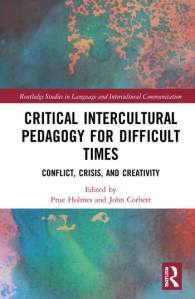
Critical Intercultural Pedagogy for Difficult Times: Conflict, Crisis, and Creativity, edited by Prue Holmes and John Corbett (2023) is a volume of case studies and theoretical reflections which arose from an AHRC Research Network project, initiated, and led by Prue Holmes of the University of Durham in 2019. Holmes was interested in exploring the theoretical and practical issues involved in the creative application of critical intercultural teaching and learning in conditions of conflict and extended crisis. In short, how does critical intercultural pedagogical theory inform creative practice, and vice versa, in what Holmes and her team came to think of as ‘difficult times’?
As Khawla Badwan, in the title of her chapter, on intercultural communication and vulnerability, observes, “I’m afraid there are no easy fixes”. There are, indeed, no easy fixes, and, for those of us engaged in intercultural education, there seems cause, too often, for despair. However, the case studies reported in this volume affirm, through their modest tales of resilience, aspiration, and hope, that in the enveloping darkness there are flickers of light.
Download the entire guest post as a PDF.



 His work on intercultural language education engages with the roles curriculum design and classroom tasks play in the development of intercultural communicative competence, most recently in situations of conflict and extended crisis. He is also interested in the interaction between intercultural language education and professionalism in domains such as medicine and tourism. He is the author of An Intercultural Approach to English Language Teaching (Multilingual Matters, 2003, second edition 2022), Intercultural Language Activities (Cambridge University Press, 2010) and (with Peih-ying Lu) of English in Medicine: An Intercultural Approach to Teaching Language and Values (Multilingual Matters, 2012). He has authored and co-authored numerous articles and book chapters, including (with Wendy Anderson and Alison Phipps) explorations of intercultural language learning and telecollaboration. He was editor of the journal Language and Intercultural Communication between 2004-9. While he works in Asia, he also has strong links with Brazil, where he has been President of the BRAZ-TESOL Special Interest Group on Intercultural Language Education.
 Center for Intercultural Dialogue