Feeding the Civic Imagination

Resources in ICD“ width=

Feeding the Civic Imagination, Lateral: Journal of the Cultural Studies Association, 13(1), 2024.

Special Issue editors: Do Own (Donna) Kim (University of Illinois Chicago), Sangita Shresthova (University of Southern California) and Paulina Lanz (University of Southern California).

Food is a powerful entry point into the civic imagination…

Food is a powerful entry point into the civic imagination—i.e., the capacity to imagine alternatives to current cultural, social, political, or economic conditions, the social process of which fosters a shared vision for collective action. As an essential material component of human life, food exists as an extremely mundane and dynamic aspect of our everyday personal and social experiences; our relationship with food is intertwined with issues of privilege, access, representation, language, ethnicity, and the materiality of culture. This forum explores diverse intersections between food and civic imagination, with topics ranging from shared memories, local (re-)imaginations, history and civic action, and private-public translations. The forum discusses how food sustains, nourishes, and connects individuals and their communities by delving into both their presence—e.g., acquiring and preparing ingredients, cooking meals, sharing or selling foods—and absence—e.g., hunger and human waste in food ecology. Articles in this collection demonstrate that the civic imagination is not only fed in dining rooms and kitchens but also in less conventionally thought-of contexts, such as digital spaces, toilets, and forums such as ours. They urge us to engage with food in new imaginative ways, fostering and bridging conversations: one cannot change the world unless one can imagine what a better world might look like, and one must explore together to navigate and actualize the imaginative possibilities.

Articles in the special issue:

A Taste of Harmony (Australia)

Applied ICDA Taste of Harmony, Australia, 17 March-18 April 2025.


Food brings people together. It’s something we can all share.

A Taste of Harmony is Australia’s largest celebration of cultural diversity and it was especially created for the workplace (but could easily be adapted to other contexts, such as education). The goal is to use food as a way of bringing people together to share, discover and learn about each other’s cultural heritage.

There are many ways for workplaces to participate in A Taste of Harmony, from encouraging staff to bring in food that reflects their cultural origins to share with their colleagues to more elaborate events. The key is bringing people together and creating a fun, informal way for colleagues to share their cultural heritage through food and discover more about their co-workers.

CFP Communicating Scotland Through Food

“PublicationCFP Communicating Scotland Through Food: From Devolution to Possible Futures. Deadline for abstract and bio: 15 October 2023.

Editors: Ashli Q. Stokes, University of North Carolina at Charlotte, USA; and Ana Tominc, Queen Margaret University, Scotland

In this call, the editors are looking for abstracts for chapters that address the question of Scottish representation through and around food from devolution (1999) to contemporary and current visions of the future. As Scotland increasingly differentiates itself politically and economically, we ask what foods define Scotland as a UK “sub-nation,” and how this communicative work helps distinguish it from England, the rest of the UK, and Europe. This volume specifically focus on the role of media, language, and communication broadly in shaping Scotland’s vision about itself and others, addressing a notable gap in discussions around Scotland’s relationship to food. The discussion is designed to contribute to the growing understanding of the role food plays in Scotland’s past, present, and future. The book offers a perspective that may help shape future discussions around the important connection between food and the question of “national” identity in health, political, economic, and other communication.

Submission Deadlines:
Abstract and Bio: October 15, 2023
Notification of Abstract Acceptance: November 1, 2023
Papers Due to Book Editors: April 2024
Final Version Due to Editors: June 2024

Those unfamiliar with the topic of food as related to intercultural matters might want to read the prior post on Urban Foodways and Communication.

A Pot of Courage: Food and Intercultural Dialogue (Australia)

Applied ICDA Pot of Courage in Ballarat, Australia, is a not-for-profit social enterprise cafe empowering women of diverse cultural backgrounds through hospitality training and employment opportunities.

Sharing stories is what. . .breaks down cultural barriers.

A Pot of Courage founder Shiree Pilkinton turned a women’s group into a cookbook and a not-for-profit, converting cooking skills into income. “We call it an intercultural cafe because it’s more active than a multicultural cafe,” says Pilkinton. “Whether you’re Anglo Australian, Aboriginal or Persian, it doesn’t matter – there’s a place for you here.”

See the original article: Levin, Sofia. (11 July 2022). This Ballarat hidden gem empowers women through a culturally diverse cafe. SBS.

The Power of Food Emojis

Applied ICD

The power of food emojis, part of The Food Chain series, by BBC.

When the San Francisco based artist and designer Yiying Lu discovered there was no emoji to represent her beloved dumpling, she knew she had to do something about it. She tells us why for her, and millions of others, emojis are an important form of communication and cultural representation.

Do you give food emojis much thought? If not, perhaps you should. Emily Thomas hears how these tiny digital images can have a big social and economic impact. The series reveals who decides which emojis are accepted and how you can propose your very own. Two Venezuelans living in the US explain why their brand new ‘flatbread emoji’ could be one the most significant achievements of their lives, and the emoji artist responsible for everything from the ‘dumpling’ to ‘bubble tea’ tells us why she sees her work as a calling, and how it has made her an unexpected cultural ambassador.

Why I fought to get my bubble tea emoji accepted is another show in the series.

Food and Cultural Identity as a Pedagogical Tool

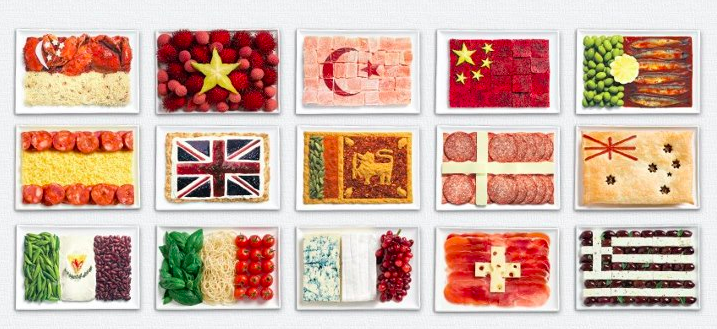
Intercultural PedagogyPrint advertisements created by TBWA, Australia, in 2009 for the Sydney International Food Festival, show flags for different countries made out of their traditional foods.

Sydney International Food Festival

So far the campaign has received a lot of attention from design and advertising sites, as in this analysis by Ads of the World, which includes images of the flags and details as to the designers, or from food websites, as with Kitchn, which focuses on the foods chosen. @Sietar_UK  tweeted about it in 2019; clearly they are correct that the campaign should get attention from those interested in intercultural matters, even a decade late. In particular, these flags made of foods should be a good way to get students actively involved in thinking about cultural differences while doing something creative, such as asking them to create flags for additional countries (especially ones to which students have connections), or to research the particular foods chosen and how they are traditionally prepared, and/or what other countries have already adopted them.

Study Abroad: Food Media, Communication & Trends (Italy)

Study AbroadStudy abroad summer 2019: Food Media, Communication and Trends Course, Rome, Italy, May 20-June 22, 2019.

Students have the possibility to earn three credits for this course from the University of Massachusetts Amherst. There are no prerequisites. The course is offered within the Critical Studies on Food in Italy Summer 2019 program which assists students in understanding the role of food in human cultures as well as the range of choices and values implicit in the foods eaten in Italy and elsewhere.  Students can also select from the other courses provided in the program: Critical Studies on Food; Food, Nutrition, and Culture in Italy; Food Waste in Italy;  Italian Language for Food and Business (Italian) (all 3 credits).  Some scholarships are available.

Gustolab International also offers courses in Vietnam (June 30-July 27) and Japan (May 26-June 23).

Critical Studies on Food in Italy (Summer 2015)

Gustolab Institute Center for Food and Culture is offering:
CRITICAL STUDIES ON FOOD IN ITALY
in cooperation with the University of Massachusetts-Amherst
DURATION 5-WEEK Full Immersion Summer Program
WHEN 18 MAY 2015 – 20 JUNE 2015
WHERE Rome Italy
The program is open to all majors, and all students, degree-seeking or not.

https://vimeo.com/gustolabinstitute

COURSES OFFERED
Critical Studies on Food Culture (3 credits)
Food media, communication and trends (3 credits)
Food, Nutrition and Culture in Italy (3 credits)
Elementary Italian Language UMASS ITAL 110 (3 credits)
Italian Lexicon for Food Studies (3 credits)

If you have any questions or to request an application, please write to info@gustolab.com