Cultural Insight Wednesdays Podcasts

Podcasts

Cultural Insight Wednesdays with Maria Hussain, podcasts on SoundCloud.

Each week, Maria Hussain is in conversation with Leeds University Business School students from a whole host of different countries, backgrounds, and levels of study. These fabulous students share their insights and experiences of what it means to be a student at the University of Leeds. The podcasts are partly designed as a way to develop intercultural competence through co-creation, as this is student-led podcasting.

Some specific titles from the series: 

These podcasts obviously should be relevant to students, both international and those based in their home countries, but they also would make a good classroom resource for teaching about intercultural competence, culture shock, and other issues. See KC3: Intercultural Competence, KC87: Culture Shock, as well as other Key Concepts in Intercultural Dialogue published by this Center for further related resources.
ICD Exercise #3: Mix, Mix, Remix: Drawing on Pop Culture Stories to Inspire Intercultural Dialogue

ICD Exercises

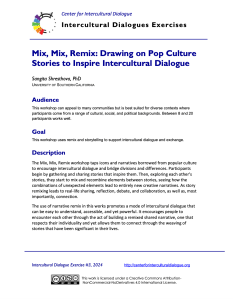
The next ICD Exercise is now available. Sangita Shresthova has written a new one, Mix, Mix, Remix: Drawing on Pop Culture Stories to Inspire Intercultural Dialogue.

The Mix, Mix, Remix workshop taps icons and narratives borrowed from popular culture to encourage intercultural dialogue and bridge divisions and differences. Participants begin by gathering and sharing stories that inspire them. Then, exploring each other’s stories, they start to mix and recombine elements between stories, seeing how the combinations of unexpected elements lead to entirely new creative narratives. As story remixing leads to real-life sharing, reflection, debate, and collaboration, as well as, most importantly, connection.

The use of narrative remix in this works promotes a mode of intercultural dialogue that can be easy to understand, accessible, and yet powerful. It encourages people to encounter each other through the act of building a remixed shared narrative, one that respects their individuality and yet allows them to connect through the weaving of stories that have been significant in their lives.

As with prior publications, ICD Exercises are available as free PDFs; just click on the thumbnail to download.

Intercultural Dialogue Exercise #3 by Sangita Shresthova

Shresthova, S. (2024). Mix, mix, remix: Drawing on pop culture stories to inspire intercultural dialogue. Intercultural Dialogue Exercises, 3. Available from: https://centerforinterculturaldialogue.org/wp-content/uploads/2024/02/icd-ex-3-shresthova-1.pdf

If you have an exercise you’ve used that works, and you would like to share it, please submit it. All authors will be asked to answer the same set of questions, and to make the exercises available for others to use, thus these are being published with a Creative Commons license (as is the case for all CID publications). If you are new to CID, please provide a brief resume. This opportunity is open to masters students and above, on the assumption that some familiarity with academic conventions generally, and discussion of intercultural dialogue specifically, are useful.

Wendy Leeds-Hurwitz, Director Center for Intercultural Dialogue


This work is licensed under a Creative Commons Attribution-NonCommercial-NoDerivatives 4.0 International License.

U Southampton: Politics & International Relations (UK)

“JobMultiple positions in Politics and International Relations, Department of Politics and International Relations, Highfield campus, University of Southampton, UK. Deadline: 5 April 2024.

Applications are invited for multiple positions at the level of Lecturer, Associate Professor and Professor in Politics and International Relations as part of a major expansion supported by the University during 2023/24 and 2024/25 that will further strengthen the thriving research, education and knowledge exchange culture of the Department of Politics and International Relations (PAIR) at the University of Southampton. The department has a world-leading reputation for its research in democratic governance and global political society, across areas such as political trust, democratic innovations, comparative politics, political psychology, environmental justice, global health, migration, and development. It has a strong reputation in the application of cutting-edge research methods, ranging from political ethnography to experimental social science.

Professor in Politics and International Relations

Associate Professor in Politics and International Relations

Lecturer in Politics and International Relations

U Leeds: Editorial Assistant for Conflict Management & Peace Science (UK)

“JobEditorial Assistant for the journal Conflict Management and Peace Science, University of Leeds, UK. Deadline: 13 March 2024.

Do you have excellent proof reading skills, attention to detail and the ability to produce accurate work under pressure? Do you have strong communication skills and enjoy working with a variety of people?

An Editorial Assistant is sought to work with the editorial team of the Conflict Management and Peace Science (CMPS), an international journal published by Sage on behalf of the Peace Science Society International. CMPS publishes empirical papers at the cutting-edge of peace and conflict research.

Based at the University of Leeds, you will work with the new and ambitious editorial team. This role will be based on the main campus, with scope for it to be undertaken in a hybrid manner. They are also open to discussing flexible working arrangements.


Endangered Language Fund: Language Legacies Grants 2024

Grants

Language Legacies Grants, Endangered Language Fund. Deadline: 15 March 2024.

The Language Legacies grant program supports documentation and revitalization efforts throughout the world. It is open to community members and researchers from any country (with the exception of those who are eligible for the Native Voices Endowment grants). An academic degree is not required, but the application must provide evidence that the applicant can achieve the stated goals. Grants are for one year and average around $2,000 (US).

The Endangered Language Fund is a 501(c)3 founded in 1996 with the goal of supporting endangered language preservation and documentation projects. Their main mechanism for supporting work on endangered languages has been funding grants to individuals, tribes, and museums. ELF’s grants have promoted work in over 60 countries and have funded a wide range of projects, from the development indigenous radio programs in South Dakota, to recording of the last living oral historian of the Shor language of western Siberia, to the establishment of orthographies and literacy materials to be used by endangered language teaching programs all over the world.

The UN International Year of Indigenous Languages  was expanded to the International Decade of Indigenous Languages (2022-2032) to draw global attention on the critical situation of many indigenous languages and to mobilize stakeholders and resources for their preservation, revitalization and promotion.

Coventry U: PHD Studentship in Contentious Civil Societies & Democratisation in Southeastern Europe (UK)


“Studentships“
PhD Studentship: Contentious Civil Societies and Democratisation in Southeastern Europe, Coventry University, UK. Deadline: 31 March 2024.

Coventry University is inviting applications from suitably-qualified graduates for a fully funded PhD studentship examining Contentious Civil Societies and Democratisation in Southeastern Europe. Candidates will be based in the Centre for Trust, Peace and Social Relations – a research centre in the Institute for Peace and Security.

Many current developments in Post-Communist Southeast European politics confound analysts. Firstly, while the overall trend is towards democratic backsliding, there is much variation between states to the extent that democracy databases often disagree; for example Romania’s democracy score has been on a negative trajectory since the mid-2010s according to Freedom House, but a positive trajectory according to V-Dem. Part of this confusion arises from the fact that, with the sudden emergence of battle-ready civil societies in the 2010s, most of these societies are far more contentious that they were in the 2000s. Contention is notoriously difficult to evaluate from the perspective of democracy evaluators. This ‘contention’ conundrum is of interest to political scientists and democracy promoters worldwide: are polarised, contentious civil societies better understood as catalysing or spoiling factors in young democracies? The former interpretation prevails in much rationalist political science theorising while the latter argument is rooted in agonistic democratic theory and the new social movements literature. Activists struggling for emancipatory causes are at once celebrated by democratic theorists as seeking to expand the democratic realm and (often implicitly) denigrated as drivers of polarisation by rationalist political scientists, especially as in Southeastern Europe where these activists are struggling against (often pro-EU) political elites. The whole situation calls for a closer look.

The proposed PhD project would be a mostly qualitative, possibly ethnographic study focussed in either one or two countries of Southeastern Europe that would ideally facilitate access to either or both liberal-emancipatory and illiberal civil society actors. Methodologies such as participant observation, focus groups and semi-structured interviews would be encouraged to allow civil society actors themselves to outline their interests and identities in relation to aspirations for – or against – democracy and its liberal dimensions.

Northwestern U Qatar Global Fellows 2024-25 (Qatar)

FellowshipsNorthwestern University  Qatar Global Fellows, 2024-25, Qatar. Deadline: 15 March 2024.

This call for applications is intended for researchers wishing to spend all or part of their institutional leave/sabbatical at the Institute for Advanced Study in the Global South at Northwestern University in Qatar (#IAS_NUQ) pursuing a research project of relevance to the histories, cultures, societies, and media of the Global South.

In addition to pursuing their own research projects, #IAS_NUQ Global Fellows are fully engaged in the intellectual life of the Institute. Fellows participate in research groups, receive feedback on their work-in-progress, and take part in #IAS_NUQ events. They are expected to present publicly on their research/creative scholarship and are encouraged to produce one multilingual working paper or creative output with #IAS_NUQ Press during their affiliation with the Institute.

Current research themes are 1) Genealogies and Epistemologies of the Global South; 2) Arab Media, Culture, and Politics; 3) Southern Digitalities; and 4) Critical Security Studies.

The duration of this Global Fellowship is either one month or one academic term. This is a residential fellowship; Global Fellows are therefore expected to work on campus at least four days a week during the period of their fellowship.

Counter Narratives in Progress Podcasts

Podcasts

Counter Narratives in Progress: Podcasts of the Andrew W. Mellon Fellows for Diversity, Inclusion, & Cultural Heritage.

Counter Narratives in Practice is a series of podcasts about multicultural heritage collections, storytelling, and representation in Libraries, Archives, Special Collections, Museums, and beyond are part of a larger project to highlight the work of the Andrew W. Mellon Fellows for Diversity, Inclusion & Cultural Heritage based at Rare Book School. Fellows worked together from across the U.S. to tell stories about the archival materials in their collections and how they prompt thinking about counter narratives in their professional practice.

Some specific titles from the series: 

Machuca-Galvez, M., Minor Harris, D., & Winston, R. E. (2023). We were never silent: Immigrant narratives & Caribbean print culture as counter narrative

Correa, D. J., Im, S., & Winston, R. E. (2023). We were never silent: Bilingual cartoons in the Ottoman Empire & pidgin English in Chinese text as counter narratives.

Alston, M., DuVernay, J., & Betts, V. (2023). Hidden histories: African American, Asian American, and Afro-Asian relationality.

Vargas-Betancourt, M., DuVernay, J., & Green, P. (2023). Hidden histories: Immigrant farm workers and Black intellectual histories.

These podcasts would make a good classroom resource for teaching about multiculturalism or diasporas generally, or intercultural dialogue specifically. See KC19: Multiculturalism or KC62: Diaspora as well as other Key Concepts in Intercultural Dialogue published by this Center for further related resources.

KC101: Antisemitism Translated into Spanish

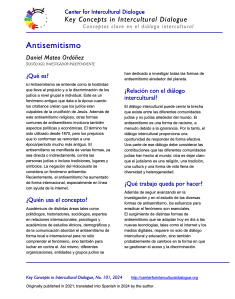
Key Concepts in ICDContinuing translations of Key Concepts in Intercultural Dialogue, today I am posting KC#101: Islamophobia, which Daniel Mateo Ordóñez wrote for publication in English in 2021, and which he has now translated into Spanish.

As always, all Key Concepts are available as free PDFs; just click on the thumbnail to download. Lists of Key Concepts organized chronologically by publication date and number, alphabetically by concept, and by languages into which they have been translated, are available, as is a page of acknowledgments with the names of all authors, translators, and reviewers.
KC101: Antisemitism_Spanish

Ordóñez, D. M. (2024). Antisemitismo. Key Concepts in Intercultural Dialogue, 101. Available from:
https://centerforinterculturaldialogue.org/wp-content/uploads/2024/02/kc101-antisemitism_spanish.pdf

If you are interested in translating one of the Key Concepts, please contact me for approval first because dozens are currently in process. As always, if there is a concept you think should be written up as one of the Key Concepts, whether in English or any other language, propose it. If you are new to CID, please provide a brief resume. This opportunity is open to masters students and above, on the assumption that some familiarity with academic conventions generally, and discussion of intercultural dialogue specifically, are useful.

Wendy Leeds-Hurwitz, Director
Center for Intercultural Dialogue


Creative Commons License
This work is licensed under a Creative Commons Attribution-NonCommercial-NoDerivatives 4.0 International License.

U Oxford: International Relations (UK)

“JobAssociate Professor of International Relations, University of Oxford, England, UK. Deadline: 26 March 2024.

The Department of Politics and International Relations in association with Exeter College are recruiting to the post of Associate Professor of International Relations to start from 1 September 2024 or as soon as possible thereafter. Applications are welcome from both early career and established scholars in any sub-field of international relations. However, the Department has particular needs at present in historical international relations, the international relations of the Middle East, Africa, Latin America, Russia and the Post-Soviet space, international law, and the international politics of the environment.

The successful candidate will be required to carry out advanced research in the field and to develop courses and provide teaching and supervision to undergraduate and graduate students; they will be expected to provide and organize undergraduate teaching for one or more of the Department’s undergraduate papers in International Relations; to contribute to the core paper of the MPhil in International Relations; to supervise graduate students in the Department’s MPhil and DPhil programmes in International Relations; to deliver undergraduate tutorial or small-group teaching in Exeter College; and to participate in academic administration, examining and assessment, the admission of students to the Department and College, and in the governance of the Department and the College.

The post will be held in conjunction with a Tutorial Fellowship at Exeter College.