CFP Communication for Social Change (Singapore)

Call for Papers
COMMUNICATION FOR SOCIAL CHANGE: INTERSECTIONS OF THEORY AND PRAXIS
Organized by: Center for Culture-Centered Approach to Research and Evaluation (CARE), National University of Singapore
Event: 8 January 2016
Deadline for submissions: 28 July 2015

In 2011, it was estimated that one billion people in the world lived on less than $1.25 a day, and that 22,000 children die each day due to poverty (World Bank, 2015; UNICEF, 2009). Global inequality continues to exist on a remarkable level, exacerbated by globalization, enactment of neoliberal regimes, and global economic restructuring that widens the gap between the rich and poor (Dutta, 2008). This has led to widening inequality and health disparities among marginalized and disenfranchised communities both in the global South and in developed countries. Against this backdrop, many communication scholars have been vested in social change work, attempting to address these problems from a communication standpoint. Within the field of communication, critical scholars have
brought attention to globalization processes and modernization projects that continue to reify structural violence and the erasure of subaltern voices from mainstream discourse under the guise of ‘aid’ (Dutta, 2008, 2010). There is a growing pool of communication scholars who reject top-down prescriptions of definitions of poverty and its solutions, and instead recognize the role of culture and structure in forming the contextual base for understanding experiences of subalternity in one’s everyday life (Airhihenbuwa, 1995; Dutta & Basu, 2008; Lupton, 1994). Within this paradigm, communication scholars seek to work with subaltern communities to foster participatory spaces for listening and dialogue, with the larger goal of social change and structural transformation. In
their negotiations of culture and structure with their material and symbolic experiences of marginalization, we see the emergence of narratives from the ground which actively challenge and resist structures that have communicatively erased the lived experiences of subaltern communities. It is within these alternative narratives and rationalities that social change is articulated in culturally meaningful ways.

The broad goal of this conference is to explore the intersections between theory and praxis in social change communication. This conference brings together communication scholars, both experienced and new, to share, dialogue, debate, and discourse on the future of social change in the discipline. The conference is also envisioned as a platform to build solidarity among people working within the academic-activist spectrum – for them to share their lived experiences in the field and to encourage young scholars in the field of communication to actively partake in social change scholarship. Finally, the conference also acts as an invitational space to celebrate novel and alternative ways of communicating for social change. Hence, this presents a unique opportunity for communication scholars around the world to come together and contribute to the intellectual space in which communicative practices are embodied and enacted in the sites of oppression and resistance and told through academic engagement, theorizing the ways in which communication can solve social problems.

We invite submission of papers that address communication and issues of social change, both theoretically and empirically, in different national contexts, pertaining to social change in the margins from around the globe.Heeding this conclusion, and based on the context and scope of
communication for social change, the following questions include, but are not limited to:
1. How are issues of social change theorized by communication scholars?
2. How do emerging alternative theories and frameworks in communication address various kinds of disparities?
3. How do communication scholars approach social change?
4. How can widening health disparities be addressed communicatively?
5. What is the role of self-reflexivity for communication scholars?
6. How do culture, community engagement, and communication intersect for social change?
7. What are the emerging innovations in research using the culture-centered approach?
8. How do communication scholars negotiate culture, structure, and/or agency in envisioning social change and social justice?
9. How do theory and praxis intersect in social change communication? What are the roles of academics and activists within this paradigm?

PAPER SUBMISSION:
Paper submissions must include a title, an abstract (max 300 words), full paper not exceeding 30 pages double-spaced (5,000-8,000 words), and a brief biographical sketch (max 150 words). Please submit your papers by 28 July 2015 to contact@care-cca.com. Please see paper submission format below. Successful applicants will be notified by the first week of October 2015. Selected papers will be developed and included in a book chapter series.

Participants are encouraged to seek funding for travel from their home institutions. Based on the quality of paper, full funding is available for two successful applicants that are developing-country researchers. Full funding would cover air travel to Singapore by the most economical means plus accommodation for the duration of the conference. Participants that qualify for full funding will be informed by early October 2015.

Conference Convenor
Professor Mohan J. Dutta
Head of Department of Communications and New Media & Director of the Center for Cultured-Centered Approach to Research And Evaluation (CARE), National University of Singapore

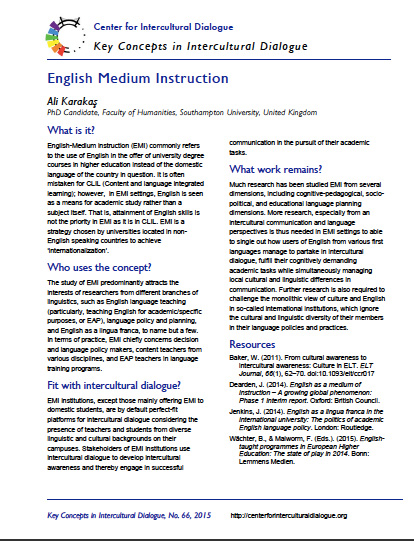
Key Concept #66: EMI by Ali Karakas

Key Concepts in ICDThe next issue of Key Concepts in intercultural Dialogue is now available. This is KC66: English Medium Instruction (EMI) by Ali Karakas. As always, all Key Concepts are available as free PDFs; just click on the thumbnail to download. Lists organized  chronologically by publication date and number, alphabetically by concept in English, and by languages into which they have been translated, are available, as is a page of acknowledgments with the names of all authors, translators, and reviewers.

Key Concept #66 English Medium Instruction by Ali Karakas

Karakas, A. (2015). English medium instruction. Key Concepts in Intercultural Dialogue, 66. Available from: https://centerforinterculturaldialogue.org/wp-content/uploads/2015/05/key-concept-emi.pdf

The Center for Intercultural Dialogue publishes a series of short briefs describing Key Concepts in Intercultural Dialogue. Different people, working in different countries and disciplines, use different vocabulary to describe their interests, yet these terms overlap. Our goal is to provide some of the assumptions and history attached to each concept for those unfamiliar with it. As there are other concepts you would like to see included, send an email to the series editor, Wendy Leeds-Hurwitz. If there are concepts you would like to prepare, provide a brief explanation of why you think the concept is central to the study of intercultural dialogue, and why you are the obvious person to write up that concept.


Creative Commons License
This work is licensed under a Creative Commons Attribution-NonCommercial-NoDerivatives 4.0 International License.

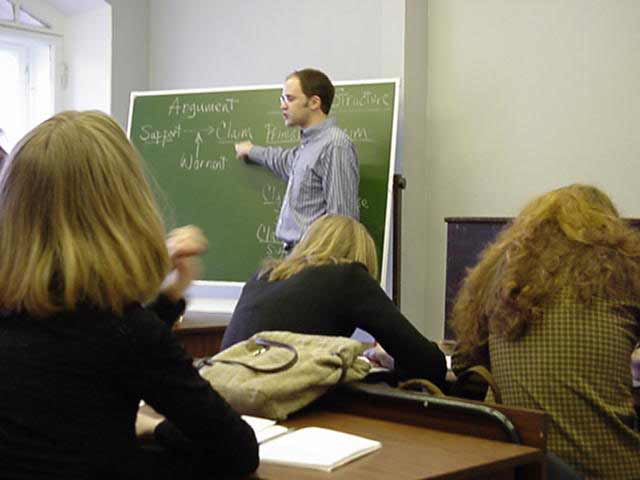
Glenn Geiser-Getz Fulbrights (Russia and Ghana)

I served as a Fulbright Fellow for the fall semester of 2000 through the end of the spring semester of 2001 in St. Petersburg, Russia. Although I applied for a teaching fellowship, I included scholarly plans in my application and I conducted research while serving in Russia.

Glenn Geiser-Getz

I found the application process pretty straightforward.  My impression is that they are looking for scholar-teachers who have a great interest in travel and other cultures. I also believe that (at least when I applied) they were interested in people who were flexible and willing to adjust to the dynamics of other places and peoples. Finally, I think they value people who are interested in a true exchange, who are not only interested in learning something new but in sharing alternate ways of being, thinking, and doing with others.  My teaching (especially of argumentation and debate) and my scholarship (which involved ethnographic interviews) required my student and faculty hosts to adjust their thinking about higher education and research. However, I also took great care to learn from them and to absorb and appreciate the culture that surrounded me.

My primary assignment was at St. Petersburg State University in the Department of International Journalism, although I am more a rhetorical scholar than a mass media or journalism scholar. I was not able to secure a sabbatical from my home institution because the application process at my campus was so different from the Fulbright application process. However, I was able to get educational leave without pay and health insurance through COBRA (the cost of which was reimbursed by my institution when I returned). I deducted all of my work-related living and transportation expenses and as a result paid less in tax than I normally would. My wife quite her elementary teaching job and joined me on the trip. In the end, the trip reduced our income but it was definitely worth it. I rank my experience as a Fulbright Scholar the third most significant experience of my life (behind my education and my marriage/children).

There were plenty of challenges during my time in Russia and some strange miscommunications, but it was all part of the rich variety of experiences I had during that year. As a result of connections with the state department and various educational and cultural organizations, I had the opportunity to teach in many cities outside of St. Petersburg. I taught college students, high school students, journalists, other college faculty, elementary and secondary teachers, and community members. I taught in gymnasiums, churches, public libraries, community centers, hotels, and (of course) college buildings. I enjoyed a great deal of travel by train to countries including Finland, Sweden, Estonia, Latvia, and others.

I also received a Fulbright-Hays Fellowship to Ghana, but that is a whole different story. It was a month-long study trip, so I was more a student and researcher than a teacher. But it was an awesome experience as well!  I encourage anyone to consider applying.

Glenn Geiser-Getz, Ph.D.
East Stroudsburg University
Department of Communication Studies
5/26/15

CFP Research in France through Fondation Maison des sciences de l’homme

Associate Research Directors (DEA) | First call for proposals 2016
Deadline : June 22th, 2015

Created in 1975 upon the initiative of Fernand Braudel, in collaboration with the French Secretary of State for Universities, Department for Higher Education and Research, the DEA Programme (Directeurs d’Études Associés, or Associate Research Directors) is the oldest international mobility programme at Fondation Maison des sciences de l’homme. It provides funding to invite international scientific experts from across the globe for one or two months and enables them to carry out work in France (field enquiries, library work and archives).

Participation requirements
The programme is intended solely for professors and senior researchers with a PhD, or equivalent, working in institutions of higher education and research.
Applicants must be no older than 65 at the time of their stay.

Benefits
A monthly allowance of 3 300 € is awarded for transport and stay expenses. In addition, FMSH provides support for visa applications and logistics (accommodation and access to libraries).

Applications and deadline
Applications must be sent before June 22th 2015.

Content of the application
*A curriculum vitae (with date of birth)
*A list of scientific publications
*A research project (4 pages minimum) with the dates of stay, and a bibliography
*A letter of support by a French researcher is welcome
*Applications should be sent via our online platform

Once on the platform, in your online application for DEA, please select for the year of the call : 2016 and for the session of the call : June 2015.

For further information or if you encounter difficulties, contact Fondation Maison des sciences de l’homme. candidatures.dea@msh-paris.fr

After a scientific expertise of the research projects, decisions regarding invitations are made by a commission made up of the administrator, scientific directors of the FMSH, as well as various specialists.

Results will be communicated directly to applicants by the end of October 2015.

The research stay must start no later than November 1st 2016.

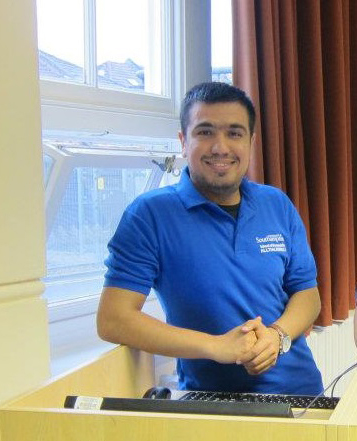
Ali Karakas Profile

ProfilesAli Karakas has a B.A. in English Language Teaching from Uludag University, and took MA courses at Hacettepe University, Turkey. He is also a member of academic staff in the ELT department of Mehmet Akif Ersoy University, which has sponsored his current PhD project at Southampton University, UK.

Ali Karakas

Currently, he is based in Southampton and working towards completing his PhD research, entitled ‘Turkish Lecturers’ and Students’ Perceptions of English in English-Medium Universities’. He is a member of several research centers and groups, such as Centre for Global Englishes (CGE), English Language Teacher Education Research (ELTER) and English as Lingua Franca Research Network (ELF-Ren). His research interests primarily include English as a Lingua Franca, Language Policies, Language Attitudes and Ideologies, Language Teacher Education and Intercultural Communication. He has presented papers and published articles in various journals and magazines on topics of his research interests.

More information on his research and publications can be obtained from his academic homepage: http://abs.mehmetakif.edu.tr/akarakas

Selected Publications

Articles

Karakaş, A. & Karaca, G. (2011). Use And Importance Of Illustration As Materials In Foreign Language Teaching. Balıkesir University. The Journal of Social Sciences Institute, 14(26), 351-357.

Karakaş, A. & Karaca, G. (2011). Yabancı Dil Öğretiminde Resmin Materyal Olarak Kullanımı ve Önemi. Yaşadıkça Eğitim Dergisi. Sayı 110, Nisan-Mayıs-Haziran, s. 14-19.

Karakaş, A. & Sarıçoban, A. (2012). The Impact of Watching Subtitled Animated Cartoons on Incidental Vocabulary Learning of ELT Students. The Journal of Teaching English with Technology, 12(4), 3-15.

Karakaş, A. (2011). Motivational Attitudes of ELT Students towards Using Computers for Writing and Communication. The Journal of Teaching English with Technology, 11(3), 37-53.

Karakaş, A. (2012). English as a Lingua Franca: Practices of Academics in a Turkish University. Uşak Üniversitesi Sosyal Bilimler Dergisi, 5(3), 160-179.

Karakaş, A. (2012). Evaluation of the English Language Teacher Education Program in Turkey. ELT Weekly Newsletter, 4(15).

Karakaş, A. (2012). Foreign Accent Problem of Non-native Teachers of English. Humanising Language Teaching, 14(5).

Karakaş, A. (2012). How to cope with Speaking Anxiety in EFL Classrooms. ELT Weekly Newsletter, 4(28).

Karakaş, A. (2013). Intercultural Attitudes of Turkish Students Studying in a UK University. Journal of Intercultural Communication, 31.

Karakaş, A. (2013). Is Communicative Language Teaching a Panacea in ELT? – Student and Teacher Perspectives. Journal of Second and Multiple Language Acquisition, 1(1), 1-19.

Karakaş, A. (2013). The Expansion of the English Language across Turkey: Threat or Opportunity. Mediterranean Journal of Humanities, 3(2), 159-171. DOI: 10.13114/MJH/201322477

Karakaş, A. (2014). Lecturers’ Perceptions of Their English Abilities and Language Use in English-Medium Universities. International Journal on New Trends in Education and Their Implications, 5(2), 114-125.

Karakaş, A. (2015). Orientations towards English among English-medium Instruction Students. Englishes in Practice, 2(1), 1-38. DOI 10.1515/eip-2015-0001

Korumaz, M. & Karakaş, A. (2014). An Investigation of English Language Instructors’ Attitudes towards Reflective Teaching. Pegem Journal of Education & Instruction, 4(1), 27-46. DOI: 10.14527/pegegog.2014.001


Work for CID:

Ali Karakas wrote KC66: English Medium Instruction, and translated it into Turkish.

Intercultural Innovation Award 2015

The United Nations Alliance of Civilizations is pleased to announce the launch of the 2015 edition of the Intercultural Innovation Award, a partnership between the United Nations Alliance of Civilizations (UNAOC) and the BMW Group. The Award searches for grassroots projects around the world that are promoting dialogue and cooperation among people from different cultural backgrounds using novel and creative methods.

Ten organizations with sustainable and innovative intercultural projects that have potential for expansion and replication will be awarded funding and strategic support by the BMW Group and the UNAOC. To be considered, organizations must apply online by Wednesday, 30 September 2015 at 5:00 pm New York City time.

The top ten finalists will be invited to present their projects at the 7th UNAOC Global Forum. A total of 100,500 USD is offered to the awardees, of which 40,000 USD goes to the first placed project. For more details, you can check the applications guidelines.

CFP: 3rd Ebenezer Soola Conference on Communication (Nigeria)

The conveners of the 3rd Ebenezer Soola Conference on Communication hereby invite abstracts and full papers from all academics and professionals in all fields of media and communication for presentation and discussion at the conference. Papers should however be based on the conference theme and sub-themes.

COMMUNICATION, CHANGE MANAGEMENT AND SUSTAINABLE DEVELOPMENT IN THE 21ST CENTURY
September 27th – 30th, 2015.
Conference Centre, University of Ibadan, Ibadan, Nigeria

The Problem: Change is the only thing that is constant in life. Nigeria, and indeed, the whole world are witnessing rapid changes in all spheres of life. The challenge facing humanity today is how these changes are managed. Change management has been defined as the application of the set of tools, processes, skills and principles for managing the people’s side of change to achieve the required outcomes of the change project or initiative. How do we combine communication with these tools, processes, skills and principles to achieve and sustain positive changes in our society? This is the problem that this conference seeks to engage.

Sub-Themes:
*Communication, Change Management and People-Centred Development
*Communication, Change Management and Transformation
*Communication, Change Management and Government Reportage of its activities
*Communication, Change Management and Corporate Reporting Culture
*Communication, Change Management and Social Responsibility
*Communication, Change Management and Gender Rights
*Communication, Change and Risk Management in the Oil and Gas Sector
*Change Management and the Broadcast Media
*Change Management and the Print Media
*Change Management and the Social Media
*Change Management and the New Media of Communication
*Change Management and the Traditional Media of Communication
*Change Management and Political Communication
*Change Management and Journalism
*Change Management and Development Communication
*Change Management and Sustainable Development
*Communication, Social Fairness and Democratic Legitimacy
*Communication, Conflict and Institutional Change
*Communication, Community and Common Destiny

Arrival:        Monday, September 27th 2015.
Conference days: Tuesday 28th – Wednesday 29th, September 2015.
Departure:      Friday, 30th September 2015.

Paper Submission Guidelines:
*Abstracts should not be more than 200 words, typed single spaced with 12 points regular Times New Roman.
*Abstracts should have title, name of author(s) and full contact details: institution, postal address, personal email address and telephone numbers.
*Full papers should not be more than 20 pages A4, typed 1.5 spacing with 12 points regular Times New Roman using the APA style of referencing.
*The first page of the paper should indicate the title, name of author(s), and full contact details: institution, postal address, personal email address and telephone numbers. All other pages of the paper must not feature any of these details.
*Abstracts and full papers should be sent as an MS Word attachment to the conference email address.

Abstract Submission Deadline    – August 30th, 2015
Full Paper Submission Deadline  – September 13th, 2015

Conference Fee – N5,000.00 per participant.
(This covers conference materials, tea breaks, lunch and closing dinner.)

Publications
*Papers that pass the process of blind, peer-review of journals shall be published in two reputable international journals, namely, the Journal of Communication and Media Research and the Journal of Communication and Language Arts.
*Other papers will be published in a well-edited book. (Note: not a book of readings, but a thematic, educational and instructional book.)

For further information please contact:
Dr. Eserinune McCarty Mojaye
Secretary, Conveners Committee

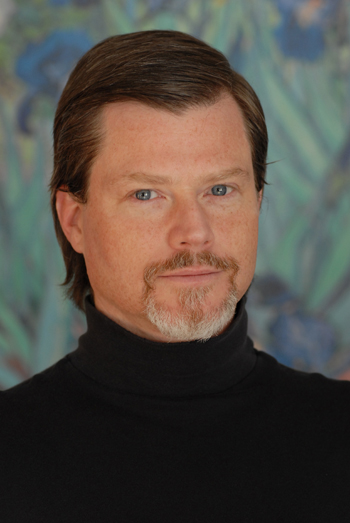
Jonathan Shailor Profile

ProfilesJonathan Shailor, Ph.D., Communication, University of Massachusetts, is a Professor at the University of Wisconsin-Parkside in Kenosha, where he directs the Certificate Program in Conflict Analysis and Resolution.

Jonathan Shailor

He is founder and director of The Shakespeare Prison Project in Wisconsin, and a 2015 Fellow with the CMM Institute for Personal and Social Evolution. His teaching, research, and community service focus on the uses of storytelling, dialogue and performance as vehicles for conflict transformation.

Selected publications:

Shailor, J. (2013). Kings, warriors, magicians, and lovers: Prison theater and alternative performances of masculinity. In S. J. Hartnett, E. Novek & J. K. Wood (Eds.), Working for justice: A handbook of prison education and activism (pp. 13-38). Champaign: University of Illinois Press.

Shailor, J. (Ed.). (2011). Performing new lives: Prison theatre. London: Jessica Kingsley Publishers.

Shailor, J. (2011). Humanizing education behind bars: The theatre of empowerment and the Shakespeare project. In S. Hartnett (Ed.), Empowerment or incarceration? Reclaiming hope and justice from the prison-Industrial complex (pp. 229-251). Champaign: University of Illinois Press.

Shailor, J. (2009). Improvising a new life: Interactive theater. In K.J. Gergen, S.M. Schrader & M. Gergen (Eds.), Constructing worlds together: Interpersonal communication as relational process. New York: Pearson Education.

Shailor, J. (2008). When muddy flowers bloom: The Shakespeare Project at Racine Correctional Institution. Publications of the Modern Language Association of America, 123(3), 632-641.

Shailor, J. (2008). A professor’s perspective: The Shakespeare Project at Racine Correctional Institution. In K. Brune (Ed.), Creating behind the razor wire: Perspectives from arts in corrections in the United States (pp. 38-41). Published by Lulu.com.

Shailor, J. (1999). Desenvolvendo uma abordagem transformacional à prática da mediação: Considerações teóricas e práticas. In D. F. Schnitman & S. Littlejohn (Eds.), Novos paradigmas en mediação. Porto Alegre, Brazil: Editora Artes Médicas Sul Ltda.

Shailor, J. (1997). Context and the coordinated management of meaning. In J. L. Owen (Ed.), Context and communication behavior. Reno, NV: Context Press.

Shailor, J. (1994). Empowerment in dispute mediation: A critical analysis of communication. New York: Greenwood Press.


Work for CID:
Jonathan Shailor wrote KC65: Conflict Transformation.

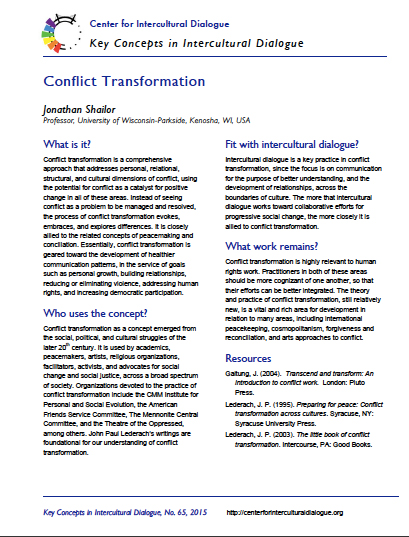
Key Concept #65: Conflict Transformation by Jonathan Shailor

Key Concepts in ICDThe next issue of Key Concepts in intercultural Dialogue is now available. This is KC65: Conflict Transformation by Jonathan Shailor. As always, all Key Concepts are available as free PDFs; just click on the thumbnail to download. Lists organized  chronologically by publication date and number, alphabetically by concept in English, and by languages into which they have been translated, are available, as is a page of acknowledgments with the names of all authors, translators, and reviewers.

Key Concept #65: Conflict Transformation by Jonathan Shailor

Shailor, J. (2015). Conflict transformation. Key Concepts in Intercultural Dialogue, 65. Available from: https://centerforinterculturaldialogue.org/wp-content/uploads/2015/05/key-concept-conflict-transformation.pdf

The Center for Intercultural Dialogue publishes a series of short briefs describing Key Concepts in Intercultural Dialogue. Different people, working in different countries and disciplines, use different vocabulary to describe their interests, yet these terms overlap. Our goal is to provide some of the assumptions and history attached to each concept for those unfamiliar with it. As there are other concepts you would like to see included, send an email to the series editor, Wendy Leeds-Hurwitz. If there are concepts you would like to prepare, provide a brief explanation of why you think the concept is central to the study of intercultural dialogue, and why you are the obvious person to write up that concept.


Creative Commons License
This work is licensed under a Creative Commons Attribution-NonCommercial-NoDerivatives 4.0 International License.

CFP Shared Histories: Media Connections Between Britain and Ireland (Dublin)

Shared Histories: Media Connections Between Britain and Ireland
A conference, to be held in Dublin, 6-7th July 2016
*Call For Papers*

The relationship between Ireland and the rest of the British Isles has a long and complex history. One key dimension has been the connections and interactions between the various media of communication – print and electronic – which have mediated this relationship. This conference seeks to address this important, but relatively neglected, topic at a timely moment in the history of Ireland, England, Scotland and Wales.

The conference organisers want to take a long view as well as look in detail at particular moments. It therefore invites papers from the sixteenth century onwards, dealing with all forms of media (print, periodical, broadcasting, ephemera) as well as with structures of ownership, regulation, distribution and identity.

The conference will examine the different kinds of media interactions from the arrival of print to the emergence of broadcasting, under what conditions they operated and to what effect. How did these interactions take place? What were the networks through which material flowed? What were the major developments in the content and reception of the media from the sixteenth century onwards? How helpful is it to think in terms of distinctive ‘national’ media traditions? In what sense, if any, are concepts such as centre and periphery of value in thinking about these relationships, or do they need revision? How has the development of relationships between the peoples of these islands been influence by shared histories of media exchange and interaction?

Proposals of up to 400 words stating the topic in relation to the conference theme should be sent to Steven Conlon by 1 June 2015.

The conference is jointly organised by the School of Communications, Dublin City University, the Centre for Media History,  Newspaper & Periodical History Forum of Ireland, Aberystwyth University, and the journal Media History. For further details please contact Mark O’Brien, Siân Nicholas, Jamie Medhurst, or Tom O’Malley.