University of Nottingham (UK) job ad: Teaching Associate

The School of English at the University of Nottingham is seeking to appoint a part-time Teaching Associate (18 hours per week) in English Language and Applied Linguistics. The successful candidate will teach across a range of undergraduate and postgraduate modules focusing on discourse analysis and sociolinguistics.

Closing Date: Wednesday, 1st July 2015

Candidates should have a PhD (or equivalent) in a relevant area of English Language and Applied Linguistics. Evidence of the ability to teach at undergraduate and postgraduate levels on our live and distance programmes is essential. A proven track record in teaching in one or more of the following areas is highly desirable: discourse analysis, sociolinguistics, language and gender, professional communication.

This is a part-time, fixed-term post from 1 September 2015 to 31 August 2018 based in the School of English, Trent Building, University Park.

The interview process will include a presentation of teaching and a formal interview.

Informal enquiries may be addressed to Professor Norbert Schmitt. Please note that applications sent directly to this email address will not be accepted.

University of Nottingham (UK) job ad: Research Fellow

The School of English at the University of Nottingham is seeking to appoint a Research Fellow. This new full-time post is an exciting opportunity to join a recently established professional communication research cluster and business unit, Linguistic Profiling for Professionals, based in the Centre for Research in Applied Linguistics.

Closing Date: Wednesday, 1st July 2015

The successful candidate will research and assist in the delivery of training and consultancy in the field of professional communication, including business discourse, health communication, the sociolinguistics of the workplace and intercultural business communication. Professional communication training and research-based consultancy will be delivered to a range of stakeholders including external businesses and organisations. The person appointed will contribute to the School’s applied linguistics research activities on its UK and international campuses.

Candidates should have a PhD (or equivalent) on appointment in a relevant area of English Language and Applied Linguistics.  Evidence of the ability to consistently develop a research area within a team and also as an individual is essential, as is the ability to deliver research-based training and consultancy on professional communication to clients in a wide variety of businesses and organisations.

This is a full-time, fixed-term post from 1 January 2016 to 31 December 2018 based in the School of English, Trent Building, University Park University of Nottingham.

The interview process will include a presentation of research and a formal interview.

Informal enquiries may be addressed to Dr. Louise Mullany. Please note that applications sent directly to this email address will not be accepted.

Assistant Professor in English Language and Applied Linguistics, University of Nottingham (UK)

The School of English at the University of Nottingham is seeking to appoint an Assistant Professor in English Language and Applied Linguistics. This new full-time post is an exciting opportunity to join a recently established professional communication research cluster and business unit, Linguistic Profiling for Professionals, based in the Centre for Research in Applied Linguistics.

Closing Date: Wednesday, 1st July 2015

The successful candidate will research, supervise and teach across the broad fields of sociolinguistics and discourse analysis, including: business discourse, health communication, the sociolinguistics of the workplace and intercultural business communication. Teaching will involve postgraduate courses, online courses and the delivery of training and research-based consultancy to a range of external businesses and organisations. The person appointed will contribute to the School’s applied linguistics research and teaching activities on its UK and international campuses.

Candidates should have a PhD (or equivalent) in sociolinguistics, discourse analysis and/or corpus linguistics. Evidence of the ability to teach successfully at postgraduate level is essential.  A proven track record of research in discourse analysis, sociolinguistics and/or corpus linguistics, with a specific focus on workplace communication, is essential.  Evidence of the ability to generate research grant income is essential.

This is a full-time, fixed-term post from 1 January 2016 to 31 December 2018 based in the School of English, Trent Building, University Park, University of Nottingham.

The interview process will include a presentation of research, teaching and a formal interview.

Informal enquiries may be addressed to Dr. Louise Mullany. Please note that applications sent directly to this email address will not be accepted.

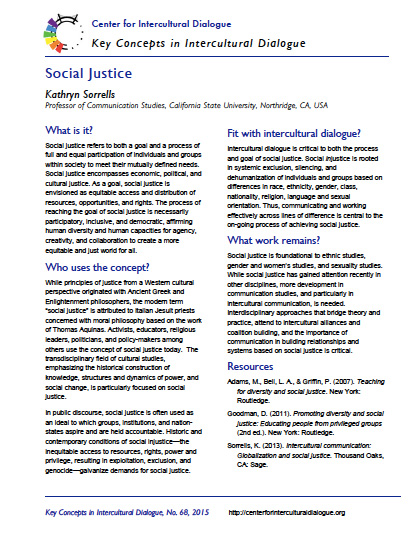
Key Concept #68: Social Justice by Kathryn Sorrells

Key Concepts in ICDThe next issue of Key Concepts in intercultural Dialogue is now available. This is KC68: Social Justice by Kathryn Sorrells. As always, all Key Concepts are available as free PDFs; just click on the thumbnail to download. Lists organized chronologically by publication date and number, alphabetically by concept in English, and by languages into which they have been translated, are available, as is a page of acknowledgments with the names of all authors, translators, and reviewers.

Key Concept #68: Social Justice by Kathryn Sorrells

Sorrells, K. (2015). Social justice. Key Concepts in Intercultural Dialogue, 68. Available from: https://centerforinterculturaldialogue.org/wp-content/uploads/2015/06/kc68-social-justice.pdf

The Center for Intercultural Dialogue publishes a series of short briefs describing Key Concepts in Intercultural Dialogue. Different people, working in different countries and disciplines, use different vocabulary to describe their interests, yet these terms overlap. Our goal is to provide some of the assumptions and history attached to each concept for those unfamiliar with it. As there are other concepts you would like to see included, send an email to the series editor, Wendy Leeds-Hurwitz. If there are concepts you would like to prepare, provide a brief explanation of why you think the concept is central to the study of intercultural dialogue, and why you are the obvious person to write up that concept.


Creative Commons License
This work is licensed under a Creative Commons Attribution-NonCommercial-NoDerivatives 4.0 International License.

CFP Conflict Mediation and Leadership

Call for Papers
Conflict Mediation and Leadership: Critical Reflections on Management and Banal Culturalism
for Volume 7, Studies in Intercultural Mediation, Peter Lang Publishers, Frankfurt
Editors: Dominic Busch and Claude-Hélène Mayer

Do mediation and leadership go together? And if they do, how do they?

During the past years, the discourse in mediation sciences and practices turns increasingly to the question how mediation is and can be used in management and leadership contexts. Research and popular publications do not only see mediation as an exclusive practice in managing, resolving and transforming conflicts, but also as a tool which can be used in managing and leading individuals, employees and organisations. Some voices seem to view concepts of mediative leadership or management-by-mediation as the new and future concepts of leading people and organisations. Other voices are highly critical that this is possible. Hardly any scientific research exists on mediation, management and leadership, their interrelationships, models, theories and practices.

In parallel, mediative strategies are frequently considered as particularly suited for a constructive management of conflict in intercultural settings. Traditionally, research on intercultural mediation has tended to rely on the assumption that people from different cultural backgrounds will prefer different modes of disputing as well as managing conflicts. More recently, critical scholars have pointed out that cultural research on these premises is based on Western ethnocentric assumptions shaping even Non-Western cultures according to the West’s ethnocentric imaginations of what is to be seen as the cultural other. Earlier research that now is frequently judged as culturalist had tended to over-generalize and to interpret anything that had been emerged in research on the basis of pre-fabricated cultural assumptions. This tendency can be found in people’s everyday discourse in Western societies, too: Here, people from other countries are consequently interpreted on the background of their assumedly foreign and different culture. What here can be termed as culturalizations in fact must be seen as an act of systematic and blurred discrimination and even racism. Leaders in international organizations here have to face the challenge of deconstructing culturalist organizational discourse – in conflict management in particular. Conditions of a constructive management of culturalisations can be subsumed under the notion of intercultural sustainability.

Volume 7 of Studies in Intercultural Mediation aims at advancing international research, practice and development of mediation theory and practice in the context of leadership. The purpose of this volume is to provide new insights and ideas into theories, practices, methods and techniques of mediation and leadership in the face of discursive culturalizations and the responsible management of cultural affiliations. It aims at contributing to the deeper understanding of conflict resolution processes in individual, cultural, organisational and societal leadership contexts.

We hereby invite abstract/chapter submissions that relate to the theoretical, empirical and practical exploration of mediation and leadership from various cultural perspectives. Authors are invited to contribute to theory, model building and practice regarding mediation and leadership in culturalist perspectives. Questions we would like to tackle in this volume are – but are not limited to – the following:
*What is the basic understanding of mediation and leadership?
*How can processes of culturalization and its responsible management in mediation and leadership be described?
*What mediation, management and leadership theories and practices apply?
*How can the concept of intercultural sustainability narrowed and elicited in regard to mediative leadership?
*What forms of mediative leadership may emerge in the lights of critical cosmopolitanism?
*Which concepts do exist in leadership with regard to conflict resolution and mediation?
*How does mediation theory and practice fit with management and leadership theories and practice, such as participative, servant, autocratic, spiritual, or charismatic leadership?
*What does empirical mediation and leadership research say in terms of the connection of these concepts in various cultural contexts?
*How do concepts such as mediative leadership or management-by-mediation contribute to the discourses on mediation, leadership and management?
*Which opinions exist with regard to the interlinkages of mediation and leadership in theory and practice.

A publication of the planned volume is scheduled for August 2016. Contributors with proposals and works in progress aiming for publication are welcome to contact the editors.

Please submit an abstract of a max. of 250 words until 15 September 2015.
Submissions will be reviewed and feedback will be provided on 1 November 2015.
Upon invitation, full articles should be submitted until 1. March 2016. Articles should not exceed 6.000 words in length excluding references.

The official language of this volume is English. Please use the reference system according to the Harvard Style. Please send your abstract until 1 August 2015 to one of the editors:
Prof. Dr. Dominic Busch, Universität der Bundeswehr, München
Dr. Claude-Hélène Mayer, University of South Africa

U.S. Mission to the European Union Funding Opportunity

The U.S. Mission to the European Union (USEU) is soliciting proposals for projects aimed at increasing understanding of U.S. foreign policy and economic priorities related to the EU; supporting U.S. goals of advancing economic growth in both regions and worldwide; and furthering U.S.-EU understanding and cooperation on our shared cultural, political and economic values, particularly democracy, rule of law, and human rights. USEU will award several cooperative agreements for projects to be carried out between September 2015 and December 2016. Section I: Funding Opportunity Description The U.S. Mission to the European Union (USEU) Public Affairs Section is soliciting proposals for projects aimed at increasing understanding of U.S. foreign policy and economic priorities; supporting U.S. goals of advancing economic growth in both regions and worldwide; and furthering U.S.-EU understanding and cooperation on our shared cultural, political and economic values, particularly democracy, rule of law, and human rights. Applicants should be legally recognized non-profit, non-governmental organizations (NGOs), think tanks, or academic institutions that comply with U.S. and EU requirements and have a proven track record of developing and implementing programs in the EU environment.

Sponsor: United States Department of State (DOS), Bureau of European and Eurasian Affairs
Closing Date for Applications: Jul 10, 2015
Estimated Total Program Funding: $180,000
Award Ceiling: $60,000
Award Floor: $10,000

CFP Audiovisualtopia: A Conference on the Contemporary Screen Scene (Madrid)

Audiovisualtopia: A Conference on the Contemporary Screen Scene
Hosted by Saint Louis University – Madrid, Spain

CALL for PAPERS: One hundred twenty years after the Lumiere Brothers’ Arrival of a Trainat Ciotat Station / L’arrivée d’un train en gare de La Ciotat and about 60 years after the insinuation of television into living rooms across the industrialized world, contemporary societies are saturated with audiovisual culture. More recently, the rise of widely affordable techno-substrates for production (digital photography) and exhibition (youtube, proliferating film festivals) are clearly enabling toward the “democratization” of audiovisual sophistication, such that the committed college sophomore can readily produce polished short films. In other words, there is much to celebrate!

In this milieu, one may also ask whether “plus ça change, plus c’est la même chose” – or whether we are imbibing from the proverbial “old wine in new bottles”. That is, even as more audiovisual material is now produced in more places with more participants, film and TV (as industries, as texts) continue to be contested on the terrain of whether they largely challenge or affirm the prevailing status quo. The conference seeks to assess where we are now in a world awash with moving/narrativized images in which everyone (“everyone”) participates as producer and audience. Beyond the celebratory impulses, where are the continuities and discontinuities with the past as concern production and reception of audiovisual materials? What transformative politics are enabled, suppressed, or ambiguated in the current environment vis-à-vis film, TV and new media? The conference (re)considers where the pillars of screen studies (production, promotion, genre, stardom, auteurs, identity) are now situated for the ostensible disruptions of the contemporary milieu.

Specific areas of interest to the conference:
-Identity and Film/TV
-New Technological Substrates (for Production/Distribution/Reception)
-Festival & Award Culture
-World/Nation/Region on Screen
-Documenting Reality
-Short Films
-Co-production
-Screen Pedagogy
-Political Economy of Film & TV
-Genre Benders
-Auteurism
-Stardom
-Promotion of Audiovisual Material
-Fans

KEYNOTE ADDRESS: Núria Triana Toribio, University of Kent, United Kingdom

ABSTRACT SPECIFICATIONS: 150-250 words. Include (A) Name(s) & Affiliations of Authors(s) and (B) 5 Keywords
CONFERENCE EMAIL ADDRESS: screen_studies@yahoo.com
DUE DATE for ABSTRACTS: Saturday 27 June 2015

STEERING COMMITTEE: The committee empanelled to judge the “Audiovisualtopia” conference abstracts consists of the following members: Christopher A. Chávez (University of Oregon at Eugene, USA); Brian Michael Goss (Saint Louis University-Madrid Campus, Spain); Mary Rachel Gould (Saint Louis University, USA); Pamela Rolfe (Saint Louis University-Madrid Campus, Spain); Arne Saeys (University of Antwerp, Belgium)

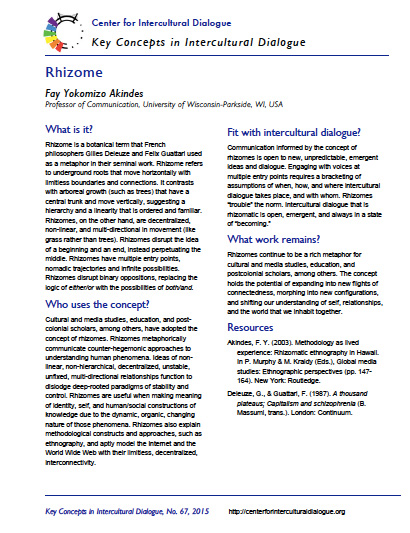
Key Concept #67: Rhizome by Fay Yokomizo Akindes

Key Concepts in ICDThe next issue of Key Concepts in intercultural Dialogue is now available. This is KC67: Rhizome by Fay Yokomizo Akindes. As always, all Key Concepts are available as free PDFs; just click on the thumbnail to download.

Key Concept 67: Rhizome by Fay Yokomizo Akindes

Akindes, F. Y. (2015). Rhizome. Key Concepts in Intercultural Dialogue, 67. Available from https://centerforinterculturaldialogue.org/publications

The Center for Intercultural Dialogue publishes a series of short briefs describing Key Concepts in intercultural Dialogue. Different people, working in different countries and disciplines, use different vocabulary to describe their interests, yet these terms overlap. Our goal is to provide some of the assumptions and history attached to each concept for those unfamiliar with it. Prior concepts are available on the main publications page. As there are other concepts you would like to see included, send an email to the series editor, Wendy Leeds-Hurwitz. If there are concepts you would like to prepare, provide a brief explanation of why you think the concept is central to the study of intercultural dialogue, and why you are the obvious person to write up that concept. Feel free to propose terms in any language, especially if they expand our ability to discuss an aspect of intercultural dialogue that is not easy to translate into English.

CFP IJOC (Un)civil Society in Digital China

Call for Proposals
International Journal of Communication (IJoC)
Special Journal Issue – (Un)civil Society in Digital China

Special Editors
Min Jiang (Ph.D.), Associate Professor of Communication Studies, UNC, Charlotte, USA

Ashley Esarey (Ph.D.), Visiting Assistant Professor of Political Science, University of Alberta, Canada

Rationale
Civil society’s role in furthering democratization and the development of a public sphere has long attracted scholars whose work has traced the historical roots of civil society in China and celebrated its emergence offline and online. While decades of economic reforms have empowered myriad civil society organizations, volatile contention has arisen among social groups along ideological, class, ethnic, racial and regional fault lines. Uncivil exchanges, amplified by the Internet and social media, often work at cross purposes and fail to produce consensus or solutions to public problems. These disputes, and the underlying social/political/cultural schisms, threaten to undermine constructive citizen engagement and the promise of civil society in China. They also challenge the notion of a unified civil society standing in solidarity against a monolithic, authoritarian state.

Consider the following examples of new sociopolitical contention:
o   The Internet flame war between Han Han and Fang Zhouzi that delegitimized the notion of “public intellectual” in China
o   Left-Right debate among China’s intellectual communities that spill over into street brawls
o   Vigilantism and breaches of privacy (i.e., instances of “human flesh search engine” and the Guo Meimei Red Cross scandal)
o   Online conflicts between “haves” and “have-nots” amidst extreme inequality
o   Virtual contention between Han and ethnic minorities over the status of Tibet and Xinjiang
o   Racial discourse on mixed-race Chinese and immigrants
o   Clashes over Taiwan’s “sunflower movement” expressed on the Internet
o   Divergent online opinions about the “umbrella movement” in Hong Kong

This special section invites contributors to unpack the multilayered, multidimensional reality and contradictions that define the Chinese Internet, focusing on the big-picture ramifications of online contention. With a population of nearly 650 million, Chinese Internet users are more diverse than the tech-savvy, liberal elites who first went online two decades ago. The groups active online today include politically conservative, nationalistic, apathetic, and even reactionary individuals. They also evince complicated attitudes towards the state, business and other demographic segments. The complex make-up of Chinese civil society and the nature of its self-representation thus challenge, on the one hand, an idealized notion of civil society that is independent from the private sphere, government and business, and on the other, the implicit assumption prevalent in Chinese Internet studies of a liberal subject demanding social justice, media freedom and political reform.

Questions for contributors:
o   What are the characteristics of Chinese civil society? What is its potential or limitations? Does the proliferation of the Internet in China necessarily empower civil society in China? Is the opposite possible?
o   Is civil society always civil? Can it be uncivil, fractious and even reactionary? How does the Chinese Internet amplify or mitigate (un)civil tendencies? To what extent is online public debate or collective action becoming more fragmentary, working at cross purposes, or resulting in “echo chamber” effects and polarization? Do nationalistic, jingoistic and even reactionary forces overwhelm and dominate “civil” discourse?
o   Are the “uncivil” tendencies of the Chinese Internet inevitable in a society composed of increasingly diverse groups? To what extent do commercial and state institutions influence uncivil tendencies online through intervention or even manipulation? What roles do powerful Internet businesses and elite personalities play?
o   Under what circumstances might incivility online prove advantageous for political or social change?
o   What evidence do we have for (un)civil society in China? Examples might include the formation of informal groups and formal organizations, discourses, and their intersection with collective action, social movements, and other social behavior.

Contributions to this special section will map a spectrum of key actors, issues, and orientations of a contentious civil society that has been submerged under a larger body of research on China and established democracies that assume state-society confrontation and fail to explore intra-societal tensions. Collectively, the contributions promise to produce a theoretically-interesting and empirically rich body of work that expands and deepens Chinese Internet research dominated by work focused on such topics as Chinese Internet censorship and propaganda, online activism, civic associations, deliberation and online culture. Insights generated from this special issue will in turn inform and advance research on civil society by debating its essence and examining the conditions conducive or unfavorable to its growth, with implications going beyond China. Although contributions will emphasize what polarizes Chinese society and sometimes seem to tear it apart, we welcome contributions that analyze the prospects for rising above incivility, bridging sociopolitical schisms, and building consensus without compromising self-expression and personal security.

Affiliated Conference
We encourage interested contributors to attend the 13th Chinese Internet Research Conference (CIRC) that includes as its theme “(un)civil society in digital China.” The conference will be held at the University of Alberta, Canada on May 27-28, 2015. The deadline for submitting paper abstracts (400 words) for the conference is February 15, 2015.

Proposed Schedule for IJoC Submissions
Abstract Deadline July 1, 2015
Notice of Abstract Acceptance August 1, 2015
Full Paper Deadline January 1, 2016

Paper Guidelines
o     Abstracts submitted for pre-screening should be less than 500 words. Please send your abstract to Min Jiang and Ashley Esarey.
o     Submitted papers will go through double-blind peer review.
o     The maximum word count is 9,000 words (including the abstract, keywords, images with captions, references, and appendices, if any). Submitted full papers are not guaranteed acceptance.
o     Formatting of the special section follows Author Guidelines of the International Journal of Communication (IJoC). Articles will be returned to authors if not APA (6th edition) compliant.

CFP Research About Communication

CALL FOR PAPERS
Research about Communication: History, current situation and prospective
Special issue of DISERTACIONES: Anuario Electrónico de Estudios en Comunicación Social
Edited by Manuel Martínez Nicolás (Universidad Rey Juan Carlos, Spain) and Miguel Vicente Mariño (Universidad de Valladolid, Spain)

Deadline for submitting full articles: 15/10/2015

The scientific research of communication has experienced during the last 25 years a pronounced expansion. During this period, it has not only reinforced its scholarly institutionalization (proliferation of university programmes, strengthening of scientific societies, launching of specialized journals…) but it has also increased its position within Social Sciences and Humanities, as far as it fully deals with one of the key features of current societies: the analysis and comprehension of the digital and communications revolution. Connected to this renewed energy, lately one can perceive a growing interest to address a reflexive approach towards the scholarly community itself, in order to analyse their scientific practices and epistemological options, to reveal its knowledge interests, to evaluate the outcomes it is producing, to account of the institutional devices influencing in research tasks or to highlight the strengthens and weaknesses that define the scientific study of communication.

There is no doubt that the reflexive attitude is an indicator of maturity within a scientific community. Moreover, it is the required path to follow in order to meet your own identity and, even more, to gain a certain degree of recognition in the general scientific field. Communication research has benefitted during the last years from the heuristic value of this reflexive approach, as the proliferation of projects dealing with the analysis of the conducted research, generally labelled as “metha-research” studies, as they synthetize the predominant objects of study, methods and theoretical approaches in the field or in their specific domains. Besides these type of publications, usually focused on the current research, there is a growing interest in renewing the history of studies about communication. Under the International Communication Association (ICA) sponsorship, and in collaboration with the International Association for Media and Communication Research (IAMCR) and the European Communication Reseach and Education Association (ECREA), London hosted the conference New Histories of Communication Studies in June 2013, putting forward an ambitious agenda for a comparative historiography and opening a great scholarly avenue for establishing and consolidating international networks and common projects. The recent joint project between ECREA and ALAIC (Asociación Latinoamericana de Investigadores de la Comunicación) to edit a volume titled Connecting paradigms: Communication studies in Latin America and Europe, where the editors ask for contributions “including a historical perspective, a detailed analysis of the current debates and future proposals”, indicates that this agenda has already started its development in specific actions.

DISERTACIONES proposes this special issue to strengthen this reflexive approach, and invites the scholarly community to send their contributions, preferably as empirical studies, helping to increase the knowledge about the field of Communication Research, and covering, among others, the following aspects:

1. The scientific production in this field, in order to identify the predominant objects of study, topics and problems; the theoretical and methodological approaches; the authors, schools and traditions; the research outputs and the contributions to the progress of the scientific knowledge about communication, etc.

2. The main features and the internal structure of the scientific community of communication researchers: research groups, networks and scholarly relations, institutional and educational profile and background of researchers, epistemological and paradigmatical adscriptions, etc.

3. The socio-institutional context in which the scientific labour is inserted, empashizing the organization of research (universities, specialized centres, companies), the public scientific policies, the funding programmes for research, the regulation to access teaching and researching opportunies (accreditation processes, system of rewards, etc.), the influence of the social and historical contexts in the research practices, etc.

4. The process of secondary institutionalization of Communication Research, particularly referred to the scientific societies (constitution, roles, functions, activities, organization, etc.), scientific journals (procedures, criteria, etc.), publishing companies and book series.

All these features of Communication Research can be approached from diverse disciplinary strategies and perspectives. Hence, within the analysis of the scientific production one can find both quantitative studies (bibliometrics, content analyses) and critical evaluations about results and contributions regarding specific domains and topics (political communication, audience/reception studies, organizational communication, etc.). Additionally, the inquiry about scientific communities, socio-institutional contexts and secondary processes of institutionalization welcome contributions from a wide array of social sciences, such as Sociology, Psychology, Anthropology, Economy, Etc.). Transversally, all these aspects can be approached from a historical perspective, both in terms of dealing with certain moments or periods in the past and in revisit their evolution across time and space.

El Anuario Electrónico de Estudios en Comunicación Social “Disertaciones” es una publicación arbitrada e indizada, editada conjuntamente entre la Universidad de los Andes de Venezuela (Departamento de Comunicación Social de la ULA Táchira, Grupo de Investigación Comunicación, Cultura y Sociedad y Laboratorio de Investigación Educativa Simón Rodríguez (LIESR)) y la Universidad Complutense de Madrid de España (Grupo Mediación Dialéctica de la Comunicación Social MDCS). En la última evaluación de Latindex, Disertaciones fue indizada cumpliendo un 100% de los criterios de calidad tomados en cuenta por este índice regional.