Global Campus of Human Rights Contest: Memory & Reconciliation

Photo ContestThe Global Campus of Human Rights has launched the third edition of the GC Visual Contest, open to photographers and video-makers, professionals and amateurs, from any part of the world. The goal of the contest is to create synergies between academia, Human Rights defenders and artists to reach a wider international public and foster a better understanding of the issues concerning human rights and their protection.

THE THEME
The visual contest will be open from 1st May and will accept submissions through June 30, 2017. The theme for 2017 is “Memory and Reconciliation”. Memory and how do we envision the past has a potent impact on the creation of the present and future of a country and the current understanding of human rights concerns.
The GC Visual Contest originates from the belief that photography and videos are powerful tools that can raise awareness and push for social change. Furthermore, the purpose of this contest is to create a network of artists, intellectuals and professionals interested in strengthening the protection of human rights and the promotion of democracy and peace.

A collective memory manifests itself in decisions regarding the commemoration of dates, trials of former oppressors, establishment of sites and museums of memory, artworks and memorials and its role in the public education. This photo and video competition seeks to promote reflection on the various collective rememberings and experiences of the past and to which extent it is possible to establish conditions for crime recognition and forgiveness.

DETAILS
The competition will have two category levels, for professional artists and amateurs to which students and Alumni from the Global Campus are particularly encouraged to apply. A number of images and videos will be selected to be displayed on a dedicated online gallery and in connection to GC events/activities ensuring international exposure also thanks to different partners and social media channels. Winners will be determined by an international jury composed of leading experts in the field of photography and documentary filmmaking and of members of the GC network.

The best pictures and short videos could receive special mentions by the partners of the contest and will be presented at the events of the Regional Masters of the Global Campus in Africa, Asia-Pacific, Caucasus, Latin America and the Caribbean, Middle East and North Africa, South East Europe.

This initiative is funded by the European Union and receives the patronage of the United Nations Regional Information centre for Western Europe (UNRIC). The Global Campus of Human Rights is a unique network of one hundred participating universities around the world, seeking to advance human rights and democracy through regional and global cooperation for education and research. 

Leila Monaghan Profile

Profiles

Leila Monaghan (Ph.D., UCLA) teaches linguistic and cultural anthropology at Northern Arizona University. Leila Monaghan

Her research interests are broad and include the history of Deaf communities, the impact of HIV/AIDS, the narrative construction of disability, and the role of Native women in the Plains Indian Wars. Co-edited books include Many Ways to be Deaf, and Barriers and Belonging: Personal Narratives of Disability. She is also editor of the new journal Language, Culture and History.

Selected publications:

Jarman, M., Monaghan, L., & Harkin, A. Q. (Eds.). (2017). Barriers and belonging: Personal narratives of disability. Philadelphia: Temple University Press.

Monaghan, L. (2012) Perspectives on intercultural communication and discourse. In C.B. Paulston, S. Kiesling & E. Rangel (Eds.), Handbook of intercultural discourse and communication (pp. 19-36). Malden, MA: Wiley-Blackwell.

Monaghan, L. F., Schmaling, C., Nakamura, K., & Turner, G. H. (Eds.). (2003). Many ways to be deaf: International variation in Deaf communities. Washington, DC: Gallaudet University Press.

Monaghan, L., Goodman, J., & Robinson, J.M. (Eds.). (2012). A cultural approach to interpersonal communication: Essential readings. Malden, MA: Wiley/Blackwell.

Senghas, R.J., &  Monaghan, L. (2002) Signs of their times: Deaf communities and the culture of language. Annual Review of Anthropology, 31(1), 69-97.


Work for CID:

Leila Monaghan wrote KC11: Intercultural Discourse and Communication, and Constructing Intercultural Dialogues #5: Intercultural Dialogue and Deaf HIV/AIDS, as well as a guest post on Intercultural Challenges of the Deaf HIV/AIDS Epidemic.


NOTE: Leila Monaghan passed away in February 2022. She was one of the first to mention the Istanbul conference on intercultural dialogue in 2009 in print, a delight to correspond with, and she will be sorely missed.
– Wendy Leeds-Hurwitz

Canterbury Christ Church University PHD Scholarships (New Zealand)

Canterbury Christ Church University (New Zealand) welcomes applicants for full-time PhD scholarships (a stipend of £13,000 p.a. and tuition fee waiver for three years). Applications are invited across a range of subjects and themes.

Among the topics that seem likely to attract interest to those following the Center for Intercultural Dialogue may be these (follow the link above for their complete list):

Education: Language and Intercultural Education; Equality, Inclusion and Social Justice; Pedagogy and Identity

Arts and Humanities: Applied Linguistics; Film Studies; Media and Cultural Studies

Social and Applied Sciences: Politics and International Relations; Sociology; Tourism Studies

Closing date: 18th April 2017. Registration date: 1st October 2017.

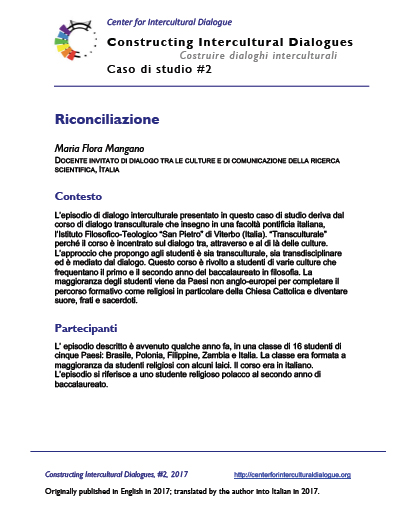
Constructing Intercultural Dialogues #2: Reconciliation Translated into Italian

Constructing ICD #7The first translation of one of the new Constructing intercultural Dialogues case studies is now available. CICD #2: Reconciliation, by Maria Flora Mangano, was published in English earlier this year, and she has now translated it into Italian. As with the continuing CID series, Key Concepts in Intercultural Dialogue, these may be downloaded for free. Click on the thumbnail to download the PDF.

A list of all case studies in this series, organized chronologically by publication date and number, is available, as is a page of acknowledgments with the names of all authors, translators, and reviewers.

CICD 2_ItalianMangano, M. F. (2017). Riconciliazione. Constructing Intercultural Dialogues, 2. Available from: https://centerforinterculturaldialogue.org/wp-content/uploads/2017/04/constructing-icd-2_it.pdf

If you have a case study you would like to share, or if you would like to translate one, send an email to the series editor, Wendy Leeds-Hurwitz.


Creative Commons License
This work is licensed under a Creative Commons Attribution-NonCommercial-NoDerivatives 4.0 International License.

Save

U Cambridge Job Ad: Centre for Educational Dialogue Research (UK)

Research Associate (Full-time, fixed-term) or Senior Research Associate (Part-time, fixed-term)
University of Cambridge

We wish to appoint a full-time Research Associate or a part-time (0.7 FTE) Senior Research Associate to support and develop the research of the Centre for Educational Dialogue Research (CEDiR) at the Faculty of Education in central Cambridge.

The appointed researcher will work closely with Professor Rupert Wegerif to develop the research base of dialogic education at Cambridge, with particular interests in dialogic education with technology, global dialogue for peace, and classroom dialogue. A key part of the work will be pro-actively seeking funding and bid writing. In addition there will be writing articles for high impact journals and practitioner journals, and working to organise research events and animate a research community which is both local and international. You will help to develop and seek funding for projects assessing group thinking. You will also develop and seek funding for projects using the internet to promote and sustain international dialogue.

Applicants must hold a PhD in a relevant subject, and have relevant qualitative and quantitative research training and experience. You should have a good understanding of dialogic education and some experience of related research. You should also demonstrate evidence of contributing to the development of bids and of writing for publication. For appointment as a Senior Research Associate you will have substantial experience as a Research Associate, along with proven ability to manage research groups and projects, and evidence of successful bids for research funding.

Fixed-term: The funds for this post are available for 3 years in the first instance.


University College London Job Ad: Applied Linguistics

Research Assistant (2 years) – Ref:1640327 ESRC-funded Family Language Policy project – Somali community in London
UCL Institute of Education, University College London

Duties and Responsibilities:
You will be a member of the UCL Centre for Applied Linguistics, which is located in the UCL Institute of Education. The UCL Centre for Applied Linguistics is a centre of international excellence in research and teaching in bilingualism and multilingualism, second language acquisition and assessment, discourse analysis, sociolinguistics, language-in-education policy and practice, English language teaching and teacher development, corpus linguistics, and intercultural communication.

The successful applicant will be involved in conducting family-based linguistic ethnography within the Somali community in London with different types of families. The post-holder will be expected to manage the day-today project objectives, under the supervision of Professor Li Wei, and to work in collaboration with the other project team members based in Reading University and Birkbeck College, University of London.

The post is available and funded from 01 September 2017 until 31 August 2019.

Key Requirements:
Candidates should have postgraduate qualifications in applied linguistics, with extensive knowledge of the Somali community in the UK and extensive knowledge of linguistic ethnography. Good knowledge of standard statistical analysis and demonstrable skills in verbal and written communication are expected.

Closing Date: 7 May 2017, latest time for the submission of applications: 23:59
Interview date:  TBC

U Tampere Job Ads: Social Research (Finland)

Five associate professor or professor posts in the New Social Research programme

The University of Tampere is an internationally renowned research-led university and one of the few in the world to specialise in the social sciences.  It has a lively, multidisciplinary and international research environment with a staff of 2,200 and 15,000 students.

The University places strong emphasis on rigorous scholarship in areas of significant social relevance. To help achieve this objective, the University has commenced the New Social Research programme. NSR has five core themes: governing complexity; transformation of agency and empowerment; the changing nature of work; the future of well-being, and; new forms of communication, information and interaction. NSR will become a truly international programme, working across disciplinary boundaries and in partnership with a wide range of external stakeholders nationally and internationally. More information on NSR is available at the programme website.

At the centre of the programme are eleven fully-funded associate or full professor posts. The director, Professor Rebecca Boden, and the first six appointments are already in place. The University of Tampere is now seeking to complete the team by appointing a further five associate or full professors. Appointees will have dual affiliation between NSR and an appropriate faculty, ensuring a clear career trajectory, and at the end of this period it is anticipated that they will take up permanent posts in one of the University’s faculties, as appropriate.

The University of Tampere is seeking highly motivated and accomplished academics who will be active and innovative co-builders of the NSR programme as research leaders. In addition to developing a strong individual research profile within the broad remit of NSR’s activities, you would work collaboratively with fellow NSR researchers to achieve significant programme synergies. Activities would include: effective research leadership (particularly of early career academics); facilitating the development of the NSR profile nationally and internationally; and seeking, winning and managing major research funding. A key role of the NSR programme is to make a major contribution to the further development of the University’s research profile more generally. As such, you would be expected to work collaboratively and constructively with appropriate faculties to embed programme gains across the institution.  Whilst the main emphasis of these roles for the first five years is on research, you would be expected to make a gradually increasing and expertise-appropriate contribution to research-led teaching, curriculum development and research student supervision in the faculties.

What you can offer
You must have: a doctoral degree in a field relevant to the research programme; high-level scientific expertise; an excellent international publication record; and teaching/supervision skills and experience across the range of levels.

Additionally, successful candidates will have a proven track record of international scientific cooperation, and the ability to offer advanced research-led teaching and supervision. Your research interests will be aligned to one or more themes in the NSR programme, but you will be able to demonstrate how you would develop those further. NSR especially welcomes applications under the theme the changing nature of work and is less likely to make any appointments of candidates whose principal contribution would be in the theme governing complexity.

Your proposed work for the duration of the programme will evidence a good fit with NSR objectives and how you would work in an inter- and multidisciplinary environment. Ideally you will have experience of leading or making a major contribution to a research group and a track record of successful applications for external research funding.

What we offer
The University of Tampere offers a dynamic and international research community with strong national and international collaborative networks. Tampere University of Applied Sciences (TAMK), Tampere University of Technology (TUT) and the University of Tampere have recently agreed to merge and will be working collaboratively together to build a unique model of higher education offering an innovative, multidisciplinary and internationally attractive research and learning environment built on demonstrably excellent foundations.  Appointment to NSR offers an opportunity to develop, lead and maintain a dynamic research programme leading to national and international recognition within this environment.

Finnish people almost universally speak English to a high level. Finland is a well-ordered and culturally sophisticated EU country which enjoys world-leading free schooling (including in English), affordable child care, excellent public services, moderate taxation and low levels of bureaucracy.  The Tampere region is one of the fastest-growing urban areas in Finland. Tampere is the largest inland city in the Nordic countries and Finland’s second largest city. The city offers an extremely pleasant environment in which to live and work. Whilst a traditional industrial centre, with an attractive heritage built environment, today the city is best known for its high-tech expertise. The city has a lively cultural life, with many theatres, galleries and museums etc. and is the most popular city to study in amongst Finnish students.

We appreciate that relocation can be daunting and the University’s HR Services provide intensive support for international recruits, especially on matters such as residence permits, registration, taxation, retirement pensions, social security issues, finding accommodation, daycare for children, schooling, health care and other local services in Tampere. You can contact the International HR Team during your application process with any specific queries or see our Join us!-pages on our website. The University of Tampere received the European Commission’s acknowledgement of HR Excellence in Research in March 2015.

The University of Tampere offers a comprehensive package of employee benefits. These include occupational health care, flexible working hours and high-quality sporting facilities. These posts include membership of the generous Finnish statutory earnings-related retirement pension scheme, further details of which are available here.

Finnish universities operate a national University Salary System and salaries will be determined by reference to that. At commencement, the minimum monthly salary of an associate professor will range between €5,000 and €5,600 a month and that of a professor between €5,700 and €6,400 a month. Higher salaries may be agreed dependent upon experience and/or performance.

These posts are subject to a four month probationary period. Initial appointment as associate professor is for five years and, subject to successful performance, post holders will become tenured members of faculty staff at the end of the five year period. The evaluation of suitability for a tenured position will commence after four years in post and appointees will be supported throughout the five year period to ease transition to faculty positions.  Full professors will hold a permanent appointment from the outset.

The application process
Applications should be written in English and submitted electronically via the University of Tampere’s electronic
recruitment system by 15:45 pm. on 2 May 2017.

The following documents should accompany your application:
A CV (excluding publications).
A list of publications compiled according to the Academy of Finland guidelines. Please indicate your ten most important publications.
A letter of application in which you set out the reasons why you are applying for the post and why you are particularly suited to it.
A five page research plan, outlining your proposed research within the programme.
The names, positions and contact details of two referees who can support your application.

Enquiries
For queries related to the NSR programme please contact the Programme Director, Professor Rebecca Boden. For queries related to the application process please contact the Faculty Head of Administration Sari Saastamoinen.


Chinese University of Hong Kong Job Ad: Globalization

CHINESE UNIVERSITY OF HONG KONG
School of Journalism and Communication
Professors/ Associate Professors/ Assistant Professors
Ref. 170000CK

Applicants should have (i) a PhD degree in communication or a related field (by the time reporting for duty); (ii) strong commitment to excellence in teaching and research; and (iii) a track record of research and publication. Applicants with expertise in digital culture and interests in globalization and communication are preferred.

Appointments will normally be made on contract basis for up to three years initially commencing as soon as possible, which, subject to mutual agreement, may lead to longer-term appointment or substantiation later.

Applications will be accepted until the posts are filled.

Application Procedure
The University only accepts and considers applications submitted online for the posts above.


Elizabeth S. Parks Profile

ProfilesElizabeth S. Parks (Ph.D., University of Washington) is an Assistant Professor of Communication Studies at Colorado State University.Elizabeth Parks

She has degrees in Communication (M.A., University of Washington), Deaf Studies: Cultural Studies (M.A., Gallaudet University), Communication Studies (B.A., Creighton University), Sign Language Interpreting (Iowa Western Community College), and a graduate certificate in Values in Society (University of Washington). She uses her many years of international fieldwork experience with diverse cultural communities to ground her scholarship in listening and dialogue, communication ethics, cultural studies, and disability studies.

Embracing a mixed method approach that draws from both social sciences and humanities, her current research focuses on the ways in which cultural diversity and embodied difference impacts perceptions and practices of “good listening” that ultimately promote ethical dialogue across difference. Fluent in American Sign Language, she pays particular attention to the ways that diverse sensory and linguistic experiences impact the ways that we conceptualize and experience listening in our relationships. She works actively with the Center for Public Deliberation at Colorado State University to expand the ways that everyday dialogue and deliberation are practiced in everyday democracy. Her first book, The Ethics of Listening: Creating Space for Sustainable Dialogue, was published in 2019 and she is the recipient of a 2019-2020 J. William Fulbright Foreign Scholarship Award. She has twice served as a guest editor for Listening: Journal of Communication Ethics, Religion, and Culture and her research has been published in journals such as the Journal of International and Intercultural CommunicationInternational Journal of Listening, Ethics & Behavior, Journal of Research in Gender Studies, Critical Issues in Language Studies, Journal of International Communication, MultilinguaJournal of Cross-Cultural and Interlanguage Communication, and Organizational Development Journal.

Her personal website can be found at www.elizabethsparks.org.


Work for CID:

Elizabeth Parks wrote Constructing Intercultural Dialogues #6: The Privilege of Listening First. She also served as a judge for the 2020 CID Video Competition.

Innovative Ideas for Intercultural Dialogue

I’ve recently read about several interesting ways people are encouraging intercultural dialogues, and wanted to call them to attention here. Readers are invited to post additional stories as comments, or send them in via email so they can be considered as additional posts.

The video “Hijabi” by Mona Haydar has only just been posted, and is already sparking a lot of conversations as a result of the uncommon portrayals of Muslim women dancing to rap music. A story about the videotape, including an interview with Haydar, is available on Huffington Post. Previously, she and her husband put up a sign saying “Ask a Muslim” and answered questions from strangers in Cambridge, MA, as a way of diffusing tensions. Read a story about this on Fusion. Apparently they were influenced by a This American Life episode, “Talk to an Iraqi” in which Haider Newmani set up a booth in cities across the US encouraging strangers to come up and ask him questions.

There have been many other examples as well, such as Firas Alshater, who stood blindfolded in the center of Berlin with a sign saying “I am a Syrian refugee. I trust you. Do you trust me? Hug me.” He went on to post a series of videos about  under the title Zucker (sugar), describing Germany from the point of view of a refugee, with lots of humor.

Recently the Tate Modern in London organized an exhibit entitled Who are We? in order to encourage conversations about the “multiple crises of identity and belonging in Europe and the UK”.

All of these efforts to start intercultural dialogues serve as important beginnings in different contexts. What other projects do you know about? What have you done yourself?

Wendy Leeds-Hurwitz, Director
Center for Intercultural Dialogue