KC91: Peace Communication

Key Concepts in ICDThe next issue of Key Concepts in intercultural Dialogue is now available. This is KC#91: Peace Communication, by Yael Warshel. Click on the thumbnail to download the PDF. Lists organized chronologically by publication date and numberalphabetically by concept in English, and by languages into which they have been translated, are available, as is a page of acknowledgments with the names of all authors, translators, and reviewers.
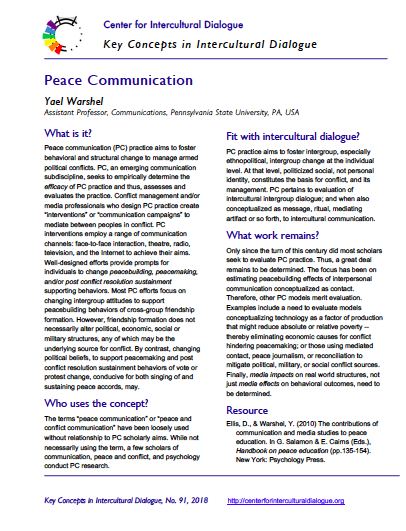
KC91 Peace CommunicationWarshel, Y. (2018). Peace communication. Key Concepts in Intercultural Dialogue, 91. Available from:
https://centerforinterculturaldialogue.org/wp-content/uploads/2018/09/kc91-peace-communication.pdf

NOTE: Yael Warshel also has presented a TEDx talk trying to answer a related question, Do Media Have the Power to Make Peace?  

The Center for Intercultural Dialogue publishes a series of short briefs describing Key Concepts in intercultural Dialogue. Different people, working in different countries and disciplines, use different vocabulary to describe their interests, yet these terms overlap. Our goal is to provide some of the assumptions and history attached to each concept for those unfamiliar with it. As there are other concepts you would like to see included, send an email to the series editor, Wendy Leeds-Hurwitz. If there are concepts you would like to prepare, provide a brief explanation of why you think the concept is central to the study of intercultural dialogue, and why you are the obvious person to write up that concept.


Creative Commons License
This work is licensed under a Creative Commons Attribution-NonCommercial-NoDerivatives 4.0 International License.


Queen’s U Job Ad: Cultural Anthro/Sociolinguistics (Canada)

Job adsAssistant Professor in Cultural Anthropology and/or Sociolinguistics, Department of Languages, Literatures and Cultures, Queen’s University, Kingston, Ontario, Canada. Deadline: November 5, 2018.

The Department of Languages, Literatures and Cultures in the Faculty of Arts and Science at Queen’s University invites applications for a Tenure-track faculty position at the rank of Assistant Professor with specialization in Cultural Anthropology and/or Sociolinguistics. The ideal candidate will have a scholarly interest, expertise and a publication record in the area of language in its social context, for example: ethnography; intercultural communication; language contacts or creole linguistics; Indigenous heritage and language revitalization; language and social justice; language and power; writing systems. We particularly welcome applications from candidates whose research relates to any of the languages offered in the department (Anishinaabemowin, Arabic, German, Hebrew, Inuktitut, Italian, Japanese, Mandarin, Mohawk, Portuguese, and Spanish). The successful candidate will contribute to the new Languages, Literatures and Cultures (LLCU) Major and will demonstrate expertise in cultural diversity and inter-cultural sensitivity. The successful candidate will participate in developing and teaching a fourth-year capstone course for the LLCU Major, and is expected to teach one or more existing core courses in the Linguistics program.

U New Mexico Job Ad: Culture & Comm (USA)

Job adsAssistant Professor in Culture and Communication, Department of Communication & Journalism, University of New Mexico, NM. Deadline: November 14, 2018.

The intercultural emphasis at UNM defines culture broadly as pertaining to emergent identities; discursive practices and norms; performative, artistic, and mediated forms; locations of speaking/acting/producing; organizational systems; and institutional structures. Culture is socially constructed and structurally produced and therefore a factor that is influential across all communication contexts. Courses reflect this emphasis, focusing on questions and critiques of “diversity” in and across local, national, and global contexts; identities and subjectivities (i.e., nationality, race, gender, ethnicity, sexuality, class, multivocality, intersectionality, positionality, and agency); and places and spaces (i.e., transnationalism and globalization, migration, borderlands, social activism and change, and sustainability).

Intercultural Communication MOOC

Job adsMOOC (Massive Open Online Course): Intercultural Communication. Starts: October 15, 2018.

Learn to appreciate, adjust to, and work or study in different cultures, with this free online intercultural communication course. This course assumes no prior knowledge and is suitable for pre-university, undergraduate and post-experience students. It does require high school-level English or above, an interest in international issues, and curiosity about, exposure to or experience with other cultures.

Taught by Steve Kulich, Hongling Zhang, and Ruobing Chi, all at the Intercultural Institute of Shanghai International Studies University, China, on the FutureLearn platform (other relevant MOOCs on this platform include Cultures and Identities in Europe or Introduction to Intercultural Studies: Defining the Concept of Culture, offered by the European University Institute and the University of Leeds, respectively).

Lûiz Fêrnando da Silva Profile

ProfilesLûiz Fêrnando da Silva is an experienced Brazilian specialist in the TV market, and a lecturer.  He is a TV market enthusiast with a professional and personal interest in content marketing, brand content, content strategy, windowing, streaming, content for social media, TV market regulation and laws, customer and audience insights, content trends, technologies for production and consumption of content and innovation in general.

Lûiz Fêrnando da Silva

Over the last years, he has worked for Globo TV, the biggest media group in Brazil and taught for Escola Superior de Propaganda (ESPM) e Marketing and Agência Nacional de Cinema, the latter being the main public investor on TV production in Brazil.

At Globo TV, he built experience with TV shows creation, development, production planning and programming for free and pay TV (Globo TV & Globosat), streaming services (GloboPlay & GlobosatPlay) and TV on demand (available through NET and SKY). During the years working as a researcher for Globo TV, he attended a variety of conferences – SXSW, TED, Mipcom, MipTV, L.A. Screenings and Natpe, to look for insights and trends to support creation, development and programming decisions. He became familiar with FremantleMedia Formats, and had the opportunity to visit some company displays at Mipcom and Natpe Miami.

As a researcher, his area of study is the Political Economy of Communication and Cultural Studies, with a specific interest in the investigation of national and international broadcasting systems and the way the Internet (streaming: VOD, SVOD, TVOD) imposes new regulatory and marketing challenges on local, regional, national, continental, and global levels. In addition, he has interests in subjects such as multiculturalism, gender, and race, and how they are being represented through media culture products.

Currently he is conducting a post-doctoral study entitled “Globo and Netflix: unfolding of the coexistence between the services of SVOD in Brazil.” In this investigation the goal is understanding how Netflix causes changes in the country’s two largest broadcasting companies, TV Globo (open TV) and Globosat (cable channel programmer), both owned by Grupo Globo. The research is being conducted at the Center for Communication and Society Studies (CECS), Minho University, in Braga, Portugal.


Work for CID:
Lûiz Fêrnando da Silva translated KC3: Intercultural Competence and KC22: Cultural Identity into Portuguese. He has also served as a reviewer for Portuguese.

CFP NAMLE 2019 (USA)

ConferencesCall for Papers: National Association for Media Literacy Education (NAMLE) Conference: A Path Forward: Elevating Conversation, Unifying Voices, June 26-28, 2019, Washington, D.C. Deadline: November 1, 2018.

The National Association for Media Literacy Education is now accepting proposal submissions for the 2019 Conference to be held in Washington D.C. from June 26-28, 2019. The conference theme, “A Path Forward: Elevating Conversation, Unifying Voices” aims to provide a platform for including voices from diverse disciplines as we explore the future of media literacy in a rapidly shifting media landscape. To this end, the conference includes innovative session formats and built-in networking opportunities to facilitate the sharing and discussion of new ideas. Through these collaborative sessions, educators, researchers, and practitioners from diverse fields within and outside of media literacy education can work with other participants of the conference to create innovative tools, practices, and strategies for moving media literacy beyond Fake News.

Translation & Translanguaging Films

Resources in ICD“ width=The 11 short films produced by the Translation and Translanguaging TLANG team provide a teaching and research resource in the areas of multilingualism, superdiversity, and sociolinguistics. They also document engagement approaches with different stakeholders. Those investigating linguistic and social diversity, migration, translation and translanguaging, may find them particularly useful. TLANG was a major research project active 2014-18; its aim was to understand how people communicate across diverse languages and cultures.

  1. Voices of the Bullring Markets : This video provides an introduction to the superdiverse nature of the Bullring meat and fish markets in Birmingham.

  2. The Library of Birmingham : This video provides an account of language and interaction at the Library of Birmingham.

  3. Communication in the Multilingual City: This film of the final TLANG conference contains discussions about translanguaging and offers a range of interpretations.

  4. Translanguaging and the Arts: A Creative Conversation:  This film explores researchers, artist and creative practitioners working together to represent multilingualism and superdiversity in new and engaging ways.

  5. Overcoming Barriers to University Education in South Africa: Highlights from workshops held in South Africa to engage university lecturers and managers in discussions about translanguaging as pedagogy in higher education in South Africa, and the role of South Africa’s official languages in university classrooms.

  6. Researching Translanguaging Summer School: Scholars from all over the world attended this summer school which explored different conceptualisations of translanguaging and methodological approaches for researching linguistic diversity.

  7. Women & Theatre: The TLANG team collaborated with a creative company, ‘Women and Theatre’, who produced an original piece of theatre in response to their engagement with the research project. The show was performed 22 times in four cities, to enthusiastic and appreciative audiences.

  8. A Network Assembly I:  This captures how a range of different stakeholders including policy makers, councillors, museum curators, local business people, artists, academics and students engage with concepts such as superdiversity, translanguaging and multilingualism.

  9. Changing Lives: This film shows the work of a Chinese community Centre and provides an account of how the lives of people visiting the centre are changing.

  10. Team Work in the City:  This film shows the coaching practices of a volleyball coach communicating with volleyball players from different countries around the world.

  11. Crossing Borders: Translanguaging as Social Practice.This short film captures our partnership with a range of stakeholders including artists, policy makers, academics and community activists around the themes of language, superdiversity, sport and law.

Sharing an Exotic Meal as ICD

Guest Posts

Sharing an Exotic Meal as a Trigger of Intercultural Dialogue. Guest post by Mine Krause.


Elif Shafak’s novel The Bastard of Istanbul (Turkish title: Baba ve Piç) tells the captivating story of a Turkish and an American-Armenian-Turkish patchwork family, both female dominated. Coming from very different cultural backgrounds, the characters’ mentalities often seem incompatible. The religious Banu lives under the same roof as her atheist sister Zeliha and their Kemalist mother Gülsüm… and yet they somehow get along and even love each other in this household full of contradictory world views. The serious issues dealt with in this novel are numerous: the role of collective amnesia and individual memory, patriarchy and women’s rights, incest, identity. Among these topics is also the relationship between food experiences and intercultural dialogue.

It might seem trivial but eating habits tell us a lot about other cultures and identities. After all, “we are what we eat,” as the slogan says. When it comes to the search for identity, the universal language of food can indeed play an essential part.

Read the entire essay.

San Francisco State U Job Ad: Global Communication (USA)

Job adsAssistant Professor of International, Transnational, and Global Communication at San Francisco State University. Deadline: October 12, 2018.

The Communication Studies Department at San Francisco State University offers an exciting opportunity for a tenure-track Assistant Professor position in international, transnational, and global communication beginning August 2019.  Preference will be given to candidates whose teaching and research interests include one or more of the following: international and intercultural communication, political economy of transmigration, human rights, indigeneity and intersectionality in a global perspective, refugees, diasporas and displaced persons, and international disputes.  We are especially interested in qualified candidates who can contribute, through their research, teaching, and service, through diversity, to the excellence of the academic community.

Northeastern U Job Ad: Race, Equity & Inclusion (USA)

Job adsOpen Rank Professor in Race, Equity, and Inclusion, Communication Studies, Northeastern University, Boston, MA. Open until filled, posted September 19, 2018.

The Communication Studies Department at Northeastern University seeks an established scholar whose research and teaching focus on cultures, discourses, and practices of communication with an emphasis on race, equity, and inclusion. We encourage applicants whose work complements and extends the interests of our department, which include argumentation and rhetoric; digital communication; health, interpersonal, and organizational communication; political communication and public advocacy; language & social interaction; and media production and entertainment. We invite applicants who contribute to the excellence and diversity mission of the department, college, and university in research, teaching, and/or outreach. We welcome all applications, especially from candidates at the level of associate or full professor. The position includes responsibilities for teaching and supervision at the undergraduate and graduate levels. The ability to collaborate on and eventually lead interdisciplinary, grant-funded projects is desirable.