MOOC: Gender-Based Violence in the Context of Migration 2019

“MOOCs”The Global Campus of Human Rights (GC) has launched the second edition of its most successful Massive Open Online Course on Gender-Based Violence in the Context of Migration. This MOOC provides participants with knowledge, multiple perspectives and examples of practices that can help them develop and reinforce their critical understanding and effective action in a field that is at the crossroads of gender, migration and human rights studies.

The online course is led by a team of Global Campus Professors from the EMA and APMA Regional Masters in Human Rights and Democratisation. They are joined in the teaching by an international faculty of academics, experts and practitioners, including: Pablo Ceriani Cernadas, former Vice-Chairperson of the United Nations Committee on the Rights of Migrant Workers and Their Families (CMW); François Crépeau, former United Nations Special Rapporteur on the Human Rights of Migrants; Ryszard Cholewinski, Senior Migration Specialist in ILO’s Regional Office for Arab States in Beirut.

The MOOC opens on 10 June 2019. Enrolment is free and available on gchumanrights.org/mooc-gbv until 30 June.
Māori and Chinese, Māori and Pākehā

Applied ICD
This is a story about the formal welcome of an immigrant group (Chinese) into a new homeland (Australia). It ends with a question about broader applications.

On April 27, 2013, the Maori formally welcomed the Chinese community to Auckland at the Taniwha [a mythical being similar to a dragon] and Dragon Festival held on to Ōrākei marae [their ancestral home] to formalise a relationship between the two cultures. There was a pōhiri [formal welcoming ceremony] and festival.

“During the pōhiri, the kaikōrero [speakers] on both sides recounted the long-standing ties between Māori and Chinese families through market gardening, for instance, and sometimes the shared experience of racism. The festival afterwards highlighted common aspects of Māori and Chinese cultures — the significance of tīpuna [ancestors] and traditions, of taniwha [water spirits] and dragons, community dance, kite-flying. And, of course, food.”

After months of careful planning, thousands of people turned up, and the event was a success, with much learning on both sides. Which made Andrew Robb wonder, might it be appropriate and feasible to organize a comparable event for the Pākehā [White New Zealanders of European descent], many of whom have lived in New Zealand for generations, and now recognize the significance of Māori culture, yet never actually came in “through the front gate,” acknowledging the presence of a pre-existing culture.

And that leads to an even broader question: could new ceremonies be created to welcome various groups of immigrants to their new homelands (even if belatedly)? and if so, would they help smooth the integration process, on both sides?

Robb, A. (March 25, 2017). Are Pākehā up for the challenge? E-Tangata.

CFP Language & Migration 2020 (USA)

ConferencesCall for Papers: Language and Migration: Experience and Memory, May 7-9, 2020. Part I, New York City: May 7-8. Part II, Princeton University:  May 8-9. Deadline: November 1, 2019.

Language is a vital, but often underexplored, factor in the lives of migrants, immigrants and refugees. It has a direct impact on the experiences and choices of individuals displaced by war, terror, or natural disasters and the decisions made by agents who provide (or fail to provide) relief, services, and status. And, distilled through memory, it shapes the fictions, poems, memoirs, films and song lyrics in which migrants render loss and displacement, integration and discovery, the translation of history and culture, and the trials of identity.

This interdisciplinary, international conference on Language and Migration will place the role of language in the lives and works of migrants in sharp relief. In Part One, to take place in midtown Manhattan, participants are invited to consider how language differently affects the experiences of several populations:  permanently settled refugees and migrants; temporarily settled refugees and migrants; and people in transit. These populations, in turn, are variegated by age and gender, literacy and educational attainment, culture and religion, and the political, economic and cultural contexts in which they seek to settle. Part Two of the conference will focus on memory in the cultural work of migrants and immigrants. On Friday evening the conference will resume at Princeton University with a reading by eminent faculty novelists in the Lewis Center for the Arts, followed on Saturday by a full-day symposium on memory, language, and migration. To foster conversation across disciplinary borders, participants are strongly urged to attend both parts of the conference

Princeton’s interdisciplinary Research Lab on “Migration: People and Cultures Across Borders” comprises both humanists and social scientists; accordingly, they invite proposals from a wide variety of disciplines, including comparative literature, history, translation studies and philosophy; political science, economics, education, sociology, and law; sociolinguistics, applied linguistics, interlinguistics and forensic linguistics, among other fields.

KC44 Multimodality Translated into Spanish

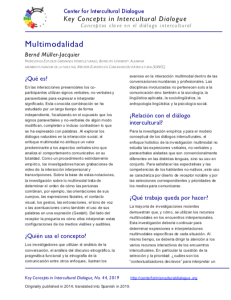
Key Concepts in ICDContinuing with translations of the Key Concepts in Intercultural Dialogue, today I am posting KC#44: Multimodality, which Bernd Müller-Jacquier first published in English in 2014, and which Ruben Mazzei has now translated into Spanish.

As always, all Key Concepts are available as free PDFs; just click on the thumbnail to download. Lists of Key Concepts organized chronologically by publication date and number, alphabetically by concept, and by languages into which they have been translated, are available, as is a page of acknowledgments with the names of all authors, translators, and reviewers.

KC44 Multimodality in SpanishMüller-Jacquier, B. (2019). Multimodalidad (R. Mazzei, Trans). Key Concepts in Intercultural Dialogue, 44. Available from:
https://centerforinterculturaldialogue.org/wp-content/uploads/2019/06/kc44-multimodality_spanish.pdf

If you are interested in translating one of the Key Concepts, please contact me for approval first because dozens are currently in process. As always, if there is a concept you think should be written up as one of the Key Concepts, whether in English or any other language, propose it. If you are new to CID, please provide a brief resume. This opportunity is open to masters students and above, on the assumption that some familiarity with academic conventions generally, and discussion of intercultural dialogue specifically, are useful.

Wendy Leeds-Hurwitz, Director
Center for Intercultural Dialogue


Creative Commons License
This work is licensed under a Creative Commons Attribution-NonCommercial-NoDerivatives 4.0 International License.

Save

Save

Princeton U: Director of Davis International Center (USA)

“Job
Director of the Davis International Center, Princeton University, Princeton, NJ. Posted May 15, 2019, Open until filled.

Reporting to the Vice Provost for International Affairs and Operations, the Director of the Davis International Center (Davis IC) provides leadership and management for a dynamic 14-person department that delivers comprehensive and specialized services that support the growth, development, and welfare of international students, scholars, and visitors at Princeton University.  The Davis IC also supports DACA (Deferred Action for Childhood Arrivals) students.  As of fall 2018, Princeton has 653 international undergraduate students (12% of undergraduates), 1,256 international graduate students (44% of graduate students), and 1,175 international scholars (postdocs, researchers, and faculty members).

Founded in 1974, the Davis IC provides immigration regulatory advising and processing, cultural adjustment, social enrichment, and assistance with practical matters related to living in the U.S.  It also acts as a center for cultural and educational programming that advances cross-cultural understanding, supports interaction between U.S. and international students and scholars, and promotes cultural competency across the University.

The successful candidate will be a committed and experienced leader with expertise in international education; a demonstrated history of successful management in higher education; and a commitment to the holistic development and support of diverse student and scholar populations.

U Madrid Postdoc: Multilingualism, Social Identities, ICC (Spain)

PostdocsMarie Skłodowska-Curie Individual Fellowship: Multilingualism, Social Identities, Intercultural Relations and Communication. Department of General Linguistics, Universidad Autonoma de Madrid, Spain. Deadline: 14 July 2019.

MIRCo (Multilingualism, Social Identities, Intercultural Relations and Communication) is a consolidated international and interdisciplinary research group, based at the Autonomous University of Madrid (Universidad Autónoma de Madrid). Since 2000, MIRCo has been devoted to the study of multilingualism in its linguistic, discursive, social, political, economic and educational aspects, from a critical, interactional and ethnographic perspective. MIRCO seeks to obtain innovative answers, not only in theoretical terms but also regarding methods and applications, for example by addressing innovative strategies such as citizen science. Our goal is for MIRCO to become a space of encounter and connection between basic and applied research networks, at the Autonomous University of Madrid (UAM). The main lines of research are: Multilingualism and multilingual practices in different social áreas; speakers’ linguistic trajectories and models of speakerhood; discourse and power; intercultural communication and intercultural relations; and linguistic landscapes and the transformation of urban spaces through communicative practices.

MIRCo are looking forward to hosting postdocs with strong interest in language and society, and/or in discourse studies. The MIRCo Researh Group will provide a space for scientific exchange in which specialists from different fields coordinate and perform “frontier research.” Interested applicants should send an up-to-date CV and a brief summary of why they would like to join the MIRCO group to the contact person before July 15th, 2019.

NCA Concepts: Microaggressions

Resources in ICD“ width=Orbe, Mark P. (2019). Microaggressions. NCA Concepts in Communication Video Series.

The National Communication Association has begun posting a series of videos explaining various communication concepts to YouTube. Four are posted as of this writing, and one of those overlaps with intercultural dialogue.

CFP Deliberative Quality of Communication

“PublicationCall for papers: Journal of Public Deliberation Special Issue: Citizens, Media and Politics in Challenging Times: Perspectives on the Deliberative Quality of Communication. Deadline: 31 July 2019.

Guest editors: Christiane Grill (Mannheim Centre for European Social Research) and Anne Schäfer (Department of Political Science), both at University of Mannheim, Germany.

The special issue Citizens, Media and Politics in Challenging Times: Perspectives on the Deliberative Quality of Communication addresses a gap in the literature by systematically bringing together different strands of research on the deliberative qualities of citizens’, journalists’, and politicians’ communication. The special issue thus aims at providing an integrative and comprehensive picture on modern political communication in times western democracies are facing a multitude of disruptive challenges. Theoretical, empirical and methodological contributions focusing on the deliberative qualities of citizens’, journalists’, and politicians’ communication are welcome.

China-US Journalists Exchange 2019 (US/China)

Professional OpportunitiesChina-US journalists exchange, East-West Center, Washington, DC. Deadline: June 17, 2019.

The All-China Journalists Association, the Better Hong Kong Foundation and the East-West Center jointly launched the 1st China-United States Journalists Exchange in 2010 to increase and deepen public understanding of the two countries and their relationship. The 2019 China-United States Journalists Exchange is scheduled for August 31 – September 14, 2019. This year marks the 40th anniversary of US-China bilateral relations, 70th anniversary of the founding of the People’s Republic of China, and 10th anniversary of the China-US Journalists Exchange. The 2019 program will focus on the prospects of business and trade between the world’s two largest economies amid continued escalation of trade friction and economic threats after trade talks concluded with no deal. The reporting tour will provide opportunities for journalists to explore these and other current issues in the important bilateral relationship under the leadership of President Donald J. Trump and President Xi Jinping. Participants will get a firsthand look at a wide range of topics impacting US-China relations including social, economic and political challenges in both countries as well as stability and security in the Asia-Pacific region.

The 2019 Exchange will take six Chinese journalists to the United States and six US journalists to China and Hong Kong to meet with government officials, business leaders, academics, journalists, non-governmental organizations and other members of the Chinese and American communities. Following these group study tours, all of the Chinese and American journalists will meet at East-West Center Washington for a one-day dialogue to share their travel experiences and exchange opinions on how media coverage of US-China issues can be improved in the participants’ respective countries.

CFP COMELA 2020 (Greece)

ConferencesCall for papers: Conference on Mediterranean and European Linguistic Anthropology, September 2-5, 2020, The American College in Greece, Athens, Greece. Deadline: November 15, 2019.

Theme: Bounded Languages…Unbounded

Politics of identity are central to language change. Here, linguistic boundaries rise and fall, motivating the ephemeral characteristics of language communities. The Mediterranean and European region is one replete with histories, with power struggles, uniquely demarcating nation, ethnicity, and community…This year’s theme encapsulates the ongoing struggle throughout Mediterranean and European regions. As the continuous tension between demarcation, and the concurrent legitimization, of languages, language ideologies, and language identities, enters an era where new modes of interactivity require language communities to take on roles super-ordinate to the past, flexible citizenship now operates within, and not only across, language communities, to unbind languages, and to create new boundaries, unlike those ever seen throughout history.

The COMELA 2020 invites work which addresses the shifting boundedness of Language Communities of the Mediterranean and Europe. Papers and posters should acknowledge and decribe processes of language shape, change, and ideology, pertinent to social, cultural, political histories, and futures of Mediterranean and European regions, and by those working in Mediterranean and European regions.