U Applied Sciences Munich: Business Communication/Intercultural Competence (Germany)

“JobProfessor of Business Communication and Intercultural Competence, University of Applied Sciences Munich, Germany. Deadline: 21 June 2019.

The Faculty of Business Administration is seeking to appoint a Professor of Business Communication and Intercultural Competence for the Summer semester 2020 or later. The successful candidate should have both professional leadership and teaching experience and be passionate about transferring knowledge in the context of international business and communication.

You will teach subject-specific modules in Business English, Intercultural Communication and Intercultural Management for undergraduate and graduate business study programmes in English. You will contribute to the development of curricula and research in these fields and course management as required. The role further requires actively fostering relationships and exchange with international partner universities and contributing to research projects with industry and business.


Migration Policy Institute Europe: Director (Belgium)

“Job

Director, Migration Policy Institute Europe, Brussels, Belgium. Deadline: 30 June 2019.


The Migration Policy Institute Europe (MPI Europe), established in Brussels in 2011, is a nonprofit, independent research institute that aims to provide a better understanding of migration in Europe and thus promote effective policymaking. MPI Europe provides authoritative research and practical policy design to governmental and nongovernmental stakeholders who seek more effective management of immigration, immigrant integration, and asylum systems in order to promote successful outcomes for newcomers, families of immigrant background, and receiving communities in Europe.

MPI Europe seeks a highly motivated, experienced professional to become the Director of Brussels-based MPI Europe. The new Director will be responsible for providing leadership to MPI Europe at a critical time of growth for the Institute and a pivotal time for migration in Europe and around the globe. He/she will work with a team of recognized experts on migration and integration based in Brussels and coordinate with the staff of its sister organization in Washington, DC (MPI), as needed.

Changing the Story as a Solution to Conflict

Applied ICDIntercultural dialogue is often about finding a way to recognize and reconcile two different sets of assumptions/beliefs. A particularly graceful solution to a conflict of beliefs between locals and tourists is described below. What is uncommon is that a solution was found in acknowledging a lack of action. 

Context: Uluṟu /Ayers Rock used to be frequently climbed by visitors, but as of October 26, 2019 is to be closed to further climbing. Uluṟu is an intensely sacred landscape for the Aṉangu people.

“In regards to the climb itself, the management board did a clever thing. Rather than simply encourage visitors not to climb, they provided a way for them to feel they had contributed something by their decision. At one time, there was a visitors’ book on the summit with the title “I climbed Ayers Rock,” where climbers could record their achievement. So, at the visitors’ centre in the nearby town of Yulara, staff installed another book, with the title “I have not climbed Ayers Rock,” where visitors could make a comment about why they chose not to climb. This inspired piece of social psychology enables visitors to see their decision as an active endorsement, rather than a passive abstention. Signing becomes a record of a different kind of achievement. I glanced through some recent comments, many of which mentioned newfound respect for Aboriginal feelings. One visitor wrote: ‘I climbed it 29 years ago. Came back wiser.'”

Among the author’s conclusions: “social change may be hastened if the narratives stress mutual benefit rather than ‘us’ vs ‘them’ antagonism. The Aṉangu position was that not climbing Uluṟu was good for visitors’ bodies (safety), good for their souls (respect for sacredness), and good for building relationships between blackfellas and whitefellas.”

Warne, Kennedy. (December 10, 2017). No more shoes on Uluṟu. E-Tangata.

Lisle Global Seed Grant Program 2019-20

GrantsGlobal Seed Grant Program, Lisle International. Deadline for request to apply for projects in 2020: July 1, 2019.

Lisle International offers a Global Seed Grant Program to support innovative projects which further the mission and goals of Lisle — improving intercultural understanding by bringing people of diverse backgrounds together to share, work together, and learn from one another.  Grants of $500 to $3,000 are available to innovative projects that match their mission.

These are quite competitive, but seem potentially appropriate for many projects of interest to followers of CID.

CFP The Politics of Researching Multilingually

“PublicationCall for Chapters: The politics of researching multilingually, to be edited by Prue Holmes, Judith Reynolds, Sara Ganassin and published with Multilingual Matters. Deadline: 1 July 2019.

How researchers draw on their linguistic resources when they undertake their research is often impacted by institutional, contextual, and interpersonal politics, and this can be a salient issue for researchers working in multiple languages when they are planning, developing, conducting and/or writing up their research. This is especially the case as researchers undertake their work in conditions of migration as a result of poverty, precarity, conflict, and/or protracted crises—where languages are often overlooked, and their speakers silenced; or in other situations where languages and those who speak them may come into conflict with political regimes, and/or other forms of structural power and agency. Thus, when undertaking their research, researchers must make decisions about which language(s) to use, when, where, and why—decisions that are often politically charged.

These decisions may be influenced by multiple factors: the topic of the research; the contexts that shape the research; the relationships among the researcher and various stakeholders (e.g., supervisors and funders of the research, and gatekeepers such as governmental officials, non-governmental groups/employees and other community groups who determine access to the research site, resources, texts and other artefacts); the languages in play in the research context (whether national, minority, tribal, colonial, travelling languages, and lingua francas); and the languages of dissemination, e.g., for participants and stakeholders in the community, in theses (in the dominant national language only, or multiple languages), and in publications (e.g., in high impact journals which are often published in English). In this sense, the languages researchers employ in the research process, and how and when they draw on their linguistic resources, are as much politically influenced as they are culturally or linguistically.


CFP Sociolinguistics Symposium (Hong Kong)

ConferencesCall for Papers: Sociolinguistics Symposium 23: Unsettling Language, University of Hong Kong, 16-19 June 2020. Deadline: 14 October 2019. NOTE Change in dates!

As a premier gathering of international sociolinguists, this biennial event has emerged as a unique and innovative forum to develop and exchange new ideas, broaden the scope of the discipline, and create new academic networks. From its beginnings as a small meeting of UK-based academics in 1976, Sociolinguistic Symposium has grown into the largest sociolinguistic conference in the world.

Its Hong Kong edition will mark the conference’s first appearance in Asia. The theme of the conference is Unsettling Language. The contemporary world is an unsettled place due to numerous conflict zones, forced migration, economic imbalances and uncertainties, as well as ideological extremism resulting in (or caused by) unsettling language emanating from powerful people, political organizations, and the media. As a form of social action, this sort of language requires serious, critical consideration, assessment and counter-action.

Furthermore, the notion of ‘language’ itself is undergoing a critical reassessment in how it is being theorized. Language is increasingly understood as more than ‘just’ a set of linguistic resources. Its embodied nature, the materiality of its modalities (speech and writing), interaction with other modalities (sound, music, images, etc.), and with time and space, requires integration of broader contexts of analysis, multimodal data sets, and multidisciplinary approaches. We invite abstracts addressing the conference theme as well as other contributions focusing on current and innovative themes and theoretical challenges.

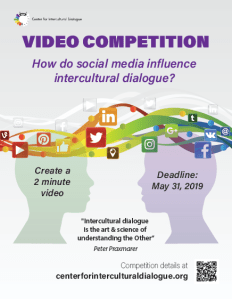
CID Video Competition: Last 5 days!

CID Video CompetitionThe CID video competition remains open, but just 5 days remain to the final deadline of May 31, 2019


CID Video Competition 2019

To enter, students must submit a video no longer than 2 minutes demonstrating their understanding of intercultural dialogue. Specifically, videos must answer the question: “How do social media influence intercultural dialogue?”

In preparing an entry, remember to think about the 2 major topics and their relationship. Winning videos must take both of these into account, not merely describe one or the other.

1) Intercultural dialogue is the term for what happens when people from different cultural backgrounds attempt to understand one other’s assumptions. Culture is a general term that includes all sorts of learned behavioral patterns. Intercultural communication can be international, interracial, interethnic, or interfaith. Intercultural dialogue is deliberate, active rather than passive. It is NOT the same as cultural analysis (understanding one culture), or cross-cultural analysis (comparing two different cultures).

2) Social media refers to any tool using the internet to help people communicate, nearly always when they are not in the same place at the same time. It includes such applications as Facebook, Twitter, Instagram, WeChat, WhatsApp, and Tumblr, among others. You can limit your consideration to any one of these, or consider several. But don’t just describe social media and how they work! The question you must answer is how the social media you choose to address influence intercultural dialogue. That means, what changes when people of different cultural backgrounds try to understand one another when they are not even face-to-face? What gets harder? What becomes easier?

If you have questions, see previously published competition rules, FAQ, and resources. See last year’s winning videos. See the reflection by one winning team on creating their video. Or send an email with a question. When you’re ready to submit an entry, click here.

Wendy Leeds-Hurwitz, Director
Center for Intercultural Dialogue

Lancaster U: Research Associate Cinema Memory & Digital Archive (UK)

“JobResearch Associate post on Cinema Memory and the Digital Archive: 1930s Britain and Beyond, University of Lancaster/Stirling University, UK. Deadline: 5 June 2019.

We are seeking to appoint a Research Associate in Film Studies, Media Studies, English, History or a related discipline in the Humanities and Social Sciences to work on the AHRC-funded project ‘Cinema Memory and the Digital Archive: 1930s Britain and Beyond’ (CMDA). This is a 35-month full-time post.

The project team is Annette Kuhn (QMUL), Richard Rushton (Lancaster University), and Sarah Neely (Stirling University), and the project is based at Lancaster University. Among other things, CMDA will properly organise and store, as well as develop a website for, the ‘Cinema Culture in 1930s Britain’ archive currently stored at Lancaster University Library. The project also involves a number of research and public engagement events relating to archives, cinema memory, and audience research.

U Macau: Instructor in Communication (China)

“JobVisiting Senior Instructor in Communication: Video Production and Public Communication, University of Macau, Macau, China. Deadline: Open until filled, posted May 16, 2019.

The Department of Communication of the Faculty of Social Sciences invites applications for the position of Visiting Senior Instructor, intended to contribute to teaching needs in two specific areas: (1) video production and (2) public communication.

The Department of Communication currently offers broad-based curricula leading to Bachelor’s, Master’s and Doctoral degrees. They cover various areas of communication studies (communication theory, intercultural communication, organizational communication, communication skills); vocationally-oriented public communication (public relations, advertising, event planning); media studies and journalism (journalism writing and publication, mass media, new media, digital culture); cultural studies (cultural and critical theory, cinema, popular culture); and communication and creative cultural industries (video production, film making, animation, photography, design). The Department of Communication has a diverse student body drawn from Macao, Mainland China, and other parts of the world.

Open U: English Language/Applied Linguistics (UK)

“JobStaff Tutor, English Language and Applied Linguistics, School of Languages and Applied Linguistics, The Open University, UK and home based. Deadline: 14 June 2019.

This is an exciting opportunity to join a vibrant, multilingual and multicultural School which offers part-time distance study in Languages and Applied Linguistics to students from across the UK and beyond. Subject areas currently include modern languages (Chinese, French, German, Italian and Spanish), English language studies, English for academic purposes, applied linguistics and translation studies.

Staff Tutors play an important role in the maintenance and development of teaching material and are vital to manage the successful delivery of all teaching in the School. As a Staff Tutor specialising in English Language and Applied Linguistics you will lead and manage a team of highly qualified part-time Associate Lecturers (ALs) tutoring students enrolled on a range of modules. As their academic manager, you will select, train, develop and supervise ALs. You will report to the School’s Associate Head (Student Experience). You will work at a distance with the Faculty’s Student Support Team in Nottingham and contribute to ensure the smooth running of tuition.