Balzan Junior Fellowships in Global History (Germany)

FellowshipsCall for applications: Junior Fellowships in Global History, Freiburg Institute for Advanced Studies, University of Freiburg, Germany, and International Balzan Prize Foundation. Deadline: March 31, 2020.

Available: up to four six-month fellowships. The fellowships are funded from the Balzan Prize for Global History awarded to Professor Jürgen Osterhammel by the Fondazione Internationale Premio Balzan. They are addressed to scholars preparing a post-doctoral research monograph (‘second book’) on a global history topic, preferably focused on the nineteenth and twentieth centuries. ‘Global history’ is to be understood in a broad sense including the study of cross-cultural connectivity, comparative approaches and the history of global thought and imaginaries. An additional interest in the theory and methodology of global (and/or transnational) history is welcome and should be specified in the application.

Fellows will join the multidisciplinary – and mainly English-speaking – community at FRIAS and will have full access to the facilities and activities of the Institute as well as to the rich academic life at Freiburg University. They have no formal obligations apart from presenting their work to the FRIAS Humanities and Social Sciences Colloquium and joining Jürgen Osterhammel and the co-director of the Balzan-FRIAS Project in Global History, Professor Stefanie Gänger (Heidelberg), in occasional workshops and informal discussions on conceptual issues of global history. Full-time presence at FRIAS is expected as the main purpose of the fellowship is to provide time for undisturbed work on a book project.
KC35 Media Ecology Translated into Korean

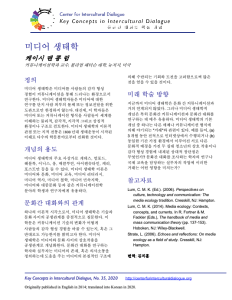
Key Concepts in ICDContinuing translations of Key Concepts in Intercultural Dialogue, today I am posting KC#35: Media Ecology, which Casey Man Kong Lum wrote for publication in English in 2014, and which Chi-Hoon Kim has now translated into Korean. This is the first translation into Korean for this series!

As always, all Key Concepts are available as free PDFs; just click on the thumbnail to download. Lists of Key Concepts organized alphabetically by conceptchronologically by publication date and number, and by languages into which they have been translated, are available, as is a page of acknowledgments with the names of all authors, translators, and reviewers.

KC35 Media Ecology_Korean

Lum, C. M. K. (2020). Media ecology [Korean]. (C.-H. Kim, trans). Key Concepts in Intercultural Dialogue, 35. Available from:
https://centerforinterculturaldialogue.org/wp-content/uploads/2020/01/kc35-media-ecology_korean.pdf

If you are interested in translating one of the Key Concepts, please contact me for approval first because dozens are currently in process. As always, if there is a concept you think should be written up as one of the Key Concepts, whether in English or any other language, propose it. If you are new to CID, please provide a brief resume. This opportunity is open to masters students and above, on the assumption that some familiarity with academic conventions generally, and discussion of intercultural dialogue specifically, are useful.

Wendy Leeds-Hurwitz, Director
Center for Intercultural Dialogue


Creative Commons License
This work is licensed under a Creative Commons Attribution-NonCommercial-NoDerivatives 4.0 International License.

St Lawrence U: International/Intercultural Studies (USA)

“JobInternational & Intercultural Studies – Assistant Director of Off-Campus Programs, St. Lawrence University, Canton, NY. Deadline: Open until filled; posted February 10, 2020.

Reporting to the Associate Dean of International and Intercultural Studies, the Assistant Director will work closely with the staff of the Center for International and Intercultural Studies to advise students and the wider campus community about off-campus study and intercultural education. S/he will be the primary manager of the St. Lawrence international studies website and assist with the Terra Dotta/Studio Abroad online application management system. S/he will work to expand the use of blogs, video, social media, and teleconferencing, to promote diversity education and enhance students’ learning experience before, during, and after study abroad.

French Culture and French Intercultural Communication (Denmark)

“JobProfessor of French Culture and French Intercultural Communication, Department of German and Romance Languages, University of Aarhus, Denmark. Deadline: 2 March 2020.

The School of Communication and Culture invites applications for the position of full professor of French culture and French intercultural communication based at the French section within the Department of German and Romance Languages. The department is looking for a dedicated applicant who has contributed substantially to research and teaching in the area of French culture and intercultural communication (including Danish-French), with a focus on culture and literature or on linguistics and communication. Applicants must also be qualified to teach core courses at BA and MA level within the above-mentioned areas.

Imagining Peace by Pádraig Ó Tuama

Applied ICDImagining Peace by Pádraig Ó Tuama.
A TEDx Talk presented on October 18, 2016.

What we need are stories that open up the possibility of relationships where there currently are none.

Pádraig Ó Tuama is a poet and a theologian. In 2011, with Paul Doran, Pádraig co-founded the storytelling event Tenx9 where nine people have up to ten minutes each to tell a true story from their lives. From 2014-2019, Pádraig led the Corrymeela Community, Ireland’s oldest peace and reconciliation organisation. Pádraig brings interest in religion, conflict and language to his work. Originally from Cork, he had a nomadic decade (Australia, Lithuania, Switzerland, the Philippines, Uganda) before settling in Belfast in 2003.

CFP Intercultural Tensions in Organizations

“PublicationCall for proposals: Special issue on Intercultural tensions in organizations in the French journal Communication & Organisation. Abstracts due: 1 March 2020.

Issue editors: Alexander Frame and Mélodine Sommier.

Although a large body of research on intercultural communication has adopted “liquid” approaches to the concept of culture, open to its plurality and endeavoring to go past national scales, these views seem to remain scarcely represented among francophone work conducted within the field of information and communication sciences and focusing on organizations. Volume 58 of the French journal Communication & Organisation will explore this dimension and invites contributions using a critical framework to interculturality with the aim of shedding light on the following issues, from theoretical, empirical and/or methodological viewpoints (the following list is not exhaustive):

-Cultural framing of organizational power struggles
-Cultural and identity dimensions of change management in organizations
-Intersectional approach (Crenshaw 1991) to organizations
-Dealing with cultural diversity and identities in organizations
-Scales to examine culture (Desjeux 2002)
-Critical intercultural methodology in organizational communication

Please note that articles must be written in French.

Language Diversity, Education & Social Participation (Germany)

Study AbroadSummer Course: Language Diversity, Education and Social Participation, Hamburg International Summer School, University of Hamburg, Germany, July 6-31 July 2020. Deadline: Rolling admission.

Earn up to 10 credits (ECTS). Language of instruction: English. Linguistic (as well as cultural and social) diversity are basic characteristics of today’s societies. Their causes include, among others, increasing migration, globalisation, new technical possibilities of communication, and interactions across traditional borders. Using three nations with significant migration – Australia, China and Germany – as examples, the course will explore how increasing diversity affects education and social participation, and what policies and discourses have been developed in response to linguistic diversity. Despite their different socio-political traditions in dealing with migration, the challenges and responses to linguistic diversity in the three countries share many similarities. Central among these is that linguistic diversity continues to be a central factor in social exclusion in the three countries. All Summer School programs include our supplementary program, focusing on German culture and history, taught through field trips and excursions.

Four core topics:

  • Key Issues in Multilingualism
  •  Language Development in Multilingual Settings
  • Language Diversity in Formal and Informal Settings
  • Multilingual Learning Motivation in a Foreign Language Context

CFP Ethnic and Religious Conflict Resolution & Peacebuilding (USA)

ConferencesCall for papers: 7th Annual International Conference on Ethnic and Religious Conflict Resolution and Peacebuilding, September 29-October 1, 2020, Mercy College, New York. NOTE: Event canceled as of July; there will be another event in 2021.

The theme of the 7th Annual International Conference on Ethnic and Religious Conflict Resolution and Peacebuilding is Ethnic, Racial and Religious Conflicts Globally: Analysis, Research and Resolution. To increase understanding of ethnic, racial and religious conflicts in different countries around the world, the conference will consider submissions from multidisciplinary fields of study and practice. Qualitative, quantitative or mixed methods research studies from university scholars and researchers are accepted. Case studies, lessons learned, success stories, policy analysis or design, and best practices from policy makers, practitioners, and indigenous peoples are also accepted. Successful abstracts or full papers shall not only bridge theory, method and practice, but must include findings and recommendations designed to further understanding and inform practical application.

Chi-Hoon Kim Profile

Profiles

Chi-Hoon Kim holds a PhD in Anthropology (Indiana University) and an MA in Anthropology of Food (School of Oriental and African Studies).

Chi-Hoon Kim

Her research examines the global rise of gastro-national branding as a nation-building strategy to understand why nation-states use food to enhance their international reputation. She investigates the political process of promoting culinary practices through international heritage regimes and global media. Chi-Hoon has published on topics such as the inflight experience of national cuisines, the use of plastic food models as gastro-national tools, and the politics of kimchi as intangible cultural heritage.

Publications:

Kim, C.-H. (2017). Let them eat Royal Court Cuisine! Heritage politics of defining global hansik. Gastronomica: The Journal of Critical Food Studies, 17 (3), 4-14.

Kim, C.-H. (2016). Kimchi nation: Constructing kimjang as an intangible Korean heritage. In C. M. K. Lum & M. de Ferrière le Vayer (Eds.), Urban foodways and communication: Ethnographic studies in intangible cultural food heritage around the world (pp. 39-54). London, UK: Roman and Littlefield.

August, T., & Kim, C.-H. (2016). The turn to ‘bad Koreans’: Transforming televisual ethnicity. Television & New Media, 17 (4), 335-349.

Kim, C.-H. (2014). The power of fake food: Plastic food models as tastemakers in South Korea. M?C Journal: A Journal of Media and Culture, 17(1).

Kim, C.-H. (2014). Tasting the nation in the air: Branding the Korean nation through airline meals. In R. Bendix & M. Fenske (Eds.), Political meals (pp. 207-217). Berlin, Germany: LIT Verlag Publications.


Work for CID:
Chi-Hoon Kim translated KC35: Media Ecology into Korean.