CIVIS: A European Civic University

Applied ICDCIVIS: A European Civic University is a network of 8 universities designed to create links across and beyond Europe. CIVIS is oriented towards the Mediterranean and Africa.

Universities included: Aix Marseille Université (France), National and Kapodistrian University of Athens (Greece),University of Bucharest (Romania), Université Libre de Bruxelles (Belgium), Universidad Autonoma de Madrid (Spain), Sapienza Università di Roma (Italia), Stockholms Universitet (Sweden), Eberhard Karls Universität Tübingen (Germany). This alliance was created under the Erasmus+ call of the European Commission, bringing together 384,000 students and 55,000 faculty and staff.

The Mediterranean zone and Africa will be at the heart of their global strategy. Founders firmly believe that the future of Europe and that of Africa are intertwined. This is why CIVIS will affirm its vocation as a bridge between Europe, the Mediterranean and Africa, as part of a long-term commitment.

KC15 Cultural Pluralism Translated into Portuguese

Key Concepts in ICDContinuing translations of Key Concepts in Intercultural Dialogue, today I am posting KC#15: Cultural Pluralism, which which Robyn Penman wrote in English for publication in 2014, and  which Filipa Subtil has now translated into Portuguese.

As always, all Key Concepts are available as free PDFs; just click on the thumbnail to download. Lists of Key Concepts organized alphabetically by conceptchronologically by publication date and number, and by languages into which they have been translated, are available, as is a page of acknowledgments with the names of all authors, translators, and reviewers.


KC15 Cultural Pluralism_PortuguesePenman, R. (2020). Pluralismo cultural. (F. Subtil, trans). Key Concepts in Intercultural Dialogue, 15. Available from:
https://centerforinterculturaldialogue.org/wp-content/uploads/2021/05/kc15-cultural-pluralism_portuguese-v2.pdf

If you are interested in translating one of the Key Concepts, please contact me for approval first because dozens are currently in process. As always, if there is a concept you think should be written up as one of the Key Concepts, whether in English or any other language, propose it. If you are new to CID, please provide a brief resume. This opportunity is open to masters students and above, on the assumption that some familiarity with academic conventions generally, and discussion of intercultural dialogue specifically, are useful.

Wendy Leeds-Hurwitz, Director
Center for Intercultural Dialogue


Creative Commons License
This work is licensed under a Creative Commons Attribution-NonCommercial-NoDerivatives 4.0 International License.

Emergent Ventures: Grants and Fellowships (USA)

GrantsEmergent Ventures funding for COVID-19 and general projects, Mercatus Center, George Mason University, Arlington, VA. Deadline: Ongoing (posted April 20,2020).

Emergent Ventures wants to jumpstart high-reward ideas – ‘Moonshots’ in many cases – that advance prosperity, opportunity, liberty, and well-being. They welcome the unusual and the unorthodox. Their goal is positive social change, but they do not mind if you make a profit from your project. (Indeed, a quick path to revenue self-sufficiency is a feature not a bug!)

Projects will either be fellowships or grants: fellowships involve time in residence at the Mercatus Center in Northern Virginia; grants are one-time or slightly staggered payments to support a project. Applicants are encouraged to think big, but very small grants or short fellowships will also be considered if they might change the trajectory of the applicant’s life. Applications from all ages and all parts of the world are encouraged.

NOTE: This support is not intended for scientific or biomedical research, although Emergent Ventures is also distributing funding for that. These grants/fellowships are for social projects which may be about the response to COVID-19, or may be about other social issues.

MOOC: Memory Sites and Human Rights (Italy)

“MOOCs”MOOC: Memory Sites and Human Rights, offered by Global Campus on Human Rights, Venice, Italy, April 27-June 21, 2020. Free enrollment until May 31, 2020.

Why and how do we remember past atrocities and human rights violations? What is the role of memory sites in social reconstruction, transitional justice and democratisation? How do memory sites shape communities, societies, identities and nations? As witnesses and testimonies of abuse and horror, memory sites aspire to build reflection, teaching and learning, critical memory and non-repetition. Memory is dynamic and constantly evolving, so memory sites function as places where to look at the past to better understand and shape the present and the future of a society and its approach to human rights. As “sites of conscience” drawing on history lessons, memory sites stimulate dialogue and healing, and inspire citizens’ action. This MOOC focuses on the role of memory sites in their crucial interplay with historical trauma, the reconciliation process, the chosen methods for dealing with the past, as well as with nation building dynamics and the shaping of societal identity.

Global Migration Film Festival

EventsGlobal Migration Film Festival, International Organization for Migration, Geneva, Switzerland. Submission Deadline: June 21, 2020. Event date: November 28-December 18, 2020.

The Global Migration Film Festival has an itinerant and unique format. The films that make up the Official Selection are included in a list which is then shared with about 100 IOM offices and partners worldwide. Each participating country office will then select the films to be screened locally during the Festival, which runs from 28 November – 18 December 2020, worldwide.

Filmmakers will receive a final list of countries where their films will be screened by mid-November. Films can be screened in impromptu scenarios, from traditional cinemas and universities worldwide, to open-air theatres in the desert in Niger and detention centers in Libya. All screenings are entrance free. This means that IOM needs the authorization from the films’ rightsholder(s) to host screenings without territory and frequency limitations for the duration of the Festival.

CFP Beyond Multilingualism – Translanguaging in Education (Switzerland)

ConferencesCall for Papers: Beyond Multilingualism – Translanguaging in Education, 2-3 November 2020, University of Basel, Switzerland. Deadline extended to 15 May 2020.

The Institute for Educational Sciences of the University of Basel and the Schaffhausen University of Teacher Education invite proposals for the two-day international conference on “Beyond Multilingualism –Translanguaging in Education” at the University of Basel, Switzerland, 2—3 November 2020. This conference takes a transdisciplinary approach to translanguaging in education. It examines how translanguaging is perceived, its impact and its implications, especially in the classroom. We are particularly interested in the relationship between everyday linguistic practices and language policies in education. To what extent are multilingualism and translanguaging taken into account as institutional issues in educational public spaces? What are the linguistic practices of various stakeholders in their diverse educational institutions?

CFP CMM Institute Fellows (USA)

Fellowships

Revised Call for Proposals: 2020 Fellows’ Program. Theme: “Going beyond polarized narratives,” CMM Institute. Deadline extended: 15 May 2020.

CMM Institute is seeking innovative proposals for projects that  show or create the potential for making better social worlds by going beyond the polarized narratives that have served to divide, rather than unite, communities and that have resulted in fragmented or disenfranchised segments of the population. Proposals can focus on adults or children and be concerned with present and/or future generations.

Every year CMM Institute selects fellows according to the following criteria:
* a scholar and/or practitioner
* who demonstrates an appreciative understanding of what it means to take and apply a “communication perspective” and
* finds creative and impactful ways of using a “communication perspective” to address real-world challenges.

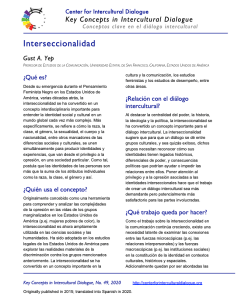
KC97 Anti-Racist Education Translated into Portuguese

Key Concepts in ICDContinuing translations of Key Concepts in Intercultural Dialogue, today I am posting KC#97: Anti-Racist Education, which Jessika Rezende Souza da Silva wrote for publication in English earlier this year, and which she has now translated into Portuguese.

As always, all Key Concepts are available as free PDFs; just click on the thumbnail to download. Lists of Key Concepts organized alphabetically by conceptchronologically by publication date and number, and by languages into which they have been translated, are available, as is a page of acknowledgments with the names of all authors, translators, and reviewers.


KC97 Anti-Racist Education_PortugueseSouza da Silva, J. R. (2020). Educação antirracista. Key Concepts in Intercultural Dialogue, 97. Available from: https://centerforinterculturaldialogue.org/wp-content/uploads/2021/05/kc-97-anti-racist-education_portuguese-v2.pdf

If you are interested in translating one of the Key Concepts, please contact me for approval first because dozens are currently in process. As always, if there is a concept you think should be written up as one of the Key Concepts, whether in English or any other language, propose it. If you are new to CID, please provide a brief resume. This opportunity is open to masters students and above, on the assumption that some familiarity with academic conventions generally, and discussion of intercultural dialogue specifically, are useful.

Wendy Leeds-Hurwitz, Director
Center for Intercultural Dialogue


Creative Commons License
This work is licensed under a Creative Commons Attribution-NonCommercial-NoDerivatives 4.0 International License.

Webinar: Impact of COVID-19 on International Assignees

EventsImpact of COVID-19 on International Assignees Webinar, Tri-State SIETAR. April 23, 2020.

Tri-State (NY-NJ-CT) SIETAR (Society for Education, Training and Research) have opened up their webinar on the impact of Covid-19 on international assignees’ mental health and approaches to overcome the challenges. International assignees tend to be highly resilient, having coped with the stresses of relocation and cultural adaptation. The stresses of Covid-19 can exacerbate unique expat circumstances, creating challenges that may be more than they bargained for.

In this webinar, Mercedes Naficy D’Angelo and Rensia Melles will discuss the impact of adverse events or crises on the mental health aspects of cultural adaptation and culture shock. They will offer tips and coping techniques to support assignees with these uncertain times away from home.

MPI Europe: Internships (Belgium)

“JobPaid internships, Migration Policy Institute Europe, Brussels, Belgium. Deadline: 26 April 2020.

The Migration Policy Institute Europe (MPIE) is seeking candidates for a full-time internship in Brussels for Autumn -Winter 2020, which offers a unique opportunity to gain in-depth knowledge and practical experience working with a broad network of experts in a wide range of policy areas, including EU immigration and asylum systems, labor migration, and immigrant integration. The internship also offers individuals the opportunity to collaborate directly with policy analysts and senior management, and potentially author research. The successful candidates will also be involved in the organization of external MPIE events, with benefits for his/her network.

The intern will provide support to the MPI Europe team, including senior management. Applicants must have at least a relevant bachelor or master’s degree and possess excellent oral and written communication skills.