EIUC Training for International Electoral Observers (Italy)

The Inter-University Centre for Human Rights and Democratisation (EIUC) is running a two modules Training Seminar for International Electoral Observers from 18-23 April 2016.

Target: The two modules are devoted to those applicants with no experience in election observation or to those observers who have participated to a maximum of two missions as short term observers. EIUC will accept candidatures for each separate module or both combined.

Eligibility: Lectures are conceived for an audience of graduates mainly in Law, Political Sciences, Economics, Sociology, Philosophy, Anthropology or similar who want to address international election observation from a multi-disciplinary approach that will be useful in further engagements on the field.

Faculty: it is composed by well-known international trainers and professionals with a long standing practical experience in election observation missions within international organisations such as the European Union and the Organisation for Security and Cooperation in Europe.

Methodology: the course will combine frontal lecturers in plenary, working groups as well as role plays, discussions and simulation exercises.
Training language: all courses will be held in English. It is, therefore, essential that all participants understand and speak English fluently.

Module I
Dates: 18-20 April 2016
Starting with a thorough introduction on the international observation theory and legal standards the first module will analyse the practical life of a short term observer from the selection procedure to the end of mission including the observation of the polls, the filling of the forms, the reporting system and the code of the conduct.

Module II
Dates: 21-23 April 2016
The second module will introduce the participants to the long-term election observation by analysing in depth some of the aspects related to an international observation mission such as working relations, interviewing techniques, media and security.
Deadline for enrolment: 1 April 2016 – Early bird 4 March 2016

For any general query about IEO training seminar you can drop an email or use the contact form
Location: Monastery of San Nicolò, Venice Lido (Italy)
Training Responsible: Demetrio Lazagna
Project Manager: Alberta Rocca

Dialogue about Border Crossers

Guest Posts

Guest post by Trudy Milburn: Dialogue about Border Crossers.

On November 20th, 2015, on behalf of the Center for International Dialogue, I attended a unique event at the Scandinavia House in Manhattan. The event was entitled “What border have you crossed?” and provided an introduction to a new exhibition opening at the Queens Museum the following day. The speakers were two of the main organizers of the exhibition and of the organization, Bordrs: Chrissie Faniadis and Marcus Haraldsson, both from Sweden.

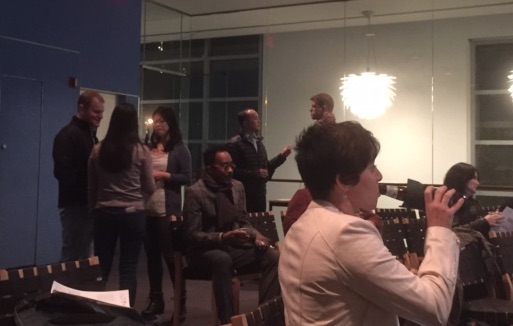
Bordr Pre-event Audience

Chrissie opened the session by recounting the way their five-person group (including a third member from Sweden, another from Seattle, US and one from Delhi, India) formed a new nonprofit organization year ago at a small, red house with white borders in the south-east of Sweden. They were interested in productive ways to contribute to the growing international dialogue about migrants and borders. In many news accounts, the problem is often one of numbers, such as the millions fleeing from Syria, or hundreds of thousands of refugees entering or trying to enter various countries. Chrissie said that their group’s goal was to “put a face back on the faceless.

After about 15 minutes, Marcus came up and began to involve the approximately 100-member audience, by asking, “Has anyone every crossed a border?” and then followed up with, “has anyone not crossed a border.” Perhaps because this was New York City on a Friday night, the responses were a bit intellectual (suggesting borders were metaphors) and some, a little cheeky (one woman saw no borders in life). Marcus then explained that throughout his journalism career and recent research, that he’s come to view borders as “the atomic particle of all human stories.” Subsequently, their group defines borders quite broadly, comprised of three legs: geographic (space), mental (emotion) and time-bound.

Bordr Projection

The Queens Museum exhibition is based on five different projects throughout the world. Some people were initially lent video cameras in order to tell their own stories, unmediated by a journalist interpretation. With additional digital recordings captured on smart phones and extensive interviews with each participant, they were able to create individual maps illustrating the important border events for each person.

Marcus drew to a close by emphasizing that their goal is to help people realize the connections and commonalities, rather than differences, among all of us who cross very different borders throughout our lives. [One audience member likened this interpretation of borders as to our ability to transcend “inhibitions;” others might call these life-transitions]. The group from Bordrs’ believes that feelings and thoughts are very important to this project and both can lead to much more empathy and understanding than seems to be present today.

Despite criticisms from a couple of audience members during the Q&A, that this is a very serious issue that should not be taken lightly, my interpretation is that the organizers of Bordr are interested in moving beyond the common discourse of blame that includes oppressor and victim dichotomies that are difficult to transcend. Perhaps by focusing on personal border stories, we may feel more compassionate than helpless; we may recognize that even if today we are not crossing a border, we all cross borders at some point in time.

Even if you cannot make it to Queens, NY during their exhibition, then you can still participate by using their new app, which will enable each of us to interact with others by considering smaller, everyday borders in each person’s life. We’re all border crossers, and you can see evidence of this by going to Queens Museum or Bordrs.

Download the entire post as a PDF.

Mediating Violent Conflict Workshop (Washington, DC)

Mediating violent conflict
A Course for Practitioners and Policymakers
United States Institute of Peace

Participants will:
• Build competence and confidence for practicing mediation
• Understand the role of international mediation in the larger peacebuilding context
• Learn skills to facilitate the practice and promotion of third-party engagement in peacemaking in interstate and intrastate conflict

Dates: December 7 – 11, 2015
Price: $550
Instructor: Pamela Aall

EIUC Training for International Electoral Observers (Italy)

Training for International Electoral Observers
23-28 November 2015, Venice
With the Patronage of: Italian, Czech and Spanish Ministry of Foreign Affairs

Early bird enrolment until 30 September 2015
More Info

We are happy to announce that EIUC training seminar for International Electoral Observers is now ready to accept candidatures.

EIUC has developed two three-day modules aiming at providing training to civilian staff in election observation missions at the first steps of their career (i.e. short term observers). Selected applicants will be allowed to become aware of the role, the tasks and the status of international observers, and will be given a theoretical and practical training on election observation and election observation missions functioning.

The first module (23-25 November 2015) will highlight the quantitative observation of the STOs. Starting with a thorough introduction on the international observation theory and legal standards the first module will analyse the practical life of a short term observer from the selection procedure to the end of mission including the observation of the polls, the filling of the forms, the reporting system and the code of the conduct.

The second module (26-28 November 2015) will introduce the participants to the long-term election observation by analysing in depth some of the aspects related to an international observation mission such as working relations, team-building, interviewing techniques and coordination of the STOs.

EIUC will accept candidatures for each separate module or both combined. Applicants will therefore have a possibility to choose the module which is more closely related to their interests and experience or combine the two of them for a more complete understanding of the topic.

The faculty is composed by well-known international trainers and professionals with a long standing practical experience in election observation missions within international organisations such as the European Union and the Organisation for Security and Cooperation in Europe.

Lectures are conceived for an audience of graduates mainly in Law, Political Sciences, Economics, Sociology, Philosophy, Anthropology or similar, and will be held in English. It is, therefore, essential that all participants understand and speak English fluently.

The seminar will take place at the Monastery of San Nicolò, at the Lido of Venice.

The deadline for sending applications is 30 October 2015 through the online application form.

For further enquiries please contact EIUC.

Intercultural Harmony Grants from Laura Jane Musser Fund

Through the Intercultural Harmony Initiative, the Laura Jane Musser Fund provides grants to projects that promote mutual understanding and cooperation between groups and citizens of different cultural backgrounds. The geographic area for this initiative is the following states: Colorado, Hawaii, Michigan, Minnesota, and Wyoming.  Online applications will be accepted at www.musserfund.org from September 16 through October 16, 2015.

PRIORITY IS PLACED ON PROJECTS THAT:
Include members of various cultural communities working together on projects with common goals
*Build positive relationships across cultural lines
*Engender intercultural harmony, tolerance, understanding, and respect
*Enhance intercultural communication, rather than cultural isolation, while at the same time celebrating and honoring the unique qualities of each culture

PROJECTS MUST DEMONSTRATE:
*Need in the community for the intercultural exchange project
*Grassroots endorsement by participants across cultural lines, as well as their active participation in planning and implementation of the project
*The ability of the organization to address the challenges of working across the cultural barriers identified by the project
*Tangible benefits in the larger community

LIMITS OF GEOGRAPHY:
Only programs in Colorado, Hawaii, Michigan, Minnesota, Ohio and Wyoming may apply.

PROJECTS ELIGIBLE FOR SUPPORT:
Intercultural Harmony projects can be carried out in a number of areas, including (but not limited to):
*The arts
*Community service
*Youth activities

OUTCOMES SHOULD INCLUDE:
*A demonstration of intercultural exchange between cultures
*Increased comfort in interaction between the groups and individual citizens addressed by the project
*Harmonious shared use of public space and community facilities
*Continued cooperation by the participants or communities addressed by the project

WHAT THE PROGRAM WILL COVER:
*New programs or projects within their first three years (up to $18,000)
*The planning and implementation phase of a project (up to $18,000)

WHAT WILL NOT BE FUNDED:
*Capital Expenses
*General Operating Expenses
*Ongoing Program Support

WHO CAN APPLY:
*Nonprofit 501(c)(3) organizations
*Organizations that are forming if they have a documented fiscal sponsor relationship
*Organizations located within one of the eligible states listed above

Visual Documentary Project: Human Flows, Movement in Southeast Asia

Visual Documentary Project 2015:
Human Flows – Movement in Southeast Asia

Movement is a fundamental reality of human societies. In Southeast Asia how does it influence individuals, families, communities and nations? What journeys do people take as they move within, across and out of the region? What are their reasons to move and what stories do they have to tell? What experiences define movement in the region? And how will the region’s governments manage flows on the eve of the birth of ASEAN Economic Community?

The Center for Southeast Asian Studies (CSEAS) is accepting short documentaries from young filmmakers who are citizens of Southeast Asian nations and Japan to reflect on Human Flows in Southeast Asia. Submissions of up to 30 minutes can be on any topic that touches upon Southeast Asian’s experiences of human movement in the region. Themes can include economic migration, movement between countries in the region, pilgrimages, migration due to political crisis or environmental degradation, cultural influences and borderless journeys/ wanderings.

About the Project
Southeast Asia is rich in its diversity of ethnic, religious and cultural composition. The region has maintained the coexistence of such diversity while at the same time achieving economic progress and becoming a hub for the flow of people, goods, money and information. Yet at present, the region is also confronted with serious issues such as the decrease of biodiversity and tropical forests, disasters, pandemics, aging population, ethnic and religious conflicts, economic differentiation and poverty.

In the face of this, how is coexistence and sustainability possible despite the diversity that exists? How can we make public resources out of the region’ s social foundations which are the basis of people’ s everyday lives? And, how can we connect these in a complementary way to existing systems of governance towards solving the problems and issues mentioned above?

In order to address these questions in the context of Southeast Asia, the Center for Southeast Asian Studies, Kyoto University has initiated this “Visual Documentary project” which explicitly examines the contours of their everyday lives through a visual approach since 2012. This project aims to use visual forms of expression to complement the growing literature that exists on Southeast Asian societies. From 2014, the Japan Foundation Asia Center joins this project as co-organizer to help widely promote the richness of Southeast Asian cultures to people in Japan. As of 2015, the project has linked up with numerous film schools in the region to help strengthen the documentary filmmaking network.

Organized by Center for Southeast Asia Studies, Kyoto University and The Japan Foundation Asia Center
In cooperation with Yangon Film School, Documentary Arts Asia, WATHANN FILM FESTIVAL, In-Docs, Bophana Audiovisual Resource Center

Save

Skype Translator – Comments anyone?

Skype Translator is now available for 50 languages using IM and 4 languages (English, Spanish, Italian and Mandarin) using only voice. It can be used by anyone who has already downloaded Skype software. “Skype Translator automatically translates your voice and video calls with real-time translation.” This is getting a lot of attention on the internet, including Gizmodo, The Verge, and Engadget. (I noticed it through a tweet from Sean Rintel – thanks for keeping me up to date, Sean!)

I’d be curious to read comments (just post below) from anyone who has tried it and has an opinion on how well it works.

Wendy Leeds-Hurwitz, Director
Center for Intercultural Dialogue

Iván Fernández Anaya as an Example of Applied Intercultural Dialogue

http://www.ivan-fernandez.com/

An interaction between Spanish and Kenyan athletes in December 2012 made a major splash in the news a month later (reaching the English language press only after it was widely reported in the Spanish language press). The story is still circulating on social media today. While not typically presented as an example of intercultural dialogue, it is an interesting model for what can happen when members of different cultural groups meet. The story is included here for those who have not yet heard about it. For those who have, it would be interesting to hear similar examples from other contexts – feel free to either reply with a comment, or send an email suggesting a related story to post.

“. . .on December 2 [2012], Spanish athlete Iván Fernández Anaya was competing in a cross-country race in Burlada, Navarre. He was running second, some distance behind race leader Abel Mutai – bronze medalist in the 3,000-meter steeplechase at the London Olympics. As they entered the finishing straight, he saw the Kenyan runner – the certain winner of the race – mistakenly pull up about 10 meters before the finish, thinking he had already crossed the line. Fernández Anaya quickly caught up with him, but instead of exploiting Mutai’s mistake to speed past and claim an unlikely victory, he stayed behind and, using gestures, guided the Kenyan to the line and let him cross first.”
    Source: Arribas, Carlos. (19 December 2012). Honesty of the long-distance runner. [Madrid].

“In the weeks that followed, Fernandez saw his story gain momentum outside the Spanish media. He gained thousands of Facebook friends and Twitter followers, and once again saw an opportunity to do something kind. The athlete put the green shirt and red shorts he wore for the race up for auction on eBay with the intention of donating all proceeds to the Red Cross, an organization he described as “one of the hardest working worldwide.”
His website lauded the organization’s dedication to promoting peace and international cooperation, as well as mutual respect and understanding among all the world’s people. . . The winning bid was €560.”
    Source: Internet swoons for Spanish runner who helped competitor win. (January 2013). CBC News [Canada].

Additional coverage:
Huffington Post
USA Today
Vancouver Sun

Mediating Violent Conflict Course

Mediating Violent Conflict
May 11-15, 2015

Participants will:
*Understand the role of international mediation in the larger peacebuilding context
*Build competence and confidence for practicing mediation
*Learn skills to facilitate the practice and promotion of third-party engagement in peacemaking in interstate and intrastate conflicts

About the Course: Working in a conflict situation often demands mediation skills, whether you are working at a grassroots level or in state capitals. Mediation is both an art and science, and requires skilled analysis, careful planning, and effective communication. Designed for practitioners working in or on conflict zones, this course will improve participants’ ability to understand the motivations and objectives of the various parties, promote ripeness, develop effective relationships, increase leverage, and strengthen mediation capacity. Participants will practice their skills through simulations, role-play, and case studies.

Instructor: Pamela Aall, Senior Advisor, USIP
Guest speakers: Chester Crocker, William Taylor, George Lopez, Alison Milofsky and Anthony Wanis–St. John.

Working in a conflict situation often demands mediation skills, whether you are working at a grassroots level or in state capitals. Mediation is both an art and science, and requires skilled analysis, careful planning, and effective communication. Designed for practitioners working in or on conflict zones, this course will improve participants’ ability to understand the motivations and objectives of the various parties, promote ripeness, develop effective relationships, increase leverage, and strengthen mediation capacity. Participants will practice their skills through simulations, role-play, and case studies.

To Apply: Please email your resume/CV and a short statement explaining your interest in the course, to the Academy registrar.

Location:
U.S. Institute of Peace
2301 Constitution Ave., NW
Washington, DC 20037

UNESCO Links Cultural Diversity to Human Rights

© UNESCO

On 31 March, 2015, UNESCO Director-General Irina Bokova took part in a round table on the theme “Human Rights and the Protection of Cultural Diversity,” held at the University of Geneva, with the participation of the United Nations High Commissioner for Human Rights, Zeid Ra’ad Al Hussein, UNESCO Special Envoy for Intercultural Dialogue, Metin Arditi and author, psychoanalyst and university professor, Julia Kristeva.

Bokova emphasized that “cultural diversity is an expression of human rights – the persecution of minorities, religious and ethnic, and the looting and pillage of cultural heritage are part of a deliberate global strategy to eradicate history and memory, the identities and the existence of these peoples and communities, and, through them, the cultural diversity that is our common heritage.”

Arditi highlighted that “the destruction of cultural heritage is but a symptom of the destruction of the Other,” noting that “the West is living through an unprecedented intellectual crisis – we need to restore the humanities at the heart of our societies, as the cradle of ideas and intellectuals for the future. Universities have a historic responsibility here, to prepare society for its own transformation and to help people understand and live together.”

All speakers stressed the importance of teaching about religions through the humanities, as areas of knowledge and understanding, as well as debate and discussion — “in order for beliefs to not become the sole possession of fanatics and extremists.”

The General-Director concluded on the key role of education for global citizenship, as promoted by UNESCO, including education for human rights as the mainstay, stressing the need for cultural literacy and development of intercultural competences to make the most of contemporary multicultural societies and the challenges of living together.

See the original article for further details.