U Utah: Journalism: Race, News & Community (USA)

“Job

Assistant Professor of Journalism: Race, News and Community, University of Utah, UT, USA. Deadline: Open until filled (posted 22 September 2022).

The Department of Communication at the University of Utah invites applications for a tenure-track Assistant Professor of Journalism: Race, News and Community effective July 1, 2023. Qualified applicants will have a Ph.D. in journalism, communication, media communication, or a closely related discipline or interdisciplinary program (ABD will be considered). The Department of Communication seeks applicants whose research, teaching, service and praxis focus on journalism and race in the U.S. The successful candidate will engage with—and facilitate academic and professional conversations about—critical topics such as newsroom diversity, inclusive and fair reporting, sourcing, community engagement, community journalism and racial justice, structural racism in the news media industry, vernacular news media and cultural power, anti-racist news practices, and solutions journalism. Also important is teaching journalism students skills to report responsibly on race. The successful candidate will have the opportunity to teach several journalism courses ranging from hyperlocal reporting of diverse communities to cross-disciplinary communication and race courses, including graduate-level courses.

U Cambridge: Senior Teaching Associate in Education and International Development (UK)

“JobSenior Teaching Associate in Education and International Development, Faculty of Education, University of Cambridge, Cambridge, UK. Deadline: 20 October 2022.

The Faculty of Education is looking to appoint a Senior Teaching Associate in Education and International Development. The postholder will be expected to contribute to a range of duties on two core Faculty programmes: MPhil ‘Education, Globalisation and International Development’ (EGID) and the BA Education ‘Education Policy and International Development’  track, for the 2022-23 academic year. The Senior Teaching Associate will lead and contribute to the Faculty’s teaching and learning at both the undergraduate and graduate level, including teaching, supervision of Master students’ research, as well as important leadership, administrative and management duties for the academic year 2022/23.

Why ‘Hamilton’ Is Tough to Translate

Applied ICD

Paulson, Michael. (2022, September 14). Six Lyrics That Show Why ‘Hamilton’ Is Tough to Translate. New York Times.

Translation is central to intercultural dialogue since there are so many different languages in the world. This article is a pragmatic example of the need to take context into account when translating. The example is a translation of Lin-Manuel Miranda’s musical Hamilton from the original English into German.

There were many moments when Miranda et al. allowed the German translators to bend the original meaning in order to preserve lyricism and melody. But there were other moments when they insisted on literalism…

Six specific sections of the musical are analyzed in detail, focusing on different issues from avoiding hyperbole, to quoting rap songs, from providing new imagery to prioritizing meaning. The translators worked hard to display intercultural competence. (For a one-page introduction, see KC3: Intercultural Competence.)


swisspeace: Postdoc in Peacebuilding (Switzerland)

Postdocs
Postdoctoral Researcher in Peacebuilding, swisspeace, Department of Social Sciences, University of Basel, Basel, Switzerland. Deadline: 15 October 2022.

The postdoctoral researcher will become part of the swisspeace research community and will be hosted by a respective programmatic team. The researcher is expected to contribute to the research profile and intellectual environment at swisspeace by producing high quality research in the, broadly defined, area of peace studies and participating in scientific activities. Candidates with a research background and plan fitting within swisspeace’s areas of expertise and strategic interests will be given preference. Postdocs at swisspeace are affiliated with the University of Basel’s Department of Social Sciences, where they can also teach and enjoy full access to the university’s resources. swisspeace strives to create conditions for the Postdoc to complete their research plans, initiate new research agendas, and apply for third-party research funding.

Understanding Race: Are We So Different?

Intercultural Pedagogy

Understanding Race: Are we so different?, originally designed as a traveling museum exhibition, has been updated and is now available online.

The exhibition RACE: Are we so different? was developed as a museum exhibit in 2007, by the American Anthropological Association in collaboration with the Science Museum of Minnesota. RACE has been the first nationally traveling exhibition to tell the stories of race from the biological, cultural, and historical points of view. Combining these perspectives offers an unprecedented look at race and racism, with a focus  on the United States.

[Racism] is not about how you look, it is about how people assign meaning to how you look. – Robin D.G. Kelley, Historian

The exhibition brings together the everyday experience of living with race, its history as an idea, the role of science in that history, and the findings of contemporary science that are challenging its foundations. Interactive exhibit components, historical artifacts, iconic objects, compelling photographs, multimedia presentations, and attractive graphic displays offer visitors to RACE an eye-opening look at its important subject matter.

The online version includes additional resources that are not typically included in a museum exhibition: a bibliography of related publications, list of related websites, and a glossary. This should be a useful tool for anyone teaching about the concept of race.

Migration Oxford Podcasts

Podcasts

Migration Oxford Podcasts, University of Oxford, Oxford, England, UK.

For several decades, researchers based at the University of Oxford have been addressing one of the most compelling human stories; why and how people move. Combining the expertise of the Centre on Migration Policy and Society, the Refugee Studies Centre, Border Criminologies in the Department of Law, and researchers involved in the multidisciplinary Migration and Mobility Network, the University has one the largest concentrations of migration researchers in the world. All of these come together at Migration Oxford.

The aim of the Migration Oxford podcast is to bring together researchers and other observers to address the major migration issues of our time, both in UK and internationally. They hope to inform and influence public debate and policy considerations, and to engage with people who want to engage more deeply with issues of human movement.

Podcast topics covered to date include: Immigration to innovation; Movement of money; Rwanda and refoulement: Can the 1951 Refugee Convention survive?; Citizenship Deprivation; and Leaving Ukraine.

Article about UNESCO Futures of Education

“UNESCO”

Sobe, Noah W. (2022). The future and the past are unevenly distributed: COVID’s educational disruptions and UNESCO’s global reports on educationPaedagogica Historica, DOI: 10.1080/00309230.2022.2112244

“the future is already here – it’s just not very evenly distributed”

Willian Gibson

“For half a century the UN’s principal agency on education, UNESCO, has sought to shape the world’s educational landscape through a once-every-generation global report (e.g. the Faure report of 1972 and the Delors report of 1996). The latest of these reports – the Sahle-Work Commission’s “Reimagining our futures together: A new social contract for education” – was developed and released amidst the COVID-19 pandemic. This article considers the ways the pandemic entered into the production of educational futures – and pasts – in this tradition of UNESCO global reports. It argues that the uneven distribution of pasts and futures is one of the key, already- existing systems of difference that set the stage for a disruptive event like the COVID-19 pandemic.” (Sobe, 2022, p. 1)

“The core of the proposed transformation agenda is the call for building “a new social contract for education” that consists of agreed-upon core principles, a redesign of education on multiple dimensions, and a rethinking of the actions and actors that implement and manage educational institutions, programmes and processes.” (Sobe, 2022, p. 8)

As more than one of the Sahle-Work Commission members has noted, the word “together” is the most important word in the report’s title. (Some, 2022, p. 10)

NOTE: The Center for Intercultural Dialogue held focus groups as part of the information gathering stage of the Futures of Education project, preparing what we learned as a report for UNESCO, in 2021.


UC San Diego: Language & Social Justice (USA)

“Job

Assistant Professor of Communication in Language and Social Justice, University of California San Diego, CA Deadline: 14 October 2022; if not filled, applications accepted until 31 December 2022.

The ideal candidate will have an active and creative research and teaching program that focuses on the relationship between language and struggles for social justice particularly as they occur around race, indigeneity, gender, disability, class and nationality. Also of interest in how language becomes an instrument for perpetuating systems of exclusion and inequality, and at the same time a vehicle for framing alternative visions that challenge such systems. Areas of specialization may include: language and globalization, including bilingualism and multilingualism; language and decolonization; language and migration; language and learning systems; language and media culture; multimodality; political, moral, and legal discourses related to language; and ecolinguistics (the relation between language and the environment). They are open to candidates trained in communication, relevant areas of linguistics (such as sociolinguistics) or other relevant fields.

Successful candidates will have strong methodological skills that augment the department’s interdisciplinary program and strengths in cultural and historical analysis, institutional analysis (including political economy), comparative analysis, ethnography and textual and discourse analysis, and community based participatory research. Candidates from a wide range of disciplinary backgrounds and/or with a research focus on LatinX or other underrepresented language communities are encouraged to apply.

Antioch College: Includes Intercultural Communication (USA)

“Job

Assistant Professor of Communication (including Intercultural Communication), Division of Social Sciences, Antioch College, Yellow Springs, OH, USA. Deadline: 14 October 2022; position open until filled.

The Division of Social Sciences welcomes candidates in communication to contribute to a student-centered interdisciplinary undergraduate liberal arts curriculum. A Ph.D. in communication or closely related field and evidence of successful teaching at the undergraduate level is required. The successful candidate will have the opportunity to build a dynamic set of communication courses within Antioch College’s unique self-designed curriculum. Salary is competitive and commensurate with experience.

The successful candidate will have broad training in communication studies and be excited to teach a range of communication courses, including survey courses (Introduction to Communication Theory, Effective Public Speaking, Introduction to Interpersonal Communication, and Intercultural Communication) and courses in their areas of specialization. Scholars with critically oriented and interdisciplinary research agendas are highly desired. Topical areas of specialization include (but are not limited to): prejudice and discrimination, race and ethnicity, gender and sexuality, economic inequality, environmental communication, and rhetoric of political and social movements.

International Translation Day

EventsInternational Translation Day, as established by the United Nations in 2017, occurs on 30 September every year.

International Translation Day is meant to be an opportunity to pay tribute to the work of language professionals, which plays an important role in bringing nations together, facilitating dialogue, understanding and cooperation, contributing to development, and strengthening world peace and security.

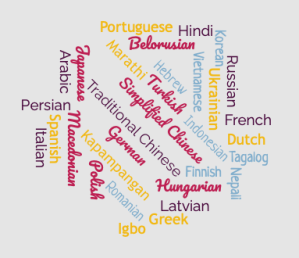
Therefore, this is an appropriate occasion on which to thank all of the translators who have taken time from other activities to help CID prepare translations of our publications into a remarkable 32 different languages. We could not do this without you! 

NOTE: If you want to translate one of the publications into a language in which you are fluent, please contact us before you start, to learn whether anyone else is already working on that publication in that language.