Auckland U of Technology: Director of AUT International (New Zealand)

“JobDirector, AUT International, Auckland University of Technology, Auckland, New Zealand. Deadline: 30 April 2025.

AUT is seeking an innovative leader of tertiary international teams to help take AUT International to the next level. You will be responsible for providing strategic leadership, aligning international initiatives with the University’s overarching strategy, whilst ensuring operational excellence in the areas of student recruitment, global partnerships, transnational education, and internationalisation of curriculum and research.

The role operates in a highly dynamic and unpredictable global environment where external factors such as geopolitical shifts, government policies, international student mobility trends and more directly impact the role and the team. The ability to adapt, pivot and analyse data to make sound evidence-based decisions is critical. You will lead a growing team of around 30 highly committed and passionate staff; primarily across Student Recruitment & Marketing, Global Partnerships & Transnational Education and AUT’s English Language Centre teams.

 

College of the Canyons: Intercultural Center Coordinator (USA)

“JobIntercultural Center Coordinator II, College of the Canyons, Santa Clarita, CA, USA. Deadline: open until filled; posted 7 April 2025.

The Santa Clarita Community College District/College of the Canyons is seeking a full-time Intercultural Center Coordinator II under the Institutional Research, Planning and Institutional Effectiveness office. Under the direction of the Dean of Institutional Research, Planning and Institutional Effectiveness, the Intercultural Center (ICC) Coordinator II oversees events and services that promote identity exploration, cultural, social justice education, and student retention. This position provides daily oversight of the ICC operations and staff, supports planning, budgeting, and participates in the program review process for the District’s Intercultural Centers. The Coordinator plays an integral part of the ICC team by contributing to the overall vision and mission of student diversity and belonging, which includes dialogues on various multicultural and intersectional issues. In addition, the Coordinator provides support for events in the ICC and supports the Dean in ensuring that the center is meeting the needs of students and the campus community. The Coordinator serves as an ICC liaison for district-wide initiatives, connects students to resources, and collaborates with the Dean and other District stakeholders to educate and support the campus community on diverse identities and concerns. Additionally, the ICC Coordinator II serves as an administrative aide to the Dean and works directly with administrators, faculty, staff, students, and community partners. Performs other duties as assigned.

Depolarizing Dialogue (Netherlands)

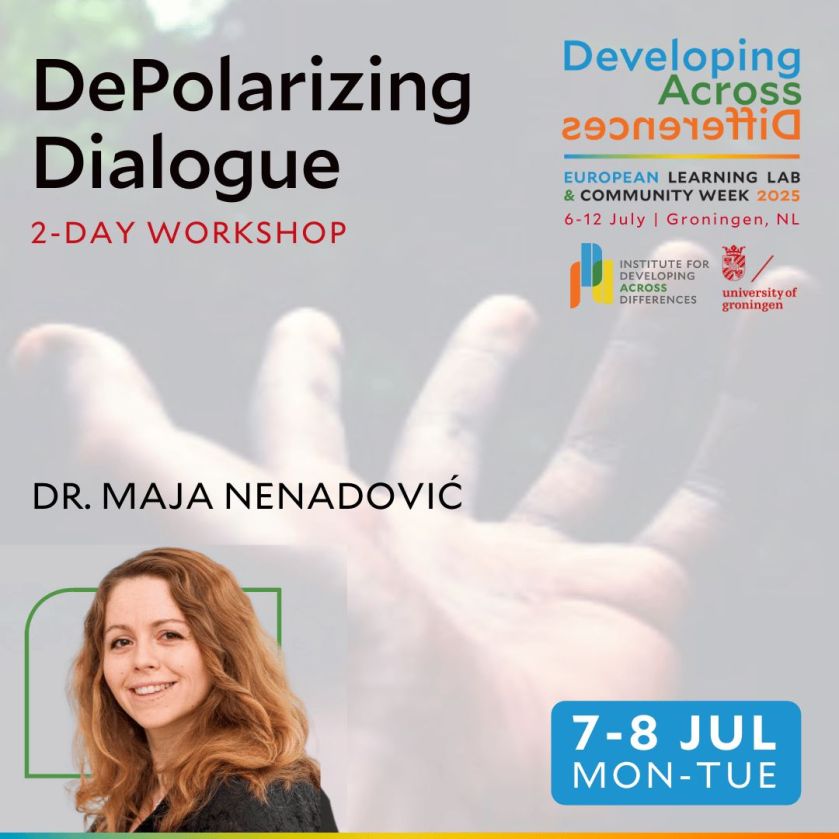
EventsDePolarizing Dialogue. Speaker: Maja Nenadovic, Institute for Developing Across Differences, University of Groningen, Netherlands, 7-8 July 2025. Registration deadline: 3 May 2025.

DePolarizing Dialogue workshop with Maja NenadovicEveryday interactions increasingly provoke angry divisiveness , making civil discussion and respectful disagreements seemingly a thing of the past. Addresses the pressing issue of divisive rhetoric and polarized encounters in Europe and beyond – whether about the pandemic and self-expression, freedom of expression versus hurtful rhetoric, or otherwise.

Register for this workshop to help yourself and those you work with:
1. “Dial down” intense verbal encounters.
2. Diagnose communication problems in real time.
3. Apply “on the spot” strategies to transform polarizing interactions.

CFP Minoritized Languages in an Age of (Im)mobility

“Publication

Call for book chapters: Minoritized languages in an age of (im)mobility: People, places and practices. Deadline: abstracts only due 22 April 2025.

Editors: Carla Jonsson, Annika Norlund Shaswar, Andreas Nuottaniemi

“We are pleased to invite chapters for a planned volume on minoritized languages in education and other contexts such as work life and community life. We have been in contact with the editors of the book series ‘Routledge Critical Studies in Multilingualism’ and we have been encouraged by them to edit a peer reviewed academic volume about this topic. We are now calling for chapters and alternative forms of publications to be included in the proposed volume which Routledge will then consider for publication and accept subject to peer-review.

The chapters can be based on empirical studies (qualitative or quantitative), literature studies or conceptual / theoretical discussions. We are also interested in alternative forms of publications (such
as for instance, but not limited to, written conversations/dialogues/interviews/thought pieces).
These could be written by representatives from organizations and civil society and/or researchers.

We have the possibility to offer two writing retreats in Sweden: one for researchers (prel. in November) and one for representatives from organizations and civil society and or researchers (prel. in September).

The volume aims to critically explore questions about minoritized languages in contexts of education
and work, investigating the possibilities and limitations of language policies in supporting their use.

By bringing together researchers from different fields the book will emphasize interdisciplinary perspectives on minoritized languages, language policy, and multilingualism in education.

This book will be aimed at academic researchers, but will also be of interest to practitioners, policy makers and other stakeholders.

We want this volume to include international perspectives and therefore hope for contributions from different contexts/places.

U Strathclyde: Role of 3rd Sector Organizations in Supporting Asylum Seekers and Refugees (UK)

Postdocs

Postdoctoral Researcher: Role of Third Sector Organizations in Supporting Asylum Seekers’ and Refugees’ Integration, Citizenship, and Belonging, University of Strathclyde, UK. Deadline: 9 May 2025.

The role of charities and community groups has become more prominent over the last decade of austerity and ongoing cost-of-living crisis, including in relation to support for asylum seekers and refugees. The aim of the study is to address this gap and provide evidence on the role of third sector organisations in supporting refugee integration and individuals who are navigating the UK asylum system.  This opportunity is for 3 years.

CFP FEL: The Missing SDG: Endangered Languages and Sustainable Development (Spain)

ConferencesCall for papers: The Missing SDG: Endangered Languages and Sustainable Development, 29th Annual Conference of the Foundation for Endangered Languages, 22-25 October 2025, University of the Basque Country, Vitoria-Gasteiz, Spain. Deadline: 15 May 2025.

Why is world shouting everywhere about sustainability but is decidedly mute on language? Sustainable Development Goals, or SDGs, are, in the words of the UN, “the blueprint to achieve a better and more sustainable future for all”. They address “global challenges” which include eradicating poverty, ensuring good health and well-being, providing quality education, protecting the environment, upholding human rights, and promoting the rule of law, among others. However, languages are not explicitly mentioned, and the way in which culture is addressed remains very limited. As one linguist (Suzanne Romaine (2019: 41) put it, “language is the missing link in the global debate on sustainability”.

Without linguistic diversity and the promotion of multilingualism, many communities, particularly minority, indigenous and marginalized groups, are excluded from decision-making processes and denied equal access to vital resources. The endangerment or extinction of languages is often a consequence of this exclusion, but it also escalates it.

Main sub-themes include the topics below:

  • The conceptialisation of the links between the maintenance and revitalisation of minority, endangered and indigenous languages and sustainable development.

  • Practices of community-based and public institution initiatives that integrate both agendas.

  • Prospects of the 2030 agenda and the inclusion of the linguistic and cultural issue.

  • Proposal for a workable UN programme and document: Designing SDG 18

Maria Flora Mangano: Gratitude is My Attitude

Guest PostsGratitude is My Attitude. Guest post by Maria Flora Mangano.

Thankfulness may become mutual, as it is focused on our approach to the Other.

Working with students can be more than a job; it may become a life choice, an answer to a call, which we choose every day. It may turn into an attitude, a perspective on reality, a vision of the world centered on the Other rather than on us. This approach may also change our relationship to our students, and, far more broadly, with our daily lives.

…If we can shift the center of gravity from ourselves to the Other, we may experience gratitude as a pure feeling which does not depend on us, thus on our abilities, successes, or results. It reminded me of the I-Thou relationship as theorized by Martin Buber (1937), thus, the basic idea that the relationship lies in the between, perhaps in the hyphen between, the I and the Thou (Mangano, 2018, p. 27). It is a space which depends neither on the I, nor on the Thou; it is in the middle, in the between, in the “space of us.”

When we are able to decenter ourselves and put the Other at the center of the scene, we may also see what already exists, rather than what is missing. We may experience wonder, as we do not expect a gift: the Other may already be a gift, and we do not need any additional expectation. This approach, that of an unexpected surprise, may provide a new perspective on reality as a glass half-full; sometimes even completely full. In this attitude, gratitude sounds likely to be close to hope, an endless source of water although just a few drops may be enough, as they can guarantee the strength to carry on.

Download the entire post as a PDF.

U Minnesota: Director of International Affairs (USA)

“JobDirector of International Affairs, University of Minnesota, Duluth, MN, USA. Deadline: 30 April 2025.

A member of the academic leadership team, the Director of International Affairs provides strategic leadership to support global engagement and campus internationalization as part of UMD’s mission. Reporting to the Executive Vice Chancellor for Academic Affairs (EVCAA) and partnering with academic deans, senior administrators, faculty, and staff, the Director will lead campus efforts related to internationalization to strengthen and enrich our campus community. The Director of International Affairs leads IPS and partners to advance the following areas:

  • International Partnerships
  • Study Abroad
  • International Student Recruitment
  • International Student Success
  • Global Education at UMD
  • Faculty and Staff International Engagement
  • Passport Acceptance Facility

The Director collaborates with the Office of Strategic Enrollment Management, the Multicultural Center, the University of Minnesota System’s Global Programs and Strategy Alliance (GPS Alliance), and many other units at UMD. In FY25, a campuswide committee conducted a thorough analysis of institutional efforts and opportunities and provided a robust set of recommendations to assist UMD in significantly strengthening internationalization. They are looking for a leader to help enact that vision.

Global Cities: Education Program Manager (USA)

“JobEducation Program Manager, Global Cities, New York, NY, USA. Deadline: 30 April 2025.

Global Cities seeks an experienced, creative, and tech-savvy Education Program Manager to join its team of accomplished educators who design and implement the Global Scholars virtual exchange program. As part of Global Cities’ collaborative and innovative team, they apply a diverse skillset to create student-centered, project-based curricula, teacher professional development, and a lively e-classroom environment for young people worldwide. Their responsibilities also include liaising with Global Scholars classroom teachers, school leaders, and education district/ministry officials, and contributing insights to initiatives for all K-12 educators interested in integrating global competency into their curriculum and instruction.

Global Cities, Inc., a Program of Bloomberg Philanthropies, promotes skills that today’s youth require for citizenship in tomorrow’s world. Global Cities has extensive experience using technology to forge connections among students and educators that promote learning, including through Global Scholars, our signature virtual exchange program for public school students. Through the program, students ages 10 to 13 engage in constructive dialogue with peers across the globe in e-classrooms. Their posts, replies, and digital projects are primary texts for them to learn about other cities and perspectives, and how to solve the shared global issue they are studying. Currently, Global Scholars connects over 10,400 students and more than 500 educators in 546 cities around the world. In addition to operating Global Scholars, Global Cities has conducted research that demonstrates that direct peer-to-peer connections develop the knowledge, attitudes, skills, and behaviors that constitute global competency. What they have learned is relevant to all educators working to ensure every child has access to education that will prepare them for success in a globalized world, and they have an ambitious agenda to share this learning with the next generation of K-12 teachers. 

U London: Migrant Futures PhD Studentships (England)

“Studentships“Two Migrant Futures Goldsmiths Ph.D. Studentships, Goldsmiths University of London, London, UK.Deadline: 25 April 2025.

Two doctoral studentships are available for entry in 2025-26. These are fully-funded studentship that may be held on a full-time or part-time  basis, pro-rata, over three years and six years and are at an equivalent rate to fully-funded UKRI studentships. They cover tuition fees and an annual stipend at the yearly UKRI rate, together with a small annual research training and support fund.

One of the two awards for entry 2025-26 will be open to eligible home applicants who identify as migrants or refugees and from racialised ethnic minority backgrounds in any field of research and practice for which supervision is available at Goldsmiths, University of London. To be clear, applicants considered for this award need not be working on a migration related topic, but they should be able to describe how their work will enhance their own economic, creative and intellectual lives and that of others.

The second of these two awards will be open to all eligible home or international applicants – irrespective of background and experience – whose proposed PhD is focused on a topic related to migration, broadly conceived, including in relation to processes of race and racialisation. Proposals must be informed by the co-production of knowledge with people and groups from migrant and refugee backgrounds, and demonstrate potential for social and cultural impact.

Migrant Futures Doctoral Studentship holders will, upon award, be designated as Fellows of the Migrant Futures Institute and will be expected to contribute to developing and enhancing the research culture of the institute through their research, creative practice and participation in MFI activities and events. Successful applicants from racialised backgrounds will also be invited to participate in the activities of Generation Delta Goldsmiths.