Passage of Dialogue (Poland)

Applied ICDShortle, Honey. (2021, October 5). The new face of the Świdnickie pass: A space for dialogue was created there. Randrlife.

A place that invites the people of Wroclaw to joint discussions and meetings is an invaluable initiative –Bartomeg Potocki, Director of the Immigrant Rights Institute

Przejście Świdnickie [Passage of Dialogue] is an information point where people can learn about current social activities carried out by Wrocław institutions and NGOs. It is also a place  for workshops, and conversations with local activists. There are 350 square meters available, divided into 8 spaces. It is intended as a space where residents of Wroclaw can meet, understand one another, and collaborate to support the development of dialogue. The spaces include a green area with more than 40 plants, a gallery, an exhibition space, and a co-working area. Discussions, exhibitions, workshops and small concerts will be organized; residents can submit events for consideration. The Passage also offers information for migrants looking for support in everyday and official matters. The inaugural event will be Dialogopolis’21 – Month of Intercultural Dialogue and Education, held in October 2021.
CFP CIES 2022: Illuminating the Power of Idealism (USA Hybrid)

Conferences

Call for Papers: CIES: Illuminating the Power of Idea/lism, Minneapolis, MN, USA with a hybrid design, April 18-22, 2022. Deadline: October 27, 2021.

The Comparative and International Education Society (CIES) 2022 theme Illuminating the Power of Idea/lism arises from the intersection of two immutable realities of our time and the impact both are having on the field of comparative and international education. The first is the global experience with the COVID-19 pandemic. The second is the rise of nativism and fundamentalism representing both ideological rigidity and political divisiveness. The CIES 2022 theme seeks to find ways to address these challenges by bringing forward new ideas with a sense of idealism in the work we all do as educationists.

In planning for CIES 2022, the hope is to gather in person after a three-year gap, with a theme grounded in the context of time, place, and possibility. The context of time refers to the global pandemic that has upended the practice of education for learners in all environments. The context of place refers to Minneapolis, a city at the crossroads of global and local, a place of refuge for new arrivals to the U.S., but also at the forefront of racial justice protests since the 2020 murder of George Floyd. The context of possibility returns to the notion of ideas where at this time and in this place, organizers seek to foster dialogue, while anticipating gathering as practitioners, academics, and students – indeed, a global community of idealists.

York U: MITACS Post-Doctoral Fellowship (Canada)

PostdocsMITACS Post-Doctoral Fellowship at the Regent Park Film Festival, Archive/Counter-Archive and The Regent Park Film Festival, Toronto, Canada. Deadline: 5 November 2021.

Archive/Counter-Archive and The Regent Park Film Festival are pleased to announce a competition for a 1-year MITACs Accelerate Post-Doctoral Fellowship position hosted by York University and The Regent Park Film Festival. In this opportunity the candidate will coordinate the Regent Park Film Festival’s Regent Park Made Visible Project as well as engage in visual research on the history of the Regent Park neighborhood and its communities. Regent Park has undergone a revitalization process, changing rapidly from a low-income to a mixed-income neighborhood accompanied by changes to community demographics and urban geographies. The successful candidate will coordinate a digital media arts project where artists will engage with visual source material (archival footage of Regent Park as well as narrative forms set in Regent Park) to respond and create original works (short films) for digital and in-person presentation at the 20th anniversary of the Regent Park Film Festival in 2022. The candidate’s own proposed project will engage in visual research both within and outside of institutional archives and will explore themes that are pertinent to Regent Park today: gentrification, immigration and belonging, community building, racial justice, housing and income security.

CFP IASFM19 (Brazil but Online)

ConferencesCall for proposals, International Association for the Study of Forced Migration Conference (IASFM19), Universidade Católica de Santos, Brazil, August 1-5, 2022, online. Deadline: January 31, 2022.

The 19th International Association for the Study of Forced Migration Conference (IASFM19), with the theme of “Global Issues, Regional Approaches – contexts, challenges, dialogues and solutions”, will be held from August 1st to the 5th of 2022 and hosted online by Universidade Católica de Santos (UniSantos). It will be the second time the event will take place in Brazil and the 3rd in Latin America and will be part of the celebrations of the 70th anniversary of UniSantos.

KC80: Cultural Discourse Analysis Translated into Russian

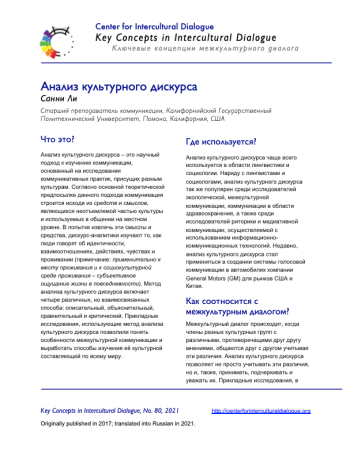
Key Concepts in ICDContinuing translations of Key Concepts in Intercultural Dialogue, today I am posting KC#80: Cultural Discourse Analysis, which Sunny Lie wrote for publication in English in 2017, and which Anton Dinerstein has now translated into Russian.

As always, all Key Concepts are available as free PDFs; just click on the thumbnail to download. Lists of Key Concepts organized chronologically by publication date and number, alphabetically by concept, and by languages into which they have been translated, are available, as is a page of acknowledgments with the names of all authors, translators, and reviewers.

KC80 Cultural Discourse Analysis_Russian

Lie, S. (2021). Cultural discourse analysis [Russian]. (A. Dinerstein, trans). Key Concepts in Intercultural Dialogue, 80. Available from:
https://centerforinterculturaldialogue.org/wp-content/uploads/2021/10/kc80-cultural-discourse-analysis_russian.pdf

If you are interested in translating one of the Key Concepts, please contact me for approval first because dozens are currently in process. As always, if there is a concept you think should be written up as one of the Key Concepts, whether in English or any other language, propose it. If you are new to CID, please provide a brief resume. This opportunity is open to masters students and above, on the assumption that some familiarity with academic conventions generally, and discussion of intercultural dialogue specifically, are useful.

Wendy Leeds-Hurwitz, Director
Center for Intercultural Dialogue


Creative Commons License
This work is licensed under a Creative Commons Attribution-NonCommercial-NoDerivatives 4.0 International License.

U of Stavanger: Diversity and Inclusion in Early Childhood & Schools (Norway)

“Job

Postdoctoral Fellow, Faculty of Arts and Education, University of Stavanger, Stavanger, Norway. Deadline: November 1, 2021.


The University of Stavanger invites applicants for a position as Postdoctoral Fellow who will conduct and disseminate  systematic research reviews on diversity and inclusion in early childhood and / or schools at the Faculty of Arts and Education, Knowledge Centre for Education. The position is vacant from 01.01.2022. The Knowledge Centre for Education is part of the knowledge ecology of Norway, mandated:

  1. to carry out research syntheses for the whole education sector – from Early Childhood through Higher education, for practitioners, researchers and policymakers;
  2. to disseminate research syntheses in ways that enable engagement and understanding;
  3. to increase knowledge about systematic syntheses of research – their relevance, their use, and how to do systematic research reviews and syntheses;
  4. to contribute to enhanced use of research in policy and practice.

The objective of the position is to strengthen research, and to give researchers/scholars holding a doctoral degree the opportunity for further qualification toward top academic positions.

Loyola Marymount: Intercultural Communication (USA)

“JobAssistant Professor of Intercultural Communication, Communication Studies, Loyola Marymount University, Los Angeles, CA, USA. Deadline: November 1, 2021.

The Communication Studies Department at Loyola Marymount University (LMU) in Los Angeles seeks applicants for a tenure-track, Assistant Professor position in the area of Intercultural Communication, beginning Fall 2022.

This position requires expertise in the field of intercultural communication in a global context. LMU is particularly interested in candidates whose teaching and research can inform our understanding of issues of race, ethnicity, culture, identity, nationality, and transnationality.

Global Citizenship Education

Applied ICD

Bosio, E., & Schattle, H. (2021). Ethical global citizenship education: From neoliberalism to a values-based pedagogy. Prospects, 1-11.

…over the past 20 years, there has been increasing interest in GCE as a means of supporting learners in developing their values, knowledge, and understanding of multiple global, national, and local issues.

This article proposes an ethical global citizenship education (GCE) framework by offering the following five dimensions: values-creation, identity progression, collective involvement, glocal disposition, and an intergenerational mindset. Ethical GCE draws on a multiplicity of critical literatures to identify characteristics of each of these dimensions. It goes beyond neoliberal/market-driven principles toward ethical perspectives promoting social responsibility, justice, human rights, and glocal sustainability. With further theoreti- cal development and strategies toward implementation, the framework has the potential to be deployed in future research and evaluation of the complex teaching and learning pro- cesses involved in GCE, particularly in a values-based perspective.

Note: Even though this article does not address intercultural dialogue directly, it seems likely that global citizenship education would only help bring about more intercultural dialogues.


CFP Counter Archives: Communities

“PublicationCall for chapters: Counter Archives: Communities, Archive/Counter-Archive (A/CA), Canada. Deadline for abstract: November 1, 2021.

Editors: Stacy Allison-Cassin, University of Toronto, and Antoine Damiens,  York University.

Archive/Counter-Archive solicits chapter proposals for Counter Archives: Communities, a hybrid media book under consideration with Concordia University Press. Political, resistant and community-based counter-archives disrupt conventional narratives and enrich our histories. Counter-archives embody both a theoretical approach to conceptualizing archives and a mode of practice—a practice that resists the universalizing force of dominant techniques of documentation and standardization at work within most institutional archives, libraries, and museums. They seek to counter the hegemony of traditional archival institutions that have normally neglected or marginalized women, Indigenous peoples, the LGBT2Q+ community, and immigrant communities. This volume is the first book within a potential book series edited by the Archive/Counter-Archive network. It seeks to reflect and theorize marginalized communities’ engagement with (counter)archival materials and protocols. As such, the book aims to decenter traditional archival narratives by focusing on community-led practices.

Globalisation and Comparative Education

“Book NotesZajda, J., & Rust, V. D. (2021). Globalisation and comparative education: Changing paradigms. Springer Nature.

…policy statements on intercultural dialogue of the UNESCO, and the Council of Europe, share a policy consensus that emerging discourses dealing with intercultural dialogue refer to values education, based on peace, the respect for human rights, democracy and the rule of law. The overarching goal is promoting ‘harmonious interaction among people and groups with plural, varied and dynamic cultural identities’ as well as their willingness to live together in peace. (p. 178)

While this is an interesting book overall, the chapter most likely to be of greatest interest to CID followers is Chapter 11: Globalisation and Cultural Identity: The Role of Intercultural Dialogue (pp. 177-186) which is where the quote above appears. They conclude that “there is a need to re-assert the relevance of intercultural dialogue in an increasingly interdependent world” (p. 184).