CFP Information and Culture

“PublicationCall for Papers: Information & Culture, University of Texas Press.

The journal Information & Culture has recently extended its remit to provide a home for scholarly work that addresses the social and cultural impact of information in our world across all areas of human activity. If you are seeking a home for information scholarship that deals directly with human and social concerns that might not fit easily in more traditional or established venues, consider submitting. Editors intend to create an inclusive, constructive-review environment for interesting work across disciplines and traditions. They do not restrict by method or theory, by topic or by era, only by quality, and welcome lengthy submissions where warranted. Under new arrangements, authors will retain the right to make pre-print and post-print versions of their article available on their personal website, institutional repository, or not-for-profit servers.

The journal welcomes submissions from an array of relevant theoretical and methodological approaches, including but not limited to historical, sociological, psychological, political and educational research that address the interaction of information and culture.

Teaching Diverse Texts

Events

Teaching Diverse Texts, College of General Studies, Boston University, Boston, MA, February 26, 2021.. Deadline: October 15, 2020.

On Friday, February 26, 2021 Boston University’s College of General Studies (CGS) will host a colloquia for Ph.D. candidates who are close to graduating and applying for jobs in academia and whose research interests include teaching diverse texts and facilitating respectful classroom dialogue, especially in general education. We welcome colloquia participant applications from Ph.D. candidates who have experience teaching general education and who are interested in a day and one half symposium where they will present on their research and teaching and will interact with nationally recognized scholars, pedagogues and Boston University students. A joint offering through Boston University’s Office of Diversity and Inclusion and the College of General Studies, participants will receive a stipend to cover transportation, accommodations and food for the day and one half experience.

KC35 Media Ecology Translated into Polish

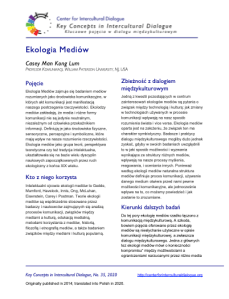
Key Concepts in ICDContinuing translations of Key Concepts in Intercultural Dialogue, today I am posting KC#35: Media Ecology, which Casey Man Kong Lum wrote for publication in English in 2014, and which Beata Krupa has now translated into Polish.

As always, all Key Concepts are available as free PDFs; just click on the thumbnail to download. Lists of Key Concepts organized alphabetically by conceptchronologically by publication date and number, and by languages into which they have been translated, are available, as is a page of acknowledgments with the names of all authors, translators, and reviewers.

KC35 Media Ecology_Polish

Lum, C. M. K. (2020). Ekologia mediów. (B. Krupa, trans). Key Concepts in Intercultural Dialogue, 35. Available from
https://centerforinterculturaldialogue.org/wp-content/uploads/2020/05/kc35-media-ecology_polish.pdf

If you are interested in translating one of the Key Concepts, please contact me for approval first because dozens are currently in process. As always, if there is a concept you think should be written up as one of the Key Concepts, whether in English or any other language, propose it. If you are new to CID, please provide a brief resume. This opportunity is open to masters students and above, on the assumption that some familiarity with academic conventions generally, and discussion of intercultural dialogue specifically, are useful.

Wendy Leeds-Hurwitz, Director
Center for Intercultural Dialogue


Creative Commons License
This work is licensed under a Creative Commons Attribution-NonCommercial-NoDerivatives 4.0 International License.

Yale-NUS Associate Dean of Students (Singapore)

“JobAssociate Dean of Students, Yale-National University of Singapore College, Singapore. Deadline: June 15, 2020.

The Associate Dean of Students is a senior member of the Dean of Students (DOS) Office leadership team, reporting directly to the Dean and will act as the deputy in the Dean’s absence. The role serves as a front-facing liaison to the student community and advises the Dean of Students on a variety of student-related matters, along with driving intra- and inter-departmental projects on behalf of the DOS Office.

This position oversees Campus Life and Student Services. Campus Life includes Student Organisations & Leadership, Athletics & Recreation, and Intercultural Engagement (i.e., Diversity & Inclusion). The selected candidate will develop strategic plans for Campus Life, as well as drive the execution of programmes, policies and initiatives to support the cognitive, intrapersonal and interpersonal development of students. Student Services oversees international student passes, student billing, student insurance, parent/family relations and housing operations.

Yale-NUS will introduce a newly designed residential curriculum starting in academic year 2020-21. The Associate Dean will help further refine the residential curriculum and assist in implementation.

Aarhus U Postdoc: Intellectual History of Global Inequality: Argentina (Denmark)

PostdocsOne-Year Postdoc Position: An Intellectual History of Global Inequality, 1960-2015: Argentina, School of Culture and Society, Aarhus University, Aarhus, Denmark. Deadline: 26 July 2020.

The School of Culture and Society at Aarhus University invites applications for a one-year postdoctoral fellowship in the history of ideas. The position is full-time, and is available from 1 February 2021 or as soon as possible thereafter. The position will be part of the project ‘An Intellectual History of Global Inequality, 1960-2015’.

The project will investigate the historical relationship between location and the intellectual history of inequality. The research objects of this study are concepts, theories and ‘languages’ relating to international economic inequality from 1960 to 2015. The approach is historical-contextualist and combines conceptual and intellectual history, focusing upon contributions to academic and public debates by public intellectuals, especially economists, sociologists, historians and philosophers. Furthermore, the approach is comparative: it will compare the thought of Northern (primarily American), Indian, African (primarily Ghanaian) and South American (primarily Argentinian) public intellectuals. The project is thus divided into four subprojects (with this position focusing on Argentina), each investigating a significant geographical area in the global discourse on economic inequality, enabling us to make new comparisons and trace connections in South-South as well as in North-South exchanges. The project will be an important contribution to the global turn in intellectual and conceptual history. The successful applicant will be responsible for the sub-project on Argentina. The postdoc will study key Argentinian intellectuals and the intellectual history of international and global economic inequality in Argentina.

Interfaith Dialogue Through Chocolate

Applied ICDBorn in Morocco, now based in Germany, Nadia Doukali has created Iftarlade chocolate which is both kosher and halal, with a label in Hebrew, Arabic, and German.

Doukali first designed a Ramadan calendar, which she called “Iftarlender,” (made up of the word “Iftar” – the evening meal during Ramadan used to break each day’s fast, and the German word “kalender” for the German advent calendars with small paper doors, and sayings or candy behind them). Then she created Iftarlade chocolate (“Iftar” + “schokolade”, or chocolate in German). She decided to make it halal, and then wanted it to be kosher as well, so she worked to gain the appropriate certifications. She sees her products as a way for people to be “united in chocolate.”

Read more here:

Avidan, Igal. (28 May 2020). Muslim German sets new bar for interfaith relations with kosher-halal chocolate. The Times of Israel.

Loho, Petra. (20 May 2020). Counting down to Eid? In Germany, Nadia Doukali gave the traditional Advent calendar a Muslim twist. Salaam Gateway.


CFP Mentoring Interculturally

“PublicationCall for Chapter Proposals: Mentoring Interculturally/Mentoring in Intercultural Contexts. Editors: Ahmet Atay and Diana Trebing. Under contract with Peter Lang. Deadline: June 15, 2020.

Editors are looking for a few additional chapters in mentoring related to different cultural contexts. Mentoring occupies a major role in higher education. We mentor students and fellow faculty members, many of whom come from diverse backgrounds, such as first-generation, LGBTQ, and other countries among others. Perhaps as scholars and educators we do not spend or have enough time thinking about mentoring. It might also not be something that we formally discussed in graduate school. As we find ourselves mentoring various groups of people in higher education, we try to model our own mentors who helped us as students or faculty. Due to lack of formal training, perhaps we might use a trial-error approach or simply find spontaneous ways to mentor.

Continue reading “CFP Mentoring Interculturally”

CFP Discourse & Rhetoric Amid COVID-19

“PublicationCall for papers: Special issue on Discourse and Rhetoric amid COVID 19 Pandemic: Dis/Articulating The ‘New Normal’ for Rhetoric and Communications E-Journal. Deadline: October 1, 2020.

Guest Editors: Andrea Valente and Paola Giorgis

The coronavirus disease (SARS-CoV-2) with its global and local pandemic has been on the top agenda of Government leaders, scientists, health professionals, as well as on the daily headlines across journalistic media. New governmental measures, decrees, scientific recommendations, and sanitary campaigns emerge everyday to combat or alleviate the pandemic which are endorsed and spread through mainstream media. On the one hand, a new discourse and rhetoric has been articulated to create, support, and even impose a ‘new normal’ that reconfigures how human beings communicate, interact, and socialize in public and private spaces. On the other hand, the new normal has triggered responses from skeptics, ‘Covideniers’ and protesters who try to disarticulate it by polarizing and politicizing the coronavirus pandemic.

With this in mind, this Special Edition invites junior and senior scholars to collaborate with articles that explore and analyze the various languages, rhetorical strategies, and discourses used during the Covid19 pandemic in order to either articulate (e.g. construct, endorse, conform) or disarticulate (e.g. contest, deny, undermine) the ‘new normal’. This Special Edition looks forward to collaborations in the field of argumentative theory, critical/discourse analysis, rhetoric, critical sociolinguistics, communication studies, and others alike.

RAI Film Festival (UK)

Film FestivalsRoyal Anthropological Institute (RAI) Film Festival, Bristol, UK. Deadline: 15 August 2020.

The RAI Film Festival celebrates documentaries and non-fiction films from around the globe that engage with themes of culture & society. It has a special focus on anthropological and ethnographic films. First held in 1985, and one of the longest-established in its field, the RAI FILM FESTIVAL serves as a leading forum for exploring the multiple relationships between documentary film-making, anthropology, visual culture, and the advocacy of cultural diversity and intercultural dialogue through film.

Calling for short, mid- and feature length documentaries, ethnographic / anthropological films, student films. Open to all.

The 17th RAI Film Festival will take place 25-28 March 2021 in Bristol, UK.

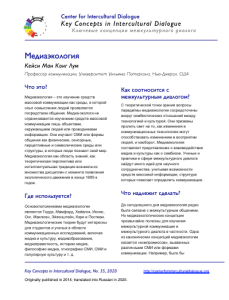
KC35 Media Ecology Translated into Russian

Key Concepts in ICDContinuing translations of Key Concepts in Intercultural Dialogue, today I am posting KC#35: Media Ecology, which Casey Man Kong Lum wrote for publication in English in 2014, and which Milana Petrova has now translated into Russian.

As always, all Key Concepts are available as free PDFs; just click on the thumbnail to download. Lists of Key Concepts organized alphabetically by conceptchronologically by publication date and number, and by languages into which they have been translated, are available, as is a page of acknowledgments with the names of all authors, translators, and reviewers.


KC35 Media Ecology_RussianLum, C. M. K. (2020). Media ecology [Russian]. (M. Petrova, trans). Key Concepts in Intercultural Dialogue, 35. Available from https://centerforinterculturaldialogue.org/wp-content/uploads/2020/05/kc35-media-ecology_russian.pdf

If you are interested in translating one of the Key Concepts, please contact me for approval first because dozens are currently in process. As always, if there is a concept you think should be written up as one of the Key Concepts, whether in English or any other language, propose it. If you are new to CID, please provide a brief resume. This opportunity is open to masters students and above, on the assumption that some familiarity with academic conventions generally, and discussion of intercultural dialogue specifically, are useful.

Wendy Leeds-Hurwitz, Director
Center for Intercultural Dialogue


Creative Commons License
This work is licensed under a Creative Commons Attribution-NonCommercial-NoDerivatives 4.0 International License.