Understanding Knowledge as a Global Commons

Director's ActivitiesLeeds-Hurwitz, W. (2019). Commentary: Moving (slowly) toward understanding knowledge as a global commons. Journal of Multicultural Discourses, 15. DOI: 10.1080/17447143.2019.1695806

My commentary article was invited as a response to “Power relations in global knowledge production: A cultural/critical approach” by Marton Demeter. Both articles are already available online, and will be in print within a few months. To give you the flavor of the article, let me quote the first and last paragraphs. If you then wish to read the entire commentary, 50 copies may be downloaded free using this link. If you are the 51st person or beyond and those copies are gone, you may send an email requesting a personal copy.

“Marton Demeter responds to the move to de-westernization . . . by asking whether the reality of practice in cultural discourse studies fits with the stated goal of acknowledging globalization by expanding what is accepted within academia (so that the US and Western Europe do not assume they will produce the research that scholars in other countries read, but instead that everyone will produce interesting work that everyone else will read). He examines journal publications, a central tool in the social construction of knowledge, looking in greatest detail at ‘diversities in editorial boards, diversities in science output and the network of collaboration’. He finds that editorial board diversity correlates with the home country of the authors (so that journals with mostly US/Western scholars on the editorial boards publish few articles by authors from other parts of the world, despite explicit statements taking this as a goal).”

. . .

“In sum, I do not argue with Demeter’s findings, and in fact wish he had been a bit more radical in his call for change. In addition to internationalizing editorial boards, authors, and research teams, I have suggested that we need to recognize and reward intercultural capital, expand international networks at all levels (including editors and peer reviewers specifically for journal publishing, but more broadly expanding international research collaborations), and consider how to use the available technology to ensure that knowledge will be free and accessible to all, calling on senior faculty and major universities to make the first move. I would summarize this set of options as moving towards a global knowledge commons, a phrase others have used, but which has not yet been widely adopted.”
Aarhus IAS Fellowships (Denmark)

Fellowships

AIAS-COFUND II Marie Skłodowska-Curie Fellowships, Aarhus Institute for Advanced Studies, Aarhus, Denmark. Deadline: 17 January 2020.

Up to 15 AIAS-COFUND fellowships are available for the most talented researchers from around the world and within all research disciplines and topics. The scheme is funded by the European Union’s Horizon 2020 Research and Innovation Programme under the Marie Skłodowska-Curie actions (grant agreement no 754513) and Aarhus University Research Foundation.

Two types of AIAS-COFUND II Fellowships are available:

  • AIAS-COFUND Junior Fellowships for postdoctoral researchers with a career experience of 2-10 years. Duration from 12-36 months.

  • AIAS-COFUND Senior Fellowships for researchers with a career experience of 10+ years. Duration from 6-18 months.

CFP Transnational Journalism History (USA)

ConferencesCall for Papers: Transnational Journalism History Conference, May 28-30, 2020, Augusta University, Georgia, USA. Deadline extended to  February 17, 2020.

The fifth annual conference on Transnational Journalism History is seeking papers that study historical transformations in journalism from a transnational perspective. Papers welcomed that discuss theoretical or methodological issues as well as empirical case studies from all parts of the world. Specifically, organizers invite contributions that consider:

– the transfer of norms, practices and textual conventions from one country/region to another and their consecutive adaptation in national contexts
– transnational networks of actors
– biographical studies of transnational agents such as journalists or publishers
– the transnational coverage of particular news stories
– transnational audiences
– the impact of (emerging) technologies on transnational journalism
– different media such as television, radio, newspapers or magazines, and the intersection between them
-theoretical perspectives/interpretations/applications of transnational journalism history

KC35 Media Ecology Translated into Japanese

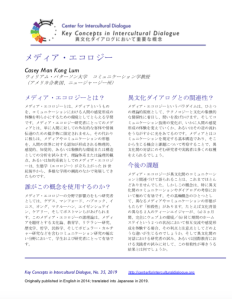
Key Concepts in ICDContinuing translations of Key Concepts in Intercultural Dialogue, today I am posting KC#35: Media Ecology, which Casey Man Kong Lum wrote for publication in English in 2014, and which Atsushi Katayama has now translated into Japanese.

As always, all Key Concepts are available as free PDFs; just click on the thumbnail to download. Lists of Key Concepts organized alphabetically by conceptchronologically by publication date and number, and by languages into which they have been translated, are available, as is a page of acknowledgments with the names of all authors, translators, and reviewers.

KC35 Media Ecology_JapaneseLum, C. M. K. (2019). Media ecology [Japanese]. (A. Katayama, trans). Key Concepts in Intercultural Dialogue, 35. Available from:
https://centerforinterculturaldialogue.org/wp-content/uploads/2019/11/kc35-media-ecology_japanese.pdf

If you are interested in translating one of the Key Concepts, please contact me for approval first because dozens are currently in process. As always, if there is a concept you think should be written up as one of the Key Concepts, whether in English or any other language, propose it. If you are new to CID, please provide a brief resume. This opportunity is open to masters students and above, on the assumption that some familiarity with academic conventions generally, and discussion of intercultural dialogue specifically, are useful.

Wendy Leeds-Hurwitz, Director
Center for Intercultural Dialogue


Creative Commons License
This work is licensed under a Creative Commons Attribution-NonCommercial-NoDerivatives 4.0 International License.

U Utah Asia: Dean of Faculty (South Korea)

“JobChief Administrative Officer and Dean of Faculty, University of Utah Asia Campus, Incheon, South Korea. Deadline: Review begins December 15, 2019; open until filled.

The University of Utah Asia Campus located in South Korea is an extended campus of the University of Utah. The UAC is in its 5th year of operation and has experienced tremendous growth and development since inception. We are seeking a dynamic and engaging leader to serve as the next Chief Administrative Officer and Dean of Faculty to continue this upward trajectory. The CAO-DOF is responsible for providing strategic vision and leadership in the overall operation of the UAC. This position is also responsible for the oversight of all UAC Faculty and will work to create a vibrant intellectual environment for student success.

The UAC-DOF coordinates directly with leadership from the Salt Lake campus to ensure the continued growth and success of the UAC and more importantly maintaining a direct connection between the two campuses. The CAO-DOF partners with local Korean government officials, alumni and other stakeholders to ensure sustainability of the campus, and to ensure that the UAC is compliant with all Korean laws. This position is responsible for leading the implementation of academic curriculum, providing leadership to the faculty and managing the processes through which teaching is conducted and administered at the UAC.

U Chicago: Parrhesia Program for Public Discourse (USA)

“JobSenior Lecturer and Deputy Director of Parrhesia Program for Public Discourse, University of Chicago, Chicago, IL, USA. Deadline: December 31, 2019.

The Humanities Collegiate Division at the University of Chicago is accepting applications for the position of a full-time Senior Lecturer in the Parrhesia Program for Public Discourse, for a three-year renewable term beginning 1 September 2020. In addition to the appointment as Senior Lecturer, the successful candidate will be appointed as Deputy Director of the Parrhesia Program for Public Discourse.

Rooted in the University of Chicago’s principles of freedom of expression and academic inquiry, the Parrhesia Program for Public Discourse offers an innovative curriculum in the theory and practice of public discourse and deliberation. It strives to foster open and inclusive public discourse by developing students’ abilities to articulate and communicate their ideas effectively, thereby allowing them to engage productively in civic deliberation and dialogue. Theory-driven as well as practice-oriented, the Parrhesia Program offers courses at multiple levels of instruction, such as courses on the history and theory of free discourse and rhetoric as well as on the principles and practices of public speaking, deliberation, and dialogue. The curriculum aims to develop communicative competence within a wide variety of communities, including academic, professional, and civic.

Università Ca’ Foscari Venezia: History of East and Southeast Asia (Italy)

“JobAssistant Professor in History of East and South-East Asia, Department of Asian and North African Studies, Università Ca’ Foscari Venezia, Italy. Deadline: 14 January 2020.

Ca’ Foscari is looking for a researcher in the area of History of East and South-East Asia, who will be involved in the “Department of Excellence” project. The successful candidate should be capable of inspiring students to become game-changers in their own fields and to make a genuine difference in the world.

The position will be hosted in the Department of Asian and North African Studies. The Department has recently received a  “Department of Excellence” Award by the Italian Ministry of Education, Universities and Research. The Excellence Award has allowed the department to receive additional state funding to develop innovative projects for the creation of the Marco Polo International Research Centre (MaP) Centre for Global Europe-Asia Connections. The aim is to foster scientific cooperation at international level on innovative topics such as new religious identities, migrations, climate change and the history of relations between Europe, Asia and the Arab and Islamic world in a Transcultural perspective.

The specific fields of interest, often cross-disciplinary, can be divided into four main areas: linguistics, philology and literature; religions and philosophy; archaeology and cultural heritage conservation, figurative arts and perf

Xavier U: Associate Director Brueggeman Center for Dialogue (USA)

“Job

Associate Director of the Edward B. Brueggeman Center for Dialogue, Xavier University, Cincinnati, OH. Deadline: January 10, 2020.

NOTE: There is now also a position for Director available, with a deadline of 1/31/20.

The Associate Director will work with the Executive Director in support of the Brueggeman Center’s mission to advance the core mission of the University through teaching, research, and convening programs and conferences. The Center’s mission statement, “Working collaboratively for a more just, sustainable and equitable world,” dovetails with the University’s commitment to provide a rigorous education dedicated to high academic standards and social justice. The work of the Center also supports Xavier’s commitment to the development and success of diversity and inclusion initiatives.

If desired and with appropriate qualifications, the Associate Director may request a faculty appointment, though such appointment will require the review and approval of the relevant academic department and conform to the guidelines of Xavier University’s Faculty Handbook.

The Associate Director will help the Executive Director manage the Center’s ongoing programs and develop new initiatives for the Center to pursue. The range of current programming falls into the following categories, with interfaith dialogue and collaboration being key:

  • Interfaith Dialogue and Collaboration
  • Environmental Sustainability
  • Globalization and Internationalization
  • Refugee and Asylee Work
  • Political and Economic Justice

The Associate Director will work in support of the Executive Director through the 2020-2021 academic year with the prospect of assuming the position of Director of the Center during the 2021-2022 academic year.   Preferred start date is March 2, 2020, but a later start date is negotiable.

1 Minute Intervention to Reduce Prejudice Through Logic

Applied ICD

Berger, Michele W. (October 7, 2019). A simple intervention enduringly reduces anti-Muslim sentiment. Penn Today.

“Research from the Annenberg School for Communication found that calling out the hypocrisy of collective blame—holding an entire group that’s not our own responsible for acts of a single person—significantly lessened hostile sentiments toward that group…Emile Bruneau, who runs the Peace and Conflict Neuroscience Lab at the University of Pennsylvania, wanted to understand why collective blame—holding an entire population responsible for the acts of a single person belonging to that group—happens and how challenging it might be to change. He and colleagues from Northwestern University and the University of Granada found that by using a simple, one-minute intervention, they could reduce anti-Muslim sentiment on the spot. What’s more, the effect held when tested again a month, and a year later.

“For the experimental group, participants went through what the researchers dubbed a “Collective Blame Hypocrisy” intervention at the initial encounter. First, participants read three descriptions of violence committed by white Europeans like Anders Breivik, a right-wing extremist who went on a shooting rampage, killing 77 people in Norway in 2011. After each example, participants rated how responsible they felt white Europeans were as a group, and how responsible they personally were, for those attacks.

“Next, they read a description of the 2015 Islamic State–led violence in Paris, accompanied by the biography of a Muslim woman named Fatima Wahid who owned a bakery there. How responsible were Fatima and others like her, participants were asked, for the violence they’d just read about? “The Spaniards who went through the simple exercise replied with a 10 on the 100-point scale,” Bruneau says. “That’s a fourfold difference from the control group.” Responses to questions about participants’ anti-Muslim sentiments (which included those assessing support for allowing Muslim refugees into Spain and for anti-Muslim policies such as closing down mosques in Spain) also improved for those who did the intervention.

“That difference in perception remained steady even a year out—the finding Bruneau says he is most excited by. “A one-minute, logical activity shook the collective blame of Muslims enough that anti-Muslim sentiments were less than the control group a full year later,” he says.

Original publication citation:
Bruneau, E., Kteily, N. S., & Urbiola, A. (2019). A collective blame hypocrisy intervention enduringly reduces hostility towards Muslims. Nature Human Behavior.

Atsushi Katayama Profile

Profiles

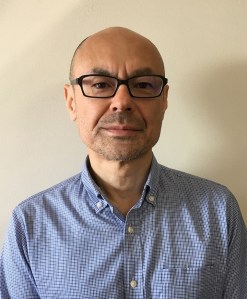
Atsushi Katayama is a PhD candidate in Communication Studies at Tokyo Keizai University in Japan.

Atsushi Katayama

He earned his MA in Media Studies from New York University. He has been working in the advertising industry as a creative director and copywriter for about thirty years. Throughout his experience in both  the professional and academic fields, he has been fascinated by the concept of “narrative” and the ways in which it works as a communication system in advertising.


Work for CID:

Atsushi Katayama translated KC35: Media Ecology into Japanese. He has also reviewed translations into Japanese.