KC99: Translanguaging Translated into Simplified Chinese

Key Concepts in ICDContinuing translations of Key Concepts in Intercultural Dialogue, today I am posting KC99: Translanguaging, originally written by Mohammed Guamguami for publication in 2021, and now translated by Yan Qiu into Simplified Chinese.

As always, all Key Concepts are available as free PDFs; just click on the thumbnail to download. Lists organized chronologically by publication date and numberalphabetically by concept in English, and by languages into which they have been translated, are available, as is a page of acknowledgments with the names of all authors, translators, and reviewers.

Key Concept #99: Translanguaging Translated into Simplified ChineseGuamguami, M. (2025). Translanguaging [Simplified Chinese]. (Y. Qiu, Trans.) Key Concepts in Intercultural Dialogue, 99. Available from: https://centerforinterculturaldialogue.org/wp-content/uploads/2024/12/kc99-translanguaging_simplified-chinese.pdf

If you are interested in translating one of the Key Concepts, please contact me for approval first because dozens are currently in process. As always, if there is a concept you think should be written up as one of the Key Concepts, whether in English or any other language, propose it. If you are new to CID, please provide a brief resume. This opportunity is open to masters students and above, on the assumption that some familiarity with academic conventions generally, and discussion of intercultural dialogue specifically, are useful.

Wendy Leeds-Hurwitz, Director
Center for Intercultural Dialogue


Creative Commons License
This work is licensed under a Creative Commons Attribution-NonCommercial-NoDerivatives 4.0 International License.
Save

Li & Lee: Transpositioning: Translanguaging and the Liquidity of Identity

Resources in ICD“ width=Li, W., & Lee, T. K. (2023). Transpositioning: Translanguaging and the liquidity of identity.
Applied Linguistics, 20, 1–16. https://doi.org/10.1093/applin/amad065

Transpositioning is an adaptation of the concept of positioning as used in social psychology, and is defined as “the process in which individuals articulate their personhood by taking up changeable identities in interaction” (p. 2). It should be relevant to those studying intercultural dialogue, though it has not yet been used in that context. See KC99: Translanguaging for a brief explanation of that concept.

“This essay seeks to address the seemingly random, ever-expanding, and shifting communicative demands of liquid modernity by focussing on two key issues: the need to reconceptualize language and communication as a consequence of the diversification of media and resources users draw upon to meet these demands; and the need for a new analytical framework to capture how people perform multiplex roles spontaneously and simultaneously through dynamic and adaptive communicative practices. We do the former with the concept of translanguaging and the latter with transpositioning.” (p. 1)

“Translanguaging facilitates transpositioning. The juxtaposition of the two terms underscores the simultaneous activation of multiple identities by way of mobilizing resources across the boundaries of named languages, new media, and entrenched ideologies. In this process, borders are renegotiated, circumvented, even outright rejected. What ensues are emergent and evolving semiotic spaces in which play—in the sense of a certain lightness of being, marked by a creative and critical ludicity—is a method of social engagement. One might thus say that communication in the liquid modern age comprises a non-committal play of identities where language users, in the manner of free-and-easy tourists creating itineraries on the whim, spontaneously (re)invent themselves by orchestrating all available and accessible resources in their semiotic repertoire in response to communicative stimuli from others.” (p. 14)

For a brief introduction to the topic, see KC99: Translanguaging.

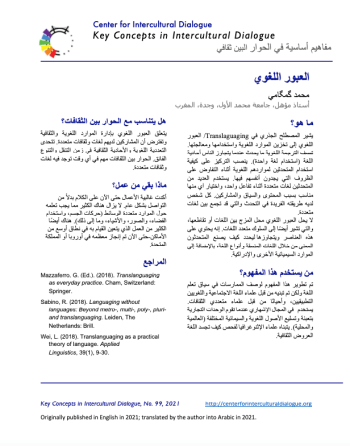
Key Concept #99: Translanguaging Translated into Arabic

Key Concepts in ICDContinuing translations of Key Concepts in Intercultural Dialogue, today I am posting KC#99: Translanguaging, originally written by Mohammed Guamguami for publication in 2021, and now translated by him into Arabic.

As always, all Key Concepts are available as free PDFs; just click on the thumbnail to download. Lists organized chronologically by publication date and numberalphabetically by concept in English, and by languages into which they have been translated, are available, as is a page of acknowledgments with the names of all authors, translators, and reviewers.

KC99 Translanguaging_ArabicGuamguami, M. (2021). Translanguaging [Arabic]. Key Concepts in Intercultural Dialogue, 99. Available from: https://centerforinterculturaldialogue.org/wp-content/uploads/2021/05/kc99-translanguaging_arabic.pdf

If you are interested in translating one of the Key Concepts, please contact me for approval first because dozens are currently in process. As always, if there is a concept you think should be written up as one of the Key Concepts, whether in English or any other language, propose it. If you are new to CID, please provide a brief resume. This opportunity is open to masters students and above, on the assumption that some familiarity with academic conventions generally, and discussion of intercultural dialogue specifically, are useful.

Wendy Leeds-Hurwitz, Director
Center for Intercultural Dialogue


Creative Commons License
This work is licensed under a Creative Commons Attribution-NonCommercial-NoDerivatives 4.0 International License.
Save

Key Concept #99: Translanguaging Translated into French

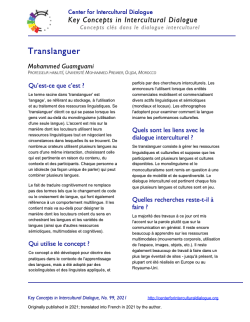
Key Concepts in ICDContinuing translations of Key Concepts in Intercultural Dialogue, today I am posting KC#99: Translanguaging, originally written by Mohammed Guamguami for publication in 2021, and now translated by him into French.

As always, all Key Concepts are available as free PDFs; just click on the thumbnail to download. Lists organized chronologically by publication date and numberalphabetically by concept in English, and by languages into which they have been translated, are available, as is a page of acknowledgments with the names of all authors, translators, and reviewers.

KC99 Translanguaging_French_v2Guamguami, M. (2021). Translanguer. Key Concepts in Intercultural Dialogue, 99. Available from:
https://centerforinterculturaldialogue.org/wp-content/uploads/2021/05/kc99-translanguaging_french_v2.pdf

If you are interested in translating one of the Key Concepts, please contact me for approval first because dozens are currently in process. As always, if there is a concept you think should be written up as one of the Key Concepts, whether in English or any other language, propose it. If you are new to CID, please provide a brief resume. This opportunity is open to masters students and above, on the assumption that some familiarity with academic conventions generally, and discussion of intercultural dialogue specifically, are useful.

Wendy Leeds-Hurwitz, Director
Center for Intercultural Dialogue


Creative Commons License
This work is licensed under a Creative Commons Attribution-NonCommercial-NoDerivatives 4.0 International License.
Save

KC99 Translanguaging

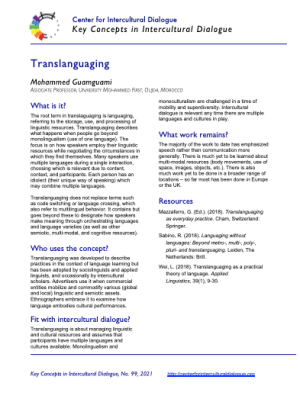
Key Concepts in ICDThe next issue of Key Concepts in intercultural Dialogue is now available. This is KC#99: Translanguaging, by Mohammed Guamguami. Click on the thumbnail to download the PDF. Lists organized chronologically by publication date and numberalphabetically by concept in English, and by languages into which they have been translated, are available, as is a page of acknowledgments with the names of all authors, translators, and reviewers.

KC99 TranslanguagingGuamguami, M. (2021). Translanguaging. Key Concepts in Intercultural Dialogue, 99. Available from: https://centerforinterculturaldialogue.org/wp-content/uploads/2021/01/kc99-translanguaging.pdf

The Center for Intercultural Dialogue publishes a series of short briefs describing Key Concepts in Intercultural Dialogue. Different people, working in different countries and disciplines, use different vocabulary to describe their interests, yet these terms overlap. Our goal is to provide some of the assumptions and history attached to each concept for those unfamiliar with it. As there are other concepts you would like to see included, send an email to the series editor, Wendy Leeds-Hurwitz. If there are concepts you would like to prepare, provide a brief explanation of why you think the concept is central to the study of intercultural dialogue, and why you are the obvious person to write up that concept.


Creative Commons License
This work is licensed under a Creative Commons Attribution-NonCommercial-NoDerivatives 4.0 International License.
Mohammed Guamguami Profile

ProfilesMohammed Guamguami is Associate Professor of English at Mohammed Premier University, Oujda, Morocco. He is also a current part-time teacher at ALC, American Language Center, Oujda.

Mohammed Guamguami

Prior to this, he was a full-time trainer at the CRMEF, teacher training center, Oujda. His doctorate is in Languages, Cultures and Communication (2015). His specializations are: English Language Teaching, Cross-Cultural Communication and Discourse Studies.

Mohammed has been a visiting scholar at several international universities: AUT, Beirut, Lebanon; DePaul University, Chicago, IL; State University of New York, NY; and IUPUI, Indianapolis, IN.

His major publications include:

Guamgaumi, M., et al. (In press). Rethinking knowledge, inquiry and learning in the big data age: Perspectives across disciplines.

Guamgaumi, M., Zeriouh, M. & Boujemâa, E. (Eds.). (2018). Culture, society and education: An interdisciplinary reader. London, UK: Dar El Maha.

Guamgaumi, M., Zeriouh, M., & Tizaoui, H. (Eds.). (2017). English for Specific Purposes: A reader. Egypt: Dar El Maha.

Guamgaumi, M., & Zeriouh, M. (2017). Moroccan cultural identity: Difference and belonging at a post-modern age. Egypt: Dar El Maha.

Guamgaumi, M. (2016). English hegemony on ICTs: Local linguistic, cultural and educational divide. Germany: Lambert.

Guamgaumi, M. (2015). Cross-cultural communication in foreign language discourse: Towards a pedagogy of culture teaching/learning in Moroccan EFL context. Germany: Lambert.


Work for CID:

Mohammed Guamguami wrote KC99: Translanguaging and translated it into French and ArabicKC100: Transcultural Communication and translated that into French and ArabicKC102: Inclusive Communication and translated that into French, and KC103: Geoculture. He is now translating earlier concepts into French; already published are KC1: Intercultural Dialogue, KC2:Cosmopolitanism, KC3: Intercultural CompetenceKC4: Coordinated Management of Meaning, KC5: Intercultural Communication, KC6: Intercultural Capital, KC7: Intergroup Relations DialogueKC8: Intercultural Dialogue, KC10: Cross-cultural Dialogue, KC11: Intercultural Discourse and Communication, KC12: Third Culture KidsKC13: Language EcologyKC14: Dialogue, KC15: Cultural Pluralism, KC16: MigrationKC17: Multilingualism, KC18: Intractable Conflict, KC19: Multiculturalism, KC21: Reflexivity, KC22: Cultural Identity, KC26: Global-Local Dialectic, KC32: Ethno-Political Conflict, KC36: Counter-narrativeKC39: Otherness and the Other(s), KC41: Yuan, KC46: Politeness, and KC49: Intersectionality. In addition, he has translated concepts into Arabic, including KC2: CosmopolitanismKC4: Coordinated Management of MeaningKC5: Intercultural CommunicationKC6: Intercultural CapitalKC7: IGR Dialogue, and KC12: Third Culture Kids. And he wrote Constructing Intercultural Dialogues #12: Transcultural Education in Context. He also participated in a CID/UNESCO focus group for the Futures of Education Initiative, and will be participating in an expert group organized by the Center.

CFP Languaging in Times of Change (UK)

ConferencesCall for proposals: Languaging in Times of Change, 26-27 September, 2019, University of Stirling, UK. Deadline: 1 April 2019.

‘Languaging’ refers to all types and modes of discourse and communication. The conference creates a space for discussions across disciplinary boundaries, as scholars come together to share research on communicative practices and ideologies in contexts of work, education, family, the arts, migration, leisure, politics, the digital world, and beyond. Organizers particularly welcome proposals for presentations from scholars whose research area is not solely or principally in linguistics. They also encourage presentations which report innovative research methodologies.

Individual papers and colloquia will be situated broadly within one of the following themes: Translanguaging, Advocacy and Activism, Superdiversity, Time/Space, Digital Worlds, Voice, Literacies.

CFP Various Guises of Translanguaging (Belgium)

ConferencesCall for papers: The Various Guises of Translanguaging, 1 July 2019, Ghent University, Belgium. Deadline: 31 March 2019.

This symposium will explore the paradoxes of translanguaging – how it is theorized, used and explained. Organizers seek to clarify but also critically evaluate the concept and to engage participants in discussion of their own and our related research. The aim of this symposium is to bring together researchers working in different disciplines, to collect a variety of perspectives on translanguaging and to stimulate discussion and participation in a day of collaborative inquiry. The symposium is a combination of traditional paper presentations and a series of keynote discussions

Organizing committee: Diane Potts (Lancaster University), Kirsten Rosiers (Ghent University), Stef Slembrouck (Ghent University), Piet Van Avermaet (Ghent University)


Translation & Translanguaging Films

Resources in ICD“ width=The 11 short films produced by the Translation and Translanguaging TLANG team provide a teaching and research resource in the areas of multilingualism, superdiversity, and sociolinguistics. They also document engagement approaches with different stakeholders. Those investigating linguistic and social diversity, migration, translation and translanguaging, may find them particularly useful. TLANG was a major research project active 2014-18; its aim was to understand how people communicate across diverse languages and cultures.

  1. Voices of the Bullring Markets : This video provides an introduction to the superdiverse nature of the Bullring meat and fish markets in Birmingham.

  2. The Library of Birmingham : This video provides an account of language and interaction at the Library of Birmingham.

  3. Communication in the Multilingual City: This film of the final TLANG conference contains discussions about translanguaging and offers a range of interpretations.

  4. Translanguaging and the Arts: A Creative Conversation:  This film explores researchers, artist and creative practitioners working together to represent multilingualism and superdiversity in new and engaging ways.

  5. Overcoming Barriers to University Education in South Africa: Highlights from workshops held in South Africa to engage university lecturers and managers in discussions about translanguaging as pedagogy in higher education in South Africa, and the role of South Africa’s official languages in university classrooms.

  6. Researching Translanguaging Summer School: Scholars from all over the world attended this summer school which explored different conceptualisations of translanguaging and methodological approaches for researching linguistic diversity.

  7. Women & Theatre: The TLANG team collaborated with a creative company, ‘Women and Theatre’, who produced an original piece of theatre in response to their engagement with the research project. The show was performed 22 times in four cities, to enthusiastic and appreciative audiences.

  8. A Network Assembly I:  This captures how a range of different stakeholders including policy makers, councillors, museum curators, local business people, artists, academics and students engage with concepts such as superdiversity, translanguaging and multilingualism.

  9. Changing Lives: This film shows the work of a Chinese community Centre and provides an account of how the lives of people visiting the centre are changing.

  10. Team Work in the City:  This film shows the coaching practices of a volleyball coach communicating with volleyball players from different countries around the world.

  11. Crossing Borders: Translanguaging as Social Practice.This short film captures our partnership with a range of stakeholders including artists, policy makers, academics and community activists around the themes of language, superdiversity, sport and law.

Free E-Seminar: Translanguaging, Superdiversity & ESOL

2017 e-seminar: ‘Translanguaging, superdiversity and ESOL’
ESOL-Research email forum
in collaboration with The AHRC-funded ‘Translation and Translanguaging: Investigating Linguistic and Cultural and Transformation in Superdiverse Wards in Four UK Cities’

Monday 23 January 2017 – Friday 10 February 2017

The e-seminar will take as a point of departure materials that will be circulated on the ESOL-Research email forum on Monday 23 January.

Discussants:
Dermot Bryers, English for Action, London
Melanie Cooke, King’s College London
Becky Winstanley, Tower Hamlets College, London

ESOL-Research members are invited to join the seminar discussion on the ESOL-Research forum.

The ESOL-Research email forum is an online site for discussion of matters relating to the teaching and learning of English for Speakers of Other Languages who are migrants to the UK. Membership stands at 950, and comprises ESOL professionals, academics and others interested in language learning in migration contexts. It is easy to subscribe, and also to unsubscribe, to the ESOL-Research email forum. Please visit www.jiscmail.ac.uk/ESOL-Research and follow the instructions at ‘subscribe/unsubscribe’. If you have any difficulty, please contact the list manager, James Simpson, j.e.b.simpson AT education.leeds.ac.uk

The timetable for the seminar is as follows:
23 January: materials for seminar distributed to ESOL-Research members
30 January: Discussant response distributed to ESOL-Research members
31 January: seminar opens to ESOL-Research members for contributions to discussion by email
10 February: seminar closes

Any queries please contact James Simpson, TLang co-investigator, University of Leeds  j.e.b.simpson AT education.leeds.ac.uk or Sarah Martin, TLang project administrator, University of Birmingham s.l.martin AT bham.ac.uk