The Role of Visual Arts in Improving Intercultural Dialogue 2025 (Malaysia)

“Collaborative

The role of visual arts in improving intercultural dialogue between sister cities, research project by Ramin Hajianfard, City University Malaysia, would appreciate your input.

Dr. Ramin Hajianfard, Senior Lecturer with the Faculty of Art at City University Malaysia, is looking for those with interests in visual arts and/or sister-city exchanges to complete a brief set of questions. The project is titled Intercultural Exchanges Between Isfahan and Kuala Lumpur in the Context of Visual Arts. Your observations and experiences are critical to understanding how visual art can foster intercultural dialogue.

This study examines how visual arts can strengthen the sister-city partnership between Isfahan and Kuala Lumpur—established in 1997—by fostering intercultural dialogue, preserving shared heritage, and advancing Sustainable Development Goals in education, urban development, and global partnerships. Employing a qualitative approach that combines semi-structured text interviews with experts, artists, and intercultural specialists, alongside case studies and document analysis, the research identifies both the barriers (e.g., limited past collaborations and misaligned policies) and the opportunities (e.g., complementary Islamic art traditions and digital platforms) for meaningful exchange. Grounded in cultural semiotics and intercultural aesthetics, the findings will inform policy alignment, institutional partnerships, and practical programs—such as reciprocal exhibitions, artist residencies, and virtual platforms—to enhance mutual understanding and sustainable cultural cooperation between the two cities.

The questions to be answered are these:

  • Arts as a Dialogue Tool: From a global perspective, what makes visual art an effective tool for fostering intercultural dialogue between communities or cities?
  • Respecting Cultural Heritage: How can international art initiatives be designed to respectfully highlight each participant’s cultural heritage while engaging diverse audiences?
  • Aligning with Global Goals: In your experience, how do intercultural arts exchanges contribute to broader goals like education and sustainable community building (for instance, what impacts have you seen related to learning outcomes or community resilience)?
  • Sustaining Partnerships: What strategies or best practices are important for establishing and sustaining successful intercultural art partnerships (such as those aligning with international collaboration goals like SDG 17)?

If you are interested, please contact him directly via email.

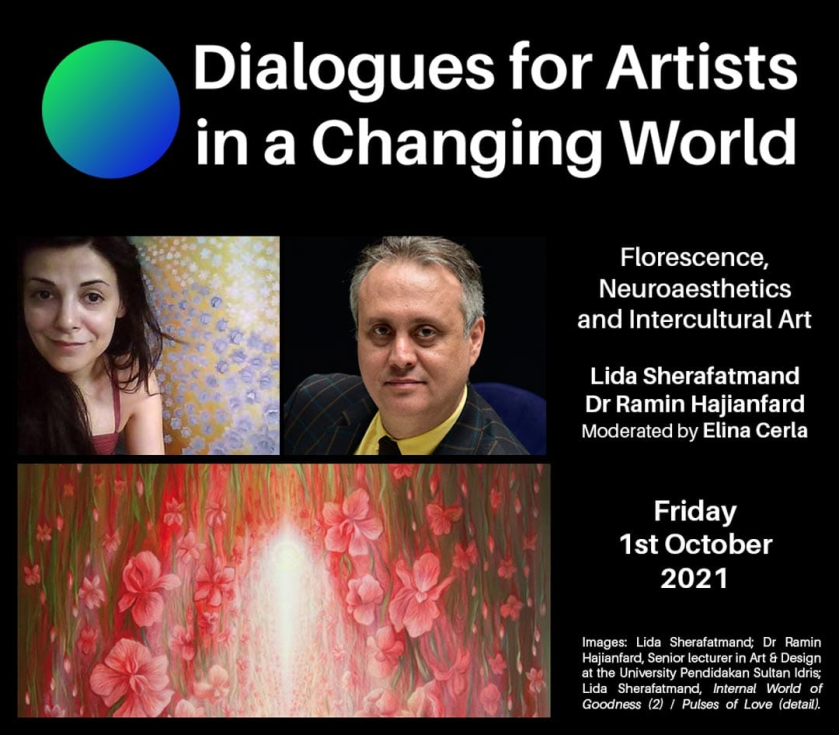
Dialogues for Artists in a Changing World (Malaysia but Online)

EventsDialogues for Artists in a Changing World: Florescence, Neuroaesthetics, and Intercultural Art, University Pendidakan Sultan Idris, Selangor, Malaysia, Online, October 1, 2021.

Dialogues for Artists in a Changing World

Florescence is the term used to refer to flowering; a potent image that recurs throughout art history with shifting contexts and symbolism. Lida Sherafatmand, co-author of the Manifesto of Florescencism, will discuss her belief in the power of art to contribute to social and environmental equilibrium, and its ability to resonate beyond geographic borders. Dr. Ramin Hajianfard, Senior Lecturer in Art & Design at the University Pendidakan Sultan Idris, Malaysia, whose research interests include peace painting and intercultural aesthetics, will participate as well. Touching on the importance of art having an awareness of other disciplines, including psychology and social science, the conversation will explore the political power of an aesthetics of gentle beauty and the importance for painting to be in constant conversation with many different spheres, as well as how research into neuroaesthetics can widen the scope of understanding of the ways in which art interacts with and affects viewers.

The event is scheduled for Friday, October 1, 2021. The times are as follows:
Malaysia – 10.50pm / 11pm start
Central Europe – 4.50pm / 5pm start
UK/Ireland – 3.50pm / 4pm start
East Coast US – 10.50am / 11am start
West Coast US – 7.50am / 8am start

(Follow the link in the first paragraph to participate.)

Ramin Hajianfard Profile

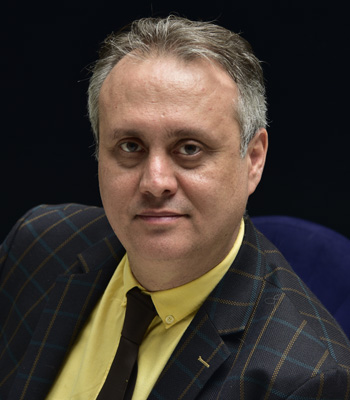
ProfilesRamin Hajianfard (Ph.D., International Islamic University of Malaysia) is senior lecturer in Art & Design at the University Pendidakan Sultan Idris, in Selangor, Malaysia.

Ramin Hajian FardHis main area of research is on Mughal miniature painting, with a secondary emphasis on interfaith dialogue during the Mughal Empire of India. His MA was on peace painting, resulting in the following article:
• Hajianfard, R. (2013). Iranian painters for peace. Peace Review: A Journal of Social Justice, 25(2), 284-290.

He has written multiple entries for encyclopedias: six entries for The Great Events in Religion: An Encyclopedia of Pivotal Events in Religious History (English), and five entries for the Great Islamic Encyclopedia (Persian).

He has published articles in both Persian and English including:

• Hajianfard, R. (2013). An introduction to the art of illuminating the Qur’an. Journal of Arts, Culture & Heritage, 2, 95-109 (English).

• Hajianfard, R. (2012-2013). Hajj painting: A traditional Egyptian art celebrating the Hajj. Bulletin of International Institute of Islamic Science, Thought and Civilization, 4, 12-13.

• Hajianfard, R. (2014). French orientalist painting: Colonial views or an artistic approach? In B. Atashinjan (Ed.), Naghd-e Nāmeh-e Honar [Professional Book (vol. 6) on the Research and Art Criticism] (pp. 25-45). Tahran: Mugham (Persian).

He has also translated multiple books, articles, and book chapters, about music, art, and philosophy, into Persian for publication in Iran.

He was the winner of the second prize for publishing and research at the University of Applied Science and Technology, Iran, 2013.

A video presentation he recently made, Persian Manuscripts of Ramayana || Illustrative Miniature Paintings, is now available on YouTube. (His part begins at 15:27.)


Work for CID:

Ramin Hajianfard wrote KC75: Sulh-i-Kul and KC83: Intercultural Aesthetics. He has translated KC1: Intercultural DialogueKC2: Cosmopolitanism, KC3: Intercultural CompetenceKC4: Coordinated Management of Meaning, KC5: Intercultural CommunicationKC6: Intercultural CapitalKC7: Intergroup Relations DialogueKC8: Public Dialogue, KC10: Cross-Cultural Dialogue, KC75: Sulh-i-Kul, and KC83: Intercultural Aesthetics into Persian. He also has served as a reviewer for translations into Persian. He is currently working on a project looking at visual art as a tool for intercultural dialogue between sister cities, and is interested in hearing from people with overlapping interests.