
 This poster was designed by Linda J. de Wit, and published previously; it now has been translated into Spanish.
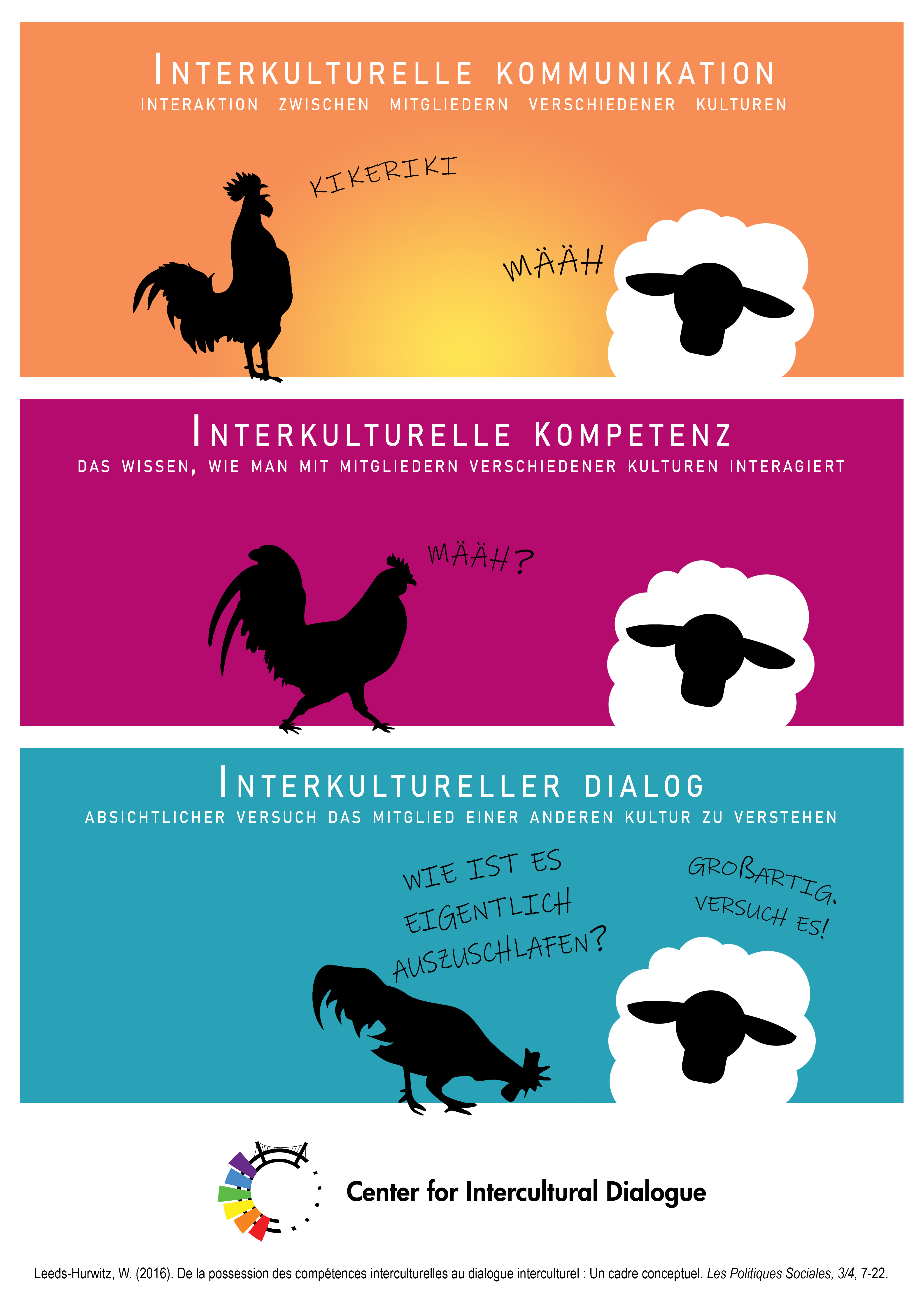
This one provides a quick and easy way to understand, and differentiate between, the concepts of “intercultural communication,” “intercultural competence,” and “intercultural dialogue,” using a rooster and a sheep to represent members of different cultures (and she notes that the animals are vector designs by vecteezy.com).
The Spanish translation was provided by Neus Crous-Costa, and the graphic design work necessary to revise was by Yan Qiu. Here then is CID Poster 1: Comunicación / comunicació / competència.
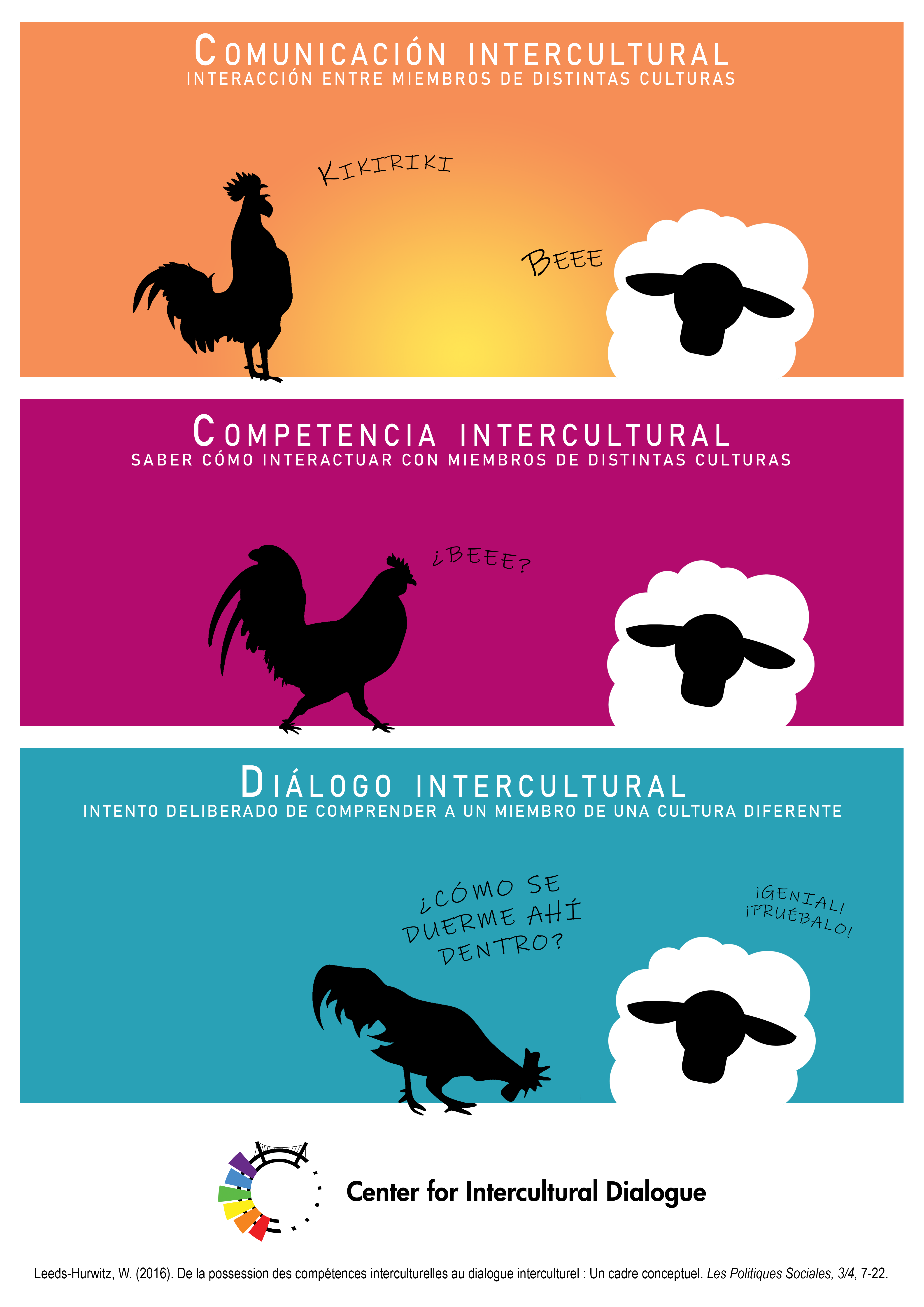
The article where these explanations of these concepts (as well as lots of other concepts) were published is:
Leeds-Hurwitz, W. (2016). De la possession des compétences interculturelles au dialogue interculturel: Un cadre conceptuel [Moving from having intercultural competencies to constructing intercultural dialogues: A conceptual framework]. Les Politiques Sociales, 3/4, 7-22.
Just in case anyone wants to cite this poster, the following would be the recommended format:
Center for Intercultural Dialogue. (2026). Comunicación / comunicació / competència intercultural [N. Crous-Costa, trans.]. CID Posters, 1. Available from: https://centerforinterculturaldialogue.org/wp-content/uploads/2026/02/cid-poster-1-animals-spanish.png
As with other series, CID Posters are available for free on the site; just click on the thumbnail to download a printable version. They may be downloaded, printed, and shared as is, without changes, without cost, so long as there is acknowledgment of the source.
As with other CID Publications, if you wish to prepare an original contribution, please send an email before starting any work to receive approval, to minimize inadvertent duplication, and to learn about technical requirements. As is the case any series, posters should be created initially in English. If you want to volunteer to translate a poster into a language in which you are fluent, send in a note before starting, to receive approval and to confirm no one else is working on the same one.
Wendy Leeds-Hurwitz
Director, Center for Intercultural Dialogue
intercult.dialogue AT gmail.com

This work is licensed under a Creative Commons Attribution-NonCommercial-NoDerivatives 4.0 International License.


 Center for Intercultural Dialogue