Maria Flora Mangano: Standing for Peace Without Weapons

Guest PostsStanding for Peace Without Weapons. Guest post by Maria Flora Mangano.

In 2025, we are celebrating the eightieth anniversary of several events related to the end of World War II, including the launch of the bombs which devastated Japan. Oppenheimer immediately realized the need to avoid global destruction, and soon he stepped back from atomic weapons, instead promoting disarmament and peace among the international community of physicists and scientists. His commitment to peace encountered strong opposition among the political and government contexts of that time. At the end of the war, he was removed from government and academic positions, and he charged with supporting communism through his pacifist ideas. He was rehabilitated, teaching in the US before his death. A few months after the creation of the atomic bomb, Oppenheimer delivered a speech in the same place where the group of physicists worked and helped to create the Association of Los Alamos Scientists. They, in turn, mobilized the scientists of the world to support a peaceful use of science and knowledge, arguing for global disarmament.

What may his words suggest to us, in this tragic and dark time for the whole world, when it seems that history has taught us nothing?

Are we really powerless and inexorably in the hands of our politicians’ choices, as the obvious vision of the world seems to suggest? Do we really believe that the end of the wars come from those with the loudest voices and as a result of weapons?

Download the entire post as a PDF.

Maria Flora Mangano: Gratitude is My Attitude

Guest PostsGratitude is My Attitude. Guest post by Maria Flora Mangano.

Thankfulness may become mutual, as it is focused on our approach to the Other.

Working with students can be more than a job; it may become a life choice, an answer to a call, which we choose every day. It may turn into an attitude, a perspective on reality, a vision of the world centered on the Other rather than on us. This approach may also change our relationship to our students, and, far more broadly, with our daily lives.

…If we can shift the center of gravity from ourselves to the Other, we may experience gratitude as a pure feeling which does not depend on us, thus on our abilities, successes, or results. It reminded me of the I-Thou relationship as theorized by Martin Buber (1937), thus, the basic idea that the relationship lies in the between, perhaps in the hyphen between, the I and the Thou (Mangano, 2018, p. 27). It is a space which depends neither on the I, nor on the Thou; it is in the middle, in the between, in the “space of us.”

When we are able to decenter ourselves and put the Other at the center of the scene, we may also see what already exists, rather than what is missing. We may experience wonder, as we do not expect a gift: the Other may already be a gift, and we do not need any additional expectation. This approach, that of an unexpected surprise, may provide a new perspective on reality as a glass half-full; sometimes even completely full. In this attitude, gratitude sounds likely to be close to hope, an endless source of water although just a few drops may be enough, as they can guarantee the strength to carry on.

Download the entire post as a PDF.

Lenehan and Lietz Guest Post: The Need for a Cosmopolitan Perspective

Guest Posts
The need for a cosmopolitan perspective. Guest post by Fergal Lenehan and Roman Lietz.

The very malleability of the cosmopolitan concept – which can sometimes make it seem incoherent – is actually the great advantage of the notion. The concept has the potential to greatly help scholars, as we argue in our book Reimagining Digital Cosmopolitanism: Perspectives from a Postmigrant and Postdigital World, to conceive of the relationship between human beings, their cultural contexts, and the wider communicative world in relation to digital technologies, in new and interesting ways which can potentially advance scholarship. This may be seen in relation to the theoretical re-thinking of the internet as a global and connecting technology, in terms of analyzing of those who use the internet, while the cosmopolitanism discourse also helps scholars when theorizing about the online spaces of encounters and the myriad of digital connections contained by, and possible with, digital technologies.

Download the entire guest post as a PDF.

Penman Guest Post: Dialogue in the Interests of Justice

Guest Posts
Dialogue in the interests of justice. Guest post by Robyn Penman.

I propose that the dialogic form can act as an aspirational model: it is an orientation to a way of communicating, a commitment to doing it better and, only occasionally, an accomplishment.

In one way, the link between dialogue and justice seems obvious, at least as far as social justice is concerned. As Kathryn Sorrells (2015) noted in her discussion of social justice Key Concepts on Social Justice, intercultural dialogue is critical to both the process and goal of social justice because it enables us to reach across difference to creatively engage with others. Yet, even appreciating how critical that link is, there is so much more that needs to be considered. In particular, as Sorrell sums up, there is a critical need for more interdisciplinary work on understanding the importance of communication in building relationships and systems based on social justice.

The critical need for taking communication into account is reflected in such questions as: How exactly does the key role of dialogue for meeting social justice goals get played out in practice? How is it possible to even create the conditions for dialogue in unjust circumstances? And what does dialogue have to do with the common idea of social justice as the equitable distribution of resources and rights? These questions open up a whole new vista of possibilities, even to a re-consideration of what justice itself can mean.

Download the entire guest post as a PDF.

Yang Guest Post: The Evolving Field of Multilingual Studies

Guest Posts
The evolving field of multilingual studies. Guest post by Mimi Yang.

The evolving field of Multilingual Studies integrates intercultural and interdisciplinary studies missed in traditional scholarship. Most people are multilingual or interlingual (that is, bilingual, trilingual, or simply polyglots), who cross linguistic frontiers as part of daily life or at times mix different linguistic codes as a second nature, usually to a receptively multilingual audience. Linguistic code switching (moving between languages or dialects in a single conversation) in itself brings cultures together in speech and dialogue, which, in return, stimulate further code-switching. Some of us are multilingual by training and others were born into an intercultural and interlingual environment. Multiple dimensions of multilingualism weave intercultural dialogues inherently and intimately.

Download the entire guest post as a PDF.

Knappitsch Guest Post: Empowering Remote-Ready Graduates

Guest Posts
Empowering Remote-Ready Graduates: The Transformative Role of Virtual Exchange in Career-Oriented Education. Guest post by Eithne Knappitsch.

The integration of Virtual Exchange (VE) and Collaborative Online International Learning (COIL) into career-oriented education represents a significant evolution in preparing students for the modern workforce. These innovative educational models not only bridge geographical and cultural gaps, offering a responsible form of international exchange, but also align closely with the shift towards competency-based learning, equipping students with the necessary skills and competencies for remote work and leadership in virtual teams. Recent studies indicate that Higher Educational Institution (HEI) educators are increasingly aware of the potential of VE in contributing to innovation and skills development.

Download the entire guest post as a PDF.

Corbett & Holmes Guest Post: Critical Intercultural Pedagogy for Difficult Times

Guest Posts
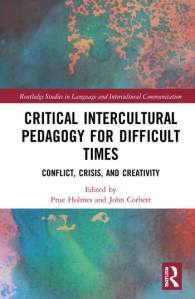
Critical Intercultural Pedagogy for Difficult Times. Guest post by John Corbett and Prue Holmes.

Critical Intercultural Pedagogy for Difficult Times: Conflict, Crisis, and Creativity, edited by Prue Holmes and John Corbett (2023) is a volume of case studies and theoretical reflections which arose from an AHRC Research Network project, initiated, and led by Prue Holmes of the University of Durham in 2019. Holmes was interested in exploring the theoretical and practical issues involved in the creative application of critical intercultural teaching and learning in conditions of conflict and extended crisis. In short, how does critical intercultural pedagogical theory inform creative practice, and vice versa, in what Holmes and her team came to think of as ‘difficult times’?

As Khawla Badwan, in the title of her chapter, on intercultural communication and vulnerability, observes, “I’m afraid there are no easy fixes”. There are, indeed, no easy fixes, and, for those of us engaged in intercultural education, there seems cause, too often, for despair. However, the case studies reported in this volume affirm, through their modest tales of resilience, aspiration, and hope, that in the enveloping darkness there are flickers of light.

Download the entire guest post as a PDF.

Hughes & Bartesaghi Guest Post: Disability as Intercultural Dialogue

Guest Posts
Disability as Intercultural Dialogue. Guest post by Jessica M. F. Hughes & Mariaelena Bartesaghi.

Ethnomethodologist Carolyn Baker argues that culture is not a pre-made context for action to unfold, but rather an ongoing moral order of categories and categorization, where locally produced categories become “locked into place” (2000, p. 99). This is how we understand—and are able to talk about—disability in terms of culture, as an assemblage of voices, bodies and actions within a contingent and shifting social order(ing). Just as Bakhtin (1986) tells us that there is no first speaker, but rather language as coordination over time and amidst utterances in relation, disability can only mean in terms of what we are able to (co)produce it as meaning. In our book, Disability in dialogue (Hughes & Bartesaghi) contributors set out on empirical projects designed to trouble the categories of disability within several cultural frames: geographical settings, diagnostic accounts, political action, crisis events, and everyday occurrences.

Inasmuch as disability is a culture, an ordering of relations and identity projects, of what is and might be possible, of what is historically entrenched and institutionally regulated, then disability is also an intercultural doing. This is the case not merely in the exchanges between a culture of able bodiedness to which disability owes its constitution, but between the multiple and diverse identity positions of those who are incumbent within the culture of disability. These exchanges are dialogic through and through, for they always mirror, borrow, and often oppose each other. In Shotter’s words (2015), these dialogues are occasions for attunement (p. 8) and intercultural betweenness.

Analyzing disability discourses means appreciating dialogic tensions, the centripetal and centrifugal forces at work, the constant interplay between dialogue and monologue. And it means listening to the diverse voices that, as Bakhtin remarked, are everywhere and always in relation.

Download the entire guest post as a PDF.

Knappitsch Guest Post: The Global Case Study Challenge

Guest Posts
The Global Case Study Challenge: Competencies for the Future of Work in Virtual Environments.
Guest post by Eithne Knappitsch.

The Global Case Study Challenge (GCSC) began as a Collaborative Online International Learning (COIL)/Virtual Exchange program, offering students an authentic and immersive intercultural learning opportunity. As the importance of New Work and remote work contexts grew following COVID, it became clear that students and professionals needed to develop more effective competencies to excel virtual and hybrid work environments. Initial iterations of the GCSC revealed that while students possessed strong digital skills, they frequently lacked essential digital collaboration competencies – the attitude, knowledge, and skills to become high performing teams in diverse, interdisciplinary, and international contexts. Recognizing this gap in competencies needed for future New Work environments and those acquired at higher educational institutions, the need for the GCSC to further develop into a transformative, career-oriented global teaching and learning program became obvious. At the same time, the GCSC management team – a virtual female-led team – became inspired by the potential for virtual exchange to contribute to a paradigm shift in higher educational settings as responsible and sustainable forms of education (and internationalization). The GCSC, over the five consequent iterations from 2018 onward evolved into a transformative program, resulting in the development of the GLOW model. This CID guest post explores how the GCSC GLObal Work (GLOW) model addresses these pressing needs and empowers students and educators with the competencies required to excel in virtual and intercultural work settings.

Download the entire guest post as a PDF.

Sommier, Roiha & Lahti: Implementing Critical Approaches to Interculturality in Higher Education

Guest Posts
Implementing Critical Approaches to Interculturality in Higher Education.
Guest post by Mélodine Sommier, Anssi Roiha & Malgorzata Lahti.

Critical approaches to interculturality have gained visibility over the years, both within and outside of academia. And yet, the increasing drive across European hHigher eEducation institutions to implement internationalization strategies is often articulated around assuming traditional notions of culture, diversity, and intercultural communication. This gap between critical research in interculturality and concrete implementation of intercultural education is what drove us to ask colleagues how they put critical approaches to interculturality into practice.

Indeed, inviting critical interculturality into classrooms is a holistic process that takes time since it asks teachers to familiarize themselves with that approach as well as to depart from the limitations of traditional pedagogical frameworks.

Download the entire guest post as a PDF.