UNESCO: Associate Project Officer: PEACE Project (Cambodia)

“JobAssociate Project Officer, Communication and Information Sector, UNESCO, ​Phnom Penh, Cambodia. Deadline: 18 November 2024.

Under the overall authority and the direct supervision of the UNESCO Representative in Cambodia, in close coordination with the Programme Specialist in Culture, the Associate Project Officer will be responsible for the overall management and implementation of the PEACE Project. In particular, the incumbent will:

  • Provide technical assistance for the overall project management and implementation to deliver the desired project activities and outcomes.

  • Manage the project team to ensure effective performance management to achieve programme objectives, including identifying subject experts and partners, developing Terms of References for experts and institutions, procuring and managing international and national experts and service providers, and ensuring close supervision and quality assurance for deliverables, products and services to implement programme activities.

  • Monitor the timely implementation and delivery of the project workplans and budget plans to achieve the identified project objectives and targets. This includes regular monitoring and supervision of missions and meetings, developing and maintaining monitoring and evaluation worksheets of project targets and progress, and knowledge products.

  • Ensure the timely preparation and submission of all progress reports, in line with KOICA’s reporting requirements.

  • Develop and implement visibility and outreach strategies to maximise the project results and impact, including through developing and disseminating communications and visibility materials such as articles, press releases, social media posts, posters, visual data, brochures, project presentations, among others.

  • Identify, maintain and expand strategic partnerships with relevant partners, including MoCFA, TSGM, Choeung Ek Genocidal Centre, line ministries, research and education institutes, CSOs, development partners, foundations, and the private sector to facilitate innovative project implementation and overall relevance and alignment of project outcomes.

  • Maintain UNESCO’s strategic role in promoting peacebuilding and human rights and addressing hate speech through archives preservation and digitization, culture conservation and peace education. This includes leading/participating and providing inputs in relevant UN inter-agency initiatives, working closely with the UN Country Team in joint advocacy, convening multi-stakeholder engagement with government entities, CSOs, international organizations, development partners, and academia, in line with the UN Sustainable Development Cooperation Framework (2024-2028).

Other current openings with UNESCO available here.
What Can and Should We Learn From These Dark and Tragic Histories?

“Associate

I spent about three months between January and April 2024 traveling in several countries in Asia, including Singapore, Malaysia, Cambodia, Vietnam, China, Hong Kong, and Taiwan.

While the trip entailed a field research project about the use of visual media as a form of multicultural communication in Southeast Asia, I took advantage of the occasion to explore many local cultures or heritages in the vast region. For example, I visited some UNESCO World Heritage sites, such as Angkor Wat in Cambodia, the Singapore Botanic Gardens in Singapore, George Town in Malaysia, and Hoi An Ancient Town in Vietnam.

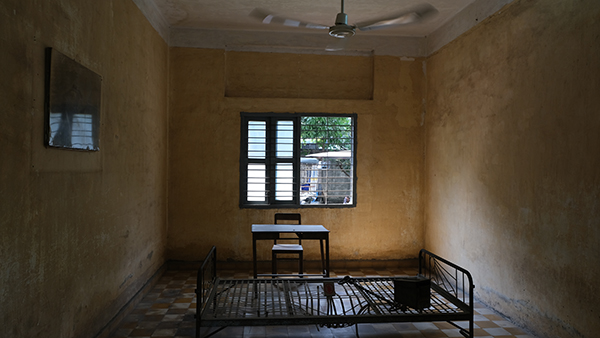
Some classrooms were repurposed as interrogation rooms at Tuol Sleng

But while the above heritage sites and many other such cultural resources were truly very remarkable, my visits of the Tuol Sleng Prison and the Choeung Ek Genocidal Center in Phnom Penh, Cambodia, have left a long-lasting impression on me. Both sites, and many other sites such as these that have been collectively called the Killing Fields, came from an extremely dark and bloody history that was the genocide (with up to three million people murdered) committed by the Khmer Rouge government under Pol Pot between 1976 and 1978.

I have read about the Cambodian genocide by the Pol Pot regime in media reports through the years since college, although I have never seen the 1984 British film The Killing Fields. But none of what I have read about this tragic history could have prepared me for the shock and sadness I experienced during my visits there.

Tuol Sleng, or S-21 Prison, was one of about 189 interrogation (read torture) centers during those tumultuous years under Pol Pot’s Khmer Rouge regime. It was inaugurated on April 17, 1980, as a memorial museum and has been open to the public since. According to the United States Holocaust Memorial Museum, “Between 14,000 and 17,000 prisoners were detained there, often in primitive brick cells built in former classrooms. Only 12 prisoners are believed to have survived.”

Located approximately 11 miles south of Phnom Penh’s city center, the Choeung Ek Genocidal Center is perhaps the most well-known among about 300 Killing Fields. Tuol Sleng was directly tied to the Choeung Ek site in that (“confessed”) prisoners from S-21 were sent to Choeung Ek for their summary execution. Close to 9,000 bodies were exhumed from the mass graves after they were initially discovered. When I was there, sections of the open-air fields were still cordoned off to prevent visitors from accidentally disturbing any human remains that were still buried there. Perhaps one of the most iconic symbols of Choeung Ek is the Buddhist stupa, which houses more than 5,000 human skulls that are encased behind acrylic glass.

My attendance at the various exhibits in both the Tuol Sleng and the Choeung Ek sites was nothing short of being surreal and, at times, bone-chilling. One of the most unforgettable parts of the visits has been our close proximity to the objects being on display. For example, in Tuol Sleng, which was housed in a repurposed school, we were standing right in front of the bed in the middle of several of the former classrooms where the prisoners were tied and tortured for their confession. In the extremely tight space inside the Buddhist stupa at Choeung Ek, we were literally inches away from the human skulls on display. I overheard a fellow traveler who refused to go inside the stupa precisely because they felt uncomfortable getting so close to the skulls.

Indeed, the visit to Tuol Sleng and Choeung Ek was by no means a positively pleasant experience, regardless of how educational it may have been. It certainly reminded me of my visit to Auschwitz I and Auschwitz II-Birkenau outside of Krakow, Poland, in 2018. In both cases, I walked away with more questions than I had answers. What can and should we learn from these dark and tragic histories?

Casey Man Kong Lum, Associate Director
Center for Intercultural Dialogue

Photo credit: Casey Man Kong Lum

Center for Khmer Studies: Junior Resident Fellowships (Cambodia)

FellowshipsCall for applications: Junior Resident Fellows Program, Center for Khmer Studies, Siem Reap, Cambodia, 1 July-9 August 2024. Deadline: 29 February 2024.

A six-week program in Cambodia for Cambodian, French, and US students to live and study alongside peers about contemporary Cambodian history and society. The Junior Resident Fellows Program provides students with a once-in-a-lifetime experience, allowing them to live and study alongside peers from different backgrounds and cultures while learning about contemporary Cambodian history and society.

Each summer, the Center for Khmer Studies (CKS) offers five U.S., five Cambodian, and five French undergraduate students and recent graduates the exciting opportunity to participate in a six-week Junior Resident Fellows Program in Cambodia. Fellows are based at the CKS campus in Siem Reap, situated on the historic grounds of Wat Damnak – one of the city’s major Buddhist pagodas – and mere minutes away from the world-renowned Angkor Wat temple complex. Fellows also spend time in Cambodia’s bustling capital city, Phnom Penh.

CFP CALA 2019 Revitalization & Representation (Cambodia)

ConferencesInaugural Conference on Asian Linguistic Anthropology, The Paññāsāstra University of Cambodia, Siem Reap, Cambodia, January 23-26, 2019. Deadline: June 15, 2018.

The theme for the inaugural CALA is Revitalization and Representation, a theme pertinent to the current state of many Asian regions and countries vis-a-vis their global analogues.

Emerging from a complex weaving for received and produced colonializations, the languages and ethnicities within Asia have experienced strong curtailment and denigration, to the point where many have reached near extinction, while others have passed the point of extinction. Here, these languages and ethnicities require urgent revitalization through an anthropological set of approaches, in collaboration with academic, and non-academic, networks globally. Revitalization can be engendered effectively through the complex channels associated with and effected through the extensive and vast work developed in Representation. Cambodia seems to be at the centre of this need for focus, with many ethnicity and their languages currently on the brink of extinction, and with several now having less than ten living speakers.

CFP Asian Linguistic Anthropology (Cambodia)

ConferencesCall for Abstracts: Conference on Asian Linguistic Anthropology (CALA): Revitalization and Representation, January 23-26, 2019, Siem Reap, Cambodia. Deadline: February 9, 2018.

Following extensive requests for an Asian specific focus on Linguistic Anthropology, and related fields, the CALA has emerged, and is now managed by the Paññāsāstra University of Cambodia. The CALA, The Conference on Asian Linguistic Anthropology, the first of which will be held in January 2019, in Siem Reap, Cambodia, and then at a different University each year, will bring together:

  • Linguists
  • Anthropologists
  • Linguistic and Cultural Anthropologists
  • Culturologists
  • Sociologists
  • Political Scientists
  • Those in the Arts
  • other related fields pertinent to Asia.

James Schnell – Fulbright

James Schnell
Ohio Dominican University

Fulbright Senior Scholar, Cambodia

The Fulbright Senior Scholar Program provided me with a wonderful opportunity to invigorate my work at my home institution by applying my expertise at another school in another culture.  I had never been to Cambodia before and working at the Royal University of Phnom Penh, the largest and oldest university in Cambodia, was personally and professionally rewarding.

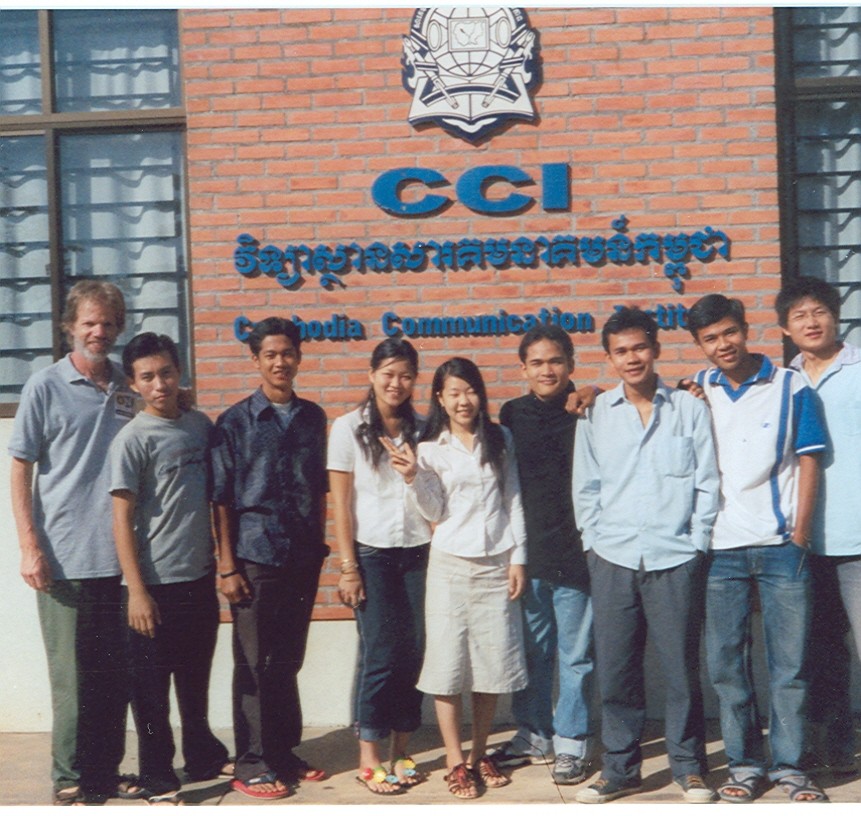
I received a six-week grant that I divided into two separate three week visits.  The first trip gave me a chance to get acquainted with the Department of Media and Communication/Cambodia Communication Institute at the university, work with students & faculty and assess how I could best make lasting contributions.  I followed this with a second trip, ten months later, and used the intervening ten months to collect materials that helped with enhancements on my second trip.

The purpose of the grant was to support the Department of Media and Communication/Cambodia Communication Institute in developing an appropriate educational program for the education and training of future Cambodian journalists.  This, more specifically, entailed focusing on development and improvement of curriculum for the undergraduate program and developing teaching materials in communication theory, human resource management, introduction to research methodology and related areas.

My work at the university involved presenting lectures, participating in seminars, conducting needs assessments, assisting with faculty development, encouraging curriculum development and other matters linked to my areas of expertise.  I created an 11 page Manual for Organization of Research Papers, Rules for Writing Style & Preparation of Oral Presentations.” I also created a small reference library consisting of over 60 new (state of the art) books that I brought as a donation to their program.  This collection consisting of books dealing with telecommunication, journalism, mass media, public relations, communication research, human resource management and related areas.

Part of the challenge of this assignment was finding creative ways to achieve objective.  The mail system in Cambodia was unreliable so I needed to personally bring the books with me.  On my second trip I was permitted 120 pounds of luggage and 105 pounds of it were books!  Getting the books to them was important as I saw this collection as being a foundation that they could build from in a variety of ways using their own initiative.

This Fulbright grant gave me a great opportunity to re-think much of what I do and how I do it at my home institution.  Working with colleagues and students in my discipline, but within another cultural context (especially one that is quickly changing), forced me to revisit many of the assumptions I have regarding my academic discipline and how I work within that discipline.  It is an invigorating experience that will have a lasting impact on my teaching and research at my home institution.  Being able to make new friends and establish collegial relationships in another culture is always fulfilling, professionally and personally.

I continue to maintain contact with Sopheap Phan, my primary host during my work in Cambodia.  We have gotten together on two occasions and we engage in periodic e-mail exchanges.  I foresee doing follow-up trips to Cambodia that will build upon my experiences there in 2005-2006.