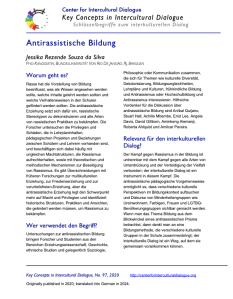
Key Concept 110: Tourism

Key Concepts in ICD

The next issue of Key Concepts in intercultural Dialogue is now available. This is KC110: Tourism by Neus Crous-Costa. As always, all Key Concepts are available as free PDFs; just click on the thumbnail to download. Lists organized chronologically by publication date and numberalphabetically by concept in English, and by languages into which they have been translated, are available, as is a page of acknowledgments with the names of all authors, translators, and reviewers.

KC110 TourismCrous-Costa, N. (2024). Tourism. Key Concepts in Intercultural Dialogue, 110. Available from: https://centerforinterculturaldialogue.org/wp-content/uploads/2024/02/kc110-tourism.pdf

The Center for Intercultural Dialogue publishes a series of short briefs describing Key Concepts in Intercultural Dialogue. Different people, working in different countries and disciplines, use different vocabulary to describe their interests, yet these terms overlap. Our goal is to provide some of the assumptions and history attached to each concept for those unfamiliar with it. As there are other concepts you would like to see included, send an email. If there are concepts you would like to prepare, provide a brief explanation of why you think the concept is central to the study of intercultural dialogue, and why you are the obvious person to write up that concept.


Creative Commons License
This work is licensed under a Creative Commons Attribution-NonCommercial-NoDerivatives 4.0 International License.

Queens U Belfast: International Relations (Northern Ireland)

“Job

Professor of International Relations, Queens University Belfast, Northern Ireland. Deadline: 22 April 2024.

The School of History, Anthropology, Philosophy and Politics (HAPP) at Queen’s University Belfast, is currently seeking to recruit a talented Professor of International Relations. They conceive of IR as a dynamic intellectual space that is transforming itself in the face of global challenges that both trouble and exceed familiar disciplinary conventions. These challenges include, but are not limited to: irreversible climate breakdown; the rise of global pandemics; new forms of capitalist extraction; increased reliance on technological and algorithmic governance; the collapse and remaking of global financial institutions; the imperatives of decolonialisation; the interlocking dilemmas of security, mobility, and liberty; transforming contexts for protest and resistance; the messy aftermath of entrenched conflict; and the blurring of war, policing, and occupation, all within a context of faltering global governance and multilateral cooperation.

Vienna School of International Studies: Postdoc in International Studies (Austria)

PostdocsPostdoctoral Fellowship in International Studies, Vienna School of International Studies, Vienna, Austria. Deadline: 2 April 2024.

The Vienna School of International Studies (Diplomatische Akademie Wien) is proposing the appointment of a Postdoctoral Fellow in International Studies for three years, starting October 2024. Upon successful evaluation at the end of the second year, the position can be extended for another two years. Geared towards promoting the professional development of the appointee, he/she will focus on his/her own research and do a limited amount of graduate teaching.

The successful candidate must hold – or have evidence of the imminent completion of – a doctorate in Cultural Studies, History, Law or Political Science. A record of research achievement at the international level, a strong agenda for future research and previous teaching experience – preferably at graduate level – are essential.

The Vienna School of International Studies is a professional school, specialized in the interdisciplinary education of graduate students, and an associate member of APSIA. The presence of international organizations in Vienna makes for excellent research opportunities, in particular for research dealing with diplomacy, governance and multilateralism broadly defined.

John Cabot U: International Relations &/or International Law (Italy)

“Job

Visiting faculty member in International Relations and/or International Law, John Cabot University, Rome, Italy. Deadline: 4 May 2024.

John Cabot University (JCU) invites applications for a full-time visiting faculty position in International Relations and/or International Law. The appointment is for one year, beginning August 2024, and with possibility of renewal. They seek candidates with a Ph.D. in International Relations or International Law, demonstrated excellence in teaching and research, and commitment to academic service. The area of specialization is open, but preference will be given to applicants with an interdisciplinary expertise in the two above-mentioned areas. Special consideration will be given to candidates with expertise in Cybersecurity, Environmental Politics, Transatlantic Relations and US Politics, Food Security and International Development.

The ideal candidate should have familiarity and experience with the American liberal arts educational tradition, and be prepared to teach introductory courses (e.g., World Politics, International Organizations, International Law) as well as courses in their area of expertise. The teaching load is three courses per semester. Candidates are expected to be fluent in English, which is the language of instruction, and to have permission to work in the EU.

CFP IICD of NCA 2024

ConferencesCall for submissions: International & Intercultural Communication Division, National Communication Association, 21-24 November 2024, New Orleans, LA, USA. Deadline: 5 April 2024.

The International and Intercultural Communication Division (IICD) of the National Communication Association invites scholarly submissions that examine, question, and/or critique communication in and across cultural, intercultural, and international contexts. Four kinds of submissions will be considered this year: (1) individual papers, (2) paper sessions, (3) panel discussions, and (4) performance sessions.

National Communication Association’s 110th annual convention theme is “Communication for Greater Regard.” The convention theme encourages scholars, teachers, practitioners, and performers in the field of international and intercultural communication to share new ideas, pursue new lines of inquiry, engage diverse theoretical and methodological approaches, foster interdisciplinary collaborations, and produce transformative scholarship. Explore communication for greater regard in three ways: 1) greater regard for what has been done before us, (2) greater regard for what is presently around us, and (3) greater regard for what will be beyond us. Specific questions to address: What does it seem the discipline has regarded for 100+ years? How does communication function in today’s climate to enrich greater regard, how has this shifted over the years, or does it need to shift in the future? How is greater regard currently exhibited in communication research, teaching, service, and practice? How are priorities and power structures shaped in the discipline and/or in human communication endeavors through greater regard or to create greater regard? What intentional contributions should we be actively undertaking to foster greater regard?

The division also encourage submitters to consider the following: How do international and intercultural communication scholars explore the past, the present, and the future of our field? What issues have been ignored/dismissed in our field and should be given attention/consideration? What are the new trends within international and intercultural communication? How can we reconcile past, present, and future trends to help our field move forward? How do we think about intercultural and international communication in the current political climate and crisis of wars? How do we move forward with international and intercultural communication while thinking about social justice? How is intercultural communication responding to racial justice movements, anti-Blackness, indigeneity, and hate crimes against Asian communities? How is technology influencing culture and politics? How do we develop critical intercultural ethics in the face of global pandemics and health crises?

Heriot-Watt U PhD Studentships: Languages & Intercultural Studies 2024 (Scotland)

“Studentships“
PhD Studentships 2024-5 in Languages and Intercultural Studies, School of Social Sciences, Heriot-Watt University, Edinburgh, Scotland, UK. Deadline: 2 April 2024.

Heriot-Watt University’s School of Social Sciences is offering a number of full-time PhD studentships to start in September 2024. Studentships include a tuition fee waiver and an annual stipend currently set at £18,622. The duration of the studentships is 3.5 years. The School of Social Sciences also offers a research support allowance of £2,250 over the registered period of study. In addition, full-time scholarship holders are normally offered an opportunity to undertake paid teaching support each academic year.

Projects in areas related to language and intercultural studies include The use of new language technologies for translation purposes by non-language professionals in higher education settings, and also Decolonising research and research methodologies

UNAOC: Intercultural Innovation Hub 2024

Grants

Intercultural Innovation Hub, United Nations Alliance of Civilizations and BMW Group. Deadline: 25 March 2024.

The Intercultural Innovation Hub (IIH) of UNAOC and the BMW Group, with the support of Accenture, connects people and cultures, empowers grassroots organizations and elevates intercultural innovation.
Innovative projects championing diversity, integration and social inclusion will be selected to scale up their impact and achieve sustainable growth.
Participants of the Hub will benefit from a financial grant of up to USD 20,000 in addition to a comprehensive capacity-building program, international workshops, customized support and mentorship, as well as membership to an exclusive global platform.

UNAOC invites grassroots organizations that promote intercultural dialogue and understanding as well as social inclusion to apply. Selected organizations will benefit from a comprehensive support programme designed to expand the impact of their projects. They will select up to 10 projects focused on addressing xenophobia and hate speech; preventing violent extremism; promoting gender equality; using sport, art and culture as tools to drive social change and foster social inclusion; and building inclusive and cohesive societies.

CFP Minzhu U China: Convergence, Diversity, and Development (China)

ConferencesCall for submissions: Conference on Convergence, Diversity, and Development, Minzhu University of China, Beijing, China. Deadline: 1 April 2024.

Working in collaboration with  the National Communication Association (NCA), the Communication University of China (CUC), and the Association for Chinese Communication Studies (ACCS), the Minzu University of China (MUC) announces an international conference addressing “Convergence, Diversity, and Development.” The conference will convene at Minzu University, in Beijing, China, on June 14-16, 2024. In Mandarin, minzu translates as ethnicities. This means that Minzu University—a campus dedicated to studying, implementing, and advancing the cause of Diversity, Excellence, Inclusion, and Access (DEIA)—is the ideal partner for hosting this event. As indicated in the conference title, organizers propose 3 lines of inquiry:

“Convergence” suggests the overlapping and intersecting of different communication infrastructures, platforms, and genres.

“Development” points to the geopolitics of modernization, including the ways U.S., Chinese, and international forces seek to spread political power by engaging in development projects in the Global South.

“Diversity”—and its expansion into the acronym DEIA—can suggest the intentional process of expanding the range of voices included in civil society, or it can be a catch phrase that leads to appropriation and cooptation.

Organizers seek research presentations rooted in the Communication discipline broadly configured among and across the lines of inquiry described above. Presentations will be limited to 10 minutes so that conference sessions can prioritize collaborative brainstorming, constructive feedback, and idea testing. Each panel session will include an equal number of Chinese and international presenters. Presentations and discussion will take place in English. Above all, they seek to facilitate dialogue and the fair and rigorous exchange of ideas representing international perspectives and diverse understandings.

Neus Crous Costa Profile

Profiles

Ms. Neus Crous-Costa is currently a researcher affiliated with the Sustainability Observatory (Spain).

Neus Crous-Costa

Her work brings together the sociology of tourism, culture, and philosophy, focusing on understanding how individuals and societies construct meaning in the context of the current socio-ecological crisis.

Earlier in her career her main research line was tourism and cultural management, exploring issues such as cultural diplomacy, intercultural dialogue, and the experience of otherness. Her work is enriched by participating in social, educational, and environmental initiatives, which have led to exploring situated action-research approaches.

Selected publications:

Crous-Costa, N., Real, J., Rodríguez-Martín, S., & Martín Martín, V. O. (2025). ¿Cómo pueden los anfitriones recobrar la capacidad de decidir sobre su hogar? Perspectivas desde el caso de las Islas Canarias. Estudios Turísticos, 229.

Crous-Costa, N., Vidal-Casellas, D., & Morere-Molinero, N. (2023). A chronological exploration of key influences on the development of tourism. In P. Goulding (Ed.), Tourism: A temporal analysis. Oxford, UK: Goodfellow Publishers.

Caselas, D., & Crous-Costa, N. (2022). Dimensión socio-cultural del turismo. Girona, Spain: Documenta Universitaria.

Crous-Costa, N. (2022). Self-otherness in tourism: A semiotic analysis of China travel posters. Rhetoric and Communications Journal, 51, 20-43.

Villagrá Álvarez, C., & Crous-Costa, N. (2020). Genetic tourism: Key to multicultural understanding and peacebuilding? in J. Tavares da Silva,  Z. Breda, F. Carbone (Eds.), Role and impact of tourism in peacebuilding and conflict transformation (pp. 302-319). IGI Global.

Crous-Costa, N. (2020). Turismo y armchair tourism: Una reflexión sobre la naturaleza del turismo. Antrópica: Revista de Ciencias Sociales y Humanidades, 6(11),  17-42.

Crous-Costa, N., & Vidal Casellas, M. D. (2020). La aparición del turismo como disciplina académica y el lugar del turista como sujeto methaodos. Revista de Ciencias Sociales, 8(2), 306-315.

Casas i Serrabassa, M., & Crous-Costa, N. (2020). Marketing como herramienta para la gestión: El caso de la Ruta del Vino de la D.O. Empordà (Costa Brava, España). Communication Papers, 9 (19).

Vidal-Casellas, D., Aulet, S., & Crous-Costa, N. (Eds.). (2019). Interpreting sacred stories: Religious tourism, pilgrimage and intercultural dialogue. CAB International.


Work for CID:

Neus Crous-Costa wrote Key Concept 110: Tourism and translated it into Spanish; she also has translated CID Posters into Spanish; the following have been published so far: #1: Comunicación / comunicació / competència intercultural, #3: Definición de diálogo intercultural, #4: Tipos de comunicación cultural, #5: La comunicación como definición de cultura, #6: Definir el diálogo, #7: Justicia social / harmonía social, #10: Multiculturalismo y cohesión social, #11: Lenguaje y comunicación intercultural, #12: El elefante en la habitación, and #13: Los ciegos y el elefante. Translations into Catalan are up as well: #1: Comunicació / competència / diàleg intercultural, #3: Definició de diàleg intercultural,#4: Tipus de comunicació cultural.

Lingnan U: 60 positions, various levels (Hong Kong)

“Job

Chair Professor / Professor / Associate Professor / Assistant Professor for Lingnan-60 Global Talent Recruitment, Lingnan University, Hong Kong. Deadline: Open until filled.

Lingnan University is one of the eight publicly funded institutions in the Hong Kong Special Administrative Region (HKSAR) with the longest established tradition among the local institutions of higher education. Lingnan University is a global leader in providing quality education focusing on whole-person development and conducting high-impact research for a better world. Moving forward, Lingnan University aspires to become a leading research-intensive liberal arts institution in the digital era.

As its 60th anniversary approaches, Lingnan University has launched the Lingnan-60 Global Talent Recruitment and will recruit over 60 outstanding scholars from around the globe to join the University as tenured or tenure-track Assistant Professor, Associate Professor, Professor, or Chair Professor in all academic fields. Interdisciplinary areas will be focused on that would spearhead a digitalized future for the University’s teaching and research capabilities. Key areas include, but not limited to, the following:

  • Art and Technology
  • Metaverse and Humanities
  • Digital Humanities
  • Financial Technology
  • Financial Sustainability
  • Social Media Marketing
  • Human-AI Interactions
  • ESG and Disclosure in the Digital Era
  • Business Analytics and Technology
  • Computational Social Science
  • Social and Public Policy
  • Mental Health and Wellbeing
  • Data Science and Artificial Intelligence (AI)
  • Industrial Data Science
  • Sustainable Energy and Materials (clean energy, energy storage, energy efficiency, green materials, etc.)
  • Carbon Neutrality (carbon capture, utilisation and sequestration, carbon loop, carbon footprint analysis, etc.)
  • Sustainable Environment (climate change, ecosystem restoration, hazard mitigation, waste management, water treatment, desalination, etc.)
  • Smart Infrastructure (AI-driven material design, smart city, smart sensor network, etc.)
  • Any other interdisciplinary areas between STEM and Arts, Business, and Social Sciences