CFP Mobile phones in Asia

Call for papers: Special Issue of the Journal of Computer-Mediated Communication

From SMS to Smartphones: Tracing the Impact of the Mobile Phone in Asia
Publication date: October 2013

The mobile phone has had a discernible impact on Asia, given its affordability, versatility and ubiquity as the key platform for computer-mediated communication. It has been widely deployed in virtually every aspect of everyday life, be it in commerce, politics, governance, education, religion, entertainment or recreation. The diversity and complexity of this fast-growing region has birthed innovative and ground-breaking applications of the mobile phone. While basic feature phones are already a mainstay in both rural and urban Asia, the smartphone is now rapidly diffusing through the region at a rate exceeding the rest of the world. Bringing the idea of the ubiquitous web to fruition, the smartphone’s heightened connectivity and thriving app market are enabling yet more revolutionary uses of the mobile phone. While the rising adoption of the smartphone burgeons with potential for civic action, commercial enterprise, employment and educational opportunities and social service provision, challenges are also emerging for consumers, industries and governments alike.

The early phase of mobile communication research was influenced by studies and theorization from North America and Europe. Spurred on by the wide diffusion of mobiles globally, research is now very much seeking to understand the international underpinnings of this form of mediated communication, especially as it increasingly blurs the lines between computers, Internet, and phones. Over the past decade, Asian research has been important in addressing the rapid diffusion, transformation, and shift in mobiles. Such research is growing, but is still relatively incipient. Against this backdrop, this special issue seeks to bring together the latest research findings, regional understandings, conceptualizations, and theories of the mobile in Asia. Article proposals are sought for topics including but not limited to the following:

*          does a digital divide exist in Asia with regard to mobile phone penetration and usage trends and if so, how can and should they be remedied?
*          what are the implications of the development of mobiles – especially smartphones and mobile Internet – for contemporary media in Asia?
*          how is the growing proliferation of the smartphone facilitating unprecedented forms and scales of communication?
*          how do issues of broad infrastructure provisions and market pricing influence the behaviour of mobile phone users?
*          how are the location based services offered by smartphones altering user behaviour and lifestyles?
*          how does mobile Internet use complement and possibly complicate fixed location Internet use?
*          what implications does the growth of smartphone apps have for the cultural complexion of Asian countries?
*          how is the mobile phone serving the needs of marginalised communities in Asia?
*          to what extent do smartphones and the behaviour which they enable test the boundaries of existing regulatory frameworks?
*          how does the rising ubiquity of the smartphone and by implication, that of always-on, always-available Internet access challenge prevailing theoretical frameworks relating to inter alia, technology acceptance, mobility, communication, social influence and identity?

Please submit an 800 word abstract and a 100 word biographical note to both special issue editors as an e-mail attachment no later than 30 June 2012.  Authors of accepted abstracts will be notified by 15 July 2012 and invited to submit a full paper. Manuscripts should be no more than 8,000 words, including notes and references, conform to APA style, and submitted by 30 October, 2012.  All papers will be subject to anonymous peer review following submission.

Important dates
Deadline for abstracts                  30 June 2012
Decisions to authors                      15 July 2012
Full paper submission                   30 October 2012
Decisions                                          30 January 2013
Revised paper submission           30 April 2013
Final proofs                                      30 June 2013
Issue publication                            October 2013

Special issue editors
Sun Sun LIM, National University of Singapore, sunlim@nus.edu.sg
Gerard Goggin, University of Sydney, gerard.goggin@usyd.edu.au
University of Lisbon

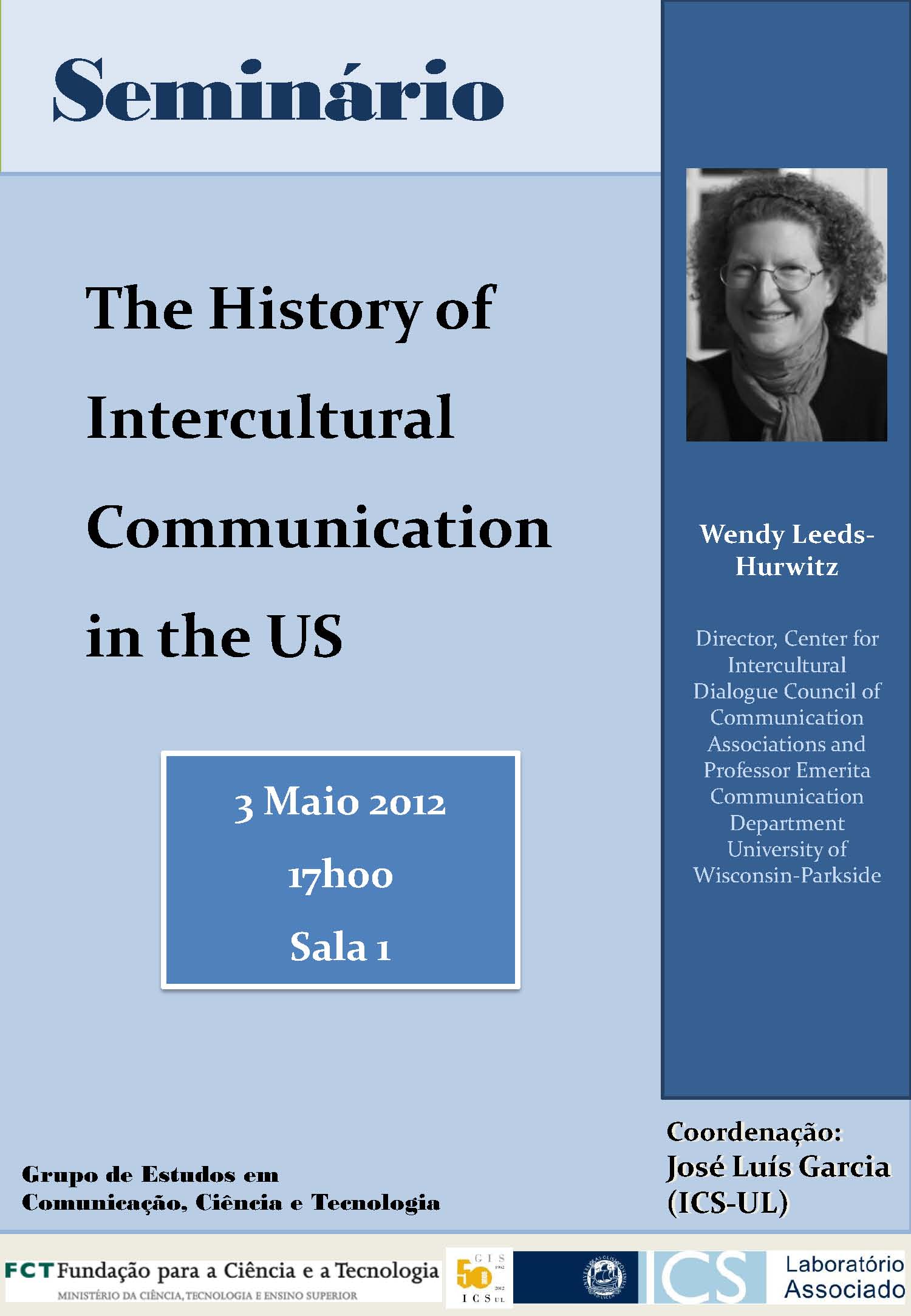
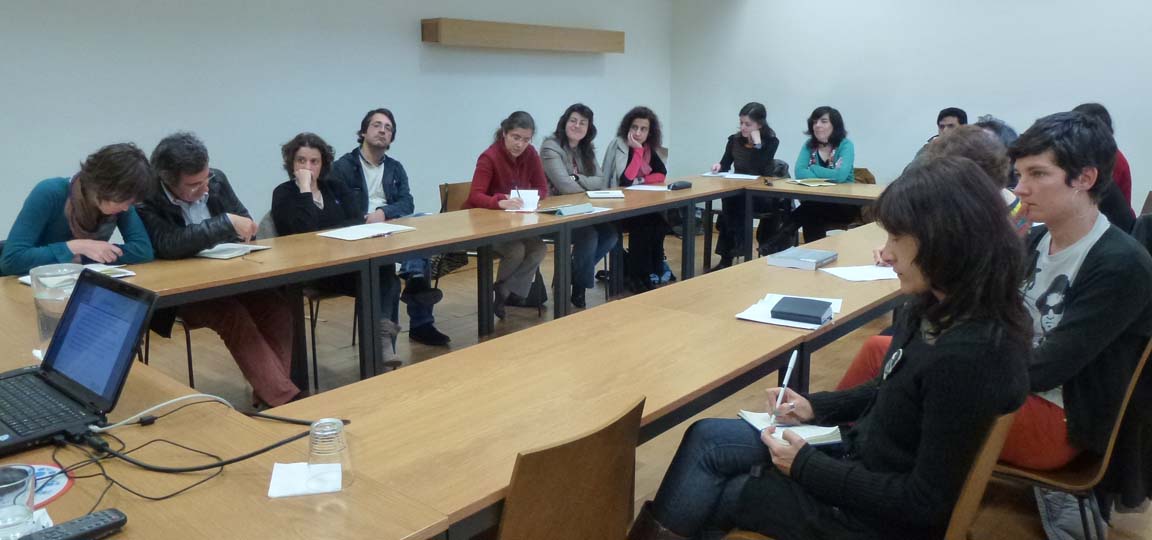
On May 3, 2012, I gave a talk entitled “The history of intercultural communication in the United States” to the Grupo de Estudos em Comunicação, Ciência e Tecnologia, which is part of the Instituto Ciências Sociais da Universidade de Lisboa, in Lisbon, Portugal.

Prof. José Luis Garcia directs this group, and so was my official host, although I owe thanks to Dr. Filipa Gonçalves Subtil for organizing the event as well as an excellent dinner afterwards. As a result of the seminar, I had the chance to talk with other scholars there, including Dr. Alexandra Dias Santos (also affiliated with the University of Lisbon), Dr. Carla Ganito (of the Catholic University of Lisbon), and Dr. Rosário Durão, the editor of Connexions: International Professional Communications Journal.

And since we spent the weekend in Lisbon, there was also time to do some sightseeing, including the Discoveries Monument shown below, documenting the 500th anniversary of Prince Henry the Navigator.

Wendy Leeds-Hurwitz, Director
Center for Intercultural Dialogue

Study abroad-Lisbon

The Study Abroad Umass in Lisbon Program.

UMass in Lisbon, sponsored by the UMass Dartmouth Center for Portuguese Studies with the support of the Luso-American Foundation, is a UMass system-wide program that offers American students the opportunity to spend a semester or year in the vibrant capital city of Lisbon learning about the vast Portuguese-speaking world and European Union.

As the only residential study abroad program in Portugal managed directly by a major American university, UMass in Lisbon provides unrivaled access to one of the world’s most strategic centers of language and culture. Through our partnership with The University Institute of Lisbon (ISCTE-IUL), students will have curricular choices in both English and Portuguese, to supplement the offerings of UMass courses taught on site by both UMass and Portuguese faculty. In addition, each student will take a course in language/culture study at her or his specific instructional level. A significant number of field trips will complement classroom learning, and living accommodations and classrooms will be shared with European ERASMUS and Portuguese university students.

Administrative assistance is available 24/7. A summer program offers additional UMass courses and access to courses and facilities of the Technical University of Lisbon’s Superior Institute of Economics and Management (ISEG-UTL).

DePaul U job ad

The College of Communication at DePaul University seeks applicants for a one-year instructor in Intercultural Communication to begin September 2012.

Ideal candidates will have the ability to teach courses in intercultural communication at both the undergraduate and graduate levels. Special consideration will be given to candidates with expertise in Latina/o Communication. The successful candidate will join a dynamic, diverse, and growing faculty who direct and support innovative and expanding B.A. and M.A. degree programs. Ph.D. preferred, but ABD will be considered. Salary is competitive and commensurate with experience.

To apply, go here.

Review of applications will begin May 15, 2012 and continue until the position is filled.

DePaul University is the nation’s largest Catholic university and the largest private university in Chicago, with more than 25,000 undergraduate and graduate students. This vibrant, diverse, and urban university provides a comprehensive liberal arts education and emphasizes both teaching and research.  The College of Communication has 49 full-time faculty serving 1655 undergraduate majors and 260 graduate students.

Statement:
As an Equal Employment Opportunity (EEO) employer, DePaul University provides job opportunities to qualified individuals without regard to race, color, ethnicity, religion, sex, sexual orientation, national origin, age, marital status, physical or mental disability, parental status, housing status, source of income or military status, in accordance with applicable federal, state and local EEO laws.

Required Application Documents:
Cover Letter
Curriculum Vitae
Three Letters of Recommendation
Evidence of teaching effectiveness including teaching philosophy and teaching evaluations

Visiting fellows-Portugal

FLAD VISITING FELLOWS IN-KIND GRANT PROGRAM 2012/2013

The Luso-American Development Foundation (Fundação Luso-Americana para o Desenvolvimento – FLAD) is opening its facilities to host up to eight fellows per semester. Eligibility is limited to professors and researchers from U.S. universities and research institutions. Candidates may apply for one semester or one academic year.

FLAD Visiting Fellows are expected to be in residence at the Foundation’s headquarters while developing a research project that is compatible with FLAD’s mission and priority areas.

Visiting fellows will be provided with office space, free internet access, limited printing, photocopy, phone (domestic calls) and mailing privileges, and other resources, adjusted on a case-by-case basis.

FLAD will contribute with its best efforts to provide a network of suitable contacts in desired research areas, setting up meetings and site visits when possible. FLAD Fellows may also participate in FLAD’s events, and collaborate on designing new projects and research engagements. These are special ‘program-launching’ conditions, and may be adjusted for competitions in subsequent academic years.

We are especially interested in hosting individuals who have a track-record of distinguished scholarship, success in securing external support for their research, and collaborate across disciplinary boundaries. We welcome requests from individuals who are looking for a collaborative research environment to spend their sabbatical.

APPLICATION PROCESS
To apply, candidates should use FLAD’s online application system to submit the following materials:
– Curriculum vitae;
– Statement of purpose, including an explanation of their research project, an outline of additional activities they would like to be involved in while in Portugal, and a list of funding sources (e.g. grants, gifts, contracts, salary) for their stay in Portugal;
– Letter(s) of support from Portuguese institution(s) (optional);
– Two reference letters.

Preference will be given to candidates showing evidence (letter of support) of having links to Portuguese universities and research institutions.

APPLICATION AND ANNOUNCEMENT DEADLINES FOR AY 2012/1013:– Applications for the fall 2012 semester (August-December) must be submitted by May 31, 2012;
– Applications for the spring 2013 semester (January-June) must be submitted by September 1, 2012.
Decisions regarding the selection of FLAD Visiting Fellows are made four weeks after the application deadline.

Upon acceptance of the fellowship, selected candidates are requested to submit a USD $100 deposit fee, refundable after their arrival in Portugal, to guarantee the office space and additional logistics involved.

CFP Connexions Journal

connexions • international professional communication journal | revista de comunicação profissional internacional places great emphasis on Special Issues as a unique means of promoting high-quality research in thematic areas related to international professional communication.

The journal is accepting proposals from Guest Editors for:
*Special Issue 2(2): December 2013
*Special Issue 3(2): December 2014
*Special Issue 4(1): June 2015
*Special Issue 4(2): December 2015
Issue 3(1): June 2014 will be composed of regular submissions.

Please send your proposals for Special Issues to Rosário Durão at   editor@connexionsjournal.org.

This page provides guidelines to help you organize proposals for Special Issues.

General requirements
*Special Issues are organized by a minimum of 2, and a maximum of 3 Guest Editors.
*Guest Editors are recognized experts in the area they are proposing for the Special Issue.
*Guest Editors are from different institutions and, preferably, countries.
*Special Issues reflect the international aims and scope of the journal. Therefore, Special Issues include a maximum of 3 papers from a particular country. Normally, the journal publishes 5 to 7 papers per issue.

J Intercultural Comm Res CFP

The Journal of Intercultural Communication Research (JICR), a publication of the World Communication Association focuses on quantitative, qualitative, critical, and rhetorical research related to intercultural and cross-cultural communication. JICR publishes manuscripts that report on the interrelation between culture and communication within a single nation/culture or across nations/cultures. Authors are invited to submit manuscripts via electronic attachment to be considered for publication in volumes 40-42 (2011-2013). Manuscripts should be submitted via Manuscript Central. Manuscripts should be no more than 25 Pages 12 pt., double-spaced, 1 inch margins), not counting references, tables or figures, and must conform to the requirements of the most recent Publication Manual of the American Psychological Association (APA). Research on the use of human participants must have been conducted in compliance with acceptable nation or international standards. (e.g., regulations of the U.S. Department of Health and Human Services) on voluntary participation, informed consent, deception, and debriefing. The manuscript should not have been published or be under consideration for publication elsewhere. A detachable cover page should include the manuscript title, each author’s name mailing address, email address, telephone and fax numbers. Author identification should include each author’s current affiliation and address, highest degree earned, the institution granting the degree, and the year granted. A 50-100 word abstract and a list of keywords should follow the title page. Table and figures must be in APA style, and on separate pages and no included in the text. They should be understandable independent of the text, but their approximate position should be indicated in the text and they should be referred to in the text. Authors are responsible for supplying copies of figures in finished form suitable for reproduction.

Dr. Stephen Croucher (Editor) & Kelsey Duarte (Editorial Assistant)

Postdoc Nat U Singapore

Two-year Postdoctoral Research Fellow Positions 15 July 2012 (avail immediately) at National University of Singapore

The Center for Culture-Centered Approach to Research and Evaluation is a project-driven center housed in the Department of Communication and New Media at the National University of Singapore that utilizes ethnographic and participatory action research methods in carrying out culturally-centered social change interventions in marginalized populations. The Center is global in scope with initial project emphases in South Asia and Southeast Asia. The goals of the Center are to (a) create a strategic research core for the social scientific study of health communication and social change issues in Asia (e.g. China, Japan, Singapore, Malaysia, Indonesia, Philippines, Thailand, Nepal, India, Bangladesh, Pakistan, and Sri Lanka), (b) develop health communication interventions and policies that are culturally-centered and developed through the acknowledgement of the participatory capacity of local communities in creating culturally meaningful and locally responsive health solutions, (c) disseminate core principles and lessons learned from the culture-centered projects within Asia and across other sectors of the globe, and (d) build health communication research capacity in Asia by creating a training hub for the next generation of health communication theorists, researchers, practitioners, and policymakers across Asia.

The candidate is expected to be familiar with the culture-centered approach to research and evaluation, and is expected to have experience conducting field-based participatory research. Training will be provided on the use of the facilities in the university. The candidate should also have some experience working with ethnography, although on-the-job training will also be provided. Other skills include the ability to carrying out social change campaigns in disenfranchised populations. Proficiency in Bangla, Hindi, Urdu, Nepali, Malay, Philippine, or Mandarin will be an added plus point.

Requirements:
– PhD in the area of health communication, public health, medical anthropology, or medical sociology, with coursework in health communication and qualitative research methods.
– Experience in conducting in-depth interviews, focus groups, and/or ethnographies.

Terms and Conditions
The terms and conditions for the Postdoctoral Fellowship (PDF) are as follows:
1.      Contract to be awarded beginning from July 2012 tenable for up to two years.
2.      An Annual Base Salary of $48,000 per year.
3.      An allowance of S$500 a month as contribution towards housing expenses for non-citizens (i.e. non-Singaporeans) and their spouses who do not own any property in Singapore and whose spouses are not in receipt of any form of housing benefits from their Singapore employers.
4.      Singapore citizens and permanent residents are eligible for provident fund benefits.
5.      Travel Assistance, payable once only, as follows.
*       $2,000 for the Postdoctoral Fellow
*       $2,000 for spouse
*       $1,000 for each eligible child, subject to a maximum of 3 children.  Children must be less than 18 years of age and receiving full-time education.
The above travel assistance is a contribution towards expenses incurred by the appointee and his/her dependants in re-locating to Singapore. Such expenses refer to costs for travel, packing, transportation and insurance of personal and professional effects as well as settling-in expenses.
The travel allowance is contingent upon the Postdoctoral Fellow’s completion of his/her initial two-years’ contract. In the event that the appointee does not fulfill the initial two-years’ contract, the appointee shall be liable to refund the University a proportionate amount of the travel assistance granted to him/her and his/her dependants on appointment.
6.      Foreign PDFs who are granted Singapore Permanent Residence will continue to receive an allowance of S$500 a month as contribution towards housing expenses.  The allowance will cease once they acquire Singapore citizenship.
7.      Medical benefits in accordance with the Medical Benefit Plan.
8.      Vacation leave of 28 days per calendar year.

Contact:
Interested candidates are invited to email a detailed resume, and copies of supporting documents and names and contact details of two academic referees to:
Dr Mohan J. Dutta, Director, Center for Culture-Centered Approach to Research and Evaluation at culturecenteredapproach@gmail.com.

Res Asst Health Comm – Nat U Singapore

Research Assistants in Health Communication- 2 positions available immediately at National University of Singapore

The Center for Culture-Centered Approach to Research and Evaluation (CARE) is a project-driven center housed in the Department of Communication and New Media at the National University of Singapore that utilizes ethnographic and participatory action research methods in carrying out culturally-centered social change interventions in marginalized populations. The Center is global in scope with initial project emphases in South Asia and Southeast Asia. The goals of the Center are to (a) create a strategic research core for the social scientific study of health communication and social change issues in Asia (e.g. China, Japan, Singapore, Malaysia, Indonesia, Philippines, Thailand, Nepal, India, Bangladesh, Pakistan, and Sri Lanka), (b) develop health communication interventions and policies that are culturally-centered and developed through the acknowledgement of the participatory capacity of local communities in creating culturally meaningful and locally responsive health solutions, (c) disseminate core principles and lessons learned from the culture-centered projects within Asia and across other sectors of the globe, and (d) build health communication research capacity in Asia by creating a training hub for the next generation of health communication theorists, researchers, practitioners, and policymakers across Asia.

The candidate is expected to be familiar with the culture-centered approach to research and evaluation, and is expected to have experience conducting field-based participatory research. Training will be provided on the use of the facilities in the university. The candidate will mostly participate in field-based culture-centered projects, running interventions, as well as conducting evaluations through the use of participatory quantitative and qualitative methodologies. Other skills include the ability to carrying out social change campaigns in disenfranchised populations. Proficiency in Bangla, Hindi, Urdu, Nepali, Malay, Philippine, or Mandarin will be an added plus point.

Requirements:
– Bachelors or Masters in the area of health communication, public health, medical anthropology, or medical sociology, with coursework in health communication and qualitative research methods.

Terms and Conditions:
Salary and benefits will be commensurable to qualifications and working experience. Interested individuals can send their applications, academic transcripts, curriculum vitae and two reference letters to the email address below.

Contact:
Interested candidates are invited to email a detailed resume, and copies of supporting documents and names and contact details of two academic referees to:
Dr Mohan J. Dutta, Director, Center for Culture-Centered Approach to Research and Evaluation at culturecenteredapproach@gmail.com.

Susan Opt – Fulbright

Susan Opt
James Madison University

Fulbright to Czech Republic

In fall 2009, I was a Fulbright scholar at Masaryk University in Brno, Czech Republic. I taught two graduate courses—Intercultural Communication and the Rhetoric of Social Intervention—and one undergraduate course in The History and Culture of US Media.

Unlike many Fulbrighters, I did not have any contacts in the Czech Republic or a letter of invitation. Instead, I spent time researching the “open” or “general” calls on the Fulbright web site and emailing some of the program officers to get information about opportunities in their region (although I did not email the program officer responsible for the Czech Republic!). In the end, I decided to apply to the Czech Republic for several reasons. First, the US institution where I was teaching at the time had been founded by immigrants from Moravia, a part of the Czech Republic. In my application, I connected my interest this historical piece with cultural insights that I might gain from working in the Czech Republic. Second, I had lived and worked in Germany and had visited the Czech Republic in its pre-revolution and immediate-post-revolutions days, so I had some familiarity with the culture. I thought my proficiency in German might come in handy in interactions with older Czechs. I also wanted to see how the culture had changed in the two decades after the revolution. Finally, I felt that the Czech Republic might be a less popular choice by other applicants and so that might increase my chances of getting an award!

After I decided to focus on the Czech Republic I spent time online researching institutions in the Czech Republic to see which ones might offer programs in my areas of interest. I applied for a teaching award because in the Czech Republic, at least, teaching awards are more numerous than research awards. I also looked for programs that offered instruction in English. In my application, I proposed classes and suggested institutions where my knowledge might be useful. In my statement, I focused on the benefits I could offer the host institution. I also emphasized what I could learn from this experience that would benefit my institution and students.

The application review involved several steps. First, the US Fulbright Commission reviewed the application and determined whether it would be forwarded to the Czech Republic. Then the Czech Fulbright Commission reviewed the application to determine whether it should be forwarded to an institution. In an “open” call, like my case, the Czech Fulbright program officers contacted Czech institutions to see if they would be willing to sponsor a Fulbrighter. After they approved the application, then it came back to the United States for final review.

If a Fulbright is granted, then there’s more work! Applicants have to pass a medical exam and, depending upon the country’s requirements, may have to go through a security check with the country’s police, get a visa, and get shots. In addition, “open” call applicants, like me, may have to spend time corresponding with the host institution to negotiate courses or research needs. At this point, one of the most helpful pieces of information acquired from either the in-country Fulbright program coordinator or from the US program officer for that country is copies of previous Fulbrighters’ final reports. Fulbrighters write a final report that summarizes their experiences and give advice for future Fulbrighters. In my case, the reports were extremely helpful in knowing what to expect in the Czech classroom and working ahead of time with the Czech institution to put enrollment limits on the courses. The reports as well as communication with the institution helped me know what technology was available and what kinds of materials I would need to bring with me. For example, Czech students cannot afford to buy textbooks. Fortunately, the Fulbright Commission provides teaching scholars a small stipend for books, so I was able to bring copies of used books for students.

Finally, the key to applying for and surviving a Fulbright is flexibility. You need to be flexible in terms of where you might be willing to go. And you need to be flexible and adaptable to the conditions that you find when you arrive. For example, you might end up teaching a course different than you had expected and prepared for. You might find that the students have different language abilities, backgrounds, and preparations than you imagined. You might find that how courses are taught and the length of courses differ from what you are used to. But these kinds of surprises teach us a lot about ourselves, our culture, and our educational system and help achieve William Fulbright’s vision of changing the world by changing how we think.