UNorth Carolina post doc

Postdoctoral Program for Faculty Diversity
UNC-Chapel Hill

The University of North Carolina at Chapel Hill Carolina Postdoctoral Program for Faculty Diversity is pleased to announce the availability of 2013 postdoctoral trainee appointments for a period of two years, starting July 1, 2013. The application process is expected to open on November 15, 2012.

Eligibility:
Applicants who will have completed their doctoral degree no later than July 1, 2013 and no earlier than July 1, 2009 are eligible to apply.
The primary criterion for selection is evidence of scholarship potentially competitive for tenure track appointments at the University of North Carolina and other research universities. AN IMPORTANT SECONDARY CRITERION IS THE SUPPORT OF PROSPECTIVE DEPARTMENTS. Preference will be given to U.S. citizens and permanent residents. The University of North Carolina at Chapel Hill strongly encourages applications from African American, Native American and Hispanic scholars.
Interested applicants should apply online.
Directions for the electronic submission are provided at the website. Any questions may be directed to the Office of Postdoctoral Affairs, opa AT unc.edu. The application deadline is Thursday, January 3, 2013 at 11:59 EST.

Arizona State U job ad

ARIZONA STATE UNIVERSITY
Hugh Downs School of Human Communication

The Hugh Downs School of Human Communication, within the College of Liberal Arts and Sciences on the Tempe Campus of Arizona State University, invites applications for a tenure-track position as an Assistant Professor of Intercultural Communication to begin in August 2013.

Required Qualifications:
1)  PhD (or foreign educational equivalent) in Communication or related field.  Must have PhD in hand by August 1, 2013.
2)  Record of research in intercultural/international communication as demonstrated by publications or works in progress, with a continuing program of scholarly activity publishable in established international refereed journals.

Desired Qualifications:
1)  Demonstrated excellence in scholarship confronting significant global and domestic issues in the ways culture plays a role in relationships between individuals, groups, and societies, scholarship that explicitly contributes to Hugh Downs School of Human Communication Strategic Initiatives (Conflict Transformation Project, Innovative Inquiry, Project for Wellness and Work-Life (see details ) and scholarship that is supportive of ASU’s campus-wide research initiatives: (1) Building strong, vibrant communities, (2) Defending and extending human rights, (3) Understanding the past and present for the sake of our future, and (4) Creating a sustainable way of life) (see details).
2)  Demonstrated potential for obtaining external funding for research projects.
3)  Demonstrated teaching effectiveness, demonstrated ability to teach courses in the existing undergraduate and graduate curriculum of the HDSHC, with potential to develop new courses in relevant areas of scholarship.
4)  Demonstrated ability to engage in service to the university, academic profession, and public/community that supports ethical/professional behavior as defined in Board of Regents, university, or academic unit policy.

The application deadline is Monday, November 26, 2012; if the position is not filled, then applications will be accepted every subsequent Monday until the search is closed.

Applicants must submit a cover letter specifying interest in the position and how their qualifications match the required and desired qualifications, curriculum vitae, evidence of effectiveness in teaching (e.g., syllabi, teaching evaluations), evidence of excellence in scholarship (e.g. reprints of published articles), and three letters of references.  Letters of reference must be emailed directly by referees to HDSHCrecruitment AT asu.edu, with the job order #10246 written in the SUBJECT area of the email.

Application materials should be submitted as a single PDF document via email only to HDSHCrecruitment AT asu.edu. Please write the job order #10246 in the SUBJECT area of the email.
Arizona State University is an equal opportunity/affirmative action employer committed to excellence through diversity. Women and minorities are encouraged to apply. See ASU’s complete non-discrimination statement. In line with the Arizona Board of Regents’ policy, a background check is required for employment.

U Colorado Denver job ad

Assistant Professor of Communication and New Media

The Department of Communication at the University of Colorado Denver (UCD) invites applications for a full-time, tenure-track position in Communication and New Media, at the assistant professor level, beginning in August, 2013.

UCD is an urban campus that serves a diverse student body, values community engagement, and seeks top-notch scholars and world-class teachers. The Department of Communication offers B.A. and M.A. degrees and serves 450majors; professors teach on a 2/2 load and perform research and service consistent with peer urban research universities. The successful candidate will teach courses that fall within the Department’s “Media Studies” pathway, which includes such classes as Introduction to Media Studies, Media and Society, and New Media.

Because the Department participates in a joint venture with the International College Beijing, the Department is especially interested in those candidates whose research touches upon issues of globalization and/or international studies. Because the Department is committed to promoting social justice through community engagement and service-learning, the successful candidate will demonstrate excellence in implementing the study and practice of New Media in the interests of under-resourced communities.

While social scientists and humanists are both encouraged to apply, the successful candidate will need to work effectively in a Department staffed with colleagues whose work falls largely in the rhetorical and cultural traditions.

The Department strongly prefers candidates with a Ph.D. in communication (or a related discipline); however, candidates who are ABD with significant progress on the dissertation will also be considered. Additional preferred qualities include evidence of superior teaching at the undergraduate and graduate level; a track record of leadership in departmental, campus, and disciplinary service capacities; and a proven history of producing significant scholarship.

Applicants should submit a letter of application, vita, three letters of recommendation,two samples of scholarly activity, and evidence of teaching excellence to Dr. Brian L. Ott, Search Committee Chair, Department of Communication, University of Colorado Denver, P.O. Box 173364, CB 176, Denver, CO 80217-3364. In addition to sending hard copies of the materials listed above, applicants must also submit these materials (but not their letters of recommendation) electronically by following the directions. The Assistant Professor position number is 819516 for Department 30095 (Communication).

Candidates with questions about this job description are invited to contact Dr. Ott at brian.ott AT ucdenver.edu or at 303-556-6719.

Review of applications will commence immediately and will continue until the position is filled; preliminary interviews will be conducted at the NCA convention.

UCD is committed to diversity and equality in education and employment. In fact, because the downtown campus is located in the heart of the city’s commercial, cultural, and recreational district, it attracts a diverse population consisting primarily of commuters, many of whom are non-traditional students. This diversity is enriched by UCD’s commitment to a philosophy of inclusion, which is embedded in all aspects of campus life.

Learning Matters

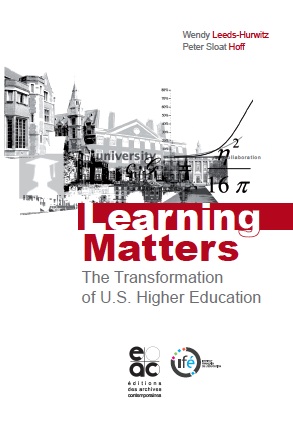
A book that I was writing while at the Institute Français de l’Education in Lyon last fall has just been published by Editions des Archives Contemporaines, based in Paris. The title is Learning Matters: The Transformation of US Higher Education. It’s co-authored with a former University of Wisconsin-Parkside colleague, Peter Hoff, who went on to become President of the University of Maine. My thanks to Yves Winkin for asking the questions about higher education in the US that led to the writing of this book.

Here is a summary of the book’s content:

Higher education in the United States of America, considered by many to set a worldwide standard for broad access and high levels of excellence, has for many decades seen massive changes in its approaches to teaching and learning. Redesigning and transforming the way colleges and universities teach their students has been likened to reconstructing an airplane while it remains aloft. More than 4,000 US colleges and universities have met the challenge by analyzing major changes in student populations and introducing new instructional techniques that recognize the primacy of learning over teaching. This seemingly innocent but powerful transformation, acknowledging that teaching only matters as a means to the real end – learning – is powering a pedagogical revolution. The Learning Revolution in US higher education began when World War II veterans flooded university classrooms, soon to be followed by their children, the American “Baby Boom.” Overwhelming numbers of new students from new kinds of backgrounds flooded colleges and universities, forcing professors to rethink how they went about teaching these new generations. To handle the numbers, many new universities were created, and many established centers for teaching excellence to help professors adapt to new populations with new techniques. In the 1990s, higher education further professionalized the teaching craft via the Scholarship of Teaching and Learning. Research into how students learn and how to help them learn took its place alongside traditional academic research. Aided by a wave of new technologies, teaching centers and the scholarship of teaching and learning are transforming the university classroom as well as many new venues outside the classroom where learning now takes place. The resulting new pedagogical architecture now embraces every dimension of US higher education.

Copies of the book are available directly from the publisher: Editions des Archives Contemporaines or, for those based outside of France, from Amazon in the US. (For those outside those two countries, the book is also available from Amazon in Germany, Spain, and the UK.)

The section of the book most directly linked to my work with the Center for Intercultural Dialogue concerns internationalization as an issue for US higher education. Here are a few relevant quotes:

  • “the rest of the world increasingly speaks English, but few Americans actively travel in international circles, so globalization may become oddly limited to the English language, passing over many native speakers” (p. 92)
  • “It would be difficult to argue that U.S. universities have been doing an adequate job of preparing students to live and work in the global village. Historically, what little was done has been deemed adequate, so few people see a need for substantial change” (pp. 97-98)
  • “The world has become smaller, and so students need to understand more of what occurs in other countries than their own. At the lowest level of application, this implies integrating international examples; at the highest level, new technologies permit international collaborative research projects.” (p. 218)

For those interested in discussing issues related to teaching and learning, and expanding on what we included in the book, my co-author, Peter Hoff, created a Facebook page: https://www.facebook.com/CollegeLearningMatters

If you read Portuguese instead of English, a monograph version, Arquitectura pedagógica para a mudança no ensino superior [Pedagogical architecture changes for higher education], prepared when I was a Fulbright Senior Specialist at the Instituto Politécnico de Coimbra during the spring, is also now published.

CFP Difference & Globalization

Call for papers
Visual Communication Journal
Special Issue: DIFFERENCE AND GLOBALIZATION
Co-edited by GIORGIA AIELLO (University of Leeds) and LUC PAUWELS (University of Antwerp)

This special issue investigates the nexus of globalization and visual communication through a rich discussion of the significance of national, racial, gendered, classed, countercultural, embodied and emplaced identities-among others. It will interrogate a variety of visual communication texts and contexts, including but not limited to those found in popular and consumer culture, web design, social media, advertising, photography, branding and public communication, tourism and urban place-making.

The visual is an especially privileged and in fact crucial mode of communication in contexts of globalization thanks to its perceptual availability and cross-cultural potential. The rise of global capitalism has been overwhelmingly associated with the increasing ‘loss’ of difference in cultural production. As a central issue in global interconnectivity, the key tension between homogenization and heterogenization has generated interest and apprehension over the preservation and disappearance of difference across cultures. Less attention has been given to how cultural and social difference may be mobilized for symbolic and material profit in global(izing) communication contexts, while also being a significant factor in the production and reception of texts. Although a critique of globalization as a homogenizing process is important and based on compelling evidence, it is therefore necessary to account for the increasingly complex, powerful and indeed heterogeneous ways in which contemporary communication is realized in everyday life.

We invite both article and visual essay submissions that address one or more of the following questions:

= What do theoretical, critical and/or empirical approaches to social or cultural difference and diversity contribute to visual communication scholarship on key processes of globalization?

= How can contemporary discussions of key articulations of difference and globalization (e.g. transnationalism, postcolonialism, cosmopolitanism) be enhanced by visual communication scholarship?

= What are some of the major ways in which global visual communication texts integrate, mobilize and/or exploit fundamental dimensions of social and cultural difference (such as race, gender, sexuality, class, nationality, political and religious beliefs, etc.)?

= What processes, forms of understanding, and practices are typical or required of designers’ work in the planning and production of visuals that aim to communicate generic meanings or, on the other hand, key forms of social and cultural difference to either global/cross-cultural or local/ specific publics?

= What are viewers’ culturally or socially specific experiences of global or cross-cultural visual communication and how do their unique ‘ways of seeing’ impact the ‘reading’ of globalization?

SUBMITTING YOUR PROPOSAL
Please send an extended 1,000 word abstract of your proposed article or visual essay describing the focus and content of the proposed contribution to GIORGIA AIELLO, G.Aiello AT leeds.ac.uk, by 31 March 2013.

Proposals will undergo a review process, and a selection will be shortlisted for development into full-length articles or visual essays. Shortlisted authors must commit to a timeline for revision, resubmission and publication, with full manuscripts to be submitted by 1 October 2013.

CFP Boundaries of Comm theories

Communication Theory special issue on
Questioning geocultural boundaries of communication theories: De-Westernization, cosmopolitalism and globalization

Guest editors: Silvio Waisbord and Claudia Mellado
Submission deadline: April 1, 2013

Although Western perspectives have been dominant in the study of communication, scholars have called for the emancipation of non-Western theories and new conceptual and theoretical perspectives. Researchers have shown the importance and vitality of communication theories grounded in various philosophical conceptions in Africa, Asia and Latin America. This call should not be understood as an effort to “de-Westernize” communication studies. On the contrary, the task is to explore whether non-Western perspectives expand the analysis and challenge central assumptions and arguments.

Communication Theory therefore invites authors to submit papers for a future special issue on “Questioning geocultural boundaries of communication theories: De-Westernization, cosmopolitalism and globalization.” Contributions could analyze current theoretical developments in communication studies across the world, revisit epistemological and historical foundations, examine the integration of Western and non-Western perspectives in communication studies, the uses of theories of global comparative research, discuss the relevance of non-Western theories and models, and successful and failed efforts at theoretical cross-pollination. Submissions may address but should not be limited to the following questions:

-Amidst the globalization, indigenization, and hybridization of communication and cultures, what do we mean by non-Western and Western theories?
-What are non-Western communication theories? Are they primarily based on non-individualistic, communitarian notions of self and universalistic premises?
-What are the commonalities and differences among non-Western theories? What contributions and differences do they offer?
-How do non-Western theories reframe questions and arguments grounded in Western theories?
-Is it valid to denominate theories on the basis of geo-cultural origin? How are essentialist positions reaffirmed? How and by whom or what are they challenged?

Manuscripts must be submitted by April 1, 2013, through the online submission system of Communication Theory. Authors should indicate that they wish to have their manuscript considered for the special issue. Inquiries can be sent to Silvio Waisbord (waisbord AT gwu.edu) and Claudia Mellado (claudia.mellado AT usach.cl).

Wayne State U job ad

Wayne State University
Assistant Professor of Public Relations

The Department of Communication in the College of Fine, Performing and Communication Arts at Wayne State University invites applications for an Assistant Professor tenure-track position in Public Relations beginning no later than August 19, 2013. Salary is competitive and commensurate with experience. Minimum qualifications are a completed PhD in Communication or related discipline by August 19, 2013.

We seek a colleague with a program of research in public relations with emphasis in social media, crisis communication, international contexts, or campaign metrics and evaluation. Preference will be given to candidates with professional experience in public relations. Candidates must present clear evidence of the potential for establishing a national reputation through an active program of research, an interest in seeking external funding, a strong record of teaching, a commitment to both undergraduate and graduate (MA and PhD) education, a willingness to mentor graduate students, and experience with diverse populations. Responsibilities include teaching undergraduate and graduate courses in public relations; mentoring undergraduate and graduate (MA and PhD) students; pursuing an active program of research and publishing in high-quality venues; seeking external research funding; contributing to the intellectual life of the department; and providing appropriate professional service.

All applicants must use the Wayne State Online Hiring System, referring to posting #038969. The application packet must include a letter of application, curriculum vita, names and contact information for three references, a representative sample of research, and a teaching portfolio that includes a statement of teaching philosophy and evidence of teaching effectiveness. Faxed or email applications will not be accepted. Please do not submit transcripts or other supporting material at this time.

Inquiries about the positions may be directed to: Pradeep Sopory, Chair, Public Relations Search Committee, Department of Communication, 585 Manoogian Hall, Wayne State University Detroit, MI 48201 (psopory AT wayne.edu). Applications remain open until the position is filled; the search committee will begin reviewing applications on November 21, 2012Wayne State University is an Affirmative Action/Equal Opportunity Employer. Women and minority candidates are encouraged to apply.

La Main à la Pâte

On October 15, 2012, I presented a talk at Fondation la Main à la Pâte in Paris, France entitled “College for Kids = Hands-on activities for students, professional development for teachers.”

Fondation la Main à la Pâte [Foundation for Collaborative Hands-on Work] is a research foundation established by a consortium of organizations: l’Académie des Sciences, l’École Normale Supérieure (in Paris) and l’École Normale Supérieure de Lyon (where I am based at present). Researchers there focus on the improving the teaching of science to K-12 students, especially using hands-on techniques. They invited me to talk about my current project documenting College for Kids in the US, which often has a focus on teaching science and on hands-on techniques, as well as sometimes having a dual track, where teachers are trained at the same time that students are educated.

My thanks to David Jasmin, Director of the Foundation for the warm welcome (and excellent Japanese lunch!). My thanks to Clotilde Marin-Micewicz for meeting with me in Lyon and introducing me to the Foundation.

Wendy Leeds-Hurwitz, Director
Center for Intercultural Dialogue

Save

U South Florida job ad

The Department of Communication at the University of South Florida invites applications for a tenure-track position at the rank of Assistant or Associate Professor to begin August 2013.  Applicants must have been awarded a doctorate in Communication by September 1, 2012. We seek a candidate whose central focus is interpersonal and relational communication and who can also offer courses and research supervision in one or more of the following areas: dialogue, applied communication, and ethics. Applicants should have a research and teaching profile that fits with our department’s qualitative, critical, and interpretive orientation, and our integration of social science with humanistic, narrative, and performative approaches to inquiry. The successful candidate will have a record of published scholarship and successful teaching experience commensurate with the length of time since earning the Ph.D. and appropriate for appointment in a doctoral degree granting department at a Research I university. The ideal candidate will have a record of (or potential for) securing external funding for research, mentoring graduate students, and building productive connections with local and/or global research sites.  Salary is negotiable and will be commensurate with the candidate’s credentials and experience.

According to Florida law, applications and meetings regarding the search are open to the public. For disability accommodations, please notify the search chair at least five working days in advance of need. USF is an Equal Opportunity, Affirmative Action, and Equal Access employer. The department strongly encourages applications from scholars of color.

Application materials (hard copy and online) must be received by November 19, 2012.

A completed application file includes a letter of application, curriculum vitae, three letters of recommendation, documentation of successful teaching and research productivity (include up to three published works). Paper copies of these must be received by November 19, 2012. Send paper copies to:
Dr. Ambar Basu
Chair, Search Committee
Department of Communication
University of South Florida
4202 East Fowler Avenue CIS1040
Tampa, FL 33620-7800

In addition, copies of your application materials, excluding the reference letters, must be submitted online via the following link.

The University of South Florida is one of only three Florida public universities classified by the Carnegie Foundation for the Advancement of Teaching in the top tier of research universities (RU/VH), a distinction attained by only 2.3% of all U.S. universities. USF is ranked 50th in the nation in total research expenditures and 27th in federal research expenditures for public universities by the National Science Foundation.  The university is authorized to provide 237 degrees at the undergraduate, graduate, specialist and doctoral levels, including the doctor of medicine. USF ranks 10th among all universities granted U.S. patents in 2011 according to the Intellectual Property Owners Association, an increase of more than 3 percent from 2010. The University has a $1.5 billion annual budget, an annual economic impact of $3.2 billion, and serves more than 47,000 students on campuses in Tampa, St. Petersburg, and Sarasota-Manatee. USF is a member of the Big East Athletic Conference

Further information about the department, its students, and faculty is available at our website. Inquiries can be addressed to Dr. Ambar Basu (abasu AT usf.edu).

Cal State U Long Beach job ad

California State University Long Beach

Tenure Track Position Opening
Recruitment  #: 1064
Effective Date: August 19, 2013 (Fall Semester)
Salary Range: Commensurate with qualifications and experience

Minimum Qualifications:  Ph.D. in Communication Studies or Performance Studies (or a closely related field) by date of appointment.  Demonstrated potential for effective teaching at the undergraduate and graduate (M.A.) level; potential for an ongoing, successful record of scholarly research and publication commensurate with professional level; commitment to and/or expertise in educating a diverse student population.

Desired/Preferred Qualifications: Demonstrated excellence in teaching at the university/college level.  Experience in teaching courses in performance studies, including oral interpretation and storytelling, and intercultural communication. The ideal candidate will have experience with oral history, ethnography, or narrative and an emphasis in issues of diversity and culture.

We also welcome applications from candidates with expertise in interpersonal/organizational contexts using quantitative social scientific methodologies, and with experience teaching courses in communication theory, research methods, and content courses relevant to those contexts.

Duties: Teach undergraduate and graduate (M.A.) department courses within the areas of the candidate’s expertise. Participate in curriculum development; engage in a systematic program of scholarship resulting in conference presentations and publication; advise and direct students; provide service to department, college, university, and community.

The Department of Communication Studies at California State University, Long Beach is committed to building a more diverse faculty, staff, and student body as it responds to the changing population and educational needs of California and the nation.  We seek applicants and nominations from those who have experience teaching, mentoring, and developing research in ways that effectively address individuals from historically underrepresented backgrounds. California State University, Long Beach is an affirmative action/equal opportunity employer.

Required Documentation:  Letter of application addressing minimum and desired/preferred qualifications as noted above; curriculum vitae with current email address. Three recent letters of recommendation. A copy of the transcript from institution awarding highest degree. Summary of teaching evaluations. Finalists will be required to submit a signed SC-1 form and official transcript. Application and required documentation should be submitted on the Academic Jobs Online website .Requests for information, official transcript, letters of recommendation and signed SC-1 form should be sent to:

Dr. Amy Bippus, Chair
Department of Communication Studies, AS 309
California State University, Long Beach
Long Beach, CA   90840-2407
562/985-4302/amy.bippus AT csulb.edu

Application Deadline:  Position open until filled or recruitment cancelled.  Review of applications to begin on November 15, 2012.

CSULB is committed to creating a community in which a diverse population can learn, live, and work in an atmosphere of tolerance, civility and respect for the rights and sensibilities of each individual, without regard to race, color, national origin, ancestry, religious creed, sex, gender identification, sexual orientation, marital status, disability, medical condition, age, political affiliation, Vietnam era veteran status, or any other veteran’s status. CSULB is an Equal Opportunity Employer.