
Key Concepts in Intercultural Dialogue in Translation!

Key Concepts in ICDI was recently asked about the possibility of translating some of the Key Concepts in Intercultural Dialogue into other languages than English. This is a great idea, and I was happy to agree. The first one appears today, KC#28: Postcolonialism, originally written by Raka Shome for publication in English in 2014, now has been translated into Italian by Miguel Ángel Guerrero Ramos. My thanks to Paola Giorgis for serving as Italian editor.

As with the originals, all translations of Key Concepts will be made available as free PDFs; just click on the thumbnail to download. Lists organized chronologically by publication date and numberalphabetically by concept in English, and by languages into which they have been translated, are available, as is a page of acknowledgments with the names of all authors, translators, and reviewers.
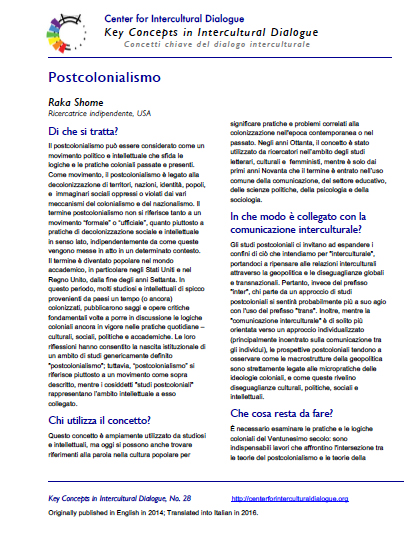
KC28 postcolonialism-ItalianShome, R. (2016). Postcolonialismo. Key Concepts in Intercultural Dialogue, 28 (M. A. Guerrero Ramos, Trans.) Available from:
https://centerforinterculturaldialogue.org/2016/06/20/key-concepts-in-intercultural-dialogue-in-translation/

If other scholars would be interested in translating any of the other Key Concepts, please send me an email. If I do not already know you, please send along a short CV that includes information about your language skills. If you are fluent in a language other than English and do not have time to create a translation yourself but would be interested in serving as a reviewer for someone else’s draft, let me know that. As a rule, I will assume that all authors will at least be enrolled in masters’ coursework, if not further along.

And, as always, if there is a concept you think should be written up as one of the Key Concepts, whether in English or any other language, propose it. As of this writing, 78 have been published in English, but words from Chinese, Portuguese, Japanese, Spanish, Belarusian, German and Arabic have also been introduced (with the discussion provided in English). Authors of the non-English words will, for obvious reasons, receive first choice of now translating their discussion into the same language as the concept.

As is all typical in academic publishing, there is no funding for this project. Rather than financial compensation, you gain a line on your CV, and the pleasure of having your work read by many colleagues (total views of the publications page have nearly reached 5000 as of this writing, a figure which does not include views of each post introducing a new concept, which can stand in the hundreds). And, at one page, these are particularly quick and easy to write up in the first place, and should be equally quick to translate or review.

Please do not begin work on a concept or a translation until you receive approval. Not only would it be a waste of time to inadvertently duplicate effort, but there are a few basic rules and a template to follow, which will be shared after your proposal has been approved.

Wendy Leeds-Hurwitz, Director
Center for Intercultural Dialogue


Creative Commons License

This work is licensed under a Creative Commons Attribution-NonCommercial-NoDerivatives 4.0 International License.

Save

Save

CFP Listening in Mediated Contexts

Call for Papers: International Journal of Listening
Fall Issue 2017: Special Issue on Listening in Mediated Contexts
Editor-in-Chief: Margarete Imhof
Guest Editors: Dr. Debra L. Worthington & Dr. Shaughan Keaton

The growth of social media and evolving technology have significantly impacted who people listen to as well as how and when they listen.  In this Special Issue, the International Journal of Listening explores the impact of social media and other technology on listening processes. The goal of the issue is to highlight exceptional articles that explore the nature of listening in mediated contexts. Mediated contexts are broadly construed, including mobile phone communication, Facebook, Skype, YouTube, Instagram or any combination of these and other popular platforms and devices. Articles may explore the impact on or relationship to individual communication styles, characteristics of mediated interaction from both the sender and receiver’s perception, social cognition, as well as the impact of new technology on individual, group and public listening processes.  Papers from various perspectives and diverse fields are welcome:  intrapersonal/ interpersonal communication, doctor-patient communication, sports communication, romantic relationships, education and instruction. Papers with a cross-cultural or international focus are particularly welcome.

Examples of themes, include:
–         Listening attitudes and behavior in social media
–         Listening in online teaching environments.
–         Social cognition and person perception in social media
–         Intercultural differences in the perception of mediated communication
–         Supportive listening via social media
–         Individual choices between voice and short messaging
–         Medium and message reception
–         Generational differences in listening to social media messages

All full length manuscripts will be submitted through https://mc.manuscriptcentral.com/ijl.  The length of articles should be no more than 6,000 words (not including references and appendices). The journal plans to publish up to six research articles in the special issue. Additional accepted articles will be published in later issues of the journal.

Submission deadline: October 1st, 2016
Expected publication: Fall 2017

Inquiries about the special issue should be directed to Dr. Debra L. Worthington.  Please use the subject line: ILJ Special Issue on Listening and Mediated Contexts.

CFP Mediated Business: Living the Organisational Surroundings

Mediated Business: Living the Organisational Surroundings
Deadline: 1 October 2016

This special issue of Culture and Organization aims to continue a line of thought initiated by the 2004 special issue in Culture and Organization on the work of Deirdre Boden and her interest in interaction in workplace settings. In her seminal book “The business of talk” from 1994, Boden uncovers the tightly interwoven sequential structure of organisational talk. She points to the importance of the local and sequential organisation of talk in interaction for the emergence of larger organisational phenomena: “Piece by piece, moment by moment, stage by stage and level by level, decisions are discussed, debated, diffused and ultimately resolved” (Boden 1994: 178). The special issue in 2004 aimed at developing Boden’s central points on how micro and macro aspects of organisational talk are interrelated. In their paper, Oswick and Richards (2004) built upon Boden’s metaphor of laminations and developed a critical framework for understanding the relationship between local conversations and the larger organisational context. Likewise, Samra-Fredericks (2004) analysed one single instance of organisational talk and showed how a wider organisational context was shaped by and brought into being by the local organisation of talk.

With the current special issue theme “Mediated business: living the organisational surroundings”, we aim to add upon the 2004 initiated ethnomethodological/conversation analytic (EM/CA)-perspective on workplace interaction by specifically relating it to the recent multimodal turn in interaction studies (Mortensen 2012; Asmuß 2015). That way, the special issue seeks to compile recent studies on workplace interactions from an EM/CA perspective focussing on how various organisational surroundings (e.g. material, spatial and/or temporal) may impact the ways organisational activities are accomplished.

In accordance with the recent trends of studying interaction from a multimodal perspective (e.g. Richards 2004; Deppermann 2013; Hazel, et al. 2014), various workplace competences have been understood in light of the members’ ability to organise a diverse array of resources in managing their business at hand. This skillset may include the efficient arrangement and navigation of task-related artefacts in the given context (e.g. Nevile 2004; Nielsen 2012). Correspondingly, the instrumental actions of a given task can be exploited to take care of “hidden” business, for instance: strategy meeting participants negotiating their entitlement through the tactic use of computer-related actions (Asmuß & Oshima 2012) and plastic surgeons performing persuasive physical examinations by labelling patients’ bodies (Mirivel 2008). On the other hand, more “neutral” surroundings – the spatial design of a room in the activity of police interrogation (LeBaron & Streeck 1997), the material/physical environments that surround an urban street sale (Llewellyn & Burrow 2008), and the biographies and other temporal/spatial surroundings of members (Samra-Fredericks 2004), to name a few – may be brought into play by the participants, and/or may shape the form of business they engage in.

These studies have shown us roughly two phenomena. First, they have shown, not only that interactants use resources available for communicative purposes, but how their competences emerge in their artful ways of selecting and highlighting different elements of their surroundings in accomplishing certain business. Second, they indicate what used to be considered as mere practical and objective conditions are often in fact interactional resources, leaving little room for distinguishing the relevant surroundings and the made-as-relevant surroundings. The aim of this special issue is to further explore this fuzzy border of “the participants’ surroundings” and “the surroundings themselves” (Mortensen 2012) in diverse organisational contexts. By examining interactants’ selection of various features in the surroundings, we are interested in exploring how people go about living the organisational surroundings, their social meanings and relationship with the managing of business. We thus welcome EM/CA-oriented contributions offering insights into (but not limited to):
• Affordances and restrictions of organisational activities as interactional resources for negotiating various business (e.g. role, identity, morality, responsibility, strategies)
• Technical/practical activities as social resources at workplace
• Multimodal resources for building interactional a/symmetries at the workplace
• Organisational strategy as a multimodal practice
• Discursive/social/interactional accomplishments of practicality at work
• Assembling workplace through interaction
• Spatiality and temporality of workplace interaction
• The ambiguous border of informal and formal business
• Organisational value of micro-activities
• The interrelationship of micro-level interactional activities and larger organisational phenomena through talk amongst managerial elites.

Submissions
Please ensure that all submissions to the special issue are made via the ScholarOne Culture and Organization site at http://mc.manuscriptcentral.com/gsco. You will have to sign up for an account before you are able to submit a manuscript. Please ensure when you do submit that you select the relevant special issue (volume 24, issue 1) to direct your submission appropriately. If you experience any problems please contact the editors of this issue.

The deadline for manuscript submission is October 1st 2016.

Style and other instructions on manuscript preparation can be found at the journal’s website. Manuscript length should not exceed 10,000 words, including appendices and supporting materials. Please also be aware that any images used in your submission must be your own, or where they are not you must already have permission to reproduce them in an academic journal. You should make this explicit in the submitted manuscript.

Please direct informal enquiries to the special issue co-editors, Birte Asmuß and Sae Oshima (please ‘cc both co-editors).

References
Asmuß, B. (2015). Multimodal Perspectives on Meeting Interaction: Recent Trends in Conversation Analysis. In J. A. Allen, N. Lehmann-Willenbrock, & S. G. Rogelberg (Eds.), The Cambridge Handbook of Meeting Science (pp. 277-304). Chapter 13. Cambridge: Cambridge University Press.
Asmuß, B. & Oshima, S. (2012). Negotiation of entitlement in proposal sequences. Discourse Studies 14(1): 67-86.
Boden, D. (1994). The business of talk: Organizations in action. Cambridge, UK: Polity.
Deppermann, A. (2013). Multimodal interaction from a conversation analytic perspective. Journal of Pragmatics 46(1): 1-7.
Hazel, S., Mortensen, K. & Rasmussen, G. (2014). Introduction: A body of resources – CA studies of social conduct. Journal of Pragmatics 65(0): 1-9.
LeBaron, C. &, J. (1997). Built space and the interactional framing of experience during a murder interrogation. Human Studies 20(1): 1-25.
Llewellyn, N. & Burrow, R. (2008). Streetwise sales and the social order of city streets. British Journal of Sociology 59(3): 561-583.
Mirivel, J. (2008). The physical examination in cosmetic surgery: Embodied persuasion in medical interaction. Health Communication 23: 153-170.
Mortensen, K. (2012). Conversation analysis and multimodality: Conversation Analysis and Applied Linguistics. The Encyclopedia of Applied Linguistics. J. Wagner and K. Mortensen. Oxford, Wiley-Blackwell.
Nevile, M. (2004). Integrity in the airline cockpit: Embodying claims about progress for the conduct of an approach briefing. Research on Language & Social Interaction 37(4): 447-480.
Nielsen, M. F. (2012). Using artifacts in brainstorming sessions to secure participation and decouple sequentiality. Discourse Studies 14(1): 87-109.
Oswick, C. & Richards, D. (2004). Talk in organizations: Local conversations, wider perspectives. Culture and Organization 10(2): 107-123.
Richards, D. (2004). Introduction. Culture and Organization 10(2): 101-105.
Samra-Fredericks, D. (2004). Understanding the production of ‘strategy’ and ‘organization’ through talk amongst managerial elites. Culture and Organization 10(2): 125-141.

Editorial information
• Guest editor: Birte Asmuß, Aarhus University, Denmark (bas@bcom.au.dk)
• Guest editor: Sae Oshima, Aarhus University, Denmark (oshima@bcom.au.dk)

CFP Roles of Communication on a Regional Conflict

Journal of Asian Pacific Journal (JAPC) Special Issue Call for Papers

The Roles of Communication on a Regional Conflict: Antipathy, Nationalism, and Conflicts in Territorial Disputes among China, Japan, and South Korea

Submissions are encouraged from scholars that use different theoretical and empirical approaches to the special issue of Journal of Asian Pacific Communication on the role of communication (e.g. legal, diplomatic, and public discourses) in territorial disputes among China, Japan, and South Korea. Territorial disputes between China and Japan over Diaoyu (Chinese) or Senkaku (Japanese) island and between Japan and South Korea over the Dokdo (Korea) or Takeshima (Japanese) island have escalated particularly in recent years and given rise to concerns about peace and security in the region. The special issue will examine the roles of communication and discourse on their political, cultural, historical, and economical aspects of the territorial disputes with a focus on the key internal and external factors shaping current and future relations. The articles will examine communication and discourse in institutional and political settings, i.e., in and around organizations, in the media, and on the internet. They will focus on how use of language and non-verbal symbolic systems in specific, esp. institutional, communicative contexts, including face-to-face diplomatic interactions/conversations, news release, and popular cultural texts such as films, music, animation, television drama, etc. impact the territorial disputes.

(1) News Coverage on the Disputes: Articles may examine how news media cover the disputes and the accompanying debates on international and domestic levels by conducting content (quantitative) or textural (qualitative) analysis of newspaper articles or broadcasting news contents in two territorial disputes among three nations (or comparative studies). They may also examine how media represent conflict and its potential impact on the audience.

(2) Public Opinion and Propaganda: Although territorial disputes are one of the most fraught issues among states, how public opinion and official and unofficial propaganda on territorial disputes varies within states and what explains the variation are often overlooked. Some articles may examine the dynamics of messages and see how public prioritizes and processes nationalistic, historical, and economic considerations over such disputes. They may hypothesize, for example, that younger generations are more likely to support some level of compromise while older generations would take a more a hawkish stance.

(3) Political and Diplomatic Communication: There are inevitable political aspects in disputed territories. The role of the U.S. can be an explosive force in these disputes. Although the U.S. may maintain the neutrality in the territorial disputes among three nations, the U.S. concerns that China’s muscle in the region could escalate the conflicts with neighboring Vietnam, Malaysia, and Philippine and Japan. The U.S. may support their territorial disputes in order to counter China’s regional hegemonic ambition. The papers may examine rhetorical aspects of political communication (emails, news releases, press conferences, legal action threats, languages of peace and conflicts) in these disputes.

(4) Role of Social Media and Bloggers: Angry and reasonable participants of social media have escalated various international conflicts including the territorial disputes. Papers may analyze social media, internet, and cyber warfare on the disputes among three nations and see how these disputes are mediated, produced, received, and reconstituted.

(5) Role of Popular Cultural Texts: These disputes have been constructed and deconstructed through comics, television dramas, films, dance, theaters, and music in three nations. They are also largely consumed and shared in internet. Papers may explore how these popular cultural texts can personalize and frame the disputes and make the readers to frame of references in their opinions on the topic. Or analyze the texts based on power, ideology, and discourses.

All manuscripts will be reviewed as a cohort for this special issue. Manuscripts must be submitted online. All submissions will go through a regular double-blind review process and follow the standard norms and processes. The deadline for submissions is September 30, 2016. Submissions should be emailed to Eungjun Min.

New Journal: Annals of the ICA

Annals of the International Communication Association
A Publication of the International Communication Association
Editor: David R. Ewoldsen, Michigan State U (effective August, 2016)

Associate Editors
Miyase Christensen, Stockholm U; KTH Royal Institute of Technology
Thomas Hanitzsch, LMU Munich
Weiyu Zheng, National U of Singapore
Herman Wasserman, U of Cape Town

The Annals of the International Communication Association is a new peer-reviewed quarterly journal publishing state-of-the-discipline literature reviews and essays dedicated to the exchange of interdisciplinary and internationally diverse scholarship relating to communication in its many forms.

The Annals will continue the traditions established in Communication Yearbook by providing an updated context for key research from across the Association. The Annals of the International Communication Association publishes three types of articles.

Review Articles are state-of-the-discipline literature reviews and essays, including descriptive reviews, meta-analyses, and theoretical essays. Reviews can be retrospective reviews, which help readers understand the development of current knowledge within the discipline, or prescriptive essays that create a roadmap for where research needs to go in the future. Reviews will go through the traditional peer review process.

Communication Insights are solicited reviews that examine a set of predetermined topics that provide a degree of continuity across the years and indicate how a specific research domain has developed. A set of predetermined topics will rotate over 5-year periods.

Topical Book Review Essays are essays that should include a discussion of recently published books that focus on a central theme within the discipline. The goal of the Annals Topical Book Review Essays is to provide a critical synthesis of a set of published books, but the essay should go beyond the confines of a traditional book review. Rather, the focus is on a critical essay that addresses issues pertinent to the discipline. The Editor recommends that at least two books be reviewed within an essay and while the books should be recently published, the inclusion of more classic texts is acceptable. The Editor encourages authors from non-English-speaking countries to consider submitting topical review essays of books not available in the English language in order to increase the reach of communication studies research globally. Unlike traditional book reviews, which are solicited, the Topical Book Review Essays are open submission and they will go through the traditional peer review process.

The Annals is both international and interdisciplinary in scope, with authors and chapters representing the broad global interests of the International Communication Association. All submissions will be subject to initial editor screening and subsequent peer review as necessary.

Details

More information: Annals of the International Communication Association. The Annals works on a continuous submission cycle. There are no deadlines for submissions. The editor anticipates publishing four issues per year. The first issue will be published in the first quarter of 2017.

For more information about the Annals of the International Communication Association, please contact Dr. Ewoldsen.

Media & Environment: Teaching in/about the Anthropocene

Teaching Media Quarterly
Call for Lesson Plans: Teaching Media Quarterly Vol. 4, No. 2
“Media and Environment: Teaching in/about the Anthropocene”
Submission deadline: Earth Day, April 22, 2016

Teaching Media Quarterly seeks lesson plans that ask students to critically engage with the complex relationship between media and the environment. We ask for submissions that explicate the role of media discourses and media technologies in light of growing concerns about an array of environmental issues including, but not limited to, climate change, drought, food justice, resource extraction, and migration. We encourage pedagogical perspectives informed by research and activism that examine the natural sciences, journalism, materiality, popular culture, and cultural studies within the context of environmental thought.

We invite submitters to consider the following potential topics as inspiration:
– Media technology and their material consequences
– News media and climate change/justice
– Representations of nature and/or environmentalism in popular culture
– Green and environmentalist media
– Greenwashing and corporate communications
– Advocacy campaigns produced by students and/or social movements

Teaching Media Quarterly Submission Guidelines
All submissions must include: 1) a title, 2) an overview (word limit: 500 words) 3) comprehensive rationale (using accessible language explain the purpose of the assignment(s), define key terms, and situate in relevant literature) (word limit: 500), 4) a general timeline, 5) a detailed lesson plan and assignment instructions, 6) teaching materials (handouts, rubrics, discussion prompts, viewing guides, etc.), 7) a full bibliography of readings, links, and/or media examples, and 8) a short biography (100-150 words).

Please email all submissions using the TMQ.Submission.Template (2) (.docx) in ONE Microsoft Word document.

Review Policy
Submissions will be reviewed by each member of the editorial board. Editors will make acceptance decisions based on their vision for the issue and an assessment of contributions. It is the goal of
Teaching Media Quarterly to notify submitters of the editors’ decisions within two weeks of submission receipt. Teaching Media Quarterly is dedicated to circulating practical and timely approaches to media concepts and topics from a variety of disciplinary and methodological perspectives. Our goal is to promote collaborative exchange of undergraduate teaching resources between media educators at higher education institutions. As we hope for continuing discussions and exchange as well as contributions to Teaching Media Quarterly we encourage you to visit our website.

CFP Seen but not Heard: Interdisciplinary Perspectives on Child Migrants & Refugees

Call for Chapter Abstracts
Seen but not Heard: Interdisciplinary Perspectives on Child Migrants and Refugees (Lexington Books)
Edited by:
Mary Grace Antony, Assistant Professor of Communication Studies, Schreiner University
Ryan J. Thomas, Assistant Professor of Journalism Studies, University of Missouri-Columbia

Amid unprecedented mass migrations across the globe stemming from civil wars, political unrest, and economic turbulence, the plight of refugees and migrants weighs heavily on policymakers and concerned citizens. Among these displaced individuals, child migrants and refugees represent an especially vulnerable and largely overlooked category of would-be immigrants. As immigration rhetoric and policies become increasingly harsher, child migrants represent a complex immigrant group with the propensity to evoke compassion and concern. This edited collection aims to provide a rich array of interdisciplinary and multi-method perspectives on child migrants.

We seek a variety of contributions that explore child migrants, be they refugees and asylum-seekers or unaccompanied minors pursuing a better life. We especially welcome interdisciplinary contributions that encompass a variety of disciplinary (e.g., psychology, sociology, history, public policy, cultural studies, literature, etc.), theoretical (e.g., rhetorical, semiotic, post-positivist, interpretivist, critical/cultural, etc.) and methodological (e.g., quantitative, qualitative, mixed-method, etc.) perspectives.

Submissions may address, but are not limited to, the following areas:
1. Child refugees
2. Unaccompanied youth migrants
3. Factors contributing to child migration in home countries
4. Reception of child migrants in host countries
5. Challenges faced by child migrants
6. Historical overview of child migrants
7. Legal procedures for child migrants

All abstract submissions must be original work, not under consideration at any other publication. Abstracts must be typed in MS Word, consist of no more than 250 words, and must address: (a) the specific disciplinary, theoretical, and methodological perspective, (b) the rationale for examining child refugees and migrants, (c) outline the scope of the potential chapter (e.g., case study, survey responses, historical overview, etc.).

Please submit your abstract by email to Mary Grace Antony by April 15, 2016.

Any queries or correspondence may be directed to Mary Grace Antony, Assistant Professor of Communication Studies, Schreiner University, Kerrville, TX, USA.

CFP Designing Professional Communication Across Cultures

CFP Designing Professional Communication Across Cultures
Special issue of connexions: international professional communication journal

In the last thirty years, two trends have transformed the world of professional communication. On one hand, a global economy has increasingly placed professional communicators in multilingual and multicultural work environments. In such environments, disciplinary borders are blurred, markets are integrated, and ideas are shared across individuals and organizations. On the other hand, advances in technology have revolutionized the ways communication products are designed, shared, and assessed. Professional communicators must thus reach and serve a diverse population of stakeholders.

They do so with multimodal forms of communication that integrate both text, visuals, and audience interactions. Design no longer means “a picture is worth a thousand words.” It is now impacted by a holistic methodology often known as “design thinking.” Design thinking encompasses the entire process of creating professional communication products and services, including websites, social media campaigns, technical documentation, and information-driven user interfaces. Neumeier (2009) wrote that design “has been waiting patiently in the wings for nearly a century, having been relegated to supporting roles and stand-in parts” (p.18). Design thinking is now important to such disparate activities as branding, innovation, and cultivating optimal user experiences. As Vogel (2009) pointed out: “Only one company in a market can be the cheapest; the rest need design” (p.8).

In this way, the practice of designing across cultures has been brought to the forefront of professional communication in order to engage stakeholders in a globalized, multicultural marketplace. From a business perspective, communicators use design thinking to discover user goals, strategize content, structure teams, and create and evaluate prototypes. Design helps distinguish brands and increase value for enterprises. Design can also help bridge linguistic and breaks language and cultural barriers, however. It can create beneficial solutions for users from minoritized, underrepresented, and marginalized populations. Good design is thus culturally-sensitive as it must adapt to and respect cultural groups being served.

This special issue of connexions: international professional communication journal seeks to understand, articulate, and evaluate the role of design in professional communication across cultures. It aims to bring together scholars and practitioners who engage in design activities in a cross-cultural or multi-cultural context. Here culture is broadly defined. We seek articles related to nationality, race, ethnicity, age, gender, disability/accessibility, sexual orientation, as well as any other cultural/professional identities.

Suggested topic areas include, but are not limited to:
Design thinking in professional communication projects
Challenges in designing for multi-national and multi-cultural audiences
Affordances for specific genres of information products within specific cultures
The design, writing, and strategy of documentation
New approaches to particular sets of audiences and markets
Design pedagogy, curricula, training, and organizational development
Design project management and team work
Design in internationally-distributed work environments
Information design and its relationship to culture
The relationship between design, users, and professional communication

References
Neumeier, M. (2009). The designful company. In T. Lockwood (Ed.), Design thinking: Integrating innovation, customer experience, and brand value (pp. 15-22). New York, NY: Allworth.
Vogel, C. M. (2009). Notes on the evolution of design thinking: A work in progress. In T. Lockwood (Ed.), Design thinking: Integrating innovation, customer experience, and brand value (pp. 3-14). New York, NY: Allworth.

Schedule
Submission deadline for manuscript abstracts: March 15th, 2016
Notification of acceptance: June 30th, 2016
Submission deadline for full manuscripts: September 30th, 2016
Expected date of publication: December 30th, 2016

Submission Procedures
Submit 500-word abstracts for original research articles, review articles, and teaching cases; or 250-word abstracts for focused commentary and industry perspectives.
Prepare a cover page for your abstract with 1.5 line spacing and Georgia, 12-point font.
Save the cover page and abstract in doc, docx, or rtf format.
Include in your cover page author(s) names, institutional affiliations, email addresses, and whether you are submitting a research article, a review article, a teaching case, a focused commentary, or an industry perspective.
Submit your abstract via email to Quan Zhou and Guiseppe Getto.

Upon acceptance of your proposal, you will be invited to submit a full-length manuscript. All manuscripts that meet the journal’s standards and requirements will be, without exception, submitted to double-blind peer review.

Abstracts To Be Developed Into
Original research articles of 5,000 to 7,000 words
Review articles of 3,000 to 5,000 words
Teaching cases of 3,000 to 5,000 words
Focused commentary and industry perspectives articles of 500 to 3,000 words

Contact information
Quan Zhou
Metropolitan State University, MN
Guiseppe Getto
East Carolina University

Global—Local Dimensions of Qualitative Communication Research

CfP Extension – Kaleidoscope: A Graduate Journal of Qualitative Communication Research is welcoming submissions through March 15, 2016 at 11:59 PM PST.

*Special Call* Global—Local Dimensions of Qualitative Communication Research

In addition to regular 7,000 word submissions and media submissions, this year’s issue will feature a special section devoted to scholarly discussions concerning global—local dimensions of qualitative communication research. Submissions should: (1) Detail the author’s/authors’ approach to global—local research; (2) Offer an example of global—local research in action (e.g., mini analysis); and (3) Describe how this work uniquely contributes to the study of communication. Topics may include (but are not limited to) theoretical and/or methodological extensions of global—local research that intersect with/derive from: neocolonialism; postcolonialism; cosmopolitanisms; critical/cultural approaches; queer theory; transgender studies; queer of color criticism; affect theories; theories of identity, voice, and agency; feminist approaches; transnational and translocal alliance building; coalitional politics; dialectics; transmodernity; globalization; glocalization. Authors should clearly mark in their cover letter that their submission is for the special call. Submissions should be no more than 2,000 words (excluding references) and be prepared using the same citation systems as regular submissions.

Kaleidoscope is a refereed, annually published print and electronic journal devoted to graduate students who develop philosophical, theoretical, and/or practical applications of qualitative, interpretive, and critical/cultural communication research. We welcome scholarship from current graduate students in Communication Studies and related cognate areas/disciplines. We especially encourage contributions that rigorously expand scholars’ understanding of a diverse range of communication phenomena.

In addition to our ongoing commitment to written scholarship, we are interested in ways scholars are exploring the possibilities of new technologies and media to present their research. Kaleidoscope welcomes scholarship forms such as video/audio/photo of staged performance, experimental performance art, or web-based artistic representations of scholarly research. Web-based scholarship should be accompanied by a word-processed artist’s statement of no more than five pages. We invite web-based content that is supplemental to manuscript-based scholarship (e.g., a manuscript discussing a staged performance could be supplemented by video footage from said performance).

Submissions must not be under review elsewhere or have appeared in any other published form. Manuscripts should be no longer than 25 pages (double-spaced) or 7,000 words (including notes and references) and can be prepared following MLA, APA, or Chicago style. All submissions should include an abstract of no more than 150 words and have a detached title page listing the author’s/authors’ name(s), institutional affiliation, and contact information. Authors should remove all identifying references from the manuscript. To be hosted on the Kaleidoscope website, media files should not exceed 220 MB in size. Larger files can be streamed within the Kaleidoscope website but must be hosted externally. Authors must hold rights to any content published in Kaleidoscope, and permission must be granted and documented from all participants in any performance or presentation.

Please direct any questions to the editor, Gregory Sean Hummel.

Rhetorical Perspectives on Chinese Media & Communication

China Media Research Call for Submissions
Theme: Rhetorical Perspectives on Chinese Media and Communication

This special section of China Media Research invites scholars from across disciplines to submit manuscripts on the theme of “Rhetorical Perspectives on Chinese Media and Communication.” About four decades have passed since China started economic reform and opening to the West. The rapid development of Chinese economy, diverse media outlets in the country, various official and unofficial voices on the Internet, and increasing exchanges with Western nations have all contributed to new rhetorical discourses that shape and reflect Chinese language, culture, persuasion, and politics. Such changes call for new conceptualizations of Chinese media and communication. This special section aims to examine the continuity and change in Chinese rhetorical practice, criticism, and theory. Over the years, the scope of rhetoric has expanded from public address to a range of artifacts including written texts, media messages, visual images, public exhibitions, and online discourses in the age of new media technologies. Papers which engage in rhetorical criticism and inform theory building are particularly welcome.

This special section is especially interested in the studies that address, but are not limited to, the following topics:
–         Rhetorical discourses in Chinese media;
–         Chinese public address and political communication;
–         Chinese epideictic rhetoric;
–         Online rhetoric of Chinese/overseas Chinese communities;
–         The role of rhetoric in the transformation of Chinese culture;
–         Comparative studies of Chinese and Western rhetorics.

Submissions must not have been previously published nor be under consideration by another publication. An extended abstract (up to 1,000 words) or a complete paper at the first stage of the reviewing process will be accepted. All the submissions must be received by March 6, 2016. If the extended abstract is accepted, the complete manuscript must be received by May 22, 2016. Manuscripts should be prepared in accordance with the APA publication manual (6th edition) and should not exceed 8,000 words including tables and references. All manuscripts will be peer reviewed, and the authors will be notified of the final acceptance/rejection decision. Please visit the journal’s website for more information about the quarterly journal of China Media Research, which publishes both print and online versions.

Please direct questions and submissions to the CMR special section guest editor, Dr. Mei Zhang.