Diversity in the College Classroom

Intercultural PedagogyDiversity in the College Classroom: Knowing Ourselves, Our Students, Our Disciplines; Eugene Fujimoto, Fay Yokomizo Akindes and Roseann Mason (Eds.)

Diversity in the College Classroom coverDiversity in the College Classroom is a collection of first-person narratives by multi-disciplinary faculty at the most racially diverse campus in the University of Wisconsin System. It reveals the complex, interior lives of college professors: how their experiences inform their teaching, relationships with students, and experimentation with innovative pedagogical approaches. All of the writers completed the University of Wisconsin-Parkside’s Summer Institute: Infusing Diversity into the Curriculum.

Table of Contents:
Foreword – Christine E. Sleeter
Introduction – Eugene Oropeza Fujimoto, Fay Yokomizo Akindes, and Roseann Mason
I-Quest: Searching for the Undivided Self – Linda K. Crafton
A Sense of Not Belonging – Damian Evans
“Infinite Diversity in Infinite Combinations”: How I Finally Learned to Apply Vulcan Ideology towards Teaching and Learning – Peggy James
Opening (Again) – Maria del Carmen Martinez
The Transformative Power of Cultural Autobiographies – Dean Yohnk
Constructing Landscapes of Learning – Shi Hae Kim
The Sound of a Heartbeat: Of Students and Friendship and Life – Abey Kuruvilla
When “Education is an Exotic Land”: Using Metaphors to Construct Student Academic Identities – Wendy Leeds-Hurwitz
Building Diversity in Undergraduate Research – Mary Kay Schleiter
“This is Jeopardy”: Cultural Capital, Whiteness, and the College Classroom – Adrienne Viramontes
Hearing Color and Seeing Sound: Teaching Physics with Music – Dileep Karanth
Diversity Economics: Chipping Away at the Oxymoron – Farida C. Khan
Infusion of Diversity into the Organic Chemistry Curriculum – Vera M. Kolb
Diversity and Economics: A Tale of Two Countries – Marcelo Milan
Learning from Others: Engaging Students with People Diagnosed with Mental Illness – Helen Rosenberg
Afterword: Pushing for Greater Academic Access and Equity: Reflections on Facilitating Summer Institute – Thandeka K. Chapman

Save

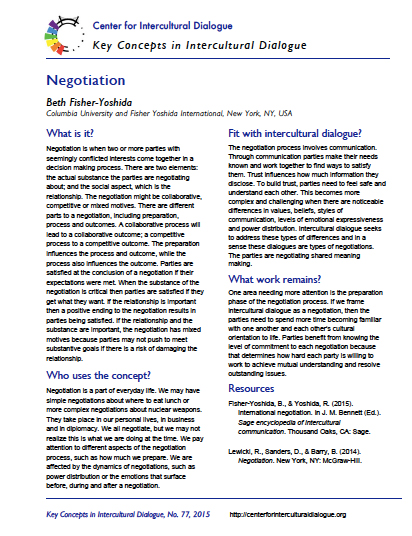
Key Concept #77: Negotiation by Beth Fisher-Yoshida

Key Concepts in ICDThe next issue of Key Concepts in intercultural Dialogue is now available. This is KC77: Negotiation by Beth Fisher-Yoshida. As always, all Key Concepts are available as free PDFs; just click on the thumbnail to download. Lists organized chronologically by publication date and numberalphabetically by concept in English, and by languages into which they have been translated, are available, as is a page of acknowledgments with the names of all authors, translators, and reviewers.

Key Concept 77 Negotiation by Beth Fisher-YoshidaFisher-Yoshida, B. (2016). Negotiation. Key Concepts in Intercultural Dialogue, 77. Available from:
https://centerforinterculturaldialogue.org/wp-content/uploads/2016/03/kc77-negotiation.pdf

The Center for Intercultural Dialogue publishes a series of short briefs describing Key Concepts in Intercultural Dialogue. Different people, working in different countries and disciplines, use different vocabulary to describe their interests, yet these terms overlap. Our goal is to provide some of the assumptions and history attached to each concept for those unfamiliar with it. As there are other concepts you would like to see included, send an email to the series editor, Wendy Leeds-Hurwitz. If there are concepts you would like to prepare, provide a brief explanation of why you think the concept is central to the study of intercultural dialogue, and why you are the obvious person to write up that concept.


Creative Commons License
This work is licensed under a Creative Commons Attribution-NonCommercial-NoDerivatives 4.0 International License.

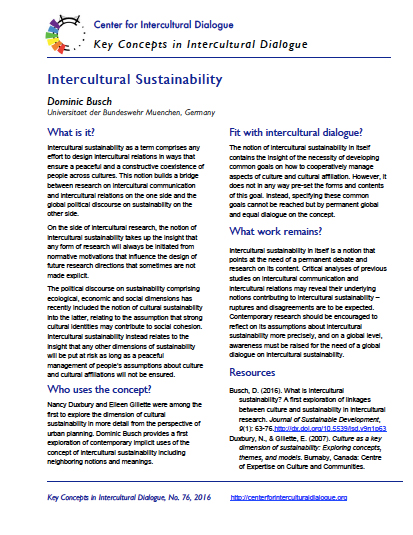
Key Concept 76: Intercultural Sustainability by Dominic Busch

Key Concepts in ICDThe next issue of Key Concepts in intercultural Dialogue is now available. This is KC76: Intercultural Sustainability by Dominic Busch. As always, all Key Concepts are available as free PDFs; just click on the thumbnail to download.Lists organized chronologically by publication date and numberalphabetically by concept in English, and by languages into which they have been translated, are available, as is a page of acknowledgments with the names of all authors, translators, and reviewers.

KC76 Intercultural Sustainability by Dominic BuschBusch, D. (2016). Intercultural sustainability. Key Concepts in Intercultural Dialogue, 76. Available from:
https://centerforinterculturaldialogue.org/wp-content/uploads/2016/01/kc76-intercultural-sustainability.pdf

The Center for Intercultural Dialogue publishes a series of short briefs describing Key Concepts in Intercultural Dialogue. Different people, working in different countries and disciplines, use different vocabulary to describe their interests, yet these terms overlap. Our goal is to provide some of the assumptions and history attached to each concept for those unfamiliar with it. As there are other concepts you would like to see included, send an email. If there are concepts you would like to prepare, provide a brief explanation of why you think the concept is central to the study of intercultural dialogue, and why you are the obvious person to write up that concept.


Creative Commons License
This work is licensed under a Creative Commons Attribution-NonCommercial-NoDerivatives 4.0 International License.

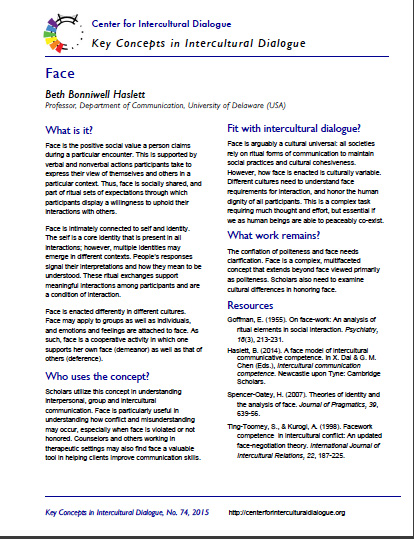
Key Concept #74: Face by Beth Bonniwell Haslett

Key Concepts in ICDThe next issue of Key Concepts in intercultural Dialogue is now available. This is KC74: Face by Beth Bonniwell Haslett. As always, all Key Concepts are available as free PDFs; just click on the thumbnail to download. Lists organized chronologically by publication date and numberalphabetically by concept in English, and by languages into which they have been translated, are available, as is a page of acknowledgments with the names of all authors, translators, and reviewers.

Key Concept 74 Face by Beth Haslett

Haslett, B. B. (2015). Face. Key Concepts in Intercultural Dialogue, 74. Available from: https://centerforinterculturaldialogue.org/wp-content/uploads/2015/11/kc74-face.pdf

The Center for Intercultural Dialogue publishes a series of short briefs describing Key Concepts in Intercultural Dialogue. Different people, working in different countries and disciplines, use different vocabulary to describe their interests, yet these terms overlap. Our goal is to provide some of the assumptions and history attached to each concept for those unfamiliar with it. As there are other concepts you would like to see included, send an email to the series editor, Wendy Leeds-Hurwitz. If there are concepts you would like to prepare, provide a brief explanation of why you think the concept is central to the study of intercultural dialogue, and why you are the obvious person to write up that concept.


Creative Commons License
This work is licensed under a Creative Commons Attribution-NonCommercial-NoDerivatives 4.0 International License.

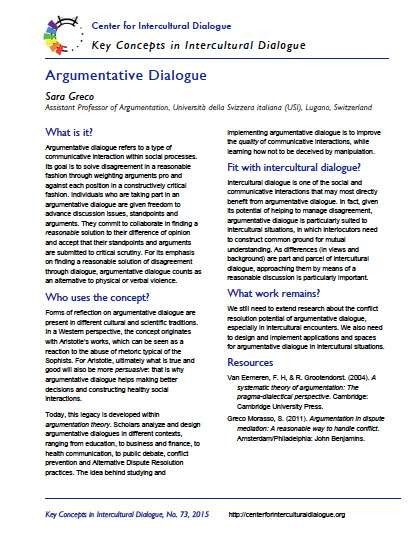
Key Concept #73: Argumentative Dialogue by Sara Greco

Key Concepts in ICDThe next issue of Key Concepts in intercultural Dialogue is now available. This is KC73: Argumentative Dialogue by Sara Greco. As always, all Key Concepts are available as free PDFs; just click on the thumbnail to download. Lists organized chronologically by publication date and numberalphabetically by concept in English, and by languages into which they have been translated, are available, as is a page of acknowledgments with the names of all authors, translators, and reviewers.

Key Concept 73 Argumentative Dialogue by Sara Greco

Greco, S. (2015). Argumentative dialogue. Key Concepts in Intercultural Dialogue, 73. Available from: https://centerforinterculturaldialogue.org/wp-content/uploads/2015/10/kc73-argumentative-dialogue.pdf 

The Center for Intercultural Dialogue publishes a series of short briefs describing Key Concepts in Intercultural Dialogue. Different people, working in different countries and disciplines, use different vocabulary to describe their interests, yet these terms overlap. Our goal is to provide some of the assumptions and history attached to each concept for those unfamiliar with it. As there are other concepts you would like to see included, send an email to the series editor, Wendy Leeds-Hurwitz. If there are concepts you would like to prepare, provide a brief explanation of why you think the concept is central to the study of intercultural dialogue, and why you are the obvious person to write up that concept.


Creative Commons License
This work is licensed under a Creative Commons Attribution-NonCommercial-NoDerivatives 4.0 International License.

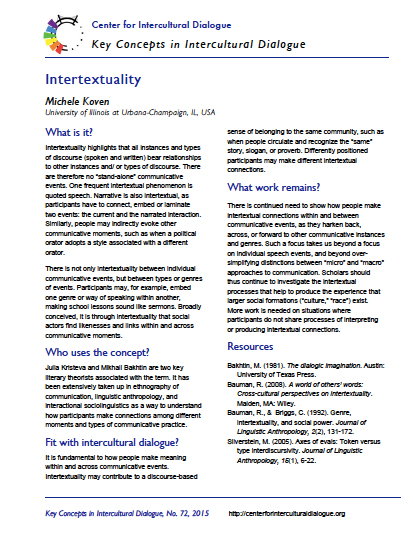
Key Concept #72: Intertextuality by Michele Koven

Key Concepts in ICDThe next issue of Key Concepts in intercultural Dialogue is now available. This is KC72: Intertextuality by Michele Koven. As always, all Key Concepts are available as free PDFs; just click on the thumbnail to download. Lists organized chronologically by publication date and numberalphabetically by concept in English, and by languages into which they have been translated, are available, as is a page of acknowledgments with the names of all authors, translators, and reviewers.

Key Concept 72 Intertextuality by Michele Koven

Koven, M. (2015). Intertextuality. Key Concepts in Intercultural Dialogue, 72. Available from: https://centerforinterculturaldialogue.org/wp-content/uploads/2015/08/kc72-intertextuality.pdf

The Center for Intercultural Dialogue publishes a series of short briefs describing Key Concepts in Intercultural Dialogue. Different people, working in different countries and disciplines, use different vocabulary to describe their interests, yet these terms overlap. Our goal is to provide some of the assumptions and history attached to each concept for those unfamiliar with it. As there are other concepts you would like to see included, send an email to the series editor, Wendy Leeds-Hurwitz. If there are concepts you would like to prepare, provide a brief explanation of why you think the concept is central to the study of intercultural dialogue, and why you are the obvious person to write up that concept.


Creative Commons License
This work is licensed under a Creative Commons Attribution-NonCommercial-NoDerivatives 4.0 International License.

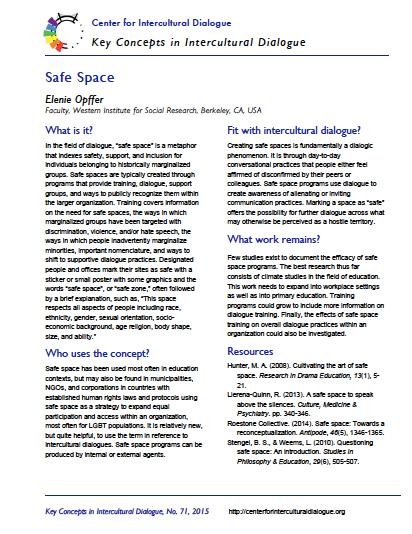
Key Concept #71 Safe Space by Elenie Opffer

Key Concepts in ICDThe next issue of Key Concepts in intercultural Dialogue is now available. This is KC71: Safe Space by Elenie Opffer. As always, all Key Concepts are available as free PDFs; just click on the thumbnail to download. Lists organized chronologically by publication date and numberalphabetically by concept in English, and by languages into which they have been translated, are available, as is a page of acknowledgments with the names of all authors, translators, and reviewers.

Key Concept 71 Safe Space by Elenie Opffer

Opffer, E. (2015). Safe space. Key Concepts in Intercultural Dialogue, 71. Available from: https://centerforinterculturaldialogue.org/wp-content/uploads/2015/08/kc71-safe-space.pdf

The Center for Intercultural Dialogue publishes a series of short briefs describing Key Concepts in Intercultural Dialogue. Different people, working in different countries and disciplines, use different vocabulary to describe their interests, yet these terms overlap. Our goal is to provide some of the assumptions and history attached to each concept for those unfamiliar with it. As there are other concepts you would like to see included, send an email to the series editor, Wendy Leeds-Hurwitz. If there are concepts you would like to prepare, provide a brief explanation of why you think the concept is central to the study of intercultural dialogue, and why you are the obvious person to write up that concept.


Creative Commons License
This work is licensed under a Creative Commons Attribution-NonCommercial-NoDerivatives 4.0 International License.

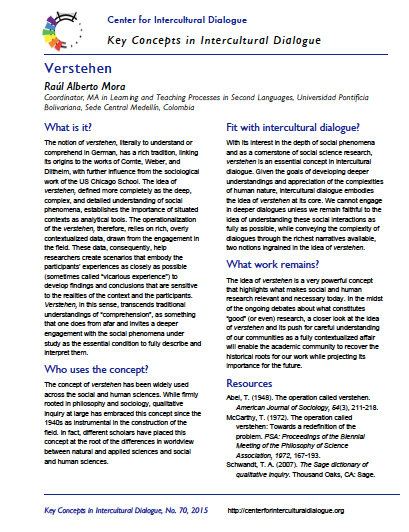
Key Concept #70: Verstehen by Raul Mora

Key Concepts in ICDThe next issue of Key Concepts in intercultural Dialogue is now available. This is KC70: Verstehen by Raul A. Mora. As always, all Key Concepts are available as free PDFs; just click on the thumbnail to download. Lists organized chronologically by publication date and numberalphabetically by concept in English, and by languages into which they have been translated, are available, as is a page of acknowledgments with the names of all authors, translators, and reviewers.

KC 70 Verstehen by Raul Mora

Mora, R. A. (2015). Verstehen. Key Concepts in Intercultural Dialogue, 70. Available from: https://centerforinterculturaldialogue.org/wp-content/uploads/2015/07/kc70-verstehen-by-raul-mora.pdf

The Center for Intercultural Dialogue publishes a series of short briefs describing Key Concepts in Intercultural Dialogue. Different people, working in different countries and disciplines, use different vocabulary to describe their interests, yet these terms overlap. Our goal is to provide some of the assumptions and history attached to each concept for those unfamiliar with it. As there are other concepts you would like to see included, send an email to the series editor, Wendy Leeds-Hurwitz. If there are concepts you would like to prepare, provide a brief explanation of why you think the concept is central to the study of intercultural dialogue, and why you are the obvious person to write up that concept.


Creative Commons License
This work is licensed under a Creative Commons Attribution-NonCommercial-NoDerivatives 4.0 International License.

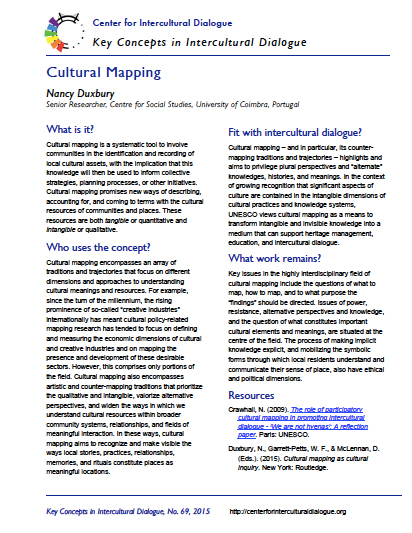
Key Concept #69: Cultural Mapping by Nancy Duxbury

Key Concepts in ICDThe next issue of Key Concepts in intercultural Dialogue is now available. This is KC69: Cultural Mapping by Nancy Duxbury. As always, all Key Concepts are available as free PDFs; just click on the thumbnail to download. Lists organized chronologically by publication date and numberalphabetically by concept in English, and by languages into which they have been translated, are available, as is a page of acknowledgments with the names of all authors, translators, and reviewers.

Key Concept 69: Cultural Mapping by Nancy Duxbury

Duxbury, N. (2015). Cultural mapping. Key Concepts in Intercultural Dialogue, 69. Available from: https://centerforinterculturaldialogue.org/wp-content/uploads/2015/06/kc69-cultural-mapping.pdf

The Center for Intercultural Dialogue publishes a series of short briefs describing Key Concepts in Intercultural Dialogue. Different people, working in different countries and disciplines, use different vocabulary to describe their interests, yet these terms overlap. Our goal is to provide some of the assumptions and history attached to each concept for those unfamiliar with it. As there are other concepts you would like to see included, send an email to the series editor, Wendy Leeds-Hurwitz. If there are concepts you would like to prepare, provide a brief explanation of why you think the concept is central to the study of intercultural dialogue, and why you are the obvious person to write up that concept.


Creative Commons License
This work is licensed under a Creative Commons Attribution-NonCommercial-NoDerivatives 4.0 International License.