Indigenous Languages through Google Earth

Applied ICDContributing to the United Nations 2019 International Year of Indigenous Languages, a Google Earth project, Celebrating Indigenous Languages, brings attention to specific languages spoken around the world by letting 55 people share examples of greetings, sayings, and stories in their native language.

“A shared language is one of the most important connections among groups of people. Not only does it create a sense of kinship, but it promotes a shared worldview through unique vocabulary and traditional sayings and songs. Yet many of the world’s 7,000 languages are in danger of disappearing; according to the United Nations 2,680 Indigenous languages are at risk. Indigenous communities around the globe are working to preserve and revitalize their languages by teaching them to future generations and sharing them with non-Indigenous speakers.”

Further reading:

Katz, Brigid. (15 August 2019). At-risk indigenous languages spotlighted on new Google Earth platform. Smithsonian.com

Šopova, Jasmina. (2019). Indigenous languages and knowledge. The UNESCO Courier, January-March 2019.

Cookies and Social Justice

Applied ICD

Choe, Caroline. (31 August 2019). Cookie artist teaches edible lessons In Asian-American history. National Public Radio.


This NPR essay, produced as part of The Salt, their section on food, highlights the work of a baker who has figured out how to use cookies to start difficult conversations about race. The article is well worth reading.

Who would have thought using baked goods as a platform to talk social justice was a thing? And yet, the attention it has garnered is exactly what we need to start dialog and to impart enlightenment.

“Jasmine Cho knows the power of a good cookie. ‘Cookies,’ she says, ‘can make anything more palatable.’ Including conversations about race and social justice in America.

A baker based in Pittsburgh, Cho creates intricate, hand-drawn cookie portraits of Asian-American figures as a way to increase representation and raise awareness of Asian-American history and identity.”

Diversity in Children’s Books

Applied ICDChildren’s books reflect the adult world, sometimes in unexpected ways. In a college course on children’s literature, I studied the ways in which children’s books dealt with serious issues (such as death). Since then I’ve paid a lot of attention to children’s books, so when I saw this infographic, I paid attention. You should too.
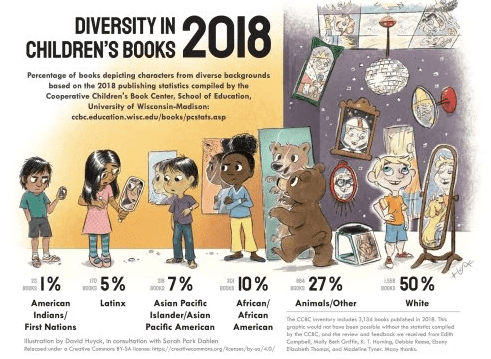
Full citation: Huyck, David and Sarah Park Dahlen. (2019 June 19). Diversity in Children’s Books 2018. sarahpark.com blog. Created in consultation with Edith Campbell, Molly Beth Griffin, K. T. Horning, Debbie Reese, Ebony Elizabeth Thomas, and Madeline Tyner, with statistics compiled by the Cooperative Children’s Book Center, School of Education, University of Wisconsin-Madison: http://ccbc.education.wisc.edu/books/pcstats.asp. Retrieved from https://readingspark.wordpress.com/2019/06/19/picture-this-diversity-in-childrens-books-2018-infographic/.

This seems to show an over-representation of White children at 50%, but now look at comparable figures for 2015:
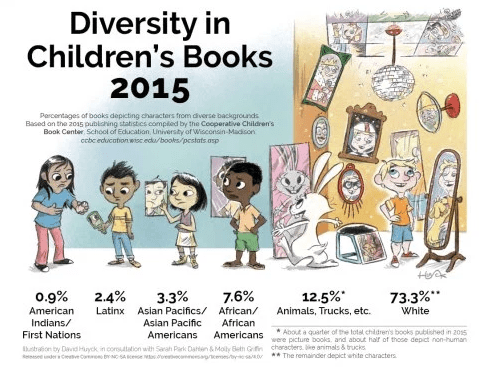
Full citation: Huyck, David, Sarah Park Dahlen, Molly Beth Griffin. (2016 September 14). Diversity in Children’s Books 2015 infographic. sarahpark.com blog.
Retrieved from https://readingspark.wordpress.com/2016/09/14/picture-this-reflecting-diversity-in-childrens-book-publishing/
Statistics compiled by the Cooperative Children’s Book Center, School of Education, University of Wisconsin-Madison:
http://ccbc.education.wisc.edu/books/pcstats.asp

Even though the number of white protagonists in children’s books has gone down over the 3 years examined, this doesn’t actually show as much increase in diverse protagonists as it might – the largest gain was in the category of “animals, trucks, etc.”! Obviously there are a lot of children’s books with diverse protagonists still needing to be written, so that all children get to see themselves represented.

Further reading:

Durand, E. S., & Jiménez-García, M. (2018). Unsettling representations of identities: A critical review of diverse youth literature. Research on Diversity in Youth Literature, 1(1 ), Article 7.

Naidoo, J. C., & Dahlen, S. P. (Eds). (2013) Diversity in youth literature: Opening doors through reading. Chicago: ALA Editions.

Wendy Leeds-Hurwitz, Director
Center for Intercultural Dialogue

Early ICD in Serbia

Applied ICDGorman, J. (20 August 2019). An archaeological puzzle on the Danube. New York Times.

This article reports on a fascinating example of early intercultural dialogue; the archaeological evidence found is in Serbia.

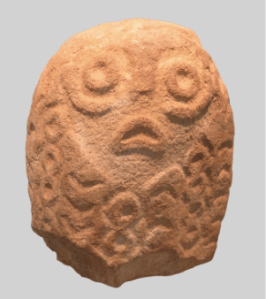
“The faces are haunting. About 8,000 years ago, over a period of perhaps 200 years, artists that lived in this settlement on the banks of the Danube carved about 100 sandstone boulders with faces and abstract designs. The faces are simple, with wide round eyes, a stylized nose and down-turned open mouths…

Researchers still debate the precise dating of different settlements at Lepenski Vir and nearby sites, but agree on the essential fact that the sites capture a record of the meeting and mixing of two cultures and peoples…

Another indication of the merging of two cultures is a change in burial practices. Throughout Europe, the Mesolithic foragers laid a body down stretched out. The migrant farmers from the Near East brought another way of treating death, setting the body in a crouched or fetal position.

Both practices are found at Lepenski Vir. And when the burial practices are combined with DNA profiles, the picture is richer still. Some of the dead of Near Eastern heritage are buried in the way of the foragers. And others of foraging heritage are buried in the way of the farmers.”

Translation x90 (Scotland)

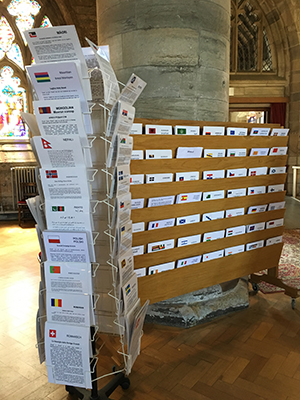
Applied ICDTraveling in Scotland, I visited the Church of the Holy Rude in Stirling. At the entrance, they have handouts outlining the history of the site – translated into 90+ languages!

Church of the Holy Rude, Stirling

I have never seen so much effort put into documentation for international visitors. If only all tourist attractions were so thoughtful.

Wendy Leeds-Hurwitz, Director
Center for Intercultural Dialogue
Visual Metaphor for Intercultural Dialogue: Tree of 40 Fruit

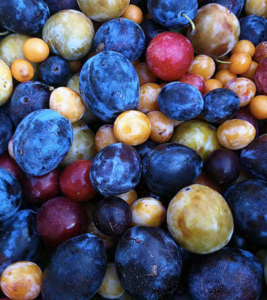
Applied ICDSam Van Aken, sculptor and art professor at Syracuse University, invented the Tree of 40 fruit, already described as “a symbol of acceptance and dialogue across differences” – and it seems well suited to that role.

The Tree of 40 Fruit is a single grafted tree with the capacity to grow over 40 different varieties of stone fruit, including peach, plum, apricot, nectarine, cherry, and almond. Appearing as a normal fruit tree through the majority of the year, in spring it blossoms in variegated tones of pink, white, and crimson, and in summer multiple fruits ripen. Primarily composed of antique and native stone fruit varieties, the Tree of 40 Fruit is a form of conservation, preserving rare, unknown, or now forgotten cultivars that are not commercially available.

Published articles:
Syracuse University Magazine
National Geographic
Zoomer Media


International Year of Indigenous Languages

Resources in ICD“ width=2019 is the International Year of Indigenous Languages. Indigenous languages matter for social, economic and political development, peaceful coexistence and reconciliation in our societies. Yet many of them are in danger of disappearing. Every 2 weeks, the world loses an indigenous language and with it an entire cultural & intellectual heritage.

“An International Year is an important cooperation mechanism dedicated to raising awareness of a particular topic or theme of global interest or concern, and mobilizing different players for coordinated action around the world. In 2016, the United Nations General Assembly adopted a resolution proclaiming 2019 as the International Year of Indigenous Languages, based on a recommendation by the Permanent Forum on Indigenous Issues. At the time, the Forum said that 40 per cent of the estimated 6,700 languages spoken around the world were in danger of disappearing.  The fact that most of these are indigenous languages puts the cultures and knowledge systems to which they belong at risk. 

In addition, indigenous peoples are often isolated both politically and socially in the countries they live in, by the geographical location of their communities, their separate histories, cultures, languages and traditions. And yet, they are not only leaders in protecting the environment, but their languages represent complex systems of knowledge and communication and should be recognized as a strategic national resource for development, peace building and reconciliation. They also foster and promote unique local cultures, customs and values which have endured for thousands of years. Indigenous languages add to the rich tapestry of global cultural diversity. Without them, the world would be a poorer place.”

from: About IYIL 2019.

Molly of Denali

Applied ICDMolly of Denali is a new PBS cartoon (created by WGBH Kids, Atomic Cartoons, and CBC Kids) and the first nationally distributed children’s series with a Native American lead. Ten-year-old Molly embodies intercultural dialogue as she walks the line between her family’s traditions (her heritage is Gwich’in, Koyukon and Dena’ina Athabascan) and modern use of the internet, including creating a video blog about her life in rural Alaska.

Stories about this:
PBS
New York Times
NPR

Learning from Intercultural Storytelling

Applied ICDLISTEN (Learning from Intercultural Storytelling) is a two year project (2016-18), co-funded by the Erasmus+ programme of the European Commission and the German Federal Ministry for Education and Research.

LISTEN uses “applied storytelling” as an educational approach for the work with refugees – be it to support language learning, to exchange about cultural differences, to create visions etc. In order to give refugees a voice in the receiving societies and to support their integration, LISTEN explores different approaches to storytelling and how radio and other forms of audio broadcasting (e.g. podcasting) can be used as medium to share those stories. LISTEN provides extensive resources on storytelling in multiple languages, in addition to presenting the stories themselves.

EIUC Electoral Observers Training 2019 (Italy)

Applied ICDTraining seminar for International Electoral Observers, Global Campus of Human Rights, Venice, Italy, 25 -29 November 2019. Deadline: 21 October 2019.

The Global Campus of Human Rights has developed a course aiming at providing training to civilian staff in election observation missions at the first steps of their career (i.e. short term observers). Selected applicants will be allowed to become aware of the role, the tasks and the status of international observers, and will be given a theoretical and practical training on election observation and election observation missions functioning. The training will take place in Venice, at the Global Campus of Human Rights Headquarters, from 25 to 29 November 2019.