 Continuing translations of Key Concepts in Intercultural Dialogue, today I am posting KC#85: Diglossia, which Marianna Kyriakou wrote for publication in English in 2017, and which she has now translated into Greek. [NOTE: this concept was updated in 2020, and the original 2018 version replaced.]
As always, all Key Concepts are available as free PDFs; just click on the thumbnail to download. Lists of Key Concepts organized chronologically by publication date and number, alphabetically by concept, and by languages into which they have been translated, are available, as is a page of acknowledgments with the names of all authors, translators, and reviewers.
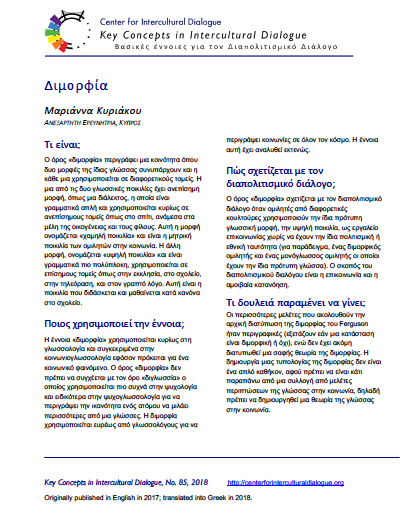 Kyriakou, M. (2020). Diglossia [Greek]. Key Concepts in Intercultural Dialogue, 85. Available from:
https://centerforinterculturaldialogue.org/wp-content/uploads/2020/02/kc85-diglossia_greek_v2.pdf
If you are interested in translating one of the Key Concepts, please contact me for approval first because dozens are currently in process. As always, if there is a concept you think should be written up as one of the Key Concepts, whether in English or any other language, propose it. If you are new to CID, please provide a brief resume. This opportunity is open to masters students and above, on the assumption that some familiarity with academic conventions generally, and discussion of intercultural dialogue specifically, are useful.
Wendy Leeds-Hurwitz, Director
Center for Intercultural Dialogue

This work is licensed under a Creative Commons Attribution-NonCommercial-NoDerivatives 4.0 International License.





 The Fulbright was for someone to teach courses in management at the Tashkent Institute of Finance. I had a keen cultural interest in Central Asia, but my Ph.D. was in Applied Linguistics, & most of my teaching dealt with the English language, with courses like applied linguistics, fiction, & non-fiction writing, I also taught an MBA course in business communication. In my Fulbright application, I stressed the fact that an American business professor teaching in a place like Tashkent would be faced with serious comprehension problems from his students, especially since management has its share of jargon and technical terms. I offered to prepare a book for management students who were also nonnative speakers of English. I was also lucky enough to have had a previous Fulbright, plus several other long-term overseas ESL teaching assignments (in Afghanistan, Saudi, & Indonesia). At any rate, the Fulbright came through, and I arrived in Tashkent with copies of the book (later published as English for Decision-Makers: A Course in Modern Management).

