FMSH: Franco Nordic Program Grants (France, Norway)

GrantsFranco Nordic Program grants, Fondation Maison des Sciences de l’Homme (FMSH), Paris, France. Deadline: 11 April 2025.

This program, led by the University Centre of Norway in Paris (CUNP) and the FMSH, aims to promote research collaboration in the field of human and social sciences and support the development of new scientific cooperation projects between French and Nordic researchers (Norwegian, Swedish, Danish, Finnish, and Icelandic). The call is open to researchers of all disciplines in the human and social sciences, starting at the doctoral level, for trilateral projects with a duration of 3 years (2026-28).

  • The project team must involve at least 3 researchers from 3 higher education institutions: 1 from Norway, who will be the project coordinator, 1 from France, and 1 from another Nordic country (Denmark, Finland, Iceland, Sweden).
  • Only the norwegian coordinator has to have a permanent position and be attached to one of the following universities which will host the project during its entire duration: University of Oslo (UiO), University of Bergen (UiB), Norwegian University of Science and Technology (NTNU), Norwegian Arctic University (UiT).
  • The other members of the team can be PhD students, post-doctoral fellows or researchers, either statutory or associated with a higher education institution in France or in another Nordic country.
  • The activities presented must take place in the countries of the project teams.
  • If necessary, it is possible to integrate a 4th partner from outside the Nordic countries: in this case, the relevance of its participation must be detailed in the project and the latter must provide co-financing.

ICD Exercise #5: Challenging Cultural Stereotypes through Intercultural Dialogue

ICD ExercisesThe next ICD Exercise is now available. Favour Ilolo, Stellina Ogedengbe, and Ifeoma Onyebuchi have written about challenging cultural stereotypes through intercultural dialogue. In addition to written instructions, this exercise comes with an infographic as well.

The objective of this exercise is to equip participants with strategies for engaging in dialogue to challenge stereotypes. Using a detailed infographic as the instructional guide, participants will learn to initiate constructive conversations, incorporating personal storytelling, active listening, counter-stories, reflection on cultural identity, creating a safe space, and following up. This exercise empowers participants to foster inclusivity and mutual understanding.

As with prior publications, ICD Exercises are available as free PDFs; just click on the thumbnail to download the infographic, and on the link in the citation to download the exercise itself.

Intercultural Dialogue Exercises #5 infographic

Ilolo, F., Onyebuchi, I., & Ogedengbe, S. (2025). Challenging cultural stereotypes through intercultural dialogue. Intercultural Dialogue Exercises, 5. Available from: https://centerforinterculturaldialogue.org/wp-content/uploads/2025/02/icd-ex-5-ilolo.pdf

If you have an exercise you’ve used that works, and you would like to share it, please submit it. All authors will be asked to answer the same set of questions, and to make the exercises available for others to use, thus these are being published with a Creative Commons license (as is the case for all CID publications). If you are new to CID, please provide a brief resume. This opportunity is open to masters students and above, on the assumption that some familiarity with academic conventions generally, and discussion of intercultural dialogue specifically, are useful.

Wendy Leeds-Hurwitz
Director Center for Intercultural Dialogue


This work is licensed under a Creative Commons Attribution-NonCommercial-NoDerivatives 4.0 International License.

CUHK: Faculty Position, Institute for International Affairs (China)

“JobFaculty position (Senior Research Fellow/Research Fellow/Associate Research Fellow/Assistant Research Fellow/Postdoc/Visiting Scholar), Institute for International Affairs, Chinese University of Hong Kong, Shenzhen, China. Deadline: 28 March 2025.

Key Duties and Responsibilities:

  • Paying close attention to the development of contemporary China and conduct in-depth academic and policy research on international relations, economics, politics, public policy, global affairs, global politics, economics or related issues;

  • Participating in the strategic consulting of think tanks, provide decision-making consulting services for government departments, and write government policy reports;

  • Independently undertaking key project work in relevant professional fields and writing relevant reports or papers;

  • Participating in or leading related activities of the Institute, including academic forums, round table discussions and public lectures;

  • Participating in the exchange and cooperation between the Institute and other research institutions around the world, and completing the special construction work of the Institute and other work related to the Institute.

Coastal Carolina U: Visiting Assistant Professor of Communication (USA)

“JobVisiting Assistant Professor in Communication, Coastal Carolina University, Conway, SC, USA. Deadline: open until filled; posted 3 February 2025.

Coastal Carolina University invites applications for a Visiting Assistant Professor in Communication, or related fields, to begin in August 2025 with the possibility of renewal for up to two years. Candidates must have a Ph.D. in Communication, Journalism, Mass Communication, or a closely related discipline. ABD candidates with a clear plan for degree completion prior to May 31, 2026, may be considered. The teaching load is three courses per academic semester and may include face-to-face, hybrid, or distance learning deliveries. They are seeking excellent teacher-scholars who have the ability to teach the department’s foundation courses, including communication theory and communication research. Faculty will also teach courses in their area of expertise. Preference will be given to those whose area of expertise is in Film Studies, Film Production, Social Media, or Intercultural Communication. Faculty are expected to provide high-quality instruction, mentor students, and provide service to the Department, College, and University when appropriate. Visiting faculty are encouraged to maintain an active research agenda.


CFP The Problem of Social Justice: Global Perspectives and Personal Narratives

“Publication

Call for submissions to Language, Literature, and Interdisciplinary Studies for a special issue on The Problem of Social Justice: Global Perspectives and Personal Narratives. Deadline: 15 March 2025.

This special issue of LLIDS seeks to initiate a global dialogue on Social Justice (SJ). While considerations of economy undergird SJ theory, its discourse reaches beyond economics to address inequalities of access, privilege, and rights. As an academic discipline, SJ theory embraces a range of critical theories and methods: colonialist criticism, critical race theory, gender criticism, and queer theory among other methods fall under its purview. For SJ theory offers to critique the institutions—social, political, economic—that sustain inequalities of access, privilege, opportunity, and rights generally. As a social praxis, SJ theory aims to deinstitutionalize systematic inequality by means of progressive public policy. Indeed, treating equal access and opportunity as matters of social “justice” necessarily entails law and policy. SJ theory seeks to protect and expand rights of individuals and communities. In concert with posthumanism and ecocriticism, SJ theory extends this same protection to the planet and to our many “companion species” whose survival is threatened by climate change and environmental degradation.

Such is the starting point for a special issue on Social Justice, which invites submissions that reflect on, analyze, expand on, and complicate SJ theory and its implications. As an international interdisciplinary journal, LLIDS seeks to involve authors and audiences globally in exploring this timely issue. A series of questions and propositions follow apropos to this topic.

  • How does SJ theory understand itself as an ideology or ideological behavior?
  • How is SJ theory taught? What is its curriculum? What are its paths of resistance?
  • In the classroom, in scholarship, and in public/political discourse, what does SJ theory enable or make visible? What does it leave unseen or unspoken? What are its “blind spots”?
  • How can SJ theory address the political-economic crisis of the 1% against the 99%?
  • Can Social Justice have the same meaning and application/implication for all communities, charting both the Global North and the Global South?
  • As per the U.N. declaration, Social Justice seeks a “fair and compassionate distribution” of wealth. This remains a noble aim and aspiration. And given the deep entrenchment of global capitalism, is it viable?
  • How can SJ advocates claim to speak “on behalf” of a community unless/until its members have spoken and been heard? Is advocacy earned through listening? (Is SJ theory a mode of “listening rhetoric”? Can/should it become one?)
  • What can SJ advocates learn from the social methods of Engaged Theory, Grounded Theory, and the Bourdieusian Theory of Practice?

ACLS: Leading Edge Fellowships 2025-26 (USA)

FellowshipsLeading Edge Fellowships, American Council of Learned Societies (ACLS is based in New York, but the fellowships are across the USA). Deadline: 12 March 2025.

The American Council of Learned Societies is pleased to announce the seventh competition of the Leading Edge Fellowship program, which demonstrates the potential of humanistic knowledge and methods to solve problems, build organizational capacity, and advance justice and equity in society. Leading Edge Fellowships place recent humanities PhDs with nonprofit organizations promoting social justice in their communities. Fellows take on substantive roles that draw on the skills and capacities honed in the course of earning the humanities PhD, including advanced communication, research, project management, and creative problem solving. This initiative is made possible through the generous support of the Mellon Foundation.

The fellowships are designed to foster mutually beneficial partnerships between fellows and their hosting organizations. Each applicant may apply for up to two of the available Leading Edge Fellowship opportunities listed below. There is a separate selection process for each fellowship opportunity.

East-West Center Summer Institute 2025: Contemporary Asias (USA)

Events

Summer Institute: Contemporary Asias, East-West Center, Honolulu, HI, USA, 9 June-4 July 2025. Deadline: 5 March 2025.

Contemporary Asias: Pluralities Beyond Areas is a 4-week Institute for college and university teachers on the East-West Center campus in Honolulu by the Asian Studies Development Program. This multidisciplinary program will explore recent changes in the production, structuring, and sharing of knowledge about Asian cultures and societies, and how these changes might foster knowledge communities that are more collaborative, responsive, and attuned to the pluralities of Asian experiences. Combining methodological reflections on area studies with context-rich engagement with key dimensions of societal and cultural transformation in contemporary Asia, the Institute will support diversity-focused teaching and learning and next-generation digital humanities.

European Alternatives: Speak Out: Empowering Youth for Change (Webinar)

EventsSpeak Out: Empowering Youth for Change, European Alternatives and Erasmus Student Network, February-March 2025 webinars.

European Alternatives and Erasmus Student Network are launching a series of four open webinars designed to train and inspire young change-makers. These sessions will provide valuable insights into tackling pressing issues such as underrepresentation, leveraging local and EU-level action, analyzing policies and stakeholders, and crafting impactful messages for recruitment and advocacy.

The webinars will cover the following topics:

Discrimination and How to Act Against It
🗓️ Tuesday, 18th February 2025 | 🕕 6:00–7:30 PM CET
Building Bridges: Activating Levers of Influence
🗓️ Tuesday, 25th February 2025 | 🕕 6:00–7:30 PM CET
Advocate! Plan Your Campaign
🗓️ Tuesday, 4th March 2025 | 🕕 6:00–7:30 PM CET
Build Your Power Base
🗓️ Tuesday, 11th March 2025 | 🕕 6:00–7:30 PM CET

ICD Exercise #4: Implicit Bias Awareness

ICD Exercises

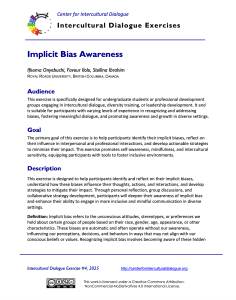
The next ICD Exercise is now available. Ifeoma Onyebuchi, Stellina Ibrahim, and Favour Ilolo have written about implicit bias awareness. 

This exercise is designed to help participants identify and reflect on their implicit biases, understand how these biases influence their thoughts, actions, and interactions, and develop strategies to mitigate their impact. Through personal reflection, group discussions, and collaborative strategy development, participants will deepen their awareness of implicit bias and enhance their ability to engage in more inclusive and mindful communication in diverse settings.

Implicit bias refers to the unconscious attitudes, stereotypes, or preferences we hold about certain groups of people based on their race, gender, age, appearance, or other characteristics. These biases are automatic and often operate without our awareness, influencing our perceptions, decisions, and behaviors in ways that may not align with our conscious beliefs or values. Recognizing implicit bias involves becoming aware of these hidden prejudices and understanding how they can affect interactions in professional and personal contexts.

As with prior publications, ICD Exercises are available as free PDFs; just click on the thumbnail to download.

Onyebuchi, I., Ibrahim, S., & Ilolo, F. (2025). Implicit bias awareness. Intercultural Dialogue Exercises, 4. Available from: https://centerforinterculturaldialogue.org/wp-content/uploads/2025/02/icd-ex-4-onyebuchi-et-al-1.pdf

If you have an exercise you’ve used that works, and you would like to share it, please submit it. All authors will be asked to answer the same set of questions, and to make the exercises available for others to use, thus these are being published with a Creative Commons license (as is the case for all CID publications). If you are new to CID, please provide a brief resume. This opportunity is open to masters students and above, on the assumption that some familiarity with academic conventions generally, and discussion of intercultural dialogue specifically, are useful.

Wendy Leeds-Hurwitz
Director Center for Intercultural Dialogue


This work is licensed under a Creative Commons Attribution-NonCommercial-NoDerivatives 4.0 International License.

Catawba College: Director of International Studies (USA)

“JobDirector of International Studies, Catawba College, Salisbury, NC, USA. Deadline: 22 April 2025.

The Director of the Glenn and Addie Ketner Center for International Studies provides strategic guidance and expertise to advance Catawba College’s commitment to global education. This position plays a key role in shaping and expanding the College’s portfolio of international study opportunities while ensuring comprehensive, equity-minded support for international students on campus.

The Director oversees the design and delivery of academically rigorous and culturally immersive international programs, including short-term faculty-led trips, semester-long exchanges, and language immersion opportunities. The Director also collaborates closely with faculty, staff, and external partners to ensure that international education initiatives align with Catawba’s mission of holistic student development and academic excellence.

By developing innovative programs and creating a welcoming, supportive environment for international students, the Director fosters global citizenship and prepares all Catawba students to thrive in an interconnected world.