Positive Approaches to Peacebuilding: A Resource for Innovators

Resources in ICD“ width=

Positive Approaches to Peacebuilding: A Resource for Innovators by by Cynthia Sampson, Mohammed Abu-Nimer, Claudia Liebler, and Diana Whitney (printed version, 2010; Taos Institute Publications WorldShare Books version, 2024). The ebook version is free to download.

Positive Approaches to Peacebuilding presents an innovative perspective on peacebuilding that breaks new ground. The theoretical frameworks are rich enough to satisfy scholars, the case studies are practical enough to engage practitioners and the tips and guides to practice are sure to inspire new and innovative work among peacebuilders. This book beautifully describes the social construction of imagined futures, inviting us, as scholar-practitioners, to move beyond ‘problem solving’ and its ethic of ‘neutrality,’ towards Appreciative Inquiry, and its ethics of narrative, voice, and meaning-making, relying on the heart-wisdom that flourishes in the context of affirmation This book powerfully delivers what it promises — a provocation to think more deeply about how we conduct our peacemaking and peacebuilding relationships. A must read for those who dare to make a difference.

Related publication: Key Concept #64: Peacebuilding by Elenie Opffer; Seeds of Dialogue.
CFP 10th Explorations in Ethnography Language and Communication (Denmark)

Conferences

Call for papers: 10th Explorations in Ethnography Language and Communication, University of Copenhagen, Denmark, 18-19 August 2025. Deadline: 18 November 2024. Deadline extended to 18 January 2025.

At the 10th Anniversary EELC conference, organizers invite scholars working at the interface between linguistics and ethnography to interrogate and explore the affordances and challenges in today’s academic landscape. Linguistic ethnographers, as other human and social scientists, contribute to the understanding of important and difficult societal developments such as AI, digital technology, political instabilities and war, climate change and increasing demographic diversity. The EELC10 will be an occasion to take stock of the present research and the future potentials.

The plenary speakers all work with pertinent societal questions:
Charles Briggs (US) continues to advance our understanding of e.g. inequality, health, and the politics of knowledge.
Adrienne Lo (US) interrogates diversity, racialization and ideologies of multilingualism.
Caroline Tagg (UK) uncovers how language, digital technologies and digital
communication practices are deeply embedded into individuals’ wider social, economic, and political lives.
Line Møller Daugaard (DK) illuminates the challenges and possibilities of cultural diversity and multilingualism in education.

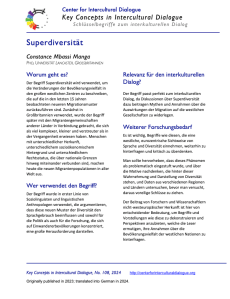
KC108 Superdiversity Translated into German

Key Concepts in ICD

Continuing translations of Key Concepts in Intercultural Dialogue, today I am posting KC108: Superdiversity, originally written by Constance Mbassi Manga for publication in 2023, and now translated by Marlena Pompino into German.

As always, all Key Concepts are available as free PDFs; just click on the thumbnail to download. Lists organized chronologically by publication date and numberalphabetically by concept in English, and by languages into which they have been translated, are available, as is a page of acknowledgments with the names of all authors, translators, and reviewers.

KC108 Superdiversity in German

Mbassi Manga, C. (2024). Superdiversität. (M. Pompino, trans.) Key Concepts in Intercultural Dialogue, 108. Available from: https://centerforinterculturaldialogue.org/wp-content/uploads/2024/06/kc108-superdiversity_german.pdf

The Center for Intercultural Dialogue publishes a series of short briefs describing Key Concepts in Intercultural Dialogue. Different people, working in different countries and disciplines, use different vocabulary to describe their interests, yet these terms overlap. Our goal is to provide some of the assumptions and history attached to each concept for those unfamiliar with it. As there are other concepts you would like to see included, send an email to the series editor, Wendy Leeds-Hurwitz. If there are concepts you would like to prepare, provide a brief explanation of why you think the concept is central to the study of intercultural dialogue, and why you are the obvious person to write up that concept.


Creative Commons License
This work is licensed under a Creative Commons Attribution-NonCommercial-NoDerivatives 4.0 International License.

U Birmingham: Stuart Hall Interdisciplinary Chair (UK)

“JobStuart Hall Interdisciplinary Chair, School of Social Policy and Society, University of Birmingham, Birmingham, UK. Deadline: 8 September 2024.

The University of Birmingham is seeking to appoint the inaugural Stuart Hall Interdisciplinary Chair. While the substantive field and disciplinary background of the post holder is open, it is anticipated that the appointee will be inspired by the work of Professor Stuart Hall and the Centre for Contemporary Cultural Studies (CCCS) and have a clear and inspiring vision of how the legacy of that work can be enhanced and developed for the future. Areas that might be relevant here include race and racism, ethnicity, gender, migration, media, representation, history, visual culture, and/or other contemporary cultural issues.

You will be able to demonstrate a world-leading research programme evidenced through high quality and influential publications and a track record of research grant capture. You will be able to lead and support a growing team of colleagues across the University in this field to consolidate and develop the University’s education offer around contemporary cultural studies.

The Chair will be based in the School of Social Policy and Society, in the College of Social Sciences. They partner with the College of Life and Environmental Sciences and the College of Arts and Law to host the Stuart Hall Archive Project, a 3-year research programme (ending July 2026), directly funded by the University of Birmingham, supporting three PIs, two researchers, and an archivist, to use Hall’s papers held by the University’s archive – the Cadbury Research Library. The project has two main aims: to explore the history of Hall’s intellectual and political formation and development at specific conjunctures; and to forge a new space for dialogue between Hall’s intellectual and political legacy and contemporary questions arising from present constituencies and communities. In addition to the development of forums and events for collaboration with external partners, researchers, artists, and community activists, the Project is committed to a range of outputs (exhibitions, publications, and online resources and platforms) and the identification of external funding opportunities for expansion and extension of the project. In addition, the University holds the archive of the Centre for Contemporary Cultural Studies.

Aarhus U: American History with Global Focus (Denmark)

“JobAssistant/Associate Professor of American History with a Global Focus, Department of English,  Aarhus University, Aarhus, Denmark. Deadline: 2 August 2024.

The School of Communication and Culture at Aarhus University invites applications for the position of either tenure-track assistant professor or tenured associate professor of American history with a global focus based at the Department of English. The tenure-track assistant professorship begins with a full-time, five-year appointment as an assistant professor with a view to permanent employment as a tenured associate professor. The associate professorship is full time and tenured.

They are looking for an applicant with a specialisation in the history of the United States of America or a closely related field in American studies. Candidates with an interdisciplinary orientation towards one or more areas that bridge the humanities and social sciences (such as cultural studies or gender studies) are particularly welcome to apply. They envision a colleague concerned not only with American history, society, politics and culture but also with the processes whereby societies and cultures interact and influence each other. Individuals able to contribute to the development of students’ knowledge, skills and competences in subjects related to interculturality (such as migration and transnational identities) are encouraged to apply.

Celebrating The Other: A Dialogic Account of Human Nature

Resources in ICD“ width=

Celebrating The Other: A Dialogic Account of Human Nature by Edward Sampson (printed version, 2008; Taos Institute Publications WorldShare Books version, 2024). The ebook version is free to download.

In this important book, Sampson launches a new attack – this time on Western culture’s centuries-long preoccupation with a contained, individualistic, monologic Self and its fearful suppression of all that is Other – all that is experienced as different from the implicit, self-affirming white male standard.

This view, he demonstrates, focuses more on the leading protagonist and supporting cast that he has assembled to service his own interests, desires and fears, than on others as viable people in their own right. Denying the Other so as to create a world secured on behalf of the dominant groups’ interests has become an obsession driving not only the larger culture but also the human sciences, in particular psychology’s theories of human nature. Women, African-Americans and others not of the dominant classes have been constructed as serviceable Others, and appear in textbooks, journals and popular accounts as figures whose images and everyday realities have been created to serve the dominant groups’ desires.

Sampson uses the writings of Mikhail Bakhtin, George Herbert Mead, and postmodern and feminist theorists to reject this dangerous obsession and to create a dialogic foundation to replace the Other-suppressing views of psychology, and indeed, of all Western culture. Sampson’s arguments are convincing, liberating, and have major implications for the human sciences and the people they claim to serve. ‘Celebrating the Other’ changes the way human nature is viewed and studied. As the author reminds us, in silencing the Other we distort our own situation and stunt our opportunities for growth – ‘no one voice can be quoted without losing the greatest opportunity of all: to converse with otherness and to learn about our own otherness in and through those conversations.’

Related publications: Key Concept #39: Otherness and the Other by Peter Praxmarer; Seeds of Dialogue, Guest post by Maria Flora Mangano.

Scoville Peace Fellowships (USA)

Grants

Call for applications: Herbert Scoville Jr. Peace Fellowship, Washington, DC, USA. Deadline for Spring 2025: 7 October 2024.

The Herbert Scoville Jr. Peace Fellowship Program invites recent college and graduate school alumni to apply for full-time, six-to-nine month fellowships in Washington, DC. Outstanding individuals will be selected to work with nonprofit, public-interest organizations addressing peace and security issues. Applications are especially encouraged from candidates with a strong interest in these issues who have prior experience with public-interest activism or advocacy.

Scoville Fellows will choose to work with one of the twenty-five organizations participating in the program. With the assistance of alumni, board, and staff, fellows will select a placement which best matches their interests and the needs of the host organization. Participating organizations provide office space and support, supervision and guidance for fellows’ work. With the exception of Congressional lobbying, fellows may undertake a variety of activities, including research, writing, and organizing that support the goals of their host organization.

Scoville Fellows create a project, in partnership with their host organizations, related to multiple broad areas, including: nuclear nonproliferation, climate and security, emerging technology threats, global health security, and also:

Peacebuilding and Conflict Resolution. This category includes but is not limited to: current and potential incursions within or between neighboring countries; conventional weapons and arms trade; cross-border refugee movements; ethnic tensions with security implications; atrocity prevention; building international and regional institutions to resolve conflicts; development and implementation of novel conflict resolutions strategies; counterterrorism and terrorism reduction strategies; supporting international agreements that can lead to peace, prosperity, and sustainability.

Broadcasts Foster Dialogue among Refugees and Host Communities (Moldova)

Applied ICD

Broadcasts to foster dialogue and understanding among refugees and host communities, Moldova.

Following the full-scale invasion of Ukraine in February 2022, UNESCO supported broadcasters in neighbouring countries, such as Teleradio-Moldova (TRM), to launch a series of programmes to aid Ukrainian refugees with support from the Government of Japan. Displaced Ukrainian media professionals were included in the broadcasts to better help refugees navigate their new lives in Moldova. Funded by the Government of Japan as an emergency project under the UN’s Regional Refugee Response Plan for the Ukraine Situation, UNESCO supported TRM to produce and broadcast programmes accessible to the displaced Ukrainians to help them settle and rebuild their lives in Moldova.

Daria Russu, host of TV Moldova 1’s 30-minute Ukrainian-language “Weekly” TV-programme, noted the challenge refugees face in accessing credible news in their mother tongue: “Ukrainian refugees have nowhere to get information about Moldova and they have nowhere to get information about the world in general. That is exactly why this project is needed, so they can get verified, truthful and complete information in their native language.”

Over the course of seven months, TRM broadcasted nearly 100 programmes for tens of thousands of Ukrainian refugees in Moldova. These covered a wide range of topics, including health, education, housing and daily life in the host country. More than 200 refugees, national experts and humanitarian actors were interviewed, providing valuable insights and perspectives for the programmes.

A key component of the project was a baseline study on the media habits and information needs of the Ukrainian refugees, commissioned by UNESCO from its long-term partner, the Norwegian Refugee Council (NRC). Loreana Sacara, TRM’s Project Coordinator, highlighted that the programmes were designed based on the research’s findings: “The programmes early gathered a wide loyal audience both among the refugees and the local population. They were aired in the Ukrainian language with subtitles or voiceovers in Romanian”.

DAAD Postgraduate Scholarships & Research Grants (Germany)

“Studentships“

Postgraduate studies, scholarships and research grants , DAAD, Bonn, Germany. Deadline: varies by program.

DAAD (Deutscher Akademischer Austauschdienst, or German Academic Exchange Service) has a scholarship programme offering a wide range of opportunities, from master’s degrees to doctoral degrees, and including research grants. A few examples include:

Master Studies for All Academic Disciplines

Research Grants in Germany (during doctorate or early post-doctoral phase)

Research Grants – Doctoral Programmes in Germany


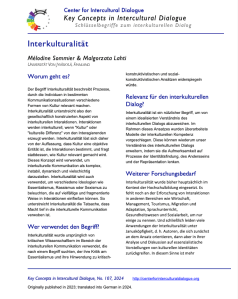
KC107 Interculturality Translated into German

Key Concepts in ICD

Continuing translations of Key Concepts in Intercultural Dialogue, today I am posting KC107: Interculturality, originally written by Mélodine Sommier & Malgorzata Lahti for publication in 2023, and now translated by Marlena Pompino into German.

As always, all Key Concepts are available as free PDFs; just click on the thumbnail to download. Lists organized chronologically by publication date and numberalphabetically by concept in English, and by languages into which they have been translated, are available, as is a page of acknowledgments with the names of all authors, translators, and reviewers.

KC107 Interculturality in German

Sommier, M., & Lahti, M. (2024). Interkulturalität. (M. Pompino, trans.) Key Concepts in Intercultural Dialogue, 107. Available from: https://centerforinterculturaldialogue.org/wp-content/uploads/2024/06/kc107-interculturality_german.pdf

The Center for Intercultural Dialogue publishes a series of short briefs describing Key Concepts in Intercultural Dialogue. Different people, working in different countries and disciplines, use different vocabulary to describe their interests, yet these terms overlap. Our goal is to provide some of the assumptions and history attached to each concept for those unfamiliar with it. As there are other concepts you would like to see included, send an email to the series editor, Wendy Leeds-Hurwitz. If there are concepts you would like to prepare, provide a brief explanation of why you think the concept is central to the study of intercultural dialogue, and why you are the obvious person to write up that concept.


Creative Commons License
This work is licensed under a Creative Commons Attribution-NonCommercial-NoDerivatives 4.0 International License.