2023 PLURAL+ Youth Video Festival (USA but Online)

Events2023 PLURAL+ Youth Video Festival, United Nations Alliance of Civilizations (UNAOC), New York, NY, USA, 15 December 2023, 3 pm EST (but also available online).

PLURAL+ Youth Video Festival is a joint initiative of the United Nations Alliance of Civilizations (UNAOC) and the International Organization for Migration (IOM) that invites the world’s youth to submit original and creative videos focusing on the themes of migration, diversity and social inclusion. By supporting the distribution of youth-produced media, PLURAL+ recognizes youth as powerful agents of positive social change in a world often characterized by intolerance, and cultural and religious divisions.

View videos from past years here, chosen by an international jury from thousands of submissions around the globe.

PLURAL+ is a youth video festival that encourages and empowers global youth to explore the issues of migration, diversity, social inclusion, and the prevention of xenophobia and to share their creative vision with the world.
Participatory ESOL Report and Podcasts

Resources in ICD“ width=

Coole, M., et al. (2023). Participatory ESOL: Taking Stock. Working Papers in
Urban Language &
Literacies, Paper 319, and 5 podcasts.

ESOL refers to teaching English to adult speakers of other languages. Here are links to five podcasts and a report on the practitioner research project, Participatory ESOL: Taking Stock.  The project was organised by English for Action and the Hub for Education & Language Diversity (HELD) at King’s College London in collaboration with teachers from different organisations across the ESOL sector.  The report and the podcasts provide a reflective account of developments in Participatory ESOL over the last 15 years, drawing on the experiences of 11 participatory ESOL teachers, but also focus more broadly on the position of participatory ESOL in the sector as a whole, pointing forward to implications for policy and ESOL teacher education more generally.

PE [Participatory ESOL] emerges … as an approach that listens to students and engages them in dialogue, that reaches beyond traditional student-teacher roles to include critique and action on social conditions, and that maintains an explicit focus on language throughout while also questioning the hegemony of English itself.

CID Quoted in Opinion Piece on Cultural Identity

About CIDNegrete, Alexcia. (13 November 2023). Opinion: College is beneficial for developing cultural identities. Daily Titan.

We knew the Key Concepts in Intercultural Dialogue get a lot of views and downloads, and are used in courses, but we don’t often see them quoted in articles or opinion pieces. Therefore we were delighted to run across this opinion piece by a student at California State University, Fullerton.

According to the Center for Intercultural Dialogue, cultural identity comes with a sense of belonging and the process of keeping up with traditions, heritage and language. Having a cultural identity isn’t just about associating yourself with ethnic groups but also gender, sexuality and religion.

This draws upon Vivian Hsueh-Hua Chen‘s description, presented as Key Concept 22: Cultural Identity.

Thanks, Alexcia – glad you found it useful!

If/when others run across similar use of any of the Center’s publications, or if you write something comparable, please let us know, and we’ll help spread the word.

Corbett & Holmes Guest Post: Critical Intercultural Pedagogy for Difficult Times

Guest Posts
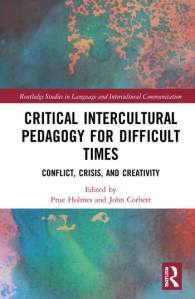
Critical Intercultural Pedagogy for Difficult Times. Guest post by John Corbett and Prue Holmes.

Critical Intercultural Pedagogy for Difficult Times: Conflict, Crisis, and Creativity, edited by Prue Holmes and John Corbett (2023) is a volume of case studies and theoretical reflections which arose from an AHRC Research Network project, initiated, and led by Prue Holmes of the University of Durham in 2019. Holmes was interested in exploring the theoretical and practical issues involved in the creative application of critical intercultural teaching and learning in conditions of conflict and extended crisis. In short, how does critical intercultural pedagogical theory inform creative practice, and vice versa, in what Holmes and her team came to think of as ‘difficult times’?

As Khawla Badwan, in the title of her chapter, on intercultural communication and vulnerability, observes, “I’m afraid there are no easy fixes”. There are, indeed, no easy fixes, and, for those of us engaged in intercultural education, there seems cause, too often, for despair. However, the case studies reported in this volume affirm, through their modest tales of resilience, aspiration, and hope, that in the enveloping darkness there are flickers of light.

Download the entire guest post as a PDF.

UN U: Outreach Communications Assistant (Japan)

“JobOutreach Communications Assistant, United Nations University Institute for the Advanced Study of Sustainability (UNU-IAS), Tokyo, Japan. Deadline: 9 December 2023.

Located in Tokyo, the Office of Communications assists the Rector in the communication about UNU’s work, engagement with key stakeholders, and visibility of UNU’s activities in Japan and globally. The work of the UNU Office of Communications focuses on communicating the outcomes from UNU research in clear, accessible language, in ensuring these messages reach the right audience and in gradually increase the size of the audience. To achieve this, the UNU Office of Communications employs high quality design, produces engaging content and deploys a wide range of communication assets.

The major responsibilities of the Outreach Communications Assistant will be to:
1. Support the visibility and interest of UNU’s Japan Outreach through digital and social media.
2. Assist and support the organization of online and in-person events related to Japan Outreach.
3. Support the translation of English material into Japanese and assist in editing and proofreading Japanese content.
4. Assist with building UNU communication products in Japanese.


Meridian: Associate, Diplomatic Engagement (USA)

“JobAssociate, Diplomatic Engagement, Meridian International, Washington, DC, USA. Deadline: open until filled; posted 17 November 2023.

The Associate, Diplomatic Engagement serves in a support role managing the day-to-day elements of the Center for Diplomatic Engagement, with an emphasis on the Insights and Diplocraft series and other convening programs for the diplomatic corps. This includes audience management, program preparation and database organization. The Associate is responsible for conducting the Center’s financial and administrative deliverables. The Associate is also involved in two signature programs – the Meridian Global Leadership Summit and the Meridian Diplomacy Forum.

This position is located in Washington, DC. Meridian requires MD, DC, or VA residence for all employees. The position may work partially remotely until further notice.

International House UC Berkeley: Residence Life Coordinator (USA)

“Job

Residence Life Coordinator, International House, University of California, Berkeley, CA, USA. Deadline: open until filled.

Reporting to the Resident Life Manager of the Robertson Center for Intercultural Leadership Programs, you will be part of a team that is integral to the overall resident experience. You will be supporting the overall mission and goals of I-House and RCILP. Your role will focus on resident life operations and resident life programming and marketing. This position requires evening and weekend working hours, as needed.

International House mission: To foster intercultural respect and understanding, lifelong friendships, and leadership skills for a more just and peaceful world.

CFP EACL 2024: Towards Ethical and Inclusive Conversational AI (Malta)

ConferencesCall for papers: European Chapter of the Association for Computational Linguistics: Towards Ethical and Inclusive Conversational AI:
Language Attitudes, Linguistic Diversity, and Language Rights, 21-22 March 2024, Malta. Deadline: 18 December 2023.

Conversational language technologies (chatbots, voice assistants, and multimodal conversational interfaces) are becoming increasingly complex and common in everyday life. Various language theories (such as speech act theory, politeness theory, conversation analysis, and interaction theory) have started influencing their development. At the same time, the development of these technologies is often driven by technology-related concerns and tends to overlook users’ needs and socio-cultural contexts. This, combined with the scarcity of human rights regulation of AI, raises concerns about linguistic discrimination, exclusion, surveillance, and security risks. In addition, training data for conversational AI mostly comes from written rather than interaction-based language data sets and often does not include gestural, social, and emotional aspects that are fundamental to human interaction. In the same vein, Sign Language is rarely facilitated. To promote a positive impact of conversational technology on linguistic diversity and inclusion, it is imperative to strike a balance between technological concerns and socially relevant matters.

This workshop to be held at EACL aims at addressing these issues by using a holistic approach that involves dialogue and collaboration among technologists, linguists, policymakers, and communities involved in the development and commissioning of conversational AI systems.

Key Themes:

  • Holistic Approach: Bridging the gap between technology and socio-cultural context.
  • Ethical Development: Addressing concerns of linguistic discrimination, exclusion, surveillance, and security risks.
  • Inclusive Data Sets: Emphasizing the importance of interaction-based language data sets and inclusion of gestural, social, and emotional aspects.

Meridian International Center Fellowships (USA)

FellowshipsCall for applications: Meridian International Center Fellowships 2024, Washington, DC, USA. Deadline: 1 December 2023 for spring awards, but April for summer, and July for fall.

Meridian International Center’s Fellowship Program exposes rising students and professionals to public diplomacy, international relations, exchanges, cultural and corporate diplomacy, and more. Fellows develop the professional experience that will allow them to explore the fields of diplomacy and international affairs by gaining an overview of the operations of a nonprofit public diplomacy center. The fellowship includes professional development activities, including mentorship, training and education sessions, lunches with senior leadership, and an opportunity to create a capstone project that can be used as part of a professional portfolio.

All Fellows will be paid the Washington, D.C. minimum wage. In addition, all Fellows working in person will be eligible for a $75 per month Metro SmartBenefits contribution.

The Meridian Fellowship Program is located in Washington D.C., and Meridian requires MD, DC, or VA residence for all employees. Fellows must have current authorization to work in the United States. Meridian does not sponsor work visas. The position may work partially remotely until further notice.

Open to undergraduate students, master’s candidates, or recent graduates of associate’s programs, bachelor’s programs, or graduate programs OR emerging professionals looking to shift their career focus.

Call for Nominations: Editor, Communication, Culture & Critique 2024

Professional OpportunitiesCall for Nominations: Editors of Communication, Culture and Critique and also Human Communication Research, International Communication Association journals. Deadline: 31 January 2024.

The ICA Publications Committee is soliciting applications for the next editor(s) of Human Communication Research and Communication, Culture and Critique. The four-year terms will begin with a transition in September 2024.

Human Communication Research works to advance understanding of human symbolic processes with a strong emphasis on theory-driven research, the development of new theoretical models in communication, and the development of innovative methods for observing and measuring communication behavior. The journal has a broad social-science focus and offers important applications for scholars in psychology, sociology, linguistics, and anthropology, as well as areas of communication studies.

Communication, Culture & Critique publishes high-quality, original scholarship utilizing a diversity of critical approaches to place questions of power, inequality, and justice at the center of empirical and theoretical inquiry. CCC prioritizes qualitative scholarship that engages with wider historical, economic, cultural, and political dynamics. The Journal is particularly interested in providing a space for scholarship on, by, and/or about people and topics underrepresented in academic publishing.