
KC6 Intercultural Capital Translated into French

Key Concepts in ICDContinuing translations of Key Concepts in Intercultural Dialogue, today I am posting KC#6: Intercultural Capital, which Andreas Pöllmann wrote for publication in English in 2014, and which Mohammed Guamguami has now translated into French.

As always, all Key Concepts are available as free PDFs; just click on the thumbnail to download. Lists of Key Concepts organized chronologically by publication date and number, alphabetically by concept, and by languages into which they have been translated, are available, as is a page of acknowledgments with the names of all authors, translators, and reviewers.
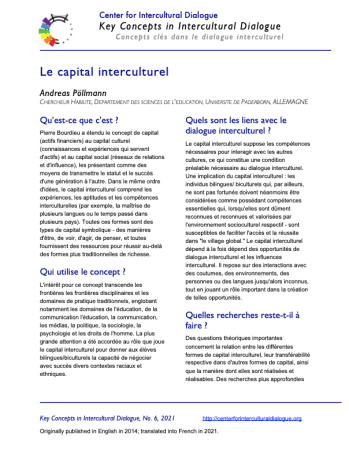
KC6 Intercultural Capital_FrenchPöllmann, A. (2017). Le capital interculturel. (M. Guamguami, trans). Key Concepts in Intercultural Dialogue, 6. Available from:
https://centerforinterculturaldialogue.org/wp-content/uploads/2021/05/kc6-intercultural-capital_french.pdf

If you are interested in translating one of the Key Concepts, please contact me for approval first because dozens are currently in process. As always, if there is a concept you think should be written up as one of the Key Concepts, whether in English or any other language, propose it. If you are new to CID, please provide a brief resume. This opportunity is open to masters students and above, on the assumption that some familiarity with academic conventions generally, and discussion of intercultural dialogue specifically, are useful.

Wendy Leeds-Hurwitz, Director
Center for Intercultural Dialogue


Creative Commons License
This work is licensed under a Creative Commons Attribution-NonCommercial-NoDerivatives 4.0 International License.

CFP Researching Transculturally

“PublicationCall for Chapters: Researching Transculturally: Methodological Issues and Challenges, to be edited by Mabel Victoria (Edinburgh Napier University).
Deadline for abstract: 30 June, 2021.

Researchers often work in culturally and linguistic challenging contexts. They interact with research participants whose native language and sociocultural backgrounds are different to their own. They also conduct fieldwork in settings that are unfamiliar to them—constantly having to make decisions as minute as what to wear, how to greet people in a culturally appropriate manner, or whether taking photographs of place and people is taboo. There are a number of other challenges, such as differing roles and expectations, conflicting cultural values and world views, power relations, and culturally sensitive ethical practices.

There is very little practical guidance in the literature that can help qualitative researchers navigate the terrain of researching across cultures. This volume will present contributions from different researchers that provide the reader with an idea of the challenges and issues they faced while researching transculturally. Contributions will provide a behind-the- scenes perspective or narrative accounts that are not often written about as part of journal articles or monographs.

Key Concept #99: Translanguaging Translated into Arabic

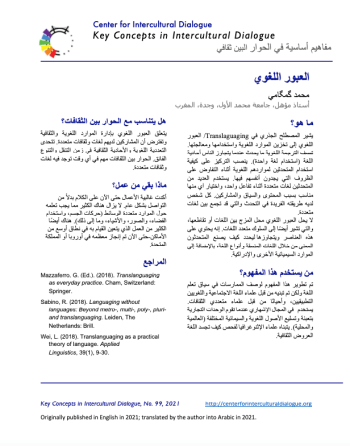
Key Concepts in ICDContinuing translations of Key Concepts in Intercultural Dialogue, today I am posting KC#99: Translanguaging, originally written by Mohammed Guamguami for publication in 2021, and now translated by him into Arabic.

As always, all Key Concepts are available as free PDFs; just click on the thumbnail to download. Lists organized chronologically by publication date and numberalphabetically by concept in English, and by languages into which they have been translated, are available, as is a page of acknowledgments with the names of all authors, translators, and reviewers.

KC99 Translanguaging_ArabicGuamguami, M. (2021). Translanguaging [Arabic]. Key Concepts in Intercultural Dialogue, 99. Available from: https://centerforinterculturaldialogue.org/wp-content/uploads/2021/05/kc99-translanguaging_arabic.pdf

If you are interested in translating one of the Key Concepts, please contact me for approval first because dozens are currently in process. As always, if there is a concept you think should be written up as one of the Key Concepts, whether in English or any other language, propose it. If you are new to CID, please provide a brief resume. This opportunity is open to masters students and above, on the assumption that some familiarity with academic conventions generally, and discussion of intercultural dialogue specifically, are useful.

Wendy Leeds-Hurwitz, Director
Center for Intercultural Dialogue


Creative Commons License
This work is licensed under a Creative Commons Attribution-NonCommercial-NoDerivatives 4.0 International License.

Save