Smithsonian Institution Fellowships (USA)

FellowshipsThe Smithsonian Institution Fellowship Program, Smithsonian Institution, Washington, DC. Deadline: November 1, 2020.

The Smithsonian Institution Fellowship Program offers opportunities for independent research or study related to Smithsonian collections, facilities, and/or research interests of the Institution and its staff. Fellowships are offered to graduate students, predoctoral students, and postdoctoral and senior investigators to conduct independent research and to utilize the resources of the Institution with members of the Smithsonian professional research staff serving as advisors and hosts.

Parts of the Smithsonian that might be of specific interest to CID followers include: Center for Folklife and Cultural Heritage, Office of International Relations, and there are Fulbright-Smithsonian Awards for those outside the US to travel to work with the Smithsonian collections.

Onboarding Best Practices for Transformation Projects Webinar

EventsOnboarding Best Practices for Transformation Projects, presented by Mithun Mridha, sponsored by SIETAR Tri-State, Webinar, August 31, 2020 from 1:00 pm to 2:00 pm (EST).

Are you working in a global organisation with multiple transformation initiatives involving significant turnover of employees over time? Do you have to deal regularly with onboarding new people in your project teams? Do you struggle with business continuity on your projects? Major challenges faced by project teams following ineffective onboarding include failed deliveries, staff turnover, unproductive employees and low knowledge retention.

Global Delivery Centres, Outsourcing and Nearshoring have become pillars of the current enterprise project landscape for international companies. Mithun Mridha, will present examples of unusual onboarding activities that managed to create extraordinary experiences for project team members, that enabled exceptional quality of project deliveries from his more 15+ years of consulting experience on Project Portfolios.

Teaching Interculturality in Higher Education (Online Event)

EventsFurther thoughts on teaching interculturality in higher education during and after the COVID-19 crisis4 September 2020.

Following a very successful and stimulating event in July 2020, this new webinar represents another contribution to reflecting on current issues in the teaching of interculturality in higher education, especially in relation to the COVID-19 crisis. New speakers were invited to share their views and reflections for this session (Australia, China, Finland, The Netherlands). Organised by Fred Dervin (University of Helsinki, Finland), Andreas Jacobsson (Karlstad University, Sweden) and Mei Yuan (Minzu University of China)

Interculturality is taught in institutions of higher education around the world under different guises (intercultural communication, intercultural encounters, global competence, etc.) and in different fields (language, teacher education, health care, business, etc.). The accelerated internationalization that these institutions have experienced for the last decades has also contributed to the popularity of courses around the notion of interculturality. What scholars note about such courses is that the ideologies, theoretical frameworks and methods used for teaching interculturality are many and varied. Furthermore, those who teach interculturality are not always specialists and they can struggle with different kinds of perspectives, paradigms, ideologies, methods…

Many argue that the COVID-19 crisis will have an influence on our lives for the years/decades (?) to come. As far as interculturality is concerned, the crisis has led to very violent acts of xenophobia, Sinophobia, blatant nationalism but also aggressive (systemic) racism and discrimination. At the same time, some of these have been counterbalanced a little by people standing up against them.

Will these have an influence on the way we see interculturality from a higher education perspective, especially on what we teach, from what perspective(s) and how? Is it time for (real) change, beyond the polarization of culturalist/essentialist and postmodern ideologies, in intercultural communication education?

KC5 Intercultural Communication Translated into Macedonian

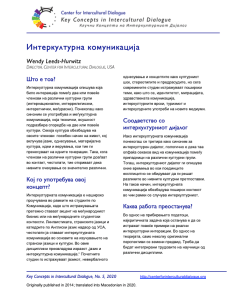
Key Concepts in ICDContinuing translations of Key Concepts in Intercultural Dialogue, today I am posting KC#5: Intercultural Communication, which I wrote for publication in English in 2014, and which Emilija Jovanovska has now translated into Macedonian.

As always, all Key Concepts are available as free PDFs; just click on the thumbnail to download. Lists of Key Concepts organized alphabetically by conceptchronologically by publication date and number, and by languages into which they have been translated, are available, as is a page of acknowledgments with the names of all authors, translators, and reviewers.

KC5 Intercultural Communication_Macedonian

Leeds-Hurwitz, W. (2020). Intercultural communication [Macedonian]. (E. Jovanovska, trans). Key Concepts in Intercultural Dialogue, 5. Retrieved from:
https://centerforinterculturaldialogue.org/wp-content/uploads/2020/07/kc5-intercultural-communication_macedonian.pdf

If you are interested in translating one of the Key Concepts, please contact me for approval first because dozens are currently in process. As always, if there is a concept you think should be written up as one of the Key Concepts, whether in English or any other language, propose it. If you are new to CID, please provide a brief resume. This opportunity is open to masters students and above, on the assumption that some familiarity with academic conventions generally, and discussion of intercultural dialogue specifically, are useful.

Wendy Leeds-Hurwitz, Director
Center for Intercultural Dialogue


Creative Commons License
This work is licensed under a Creative Commons Attribution-NonCommercial-NoDerivatives 4.0 International License.

CFP The Future of Educational Migration

“PublicationCall for papers: The Future of Educational Migration, as a special issue of Routed. Deadline: August 28, 2020.

University campuses have become unique cultural ecosystems where students from all over the world learn, socialise and live. However, over the past months, universities across the globe have been forced to abruptly shut down their campuses, move classes online and cancel study-abroad programmes causing disruption for students and institutions. As many prospective international students reconsider their plans to study abroad, governments have also discouraged and repatriated their citizens studying overseas.

The uncertainties caused by health concerns, border closures and travel limitations add to the ongoing geopolitical tensions and increasingly restrictive immigration regimes. Over the last few years, immigration policies such as the ‘hostile environment’ in the UK have also targeted international students, levying academic staff with border patrol responsibilities by pressuring them to monitor students’ immigration statuses. The current situation has intensified discrimination and visa restrictions; for instance, new international students will not be allowed to attend universities operating fully online in the US, while Chinese students in STEM fields claim to be increasingly regarded as a security threat in several countries. Meanwhile, Australia is implementing new policies to attract international students, such as allowing current students to continue their studies online while overseas. This edition will explore the future of educational migration through the lenses of COVID-19 and geopolitical changes.

CFP Multicultural Discourses (Romania but Online)

ConferencesCall for papers: 7th International Conference on Multicultural Discourses: Multicultural Discourses in a Turbulent World, Cluj-Napoca, Romania, October 24-26, 2020. Deadline: September 1, 2020.

UPDATE: Due to COVID-19, the submission deadline has been extended, and the conference will be held online.

The successful international conferences on Multicultural Discourses organized in China, Brazil, and the Netherlands, respectively, have reinforced the importance of Cultural Discourse Studies in contemporary social science and the humanities. The 7th International Conference on Multicultural Discourses, under auspices of the International Association of Multicultural Discourses, will be co-organized by the English Department of the Faculty of Letters, Babeş-Bolyai University, Cluj-Napoca, Romania and the School of Contemporary Chinese Communication Studies, Hangzhou Normal University, China. The event will be hosted at the Faculty of Letters, Babes-Bolyai University in Cluj-Napoca, Romania from October 24-26, 2020.

Mankind is witnessing yet again the centennial moment of global transformation and the world is ridden with grave challenges and great opportunities. To answer to these uncertain winds of change, scholars from various fields such as communication, media, language, literature, society, culture, international relations, etc. are encouraged to offer their insights into topics including, though not restricted to, the following:

  • Multicultural discourses of (anti)globalization, diversity, connectivity, globalism
  • Multicultural discourses of security, conflict, war, peace
  • Multicultural discourses of protectionism, (in)tangible borders, immigration, racism
  • Multicultural discourses of development, the Developing World, the Global South
  • Multicultural digital, multimodal, literary, cinematic discourses
  • Multidisciplinary, multicultural approaches to human discourses

In Dialogue: CID Occasional Papers, 1: ICD as the Elephant in the Room

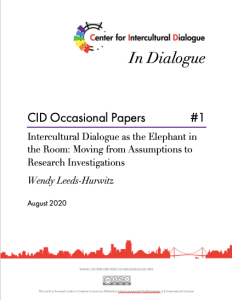
Key Concepts in ICDIn Dialogue: CID Occasional Papers, 1: Intercultural Dialogue as the Elephant in the Room: Moving from Assumptions to Research Investigations by Wendy Leeds-Hurwitz.

In Dialogue

This is the first issue of a new publication series, In Dialogue: CID Occasional Papers. The goal of this first occasional paper is to synthesize the many publications using the term “intercultural dialogue” explicitly, summarize what has been learned, and outline what remains to be studied.

Intercultural dialogue might be called the elephant in the room, a metaphor referring to something obvious which is nonetheless ignored. Most often, practitioners and diplomats use the term intercultural dialogue, but they rarely define it, and conduct little to no research in order to discover how it works, but only hold it up as a desired end. Academics, who certainly conduct research, rarely use this term, thus have rarely studied it, although some research by other names sheds light on how it works.

Leeds-Hurwitz, W. (2020). Intercultural dialogue as the elephant in the room: Moving from assumptions to research investigations. In Dialogue: CID Occasional Papers, 1. Retrieved from:
https://centerforinterculturaldialogue.org/wp-content/uploads/2020/08/op1-leeds-hurwitz-final-1.pdf

As with prior publications, these will are available as free PDFs; just click on the thumbnail to download. As with prior publications, the Occasional Papers may be downloaded, printed, and shared as is, without changes, without cost, so long as there is acknowledgment of the source.

If you are  interested in publishing in this series, contact the series editor, Wendy Leeds-Hurwitz. If you are new to CID, please provide a brief resume.


Creative Commons License
This work is licensed under a Creative Commons Attribution-NonCommercial-NoDerivatives 4.0 International License.

Radcliffe Fellowships (USA)

FellowshipsRadcliffe Fellowships 2021-22, Harvard University, Cambridge, MA. Deadline: for humanities, social sciences, and creative arts, September 10, 2020; for science, engineering, and mathematics, October 1, 2020.

The Radcliffe Fellowship Program awards 50 fellowships each academic year. Applicants may apply as individuals or in a group of two to three people working on the same project. The goal is diversity along many dimensions, including discipline, career stage, race and ethnicity, country of origin, gender and sexual orientation, and ideological perspective. Although fellows come from many different backgrounds, they are united by their demonstrated excellence, collegiality, and creativity.

Radcliffe supports engaged scholarship. . .innovative work that confronts pressing social and policy issues and seeking to engage audiences beyond academia. The Institute’s focus areas include:

* Law, education, and justice
* Youth leadership and civic engagement
* Legacies of slavery

Reflecting Radcliffe’s unique history and institutional legacy, proposals that focus on women, gender, and society or draw on the Schlesinger Library’s rich collections are welcomed.

U Konstanz Institute for Advanced Study: Fellowships & Postdocs (Germany)

FellowshipsMultiple Fellowships and Postdocs, Zakunftskolleg, University of Konstanz, Konstanz, Germany. Deadline: 15 October 2020 or rolling (depending on opportunity).

The Zukunftskolleg is an Institute for Advanced Study (IAS) at the University of Konstanz. It offers 2-year and 5-year fellowships as well as a diverse support network to promote the independence of early career researchers. Researchers at the postdoctoral level perform research without administrative constraints and have the freedom to engage in meaningful exchange with other up-and-coming colleagues and with distinguished senior researchers.

2-year Postdoctoral Fellowships are for all those in the early stage of their career who plan to develop and implement an independent research project. Deadline: 15 October 2020.

5-year Research Fellowships promote researchers with significant work experience at the postdoctoral level aiming for a career in academia. Research Fellows build their own academic identity by leading an independent research group at the University of Konstanz. Deadline: 15 October 2020.

Senior Fellows are established guest scholars from the natural sciences, humanities or social sciences who join the Zukunftskolleg for a research stay and work with the fellows. Rolling deadline.

Zukunftskolleg Konnect Fellowships support early career researchers from Africa, Asia and Latin America related to one of the thirteen departments of the University of Konstanz, or to one of the Clusters of Excellence at the University of Konstanz: “Politics of Inequality”and the “Centre for the Advanced Study of Collective Behaviour”. Rolling deadline.

CFP Legacies of Black Lives Matter

“PublicationCall for Papers: The Legacies of Black Lives Matter: Language, Communication, and Social Psychological Perspectives toward Social Justice as a special issue of the Journal of Language and Social Psychology. Deadline: Letter of Intent at around 1500 words due at earliest convenience. Final deadline of accepted proposals: April 21, 2021.

Guest Editors: Howard Giles (University of California, Santa Barbara), Natasha Shrikant (University of Colorado, Boulder), and Shardé M. Davis (University of Connecticut).

JLSP is committed to understand, learn from, and enable change from our sub-disciplinary perspective. To this end, editors invite submissions that highlight how LSP approaches can reveal ways that racism, social justice, and social change appear in everyday language and communication and submissions that illustrate ways LSP approaches can be used to address and, most importantly, remedy these social problems. How do communities discuss, define, or ask for social change? How is language symbolically impacted in these processes as a tool to uphold structural racism or to promote social justice?