

CFP ICA 2025: Disrupting and Consolidating Communication Research (USA)

ConferencesCall for papers: ICA@75: Disrupting and Consolidating Communication Research, Denver, Colorado, USA, 12-16 June 2025. Deadline: 1 November 2024.

Addressing the International Communication Association’s 75th anniversary, the 2025 conference theme is an invitation to critically reflect on communication studies as a discipline and ICA as an agent and site of disciplinary development. Theme sessions will take stock of our past, critically review present developments, and chart out future avenues for communication research. Organizers particularly welcome contributions speaking to three important aspects of the theme: communication scholarship as a transformative and stabilizing force in society, as a research practice that can be both revolutionary and consolidating, and communication studies as a disrupted and resilient discipline. In all these contexts, elements of disruption and consolidation are not necessarily antithetical but may productively be framed as a dialectical relationship.

ICA has made significant strides in amplifying the visibility of communication scholarship beyond academia. From democratic backsliding to climate change and conflict transformation, our discipline is poised to provide relevant answers to many burning questions of our time. Through public scholarship, communication scholars can make themselves useful by addressing the problems of the world’s current polycrisis. They may act as a transformative voice in society (by advocating social change) and as a stabilizing force (by maintaining democracy or social justice). A key issue in this context is the sometimes troubled relationship between scholarship and advocacy.

The public impact of scholarship is typically connected to a discipline’s ability to generate original knowledge. During the past 75 years, communication research has exponentially grown in terms of quantity. However, across a variety of disciplines and academic fields, such expansion is mostly attributed to the growth in studies that consolidate existing knowledge, pushing aside disruptive and revolutionary scholarship that forges new directions and breaks existing paradigms. The progressive fragmentation of the discipline may have contributed to this trend, along with persisting social and global inequalities in academia as well as a publication and review culture that tends to disadvantage certain types of research and scholarly communities, including those from the Global South.

Communication research is facing these issues while itself being disrupted on multiple fronts and, perhaps, with unprecedented consequences. AI-based technologies have started revolutionizing scholarly practice with vast implications for the way we conduct and evaluate scholarship. In addition to high levels of insecurity and precarity, researchers face growing demands to publish in prestigious venues, obtain large grants, and participate in reviewing and evaluations, all putting heavy mental strain on scholars. Through this call, we encourage the discipline to think about possible ways to consolidate our research environment by growing resilience and developing effective coping strategies.

In this spirit, organizers invite submissions for papers and panel proposals that address the conference theme along the lines of the outlined three areas. Submissions may address, but are not limited to, the following issues and topics:

  • Strategies to increase the visibility and impact of communication scholarship addressing the problems of our time
  • The relationship between scholarship and advocacy as well as obstacles to public scholarship and ways to overcome them
  • Research-based disruptions of dominant theories guiding communication inquiry
  • Historical trajectories of communication scholarship that have disrupted other fields of research and where communication studies has been disrupted by other disciplines
  • The cross-fertilization of communication research through disruptions originating from within
  • Research-based disruptions of dominant modes of communication inquiry from the Global South
  • The impact of AI on the conduct and evaluation of communication scholarship
  • The political economy of scholarship for the discipline’s ability to generate original knowledge
  • Assessments of growing academic demands and the resulting mental toll
  • Strategies to grow resilience and cultivate solidarity networks among various academic communities

ICA Regional Chapters

“Collaborative

Regional Chapters, International Communication Association, USA.

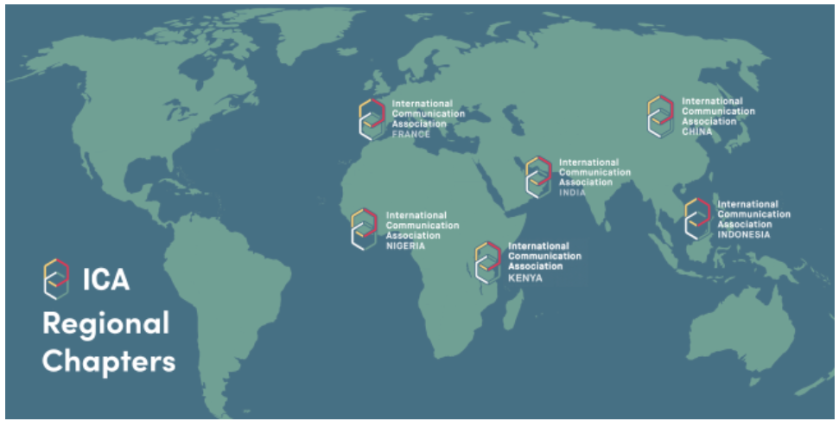
International Communication Association Regional Chapters mapThe ICA Regional Chapters Program is currently in a three-year pilot phase. No additional chapters will be approved during the pilot so that all resources can be devoted to making the six original chapters as successful as possible. The six regional chapters are: Indonesia, Nigeria, China, Kenya, France, and India.
CFP South Asia Communication Association at ICA: Communication & Global Human Rights 2024 (Australia)

Conferences

Call for Papers: South Asia Communication Association: Communication and Global Human Rights: Media Research on South Asia & Its Diaspora Worldwide, research session at International Communication Association, Goldcoast, Australia, 19-24 June 2024. Deadline: 20 January 2024.

Organizers invite you to present your research at the 2024 South Asia Communication Association (SACA)’s refereed-research session at the 74th annual conference of the International Communication Association (ICA),  in Gold Coast, Australia, Jun. 19-24, 2024. SACA will host an interactive research session, and the ICA 2024 conference program will feature the SACA session. The ICA 2024 conference promises to be an
innovative, interactive and engaging event.

You are invited to submit your research on media and communication
in South Asia or its diaspora worldwide. Organizers welcome a wide range of perspectives and approaches. Please feel free to email Dr. Jatin Srivastava if you have any questions about your research relating to the scope of the SACA research session.

CFP ICA 2024: Communication & Global Human Rights (Australia)

ConferencesCall for proposals: Theme call for papers: Communication and Global Human Rights, International Communication Association, 22-24 June 2024, Gold Coast, Australia. Deadline: 1 November 2023.

The purpose of this year’s theme, Communication and global human rights is threefold: to take stock of the contributions of communication scholarship to the study of human rights; to foreground current research and practice; and to  outline promising directions for communication studies.

Human rights is a global priority. It is a political and moral language, grounded on the notion that all human beings share universal attributes and deserve recognition and support. It is a normative horizon for making our world more humane and just. It is central to the cosmopolitan imaginary that posits the existence of a moral and political order above nation-states. It is woven into fundamental questions of our times, such as overlapping crises (e.g., climate/environment, health, migration, food insecurity), entrenched global inequalities, armed conflicts, threats to public safety, and social exclusion and hate.

Communication is central to contemporary global human rights in many ways. It is manifest in public debates spurred by the mobilization of “rights” movements as well as political/cultural backlash; efforts to raise public awareness about the significance of rights, especially given continuous violations of human rights and the tragic failure of inter-government institutions, states, and other actors to enforce rights; the evidentiary claims of human rights reporting, based on both standardized and contested communication practices; the use and critique of human rights as a discourse; conflicts over the balance between speech rights with other rights such as privacy and safety; debates over whether human rights is a universalist project embedded in Western principles and globalist projects, or an inspiring political, moral and legal framework sensitive to difference, inclusivity, localization, and reappropriation.

As a research topic, human rights cuts across the vast landscape of communication studies. Several areas of specialization explore theoretical and empirical questions situated at the intersection of communication and human rights: linguistic, historical, legal, epistemological, and political dimensions; rights movements and counter-movements; narrative about rights violation and repair; large-scale persuasion and information campaigns; institutionalization and enforcement of rights in communication and media policies. Altogether, these lines of inquiry lay out wide-ranging research agendas, as well as theoretical and empirical questions and arguments, with significant implications for scholarship, education, and public engagement.

ICA Regional Chapters: Indonesia, Nigeria, China, Kenya

ConferencesContractor, Noshir. (11 April 2023). President’s Column: The First Four: Writing a New Chapter in ICA’s International Efforts. International Communication Association Newsletter.

The International Communication Association has just established regional chapters in Indonesia, Nigeria, China, and Kenya. The ICA Indonesia Chapter was inaugurated at Atma Jaya Catholic University of Indonesia on March 7, 2023. The ICA Nigeria Chapter was inaugurated on March 24, 2023, at the University of Port Harcourt. The ICA China Chapter was inaugurated on March 28 in Beijing at an event attended by the Deans and Directors of Communication programs at seven major universities in China, including Peking University, Tsinghua University, University of Science and Technology of China, Renmin University, Zhejiang University, Fudan University, and Shanghai Jiao Tong University. And the ICA Kenya Chapter was inaugurated on April 5, 2023, at Daystar University, Nairobi. For details, see the article by ICA President Noshir Contractor.

CFP Gen Z & Global Communication ICA Preconference (Canada but Hybrid)

ConferencesCall for proposals: Generation Z and Global Communication, International Communication Association Preconference, 25 May 2023, Sheraton Centre Toronto Hotel (Hybrid: On-site and online). Deadline: 1 March 2023.

Generation Z (Gen Z), the first to have been born after the mass-adoption of the Internet, is the most electronically connected generation in history. Growing up with many high-tech devices, these digital natives are used to having access to a vast number of diverse information, doing real-time communication with their friends and others regardless of physical location and generating content instantaneously to all kinds of international digital platforms. Exposed fully to the Internet-based world, how are the attitudes and beliefs of Gen Z influenced by the virtual world, especially the world of social media? How are the media use of Gen Z similar or different between countries? What are differences between Gen Z and previous generation in terms of their perceptions and knowledge of their own countries and other countries? How does video games, the most globalized content around the world affecting the young generation?

Organizers welcome innovative and original research studies addressing the theme on Generation Z and authenticity in global communication from all disciplines, methodologies, and professions, including case studies, quantitative and qualitative research, data and network science, etc.

The preconference will have paper awards for full paper submissions but welcome extended abstract submissions (up to 500 words). All full papers and abstracts will go through double-blind review. First Place paper will receive USD300 cash award, Second Place paper will receive USD200 cash award, and Third Place paper will receive USD100 cash award. Online Media and Global Communication will reserve the first right of refusal for publishing the award-winning submitted papers in the themed issue.

CFP South Asia Communication 2023 (Canada)

ConferencesCall for Papers: South Asia Communication Association: Reclaiming Authenticity in Communication: Media Research on South Asia & Its Diaspora Worldwide,  Toronto, Canada, 25-29 May 2023. Deadline: 31 January 2023.

Organizers invite you to present your research at the 2023 South Asia Communication Association (SACA)’s refereed-research session at the 73rd annual conference of the International Communication Association (ICA), in the Sheraton Centre Toronto Hotel, Toronto, Canada, from 25-29 May 2023. In their commitment to the 2023 ICA conference theme “Reclaiming Authenticity in Communication,” SACA will host one interactive research session.

Since SACA is an organizational member of ICA, this session will be featured in the official program of the ICA annual conference. ICA 2023 promises to be an innovative, interactive, and engaging conference.

CFP ICA 2023: Regional Hub Grant Application

ConferencesCall for proposals: International Communication Association Regional Hub Grant Application, to participate in ICA 2023. Deadline: 1 December 2022.

“In conjunction with ICA’s hybrid annual conference slated for May 2023 in Toronto, Ontario (Canada), the Executive Committee has approved the continuation of our Regional Hubs program. Of course, ideally we would want everyone to join us in person, but for some–particularly those in areas with unreliable personal wifi access–we provide the opportunity to apply for modest financial support as an attendance “hub” for attendees in one area.

The proposed hub in question should nominate one person to fill out the application and serve as the sole point of contact for ICA headquarters. This person should, prior to filling out the application, ascertain how many attendees they anticipate inviting to take part in their hub experience, obtain permission from the facility in question, and include estimated expenses for both in their proposal. For instance, a university’s dean may want to activate a regional hub and can assume the participation of 12 local attendees (from the same region or country). A potential hub proposal might, for example, request:

  • WiFi support (to boost the wifi capabilities of the host site or university for the month in which the conference takes place), and
  • Funding for food & beverage over five days.
  • (NOTE: We discourage submitting expenses for attendee travel as part of your budget, as these hubs are meant to be hyper-local.)
  • The estimated number of attendees you anticipate.

You should base your application on YOUR group’s specific needs. Any funding awarded from ICA headquarters will be given directly to the hub organizer, not to individual attendees of that hub. As with a stand-alone regional conference, receipts and a final budget accounting for costs, with receipts, must be submitted upon the conclusion of the conference.”

CFP ICA 2022: One World, One Network‽ (France)

ConferencesCall for proposals: Theme call for papers: One World, One Network‽International Communication Association, Paris, France, 26-30 May 2022. Deadline: 5 November 2021.

The ICA 2022 conference theme One World, One Network‽ invites reimagining communication scholarship on globalization and networks. The use of the interrobang glyph – a superposition of the exclamation and question punctuation marks – seeks to simultaneously celebrate and problematize the “one-ness” in the theme. The theme invites research, reflection, and critique of the “One World, One Network‽” discourse in communication studies on questions including (but not limited to) the following:

  • How do we theorize and model interdependent networks nested at many levels (from brain cells to societies) to better understand and enable how communicative processes and structures shape our world?

  • How do global networks organize and mobilize socio-political contestations online and offline?

  • How can networks of resistance, solidarity, and counter-power through regional formations both beyond and beneath the nation-state shape “Another World”?

  • How are advances in artificial intelligence, robotization, the Internet of Things, genetic engineering, and neuroscience, among others, contributing to the future trajectories of algorithmically infused societies and networks, at work and play, around the world?

  • How are media systems – old and new – nurturing networks of “intimate publics” and “counter publics” among communities around the globe?

  • How and why do some networks infiltrate mainstream media systems with disinformation, propaganda, and hate while other networks find themselves ignored, censored, or targeted?

  • How are networks contributing to images of the Global South produced and consumed in the Global North – and vice versa?

  • How do these asymmetries shape inequities in our responses to global challenges such as pandemics and sustainable development?

  • How can networks change the lived experiences – training, mentoring, publishing, co-authoring, and recruiting – of under-represented scholars around the world in the field of communication?

  • How do we square the circle of “oneness” while promoting visibility of minoritized positions?

  • What must we do to decolonize communication scholarship and address methodological imperialism? How do we expand the notion of “One World” to also signal, inclusively, “All Our World(s)”?

Update, Oct 7, 2021: Podcasts relating to the conference and its theme now available.  

CFP History of Communication ICA Preconference (Online)

ConferencesCall for proposals: Exclusions in the History and Historiography of Communication Studies, International Communication Association Remote Preconference, May 27, 2021. Organizers: David W. Park, Jefferson Pooley, Peter Simonson. Deadline: 20 December 2020.

The broader field of communication studies is in a moment when we are—or should be—intensively interrogating patterns of exclusion and hegemony that have continued to constitute it: around global region (de-Westernizing, theory from the South, persistent patterns of American influence/hegemony), race (#communicationsowhite), gender (#metoo, #gendercom, Matilda effects,), and indigeneity/colonization (postcolonial and decolonial initiatives). To frame these exclusions as constitutive is to head off any easy solutions in terms of greater inclusivity, though that needs to be part of the mix; rather, it is to invite us to consider all of the ways in which these and other exclusions have functioned to center certain problems, theories, methods, languages, nations, social identities, and publication venues; and to exclude or marginalize others that are cast as differentially less valuable, lower status, Other, and more. To frame them as constitutive is also to draw attention to how those exclusions are performatively enacted on an ongoing basis through the full range of practices, social and epistemological, through which the field (re)produces itself.

It is time to animate our histories of communication and media studies with similar problematics, recognizing the patterns and performances through which the field(s) has organized itself around constitutive exclusions and continues actively to do so in its historiography. How have particular geopolitical locations (including but not limited to nations) achieved centrality, established standards and status hierarchies, and accumulated advantages and various forms of capital through marginalization and exclusion? How has colonialism and its persistent structural effects fueled communication study around the globe, and how does our historiography maintain that form of dominance and exclusion? How have gender/patriarchy, race/racism, and ethnicity fueled analogous processes? What forms of resistance and counter-hegemonies have arisen or persisted?

Continue reading for full details.