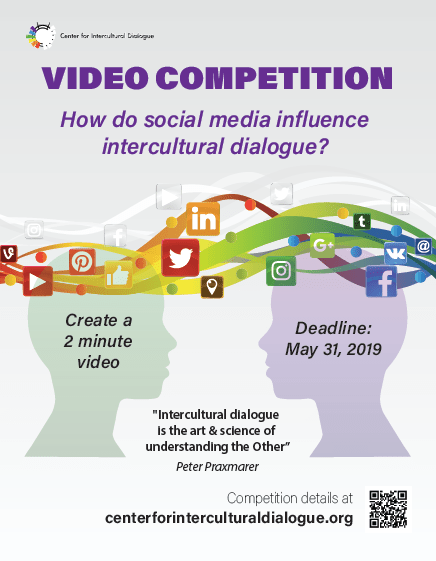
CID Video Competition: Last 5 days!

CID Video CompetitionThe CID video competition remains open, but just 5 days remain to the final deadline of May 31, 2019


CID Video Competition 2019

To enter, students must submit a video no longer than 2 minutes demonstrating their understanding of intercultural dialogue. Specifically, videos must answer the question: “How do social media influence intercultural dialogue?”

In preparing an entry, remember to think about the 2 major topics and their relationship. Winning videos must take both of these into account, not merely describe one or the other.

1) Intercultural dialogue is the term for what happens when people from different cultural backgrounds attempt to understand one other’s assumptions. Culture is a general term that includes all sorts of learned behavioral patterns. Intercultural communication can be international, interracial, interethnic, or interfaith. Intercultural dialogue is deliberate, active rather than passive. It is NOT the same as cultural analysis (understanding one culture), or cross-cultural analysis (comparing two different cultures).

2) Social media refers to any tool using the internet to help people communicate, nearly always when they are not in the same place at the same time. It includes such applications as Facebook, Twitter, Instagram, WeChat, WhatsApp, and Tumblr, among others. You can limit your consideration to any one of these, or consider several. But don’t just describe social media and how they work! The question you must answer is how the social media you choose to address influence intercultural dialogue. That means, what changes when people of different cultural backgrounds try to understand one another when they are not even face-to-face? What gets harder? What becomes easier?

If you have questions, see previously published competition rules, FAQ, and resources. See last year’s winning videos. See the reflection by one winning team on creating their video. Or send an email with a question. When you’re ready to submit an entry, click here.

Wendy Leeds-Hurwitz, Director
Center for Intercultural Dialogue

CID Video Competition: 1 1/2 Weeks Left to Submit!

CID Video CompetitionThe CID video competition is open. The first few dozen entries have already been submitted and the first judges have agreed to serve. Just 1 1/2 weeks remain to the final deadline of May 31, 2019

CID Video Competition 2019

To enter, students must submit a video no longer than 2 minutes demonstrating their understanding of intercultural dialogue. Specifically, videos must answer the question: “How do social media influence intercultural dialogue?”

As you prepare your entry, remember to think about the 2 major topics and their relationship. Winning videos must take both of these into account, not merely describe one or the other.

1) Intercultural dialogue is the term for what happens when people from different cultural backgrounds attempt to understand one other’s assumptions. Culture is a general term that includes all sorts of learned behavioral patterns. Intercultural communication can be international, interracial, interethnic, or interfaith. Intercultural dialogue is deliberate, active rather than passive. It is NOT the same as cultural analysis (understanding one culture), or cross-cultural analysis (comparing two different cultures).

2) Social media refers to any tool using the internet to help people communicate, nearly always when they are not in the same place at the same time. It includes such applications as Facebook, Twitter, Instagram, WeChat, WhatsApp, and Tumblr, among others. You can limit your consideration to any one of these, or consider several. But don’t just describe social media and how they work! The question you must answer is how the social media you choose to address influence intercultural dialogue. That means, what changes when people of different cultural backgrounds try to understand one another when they are not even face-to-face? What gets harder? What becomes easier?

If you have questions, see previously published competition rules, FAQ, and resources. See last year’s winning videos. See the reflection by one winning team on creating their video. Or send an email with a question. When you’re ready to submit an entry, click here.

Wendy Leeds-Hurwitz, Director
Center for Intercultural Dialogue

CID Video Competition: 2 1/2 Weeks to Submit!

CID Video CompetitionThe CID video competition is open. The first few dozen entries have already been submitted and the first judges have agreed to serve. Just 2 1/2 weeks remain to the final deadline of May 31, 2019

CID Video Competition 2019

To enter, students must submit a video no longer than 2 minutes demonstrating their understanding of intercultural dialogue. Specifically, videos must answer the question: “How do social media influence intercultural dialogue?”

As you prepare your entry, remember to think about the 2 major topics and their relationship. Winning videos must take both of these into account, not merely describe one or the other.

1) Intercultural dialogue is the term for what happens when people from different cultural backgrounds attempt to understand one other’s assumptions. Culture is a general term that includes all sorts of learned behavioral patterns. Intercultural communication can be international, interracial, interethnic, or interfaith. Intercultural dialogue is deliberate, active rather than passive. It is NOT the same as cultural analysis (understanding one culture), or cross-cultural analysis (comparing two different cultures).

2) Social media refers to any tool using the internet to help people communicate, nearly always when they are not in the same place at the same time. It includes such applications as Facebook, Twitter, Instagram, WeChat, WhatsApp, and Tumblr, among others. You can limit your consideration to any one of these, or consider several. But don’t just describe social media and how they work! The question you must answer is how the social media you choose to address influence intercultural dialogue. That means, what changes when people of different cultural backgrounds try to understand one another when they are not even face-to-face? What gets harder? What becomes easier?

If you have questions, see previously published competition rules, FAQ, and resources. See last year’s winning videos. See the reflection by one winning team on creating their video. Or send an email with a question. When you’re ready to submit an entry, click here.

Wendy Leeds-Hurwitz, Director
Center for Intercultural Dialogue

Do You Speak Social?

Job adsWhat does it mean to “speak social”? And how is it different from face-to-face interaction? This year’s CID Video Competition asks How do social media influence intercultural dialogue? so, presumably, knowing how to “speak social” would be one good beginning point.

“I grew up in a physical world, and I speak English. The next generation is growing up in a digital world, and they speak social.” -Angela Ahrendts, Senior Vice President of Apple Retail (quoted in Manor, p. 29).

Manor, I. (2019). Public diplomacy and the digital society, in I. Manor (Ed.),  The digitalization of public diplomacy (pp. 29-63). New York: Palgrave Macmillan.


No, I’m not going to answer the question – that’s for those who are putting together videotapes to submit to the competition! I just thought it might be useful as a prompt while you’re working.

Hint: be sure to address both what intercultural dialogue is, and what happens when you use social media to connect to someone of a different cultural group; do not just explain social media! This video competition asks you to combine the two elements.

The CID video competition for 2019 is open for submissions until May 31, 2019. If you have questions, see previously published competition rules, FAQ, and resources. See last year’s winning videos. See the reflection by one winning team on creating their video. Or send an email with a question.

Wendy Leeds-Hurwitz, Director
Center for Intercultural Dialogue

CID Video Competition Now Open!

Job ads
The CID video competition for 2019 is now is open for submissions. To submit an entry, click here. Final deadline:
May 31, 2019.

CID Video Competition 2019

CID’s second video competition is now open for submissions by students enrolled in any college or university during the 2018-2019 academic year, anywhere in the world. And this year, high school students can enter as well, if they want. The question posed this year is “How do social media influence intercultural dialogue?” Answer the question in a 90-120 second video for a top prize of $200. Three top prizes and several awards of excellence will be announced in July, and all winning videotapes will be posted to this website, as well as to all the social media where CID maintains a presence.

See previously published competition rules, FAQ, and resources. See last year’s winning videos. See the reflection by one winning team on creating their video. Or send an email with a question.

Reflection on Making a Video for CID’s Competition

CID Video Competition

“The Making of…”: A Path between Cultures by Bruno Alicata and Giorgia Culotta.


In the following contribution we wish to present ‘The Making of’ the video of Class 5B which won the Second Prize in the 2018 CID international video competition “What Does Intercultural Dialogue Look Like?” We believe it is important to share such experience because making the video became the occasion for a meta-reflection on what ‘intercultural dialogue’ means to us and, at the same time, the occasion to actually practice several forms of intercultural dialogue. Therefore, besides the final result – which came unexpectedly, and made us greatly rejoice! – we wish to show how a collective and co-constructed endeavor can be the occasion to realize intercultural practices in their widest and most profound sense. – Paola Giorgis, Teacher, the School of Arts “Aldo Passoni,” Turin, Italy

[If you want to participate this year, check out 2019 CID Video Competition details]

Bruno Alicata: “The meeting of two personalities is like the contact of two chemical substances: if there is any reaction, both are transformed.” (Carl Gustav Jung, 2005 [1933], p. 49) Taking my cue from Jung, I must say that this experience was transformative, I believe for each person who took part in our work. As one of the most important reasons why we chose to take part in this competition was to experience an inner transformation by meeting other personalities from other cultures, I can say that, at the end of all this, this objective was fulfilled.

Read the full essay.

CID Video Competition Resources

Job adsThe following resources discussing intercultural dialogue as a concept may be of help to those preparing entries for the Center for Intercultural Dialogue 2019 Video Competition.

Reminder: the question to answer in 2019 is: How do social media influence intercultural dialogue?

Short, basic definitions for the two concepts that must be addressed by any video:

1) Intercultural dialogue is the term for what happens when people from different cultural backgrounds attempt to understand one other’s assumptions. Culture is a general term that includes all sorts of learned behavioral patterns. Intercultural communication is generally accepted as including international, interracial, interethnic, and interfaith. Intercultural dialogue is deliberate, active rather than passive. It is NOT the same as cultural analysis (understanding how one culture does things), or cross-cultural analysis (comparing how two different cultures do things).

2) Social media refers to any tool using the internet to help people communicate, especially when they are not in the same place at the same time. It includes such applications as Facebook, Twitter, Instagram, WeChat, WhatsApp, and Tumblr, among others. You can limit your consideration to any one of these, or consider several. But don’t just describe the social media by themselves! The question you must answer is how the social media you choose to address influence intercultural dialogue. That means, what changes when people of different cultural backgrounds try to understand one another when they are not even face-to-face? What gets harder? What becomes easier?

Any of the winning videos from the 2018 CID Video Competition should be helpful in providing models of what last year’s judges deemed the most worthy entries. Remember that those participants were answering a different question (What does intercultural dialogue look like?).

CID issues a number of publications that are designed to expand understanding of intercultural dialogue at greater length than the sort explanations above, but still only in 1 or 2 pages. A few that may be of particular help to newcomers to the topic are these:

Key Concepts in Intercultural Dialogue
#1:    Intercultural dialogue
#8:   Public dialogue
#10: Cross-cultural dialogue
#14: Dialogue
#81: Dialogue as a Space of Relationship
#84: Double Intercultural Dialogue

CID Posters
#3: Intercultural dialogue
#6: Dialogue defined
#8: Intercultural competence/intercultural dialogue

If you have further questions, see previously published competition rules, and FAQ. See the reflection by one winning team on creating their video. Or send an email with a question. When you’re ready to submit an entry, click here.

CID Video Competition FAQ 2019

Job adsAs people are learning of the CID Video Competition, they have been asking questions. In hopes this will help others, the questions will be posted, along with answers. As further questions are asked, they will be answered here.

Please read the entry rules carefully! If submissions do not meet the requirements, they cannot be considered for a prize until and unless they are revised. When ready, submit your video.

What exactly is intercultural dialogue, anyway?
Here’s the short answer: Intercultural dialogue requires at least two people, and they have to come from different cultural groups (international, interracial, interethnic, interfaith). It is active (people actually communicating in some way, having dialogue) rather than passive (knowledge in people’s heads). Here’s a longer answer: Key Concepts in Intercultural Dialogue #1: Intercultural Dialogue. For more details, see this list of additional resources.

What about intergenerational dialogue, is that intercultural as well?
NO, intergenerational dialogue within a single culture is not usually considered a form of intercultural dialogue. An argument could presumably be made, but that may be difficult given the short time limit for the video.

Do all forms of social media have to be addressed?
NO, at least one, but as many as you like. Remember that the point is to show how social media influence intercultural dialogue – the goal is NOT to give a history or critique of social media.

Since Google Translate helps people communicate across language barriers when using social media such as Facebook, could that be considered as a form of social media for the video competition? What about Line, a freeware app for instant communication?
YES, both would be appropriate to consider as social media in this context.

Can a group of students submit a video instead of one person?
Yes, absolutely. In fact, that is encouraged, as a way to ensure different points of view.

Can faculty members participate?
NO, this is a competition for students only. Faculty members can serve as informal advisers or critics, and are certainly asked to encourage participation, or even require participation as a course requirement if that suits their needs. But faculty members should NOT be part of the group that actually works on the video, and should NOT be the one submitting a video.

Can audiotapes be submitted in lieu of videotapes?
NO, sorry, audiotapes are NOT videotapes.

Where should videos be uploaded?

Videos should be uploaded here. You have to create an account when you get to the site, with your email, name, and a password. Videos should NOT be uploaded directly to YouTube or any other server.

Help, I don’t understand the directions when I get to the upload site!

When you click on the link, you will be asked to “Login or create an account.” The first time there, you need to create an account. That means you provide your email address, first name, last name, and make up a password which you provide twice to confirm. Then you click on “Register.” At that point you need to answer all the questions on the application. If you don’t finish the first, time, when you go back to the site you will need to choose login. Your email is your “Login ID” and the password is the same one you provided.

My students are having difficulty submitting their videos. Can a faculty member help with this step?
YES, absolutely. The goal is to have student-created videos. There’s no problem with a faculty member helping to get those videos uploaded so they can be entered in the competition. However, please do NOT do it for them – that means, the account should not be in the faculty member’s name. Let the student create an account, and then help as needed with any technical or translations issues.

My students created videos as a course assignment, so there are several to be uploaded. Does each video need to be submitted separately?
YES, absolutely. Each video, whether created by one student or by a group of students, should be uploaded separately so it can be evaluated by the judges.

Four of us worked on a video together. Do we submit it once or 4 times?
ONLY ONCE! A group video should be submitted once, with all students who worked on the video being listed as authors. Choose a student who checks their email fairly often as the one to upload the video, so if there are any questions, they will see the email and be able to respond.

Can 30-minute videos be considered?
What part of “no less than 30 seconds, no more than 2 minutes long” is unclear?

Is there a language requirement for the videos?
YES, the videos must be in English or subtitled in English. Permitting other languages would imply having judges who know all the several dozen languages currently represented on the site, which would be impossible. However, choosing to have most of the video silent, with minimal talking, or using subtitles, are appropriate ways to finesse the language requirement for those who primarily use other languages.

Do the videos have to be live action?
NO, animation was successfully incorporated into several of last year’s submissions. However, a PowerPoint slideshow is unlikely to result in an award.

CID Video Competition: How do Social Media Influence Intercultural Dialogue?

Job adsThe Center for Intercultural Dialogue announces its second annual video competition, open to students enrolled in any college or university during spring 2019. Final deadline is May 31, 2019, at midnight (east coast US time).

CID Video Competition 2019

What is intercultural dialogue (ICD)? It is “the art and science of understanding the Other.” ICD can include international, interracial, interethnic, and interfaith interactions, but it is always active (“a matter of what someone does”) rather than passive (“a matter of what someone knows”). Typically, people assume that ICD requires face-to-face interaction. This competition asks: “How do social media influence intercultural dialogue?”

**Entries must be between 30 seconds to 2 minutes in length, and may be submitted here until May 1-31, 2019.  Longer videos will be disqualified.

Faculty members are invited to discuss intercultural dialogue in a class, perhaps showing winning entries from 2018, and to suggest students produce videos as their responses. Students are encouraged to be creative, show off their knowledge and skills, and have fun with this topic

The top award winner will receive a $200 prize. All award-winning entries will be posted to the CID YouTube channel, and highlighted on the CID website, LinkedIn group, Facebook group, and Twitter feed, through posts describing the creators and highlighting each of their videos. Perhaps most important to student learning, all entries will be sent comments from the judges. Winning entries last year came from not only the USA, but also Italy, the UK, and Peru.

See our FAQ. resources, reflections by winning students last year, or contact Wendy Leeds-Hurwitz, CID Director, with any questions.

Competition Rules:

  1. Submissions will be evaluated based on originality, clarity, understanding of intercultural dialogue, effective use of technology, and overall impact.

  2. All part-time or full time undergraduate or graduate students (post-graduates for those outside the USA) currently enrolled at any university or college or community/ technical college/school, anywhere in the world are eligible. If high school students wish to join in, they are welcome as well. Students can work independently or in groups. Given the topic, incorporating more than one viewpoint may be particularly appropriate. Similarly, ensuring that at least someone in the group knows something about the idea of intercultural dialogue, and at least someone has created a video before, should be useful.

  3. Videos should be created by students, not edited and corrected ahead of time by their instructors. Students must submit videos themselves.

  4. In addition to a video, each entry must be accompanied by a completed brief information form about the creator(s). This will be used as a resource in contacting winners, and then in sharing information about them on the CID website and other social media at the end of the competition.

  5. By submitting your entry, you are attesting that you have the necessary authorization to use the images, audio, text, music, and any other content contained in your video. Please do not enter if you are in violation of, or uncertain of your rights to, any copyrights, patents, trademarks, video, music or other intellectual property. Consult your faculty advisor if you have any questions or doubts about the content of your entry. Applicants will be held fully liable under the law for any copyright or other intellectual property violations.

  6. Submissions found incomprehensible, inappropriate, or in violation of intellectual property rights for any reason in the sole judgment of CID will not be accepted into the competition.

  7. Entries will be accepted from May 1-31, 2019. CID is not responsible for any entry that is misdirected, corrupted, or not received by such date. Judging will occur in June, and winners will be announced in July.

  8. Funding for the first prize cash award is provided by the Broadcast Education Association (BEA), one of the members of CID’s parent organization, the Council of Communication Associations.

CID Video Competition 2018 Results

CID Video CompetitionCID’s first video competition is now over, and the judges have reviewed all the videos. As a reminder, the instructions were to answer the question “What does intercultural dialogue look like?” in 90-120 seconds, on video. Separate posts have appeared over the past weeks describing each of the videos and their makers, but here is a single list with links to all of them.

The winners were:
1st prize: Jinsuk Kim, MA student, Temple University, USA
2nd prize: Class 5B,  School of Arts “Aldo Passoni,” Turin, Italy
3rd prize: Sahiti Bonam, BA student, Temple University, USA

In addition, there are three Awards of Excellence:
Victoria Wasner, PHD student, Durham University, UK
Mónica Estrella Oliva,Gabriela Quevedo Rabanal and Renato Morales Camacho, BA students, University of Lima, Peru
Coyote Creative Practicum, BA students, University of South Dakota, USA

My thanks to all the competitors, who took the time to really think about the question of how to show intercultural dialogue visually. Thanks to colleagues around the world, who helped spread the word about the competition. Thanks to the judges of the competition, professionals who made time to review student videos (and special thanks to Mary Schaffer, on the CID Advisory Board, who not only served herself but recruited the other judges, and helped guide me through the logistics.) Thanks to Heather Birks, for initially suggesting the idea, for arranging funding for the award to be provided by the Broadcast Education Association (BEA), for providing server space for the videos, and for JD Boyle, at BEA, to provide technical support. Thanks to Linda J. de Wit, former CID intern, for designing the poster. The competition would have been impossible without all of the work of all these people.

Wendy Leeds-Hurwitz, Director
Center for Intercultural Dialogue