Quilt of Belonging: A Place for All

Applied ICD

Quilt of Belonging: A Place for All, primarily created in Glengarry Village, Williamstown, ON, Canada.
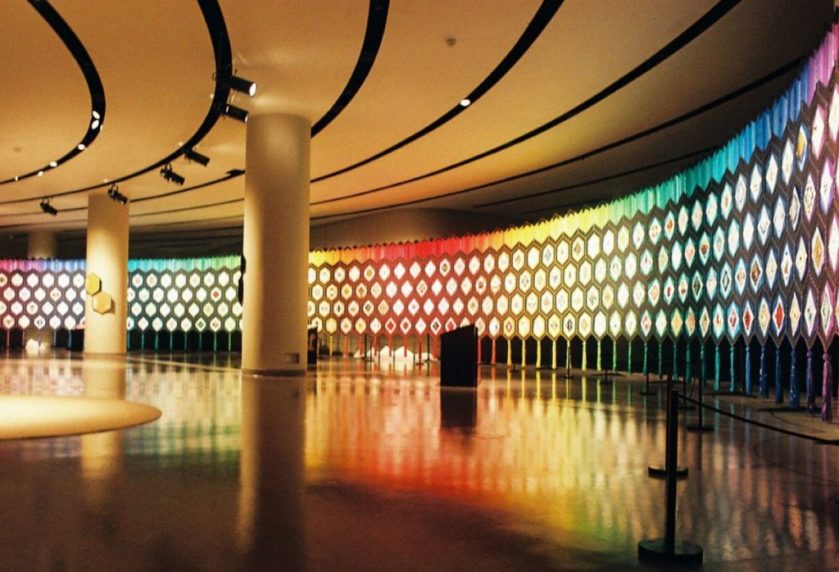
The Quilt of Belonging: A Place for All is a collaborative work of art whose mission is “to recognize Canada’s diversity, celebrate our common humanity and promote harmony and compassion among people.” A richly hued portrait of the human family, Quilt of Belonging is a 120 foot (36 metres) long collaborative textile art project. Its 263 blocks portray the rich cultural legacies of all the First Peoples in Canada and every nation of the world at the dawn of the new Millennium. The goal of those who created it is to “tell the stories of Canadians of all generations throughout our history, from First Nations to new settlers to the new citizens of today, to all from coast to coast to coast who call this wonderful country home.”

The Quilt of Belonging was begun in the fall of 1998 by artist Esther Bryan. In 1995 she went on a life-changing journey to Slovakia with her parents to find the family and home her father had left behind 43 years earlier. The dream of making this artwork was born as she recognized that everyone has a story to tell, each culture has a unique beauty and that the experiences and values of our past inform who we are today. Volunteers were found from each cultural identity to create the 263 diamond shaped textile blocks. Help was provided as needed with design, research and needlework to ensure that each piece reflects the unique beauty and character of the culture depicted. In this textile mosaic, each person can experience a sense of belonging and find a place in the overall design – there is “A Place for All.” Together they record human history in textile, illustrating the beauty, complexity and sheer size of the human story.

Canada’s immigration records showed that as of January 1st, 2000 at least one person from every country of the world was living in Canada. It took over 6 years for volunteers to find a representative from each of the 263 cultural groups on the quilt. Thousands of calls, letters and countless visits were made to organizations, immigration centres, native bands, churches, embassies, and individual contacts – in short every possible source was considered. Appeals were also made in the media, needlecraft publications and numerous “in-progress” exhibitions.

Blockmakers were found to create the 9-inch diamond shaped textile “block”. Volunteers assisted them with materials, design and sewing expertise. Countless hours of research supplied information on design, fabrics and techniques and provided the historical, cultural context from which to make the artwork and develop texts for books and web-site.

Over 3 million visitors have seen the Quilt while the Quilt of Belonging companion book is available in English or French, and the 48-minute documentary is free to watch online. This artwork is also used in a variety of projects and education programs, creating an impact nationally and around the world. As of 2025, it is housed at TriSisters Art House in St Jacobs, Ontario, when not on tour.

CFP Media Ecology Association (Canada)

ConferencesCall for papers: Crossing[out] Borders in our Global Village, Media Ecology Association, University of Winnipeg, Manitoba, Canada, 25-28 June 2026. Deadline: abstract only 1 November 2025.

The annual meeting of the Media Ecology Association provides an opportunity for scholars, artists, professionals, educators, and students to exchange experiences and ideas in a friendly environment. They invite proposals for papers and panels related to the field of media ecology.

The conference theme — crossing[out] borders in our global village — is offered as a generative and open cue. Anyone attending the conference will have crossed some sort of border, and many of us do research that considers the power of relationality and purpose of differentiating. Figuratively, many of us cross borders by blending disciplinary interests or research methods. They chose this theme to suggest that all avenues are open, all topics welcome for review.

U Laval: Teaching Global Issues (Canada)

“JobTenure track faculty position in Teaching Global Issues, Graduate School of International Studies, Université Laval, Quebec City, Canada. Deadline: 30 September 2025.

The Graduate School of International Studies at Université Laval, located in Quebec City, Canada, invites applications for a faculty position in teaching global issues. The selected candidate will hold the Teaching Leadership Chair in Global Issues and will work in collaboration with the Faculty of Business Administration.

The Chair is dedicated to advancing pedagogical innovation and fostering critical thinking in both teaching and research. Its goal is to train students capable of analyzing the complexity of contemporary international dynamics. The selected candidate will play a pivotal role in shaping the school’s academic programs, producing knowledge in the field of international studies, and developing innovative teaching practices that benefit not only students, but also professionals, institutions, and members of the public engaged with global challenges.

Global issues encompass a wide range of pressing and interconnected problems that define the landscape of international relations. These include the dynamics, actors, and institutions involved in collective responses to today’s global governance challenges. Areas of expertise sought by the school include, but are not limited to, the following: global health and health security; climate governance, energy, and sustainable development; conflicts below the threshold of war (e.g., cyberattacks, propaganda, subversion, disinformation, sanctions, etc.); international migration and migration policies; transformation of the international order and reform of global institutions.

The study of global issues is inherently interdisciplinary and draws on a wide range of theoretical and methodological approaches. It seeks to enhance understanding of the increasing interdependence of societies, as well as the enduring tensions between state sovereignty and the imperative for international cooperation. From a pedagogical standpoint, the Chair will use innovative and cutting-edge techno-pedagogical tools to help students engage more effectively with complex global phenomena.

A research advisor will support the Chair in developing, planning, and submitting research grant applications, while also ensuring the Chair’s outreach activities are maximized. A budget will also be allocated to provide doctoral scholarships associated with the Chair.

Royal Roads U: Postdoc Possibilities (Canada)

Postdocs

Multiple postdoc opportunities, Royal Roads University, Victoria, BC, Canada. Deadline: 3 July 2025.

Royal Roads University (RRU) invites expressions of interest from those wishing to develop a Canada Postdoctoral Research Award (CPRA) application. CPRA award amounts of $70,000 (taxable income) per year for 2 years (non-renewable) are used to fund a postdoctoral researcher position at the university and are subject to MERCs (mandatory employment related costs). RRU seeks expressions of interest specific to a series of research topics; that most likely relevant to followers of this Center is this one:

Dr. Juana Du is seeking a postdoctoral scholar to support her research interests which include the impact of cultural awareness and assumptions on intercultural experiences; communication and intercultural adjustment of sojourners, particularly around international students and business expatriates; organizational culture, learning and knowledge sharing in multinational and multilingual organizations in different cultural and institutional contexts. Her recent research projects examine organizational identification in global virtual teams and boundary conditions, with an emphasis on the role of emerging technology, and AI literacy at the hybrid workplace.

Royal Roads U: Canada Research Chair in Changemaking (Canada)

“JobTier 2 (Emerging Scholars) Canada Research Chair in Changemaking, Royal Roads University, Victoria, BC, Canada. Deadline: 9 July 2025.

As a Tier 2 CRC at Royal Roads, you will develop an exemplary scholarly and creative presence, complement, and enrich research and scholarship among faculty and graduate students, and participate in local and international research networks. While based in one faculty, you will collaborate with other units within RRU as appropriate.

As the Tier 2 CRC in Changemaking, you will have established relationships in both academic and non-academic communities and a portfolio demonstrating the application of applied and problem-based research methods. You will also have demonstrated success (or a high degree of promise) in obtaining research funding from diverse sources, leading collaborative research initiatives, establishing and maintaining community relationships, supervising student research, and mobilizing research. Royal Roads considers a broad range of contributions to research, training and mentoring as part of the merit review process, with a focus on the quality and impact of these contributions.

The successful applicant will be nominated by the University for a Tier 2 CRC and, upon approval by the CRC Secretariat, will be offered an initial five-year continuing-track appointment with the possibility of conversion into a continuing appointment, subject to performance and program needs. The Tier 2 Chairs include the possibility of a renewal for an additional five years.

This position is not currently linked to a particular school within the Faculty of Interdisciplinary Studies and is open to candidates from a wide variety of disciplinary backgrounds. The determination of school will be based on the successful candidate’s area of focus. The nominee’s research area, however, must be primarily in the social sciences and humanities (i.e., aligned with the legislated mandate of the Social Sciences and Humanities Research Council of Canada).

Tier 2 Chairs are intended for exceptional emerging scholars. Candidates must have been an active researcher in their field for fewer than 10 years at the time of nomination. Applicants who are more than 10 years from their highest degree may have their eligibility for a Tier 2 Chair assessed through the program’s Tier 2 justification process. This process considers career breaks such as parental leave, illness, administrative burden, clinical training, and others. For further information, see the Canada Research Chairs website.


Cole Foundation Grants: ICD Through Theatre 2025 (Canada)

Intercultural Conversations-Conversations Interculturelles programme, Cole Foundation, Montreal, Canada. Deadline: 28 March 2025.

Twice a year the Cole Foundation’s Intercultural Conversations-Conversations Interculturelles (IC-CI) program disperses hundreds of thousands of dollars to support professional Montreal theatre companies to produce, commission and translate plays that show diversity on stage. This encourages greater understanding of Montreal’s intercultural reality by having audiences both learn about and see their stories presented.

The Cole Foundation is committed to celebrating the vibrant multi-cultural mosaic of Montreal, Quebec and the rest of world by supporting professional theatre that features the stories of different (racial, ethnic or religious) cultures. We hold a bi-annual competition, awarding grant funding to the production, creation, and translation of plays that bring to the stage the voices of such cultures.

Vancouver Dialogues (Canada)

Applied ICDVancouver Dialogues: First Nations, Urban Aboriginal, and Immigrant Communities, Vancouver, BC, Canada.

“Stories build community and create understanding. They are the memories and oral histories of peoples who have taken different journeys to create a home in Vancouver. The City of Vancouver Dialogues Project aimed to create cohesive communities by exploring the stories of Vancouver’s First Nations, urban Aboriginal and immigrant communities.”

The book resulting from the 2010-11 project (available online, for free) can serve as a model to other communities for how to get people from different cultural backgrounds talking to one another. At the end of the project, “Overwhelmingly, those who have been involved with the Project have asked for a continued dialogue about the issues which have been raised,” which can only be understood as a marker of success.

Stories from the Silk Roads (Canada)

Applied ICD

Storis from the Silk Roads, Kulea Culture Society, Victoria, British Columbia, Canada, 8-11 May 2024.

Stories from the Silk Roads, Kulea Culture Society

During Asian Heritage Month, Kulea Culture Society presents Stories from the Silk Roads, a four-day event of music and film to celebrate the rich heritage of Canadians with roots in the Asian continent. The Silk Roads were a system of caravan routes crossing the Eurasian continent from the Mediterranean Sea to China. They influenced the emergence and development of trade and cultural ties between people and statehoods located along the way and beyond. The routes carried goods, ideas, people across the continent and the sea from China, India, Uzbekistan, Turkmenistan, Kazakhstan, Iran, Syria, Turkey among others to the Mediterranean and the West. Just like on the Asian continent, different Asian communities live across Canada today. These cultures have developed their distinct identities, arts and histories through interaction and communication with each other in Canada. Stories from the Silk Roads highlight diversity and harmony through arts and culture.

U Montreal: Assistant Professor of Anthropology (Canada)

“JobAssistant Professor of Anthropology, Faculty of Arts and Sciences, Université de Montréal, Montréal, Québec, Canada. Deadline: 20 November 2023.

The Department of Anthropology invites applications for a full-time, tenure-track position as Assistant Professor of anthropology. Specifically, the Department seeks candidates with an active research programme on social mobilisations (collective action, social movements) and/or information technology and circulation. The selected candidate’s research programme must be ethnographic in nature and comprise an international dimension. Original methodological innovations will be an asset, as will having thematic or geographical research expertise not currently represented in the Department. In their teaching and student mentorship, the selected candidate will also contribute to the International Studies program.

NOTE: The Université de Montréal is a French-language institution.

York U: Postdoc in Education, Mobility & Social Capital (Canada)

Postdocs
Jean Augustine Chair in Education, Community and Diaspora, York University, Toronto, Canada. Deadline: open until filled (posted June 2023).

York University invites applications for a Postdoctoral Fellowship in the area of education, social mobility, and social capital amongst Black adult learners. The Jean Augustine Chair in Education, Community & Diaspora is a university chair in the Faculty of Education at York University, which aims to advance access, equity and inclusivity to education through community engagement and collaborative action. First launched in 2008, the chair holder initiates, facilitates, directs and engages in research, educational programs, and community partnerships which are culturally responsive and relevant to the educational and social needs, interests and aspirations of Black and other racialized community members.

The Postdoctoral Fellow will engage in research that (1) advances knowledge about the lives of Black people in Canada with attention to the educational and community interventions that can support Black students as well as (2) establishes a comprehensive, nation-wide understanding of the pathways racialized individuals utilize towards realizing educational, social and economic mobility in Canada. It is expected that this Fellowship will offer emerging Black scholars and recent graduates new and/or additional opportunities, supports and education that will build on their graduate work; as well as opportunities to engage in research, writing, publishing and mentorship activities.