For this interview, I had a very interesting conversation with Sangita Shresthova, Associate Research Professor of Communication at the University of Southern California and a member on the Advisory Board of the Center for Intercultural Dialogue, about some fascinating aspects of her new book, The Cross-Cultural Parenting Playbook. Sangita’s book can be considered as a “practical research-backed guide for parents raising children across multiple cultures in a media-filled world.” I think the synopsis that Sangita offers below provides a very good introduction to the book’s general focus:
Every day, more families span continents, cultures and languages to raise cross-cultural children. Yet even as media brings us closer than ever, travel restrictions and censorship remind us how fragile these connections can be. Offering real-life stories, strategies and activities, this book explores how diverse families use media, both old and new, to bridge cultures and support their parenting journey. We meet children who balance frequent moves with staying in touch with a distant homeland. We encounter parents navigating multiple languages under one roof. We hear from relatives determined to keep in touch despite the challenges involved. We learn that media remains a vital tool that helps all these cross-cultural families stay connected – through shared recipes that conjure memories, video calls that span time-zones, popular culture that reflects a family’s blended identity, and more. This is a book for anyone preparing for or living the realities of cross-cultural parenting.
Recently I began a series of conversations with colleagues in various disciplines for their insights and perspectives on matters and practices in intercultural dialogue and, more generally, intercultural communication and education. The first two of these conversations have already been posted in the Associate Director’s Activities column. But after further reflection and deliberation on how best to share these dialogues with interested colleagues, we have decided to introduce a new series entitled Voices from the Field that you see herein. Similar to the entries in our Guest Posts, you will find a link to a PDF of each of the dialogues in this series.
The motivation behind becoming a world language teacher
Challenges facing world language students and their teachers, as well as the triumph they share
A career path between (or from?) world language teaching and (or to?) international and intercultural education
Advocating for study abroad programs in schools: challenges and opportunities
Benefits for students to partake in curricular travels, such as foreign exchange or study abroad programs
The transformative experience of being an international and intercultural educator
Best practices in promoting international and intercultural education
Some advice for aspiring practitioners in the field
What have been some of your most gratifying experiences or outcomes as a practitioner in intercultural and international communication and education?
“…Some of my best memories from teaching are when I reflect on students playing games in the target language, listening and analyzing music, following a film, or discussing cultural practices. These are priceless, authentic moments where I’ve seen my students be truly comfortable in trying something new and having fun while learning. That’s what it’s all about.”
An ethnographic study of ethnic minority students’ multilingualism in rural China: A conversation with Yizhe Jiang.
I have had the good fortune of sharing a conversation recently with Professor Yizhe Jiang (at the University of Macau) about her doctoral dissertation research in Guizhou Province, China. Her research on some important aspects of multilingualism of young ethnic minority students in Rural China involved extensive ethnographic fieldwork and, in my views, its outcome can help shed light on some important aspects of our work in intercultural communication and dialogue. This is the second installment of a series of conversations with colleagues in various disciplines for their insights and perspectives on matters and practices in this regard.
Yizhe, thank you very much for sharing your research work and reflections with us. To better contextualize our conversation for our readers, what is the general focus or thesis of your Ph.D. dissertation research? How is the research focus relevant to intercultural communication or dialogue?
The title of my Ph.D. dissertation is The Nature of Multilingualism of Ethnic Miao and Dong Liushou Ertong in Rural China. This research is based on an ethnographic study of a unique group of children in Guizhou Province (貴州省), China. These children belong to the Miao (or Hmong) and Dong (or Kam) ethnic groups and live in the multiethnic and multilingual Jinping County (錦屏縣), which is part of Qiandongnan Miao and Dong Autonomous Prefecture (黔東南苗族侗族自治州) in Guizhou. They speak their ethnic languages (Miao or Dong), a regional Han Chinese dialect (Jinpinghua), standard Mandarin (Putonghua), and learn English in junior middle school. My study investigated their daily language use and functions at school, as well as their ideologies regarding these different language varieties.
Through many intercultural dialogues, the research highlighted how these children navigated various cultural contexts—Miao, Dong, and Han (the majority ethnic group in China), as well as modern and traditional, formal and informal, urban and rural dynamics.
What motivated you to pursue the subject matter? Why was researching the subject matter important to you, say, professionally and personally?
Due to significant economic disparities between major cities in eastern China and rural areas in the west, my study participants are ethnic minorities and Liushou Ertong (留守兒童), a unique group of children whose parents work in large cities for better incomes. Consequently, these children are often cared for by their grandparents and see their parents only a few times a year. Unlike their urban counterparts raised by their parents, these students show stronger proficiency in their ethnic languages, namely Miao or Dong, as they have to communicate with older relatives in their traditional villages. At school, they naturally switch between ethnic languages, Jinpinghua, and Putonghua for different communicative purposes. Intrigued by their linguistic repertoires and concerned about their living conditions, I am eager to explore their stories and share them with the outside world.
Please briefly describe your project’s field research sites and their relevance to address your questions.
A glimpse of the center of Jinping County (錦屏縣), Guizhou, China, September 2021
I took the above picture in the center of Jinping County, where two large rivers merge—part of the upper reaches of the Yangtze River. The government has implemented strict environmental protection laws and regulations. As a result, there are few large companies and factories in the area, causing most young adults to work outside the county. Consequently, many children here are Liushou Ertong, especially those living in remote villages.
All of my participants were enrolled in a suburban boarding middle school, featuring an equal representation of Miao and Dong students. Due to the accelerating pace of urbanization, fewer children remain in villages in Jinping, resulting in the closure of middle schools in remote areas. After graduating from village elementary schools in six Miao and Dong towns, these students enter the central middle school in suburban Jinping, where they spend five days a week and take a bus home on weekends.
Who were the main human subjects of your project’s field research, such as students, their families, teachers, school administrators, etc.)?
At the center of my study are four ethnic minority Liushou Ertong: Ling, Xian, Min, and Fei (pseudonyms). Ling and Xian are Miao girls from different villages in the same town, while Min is a Dong girl living half an hour away from Fei, a Dong boy from the same mountain range.
To understand the students’ language use at home, I interviewed their grandparents. I also interviewed four teachers: Mr. W, a Dong male history teacher who occasionally uses Dong in formal classes; Mr. W, the vice principal and English teacher who knows the school language policy well; Mr. P, a Dong female who served as their Chinese teacher and frequently communicated with the students’ families; and Mr. L, a Miao female English teacher who taught these students for one year. All are fluent in their ethnic languages and familiar with the students’ language habits.
What have been some of the biggest challenges facing you over the course of your fieldwork and how did you address these challenges?
First, my unfamiliarity with Guizhou Province presented a challenge, as I had never visited it before. To acclimate, I worked as an English teacher for a year, teaching 266 hours to build rapport with students and teachers while learning the local languages.
Second, transportation was an issue since many participants lived in remote villages, with some Dong students residing up to an hour and a half from downtown. The winding mountain roads often made me carsick, so I sometimes invited friends or family to drive with me. I also hosted students in my apartment for TV or homework sessions, fostering communication among diverse linguistic backgrounds.
Another challenge involved language barriers. While I gradually learned the local dialect, Jinpinghua, I struggled with Miao and Dong, which belong to different language families. This often required me to rely on student translations during interviews, necessitating repeated confirmations for clarity.
What were the most memorable moments, events, encounters, etc., that you experienced over the course of your fieldwork? Why were they memorable to you?
While reading this question, many memorable moments came to mind. One afternoon, when I was walking in the mountains with two girls, I discovered a beautiful crystal stone. A girl told me it was a flint, and they introduced me to various herbs along the path. Despite being their teacher, I learned a great deal about nature from these students.
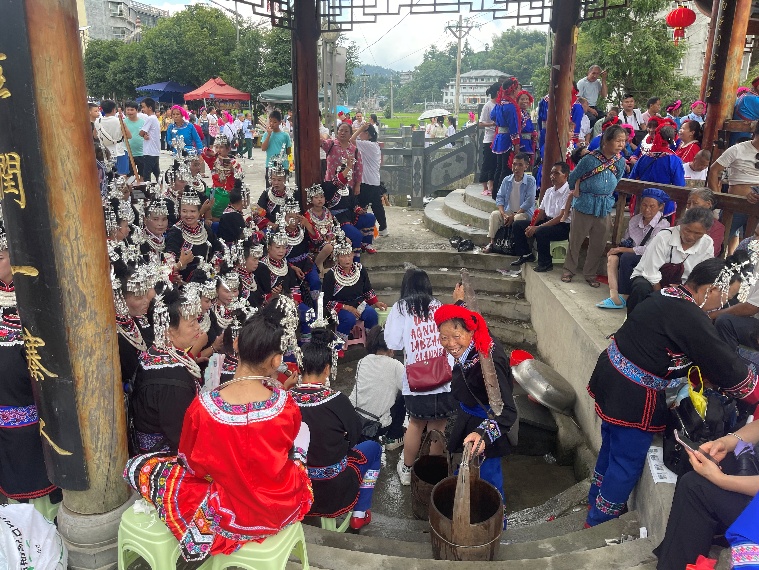
Another highlight was participating in the Miao Tasting Festival, which celebrates rice growing. Jinping is sea of folk songs, with singing competitions and activities during every traditional festival. People dressed in their ethnic attire came from various villages and even neighboring provinces. I captured a photo of some Dong and Miao people in different styles of costumes, resting and chatting by a well.
A Miao tasting festival underway in Ouli Town (偶里鄉), July 2023
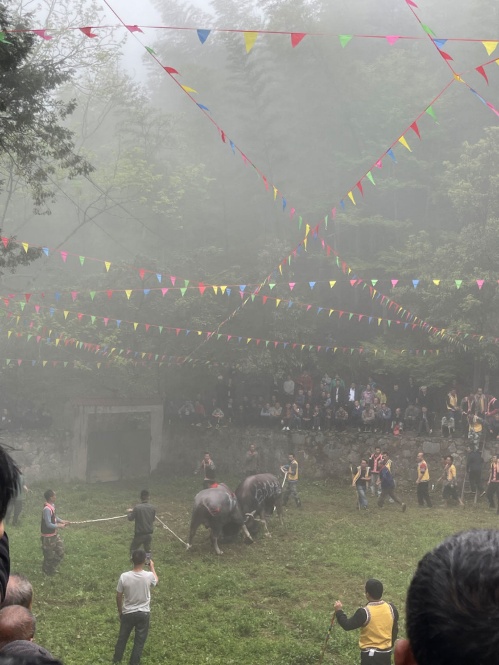
I also attended a bullfighting competition, a favorite among the Dong people, which caused traffic jams even in the mountains.
A bullfighting competition in action in Yandong Town (彥洞鄉), April 2023
The most touching moments were those spent in nature, truly experiencing “field” work. Observing students in rice fields, villages, and forests, I recorded the beautiful sounds of cicadas, birds, barking dogs, crowing roosters, and the sound of fish tails hitting the water in the rice fields, along with the elders singing Dong songs. I dedicated my thesis to this generous, poetic, and mysterious land of Guizhou Province.
What was the one most important lesson that you think you have walked away with from your ethnographic fieldwork?
I believe the most important lesson is to be patient. During my initial round of interviews with the children, they were uncertain about their use of and feelings toward different languages. I felt disappointed, fearing I might not uncover many interesting aspects.
However, as I grew more familiar with them, I discovered numerous intriguing moments. For example, Jinpinghua is commonly spoken in Miao villages near the downtown area, but it was almost inaudible in Dong towns. After spending a year at school, Dong students picked up this dialect from their Miao peers and those from downtown, eventually speaking it fluently.
What advice would you give to colleagues in the field who are interested in conducting ethnographic research in China (especially in rural China), such as things they must consider doing or preparing for and things they should avoid?
I believe the first step is to be patient, as people from these areas may be unfamiliar with being observed and interviewed. Most of them have never been interviewed before and often associate it with something serious and formal. It’s crucial to spend time with them, building close relationships that help them relax, trust you, and understand that your study is not an exam.
You also need to respect local culture and customs. For example, my students’ grandparents always cooked and waited for me to share a meal during my visits. Initially, I felt guilty, but I soon realized this was their custom. They feel sad if guests don’t join them for a meal. So, throughout the rest of my study, I always brought food or cooked with them, which provided many opportunities to observe their conversations in the kitchen.
Additionally, attending their traditional festivals and activities is always fascinating, as it allows you to witness people from different backgrounds gathering and engaging in intercultural communication.
In summary, reflecting upon my learning from Yizhe’s experience and insight, I would like to offer four Key Takeaways, as follows:
First, it is not uncommon that students in China of ethnic minority heritages are bilingual or multilingual, thus presenting unique challenges and opportunities to language or intercultural educators.
Second, rural education in China, especially in regard to world language education in rural China, remains a subject that has yet to receive an extent of academic attention it rightfully deserves.
Third, due to diverse and complex inter-regional or intra-cultural differences, conducting ethnographic research in China requires a great deal of preparation and patience even as the researchers may have come from a Chinese heritage.
Fourth, immersing oneself in ethnographic research, in the manner in which Dr. Jiang has endeavored, can be, and often is, a transformative experience for the researcher.
Perspectives on world language education as intercultural learning: A conversation with a Mandarin teacher.
I have begun a series of conversations with colleagues in various disciplines for their insights and perspectives on matters and practices in intercultural communication and dialogue. The following is the first installment of these conversations. Our special guest in this conversation is Xiaofan Chen, a veteran Mandarin Chinese teacher in New York City.
Casey Man Kong Lum, Associate Director, CID
Xiaofan, thank you very much for agreeing to share your experience and insights. To begin with, how do you conceptualize and describe world language education as intercultural education and why?
As a world language teacher, I believe we should not only focus on students’ linguistic proficiency but also their ability to interact appropriately and effectively with people from different cultures. In the classroom, teachers should guide students to compare cultures with critical thinking and to question stereotypes, and learn to communicate with meaningful context. The purpose of learning a language in this global world is not only just developing linguistic skills, but also helping students navigate in or among diverse communities and having the ability to understand and respect different cultures. This will help them become global citizens.
By extension, what do you think students should expect to learn from studying world languages and why?
Linguistically, students develop four skills—reading, writing, listening, and speaking. This allows them to explore new environments and exchange new information. Culturally, students can learn about values in life through different cultural perspectives. One of our goals is to help students realize that they can see the world from diverse perspectives.
From your experience, and from your exposure to professional colleagues in your field over the years, what have been some of the key challenges facing students (at the grade levels you’re familiar with) studying Mandarin and why?
The first challenge is definitely tones. Mandarin is a tonal language, which is very different from English. The same syllable in Mandarin can mean completely different things depending on the tone. Students often struggle to hear, repeat, and differentiate tones in Mandarin.
Secondly, learning to write the Chinese characters – as opposed to the phonetic alphabet in English, for example – is also very challenging to students. Many characters provide no phonetic clues for pronunciation, and a lot of times students need to learn both pinyin, the Chinese phonetic alphabet, and characters at the same time. This requires a lot of time spent in memorization and it can cause frustration.
Thirdly, it is very hard for students to find authentic Mandarin language environments. My students are lucky to live in one of the most culturally and linguistically diverse cities in the world (New York City) and can access real life Mandarin speaking environments, such as Chinatown in Manhattan or Flushing in Queens. Unfortunately, this is not the case for everyone. A lot of students who live in smaller cities have trouble finding people or places they can practice the language with or in. This might lead to students’ lack of motivation and to drop the class. The difficulty of not having an authentic Mandarin language environment accessible means that in some areas, Chinese programs are being cut due to low enrollments.
From your experience and from your exposure to professional colleagues in your field over the years, what do you think are some of the best practices that Mandarin teachers use for helping their students address the challenges and why?
I’ve noticed when I put tones into songs and Total Physical Response (TPR) games, students tend to get more interested and have better understanding of them (e.g., Bui, 2018). Especially with TPR games, tones become muscle memory and the games increase engagement. When learning about characters, instead of pure memorization, I like to make up stories based on the character’s shapes and sounds and use more visual aids to help students remember them. I also have found out that learning radicals – the basic components that offer clues to a character’s meaning or pronunciation – can help students memorize characters faster (e.g., Clydesdale, n.d.). Bringing students to an authentic learning environment can also help with language learning. For example, each year we have guided trips to Chinatown and Flushing. Students can practice how to order food, greet someone, or express opinions with Chinese people in real life scenarios.
What have been some of your most gratifying experiences or outcomes as a Mandarin language teacher and why?
One of the best such outcomes is when students not only develop skills in the language but also have an interest in Chinese culture beyond the classroom. Students often try to find people with whom to practice their Mandarin outside of class, learn about Mandarin popular culture through music and TV shows, and so on. Some students also try authentic Chinese food from different regions. Some even plan trips to China! These always make me feel so rewarded as a language teacher.
What advice would you give to students in world language education who aspire to become world language teachers?
My advice to aspiring world language teachers is to stay curious and be open-minded. Language is not just studying grammar and vocabulary. It is also a way to make connections, find identity, and explore culture. A lot of times we need to figure out a way to combine the language and the culture into cohesive lessons.
References
Bui, G. (2018). Total physical response. In J. Liontas (Ed.), The TESOL encyclopedia of English language teaching. Oxford, UK: John Wiley and Sons.




 Center for Intercultural Dialogue