CFP Chinese Journal of Communication: Transnational Migration To/From China

“Publication

Call for a special issue of Chinese Journal of Communication on Transnational Migration to/from China: The Role of Digital Platforms, Publics, and Policies. Deadline: 31 July 2025.

Issue editors: Saif Shahin, Mingyi Hou, and Sagnik Dutta (all at Tilburg University, the Netherlands)

This special issue of the Chinese Journal of Communication aims to expand our understanding of transnational migration in the digital age, especially as it relates to platforms, publics, and policies. It explores how digital platforms (Chinese and non-Chinese), their sociotechnical affordances, and the discourses they produce (or censor) bear upon transnational migration between China and various parts of the world, including Southeast Asia, Oceania, Africa, and Latin America, as well as North America, Europe and the rest of Asia. Editors are particularly interested in submissions that draw attention to the implications of digital technologies for migrant communities and the relations of power they (re)produce, user practices that work with or around digital affordances to achieve individual or collective goals, and national or supranational laws and regulations that shape digital industries and ecosystems and their impact on transnational migration.

CFP Comparative Cultural Studies: Youth and Participation (Spain)

“Publication

Call for a special issue of Comparative Cultural Studies: European and Latin American Perspectives on Youth and participation: Good practices in socio-educational research and intervention. Deadline: 21 July 2025.

Issue editors: Itahisa Pérez-Pérez and David Pérez Jorge (Universidad de La Laguna, Spain).

The monograph Youth and participation: Good practices in socio-educational research and intervention aims to make visible, dignify and reflect on scientific and professional experiences related to socio-educational research and intervention from an international perspective, focusing on youth participation and sustainability as key drivers of social change.

In this edition, editors invite the scientific community to contribute with theoretical works and research studies that promote youth participation and leadership, community development and socio-educational interventions aimed at young people, contributing to the development of critical knowledge that promotes the creation of fairer and more inclusive societies.

Questions to be answered:

  • How do youth contribute to community development through socio-educational initiatives?
  • What socio-educational or cultural policies have proven to be most effective in fostering youth inclusion and well-being?
  • How do migration processes affect the socio-educational life and development of young people?
  • How does cultural diversity influence youth education and participation in socio-educational activities?
  • Which gender-sensitive socio-educational strategies have had the greatest impact on gender equity among young people?
  • How are human rights, ethical values and the management of emotions being promoted in the education of young people?
  • How are young people participating in decision-making within socio-educational, political or community processes?
  • What models of socio-educational health intervention have proven to be most effective in improving the physical and mental well-being of young people?
  • What are the main challenges facing youth in formal educational settings and how can they be overcome?
  • How are youth contributing to the Sustainable Development Goals (SDGs) and how can socio-educational interventions enhance their participation in the 2030 Agenda?
  • How do non-formal education spaces influence young people’s active participation and personal development?

CFP Nordic Journal of Media Studies: Media and the Past: Mediating the Past

“Publication

Call for a special issue of the Nordic Journal of Media Studies on Media and the Past, Mediating the Past. Deadline for abstracts: 1 February 2025; deadline for full papers: 15 August 2025.

Issue editors: Kirsten Frandsen (Aarhus University) and Manuel Menke (University of Copenhagen).

Nordic Journal of Media Studies invites contributions to the 2026 issue exploring the relationship between media, communication, and the past, focusing on international as well as Nordic perspectives. The issue aims to delve into the intersection of the uses of the past with media content, discourses, events, practices, and technologies, including but not limited to the mediated communication of the past and collective memory in areas such as politics, journalism, popular culture, film and television, and sports…

The past in media extends beyond mere representation. It is used to compose cultural narratives, it contributes to identity formation, and it influences social cohesion. Media serve as powerful mediators between the past, the present, and the future, thereby taking a significant position in whose pasts get (no) recognition at present and (no) consideration for the future. Investigating these dynamics allows for a nuanced exploration of how media contribute to the construction of shared pasts and the negotiation of diverse cultural identities. The past is not only being renegotiated and contested in the Nordic context but also everywhere else, where progressive cultural and societal ambitions are intertwined with both rich historical traditions and conflicts rooted in colonial pasts. Consequently, examining how media contribute to the construction, preservation, reinterpretation, or even revision of narratives about the past becomes imperative to understanding where regions, nations, and communities might be heading.


Call for Contributing Authors: Draft Global Constitution (Netherlands)

“Publication

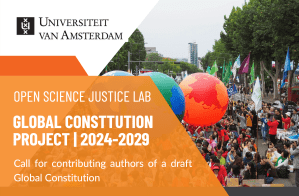
Call for contributing authors of a draft Global Constitution, 2024-2029. Deadline for 1st round of submissions: 1 February 2025; and 2nd round: 1 February 2026.

Global Constitution ProjectDistinguished Professor Joyeeta Gupta of the University of Amsterdam, and winner of the Spinoza Award 2023, is undertaking a research project to write a Global Constitution. The aim of this draft Constitution is to identify rights and responsibilities for all within the context of the Anthropocene. It aims to promote social wellbeing and environmental prosperity within an equitable world.

If you want to be a contributing author, write a 1000 word essay on what a 21st century global constitution should include. All serious essays will be taken into consideration. Send your essay with name, age and occupation to Joyeeta.Gupta@uva.nl or via the form in the qrcode. The essays will be assessed on a rolling basis.

Key Components of the Project:

  • Scientific research into various aspects of global governance and constitutionalism.

  • Perspectives from contributing authors, providing fresh and diverse ideas.

  • Workshops for collaborative discussions and refinement of the draft constitution.

CFP Translating Words, Transferring Wisdom, Traversing Worlds

“Publication

Call for contributions to Translating Words, Transferring Wisdom, Traversing Worlds. Deadline for chapter proposals: 17 November 2024; full chapters due 14 January 2025.

Mimi Yang (Professor Emerita, Carthage College) seeks chapter contributions to a forthcoming edited volume on translation studies. Translation Studies is far more complex and nuanced than the word-for-word transmission of meaning from one language to another. Translation transfers cultural wisdom and historical value from one language-speaking swath to another and traverses seemingly distant worlds in a vehicle of languages. Translators navigate the diversities of languages, cultures, perceptive frames, and ideologies to bridge words of different tongues, connect disjoint worlds, embark on the search for shared wisdom, and, most importantly, facilitate cross-cultural understandings. This project will unpack the realms hidden behind words, ramified from textual lines, and woven with writers’ horizons when translation occurs. These realms include linguistic and cognitive dimensions, sociopolitical, historical, and geographic contexts/texts, and, most significantly, a cross-cultural power structure that erects hierarchies in languages, cultures, and people of different traditions, races, and religions.

Interested authors please take a look at the full description of the book, register, and send an abstract via this link.

CFP Comm & Democracy: Critical Race Theory

“Publication

Call for submissions to a special issue of Communication and Democracy on Critical Race Theory. Deadline for full papers: 15 January 2025.

Guest Editors: Danielle Hodge (University of Colorado) and Karma Chávez (University of Texas).

In 1995, critical race scholar Derrick Bell asked a pointed question of the legal critics of the time: “Who’s afraid of critical race theory?” Interrogating the ways critical race theory (CRT) was reduced to a discipline of “deficiencies,” Bell articulated CRT as an epistemology concerned with the racialization of law, power, and policy that demanded a process of radical assessment. Rearticulated as the “perfect villain” (Wallace-Wells, 2021) and a “divisive concept” (Vought, 2020) twenty-five years later, CRT has since been subject to an onslaught of nationwide assaults that seek to ban its teaching and discussion in both K-12 and higher education contexts. These bans have detrimental implications for free speech, academic freedom, and the possibility for a healthy democracy as they limit what can be taught, learned, and discussed about US history, race and racism, and the contemporary political sphere. Understanding and intervening in these attacks is thus of vital importance for scholars of communication and democracy.

Consequently, in this special issue, the editors ask: Who’s STILL afraid of critical race theory? They seek a venue to respond to the persistent attacks against non-white, but specifically, African American and Black thought, bodies, and lives. Importantly, we are concerned with how these intellectual ambushes are inextricable from broader attacks on democracy that CRT helps to explain. In other words, how do we understand CRT as a sociocultural and political lightning rod that has exposed a democratic and communicative crisis?

Bell (1995) reminds us that “at a time of crisis, critics serve as reminders that we are being heard, if not always appreciated” (p. 908). Yet, in the face of so many attacks, the lack of being heard, let alone appreciated, is palpable. This special issue seeks to bring scholars together to be heard and to lay out an agenda for the relevance of CRT in the field of Communication.

CFP Journal of Family Communication: Global Families

“PublicationCall for submissions for a special issue of the Journal of Family Communication on Communication in Global Families Deadline for abstract: 15 October 2024; deadline for full manuscripts: 1 January 2025.

Special issue editors: Haley Kranstuber Horstman (University of Missouri) and Meng Li (Loyola Marymount University)

The purpose of this special issue is to spotlight scholarship on communication in global families. The editors seek research on family communication that 1) demonstrates global diversities in communication within and about the family and/or 2) reveals the impact of globalization (i.e., the movement of people, ideas, images, capital, goods, and risks on a global scale) on family communication. They call for research that would continue the efforts of the Journal of Family Communication to increase the diversity and inclusivity of family communication scholarship, which has primarily focused on families in the United States.

This special issue will celebrate and encourage current momentum in research on communication in global families. Diverse methodological approaches and innovative theoretical perspectives that reflect the complexities and diversities of communication in global families will be included. The editors encourage researchers from a wide range of fields (e.g., communication studies, ethnic studies, family studies, health fields, psychology, sociology, and women’s and gender studies) to submit. They seek two types of papers: data-based and critical reflections.

CFP The Possibilities and Limits of Dialogue in a World of Political Populisms

“Publication

Call for submissions to a special issue of Journal of Dialogue Studies on The Possibilities and Limits of Dialogue in a World of Political Populisms. Deadline: 7 October 2024.

The new issue of the Journal of Dialogue Studies on ‘The Possibilities and Limits of Dialogue in a World of Political Populisms’ seeks to bring together scholars, researchers, and practitioners from various disciplines to explore and critically examine the dynamics of such political populisms and their impact on dialogue and communication within and between nations. They invite contributions that address (but are not limited to) the following themes:

  • Populisms: Historical and Theoretical Perspectives
  • Populisms and international relations
  • Comparative Politics of Populisms
  • Digital Dialogues and Populisms
  • Religion and Populisms
  • Media, Communication, and Populisms
  • Populisms and Truth
  • International order, Institutions and Populisms

CFP JALT: Intercultural Competencies and Higher Education

“Publication

Call for submissions to a special issue of the Journal of Applied Learning and Teaching on Intercultural Competencies and Higher Education. Deadline for abstracts: 31 December 2024; full papers will be due 30 April 2025.

Guest Editor: Dr. Kyriaki Koukouraki.

In today’s globalized world, fostering intercultural understanding and skills in higher education is more crucial than ever. This special issue aims to explore innovative approaches, research, and practices that enhance intercultural competencies among students, educators, and institutions. Potential submissions may include: research articles, opinion pieces, brief articles, case studies, and book reviews

Topics of Interest Include (but are not limited to):
– Intercultural Competencies and Faculty Development
– Intercultural Competencies and Assessment
– Intercultural Competencies and Global Citizenship
– Non-Western approaches to Intercultural Competencies

CFP ALF Knowledge for Action

“Publication

Call for proposals for Anna Lindh Foundation Knowledge for Action. Deadline: 9 September 2024.

The ALF Knowledge for Action Programme is designed to promote the production of evidence-based and policy-oriented research that addresses relevant dimensions of Intercultural Dialogue in the Euro-Mediterranean region through presenting recommendations to facilitate policymaking by evaluating policy options regarding a specific issue. The Programme seeks to enhance collaboration between research/academic institutions (think-tanks, specialised centers, and universities) and civil society organisations.

Briefs or papers adressing the following topics:

  • Peacebuilding, conflict resolution/prevention, coexistence and inclusive dynamics
  • Disinformation and misinformation in the Euro-Mediterranean region
  • Living together promoting tolerance and understanding in the Euro-Mediterranean context
  • Youth engagement in participatory dialogues and decision-making processes in the Euro-Med
  • Ethics and governance of Artificial Intelligence technologies in the Euro-Mediterranean region
  • Social innovation as a catalyst for social inclusion in culturally diverse Euro-Med societies
  • Empowering women in the Euro-Med region as a way to challenge gender stereotypes and beyond
  • Integrating social dimensions in climate change policies in the EuroMed region
  • International cultural relations and cultural diplomacy to bridge both shores of the Mediterranean
  • Creative industries and arts