
 Sheila McNamee is Professor of Communication at the University of New Hampshire. She submitted the following discussion of her Fulbright award.
In 2012 I was a Fulbright Specialist at the University of Caldas in Manizales, Colombia. The invitation arose because, during this period, I was supervising an Assistant Professor at the University of Caldas in her PhD work. Her PhD research was on the re-integration of former child soldiers into civilian life. The opportunity to work with her research group, CEDAT, provided a living laboratory where the constructionist ideas I write about could be put into practice.
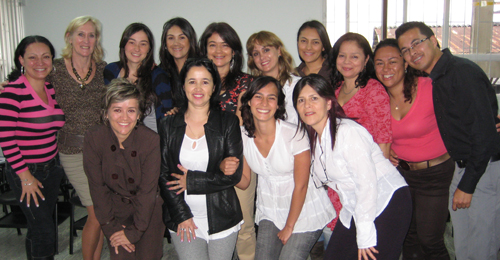
The project consisted of training in a social constructionist stance aimed at undergraduate and graduate faculty of the University of Caldas. Focus was on exploring how a social constructionist approach could be applied to specific areas such as social work, family development, social sciences, social research, conflict resolution and mediation. I was engaged in offering seminars, workshops and consultation with research groups. While most of my work was with faculty, some activities were extended to students and professionals from the academic community. The faculty with whom I worked were expected to begin a reflective process on teaching, research and professional practices, from a social constructionist approach and apply the knowledge acquired during the training, within the undergraduate curriculum, graduate curriculum, and social extramural programs such as “Tutor Home” and the “Center for family Intervention.” I worked with several research groups to offer advice on the specific projects being carried out at the moment as well as guidance on new projects. I worked a good deal with one research group, CEDAT. They develop processes in the area of conflict, violence and coexistence within the context of the Colombian conflict. This is one of the strategic areas of research at the University of Caldas.
My work with CEDAT focused on conflict resolution and mediation, from a constructionist perspective. These topics are central to CEDAT’s focus on reintegration into civilian life of children and young people detached from the Colombian armed conflict. I engaged dialogical workshops with specific groups of professors with a particular focus according to the programs and needs: (1) a seminar on social construction and social work aimed to professors of the department of human development; (2) a training Workshop on constructionist research addressed to professors assigned with various research groups. These activities included Master students; (3) a training workshop on dialogue, conflict resolution and mediation; (4) a training workshop on family intervention for professors assigned to the department of family studies and the Center for family intervention staff; and (5) a seminar open to the academic community on social constructionist theory.
While these are all the “formal” activities in which I engaged, my own learning was expanded tenfold thanks to this Fulbright. It was exciting working with research groups who were focusing on the long-standing and crippling conflict in Colombia. This was an opportunity to take my work beyond local community and organizational conflicts and see how it could be put to use in an enduring cultural struggle. The experience transformed my work and provided countless connections to both scholars and practitioners interested in working with dialogic ways of generating new forms of understanding.
 I made two Fulbright visits as a Fulbright Specialist after I retired from Arizona State University in 2011. The first visit was in 2012 to Zeppelin University (Friedrichshafen, Germany), with a brief lecture trip to Vienna, Austria; the second was in 2017 to Universidade Catolica Portuguesa (Lisbon, Portugal). A few comments about contacts, networks, and curricular notions will be followed by an overview of the experiences.

 The Fulbright was for someone to teach courses in management at the Tashkent Institute of Finance. I had a keen cultural interest in Central Asia, but my Ph.D. was in Applied Linguistics, & most of my teaching dealt with the English language, with courses like applied linguistics, fiction, & non-fiction writing, I also taught an MBA course in business communication. In my Fulbright application, I stressed the fact that an American business professor teaching in a place like Tashkent would be faced with serious comprehension problems from his students, especially since management has its share of jargon and technical terms. I offered to prepare a book for management students who were also nonnative speakers of English. I was also lucky enough to have had a previous Fulbright, plus several other long-term overseas ESL teaching assignments (in Afghanistan, Saudi, & Indonesia). At any rate, the Fulbright came through, and I arrived in Tashkent with copies of the book (later published as English for Decision-Makers: A Course in Modern Management).
 Center for Intercultural Dialogue