CFP Taos Institute: Co-Creating Social Worlds (USA)

Conferences

Call for papers: Co-Creating Social Worlds Symposium, Taos Institute, held at Mercy University, New York, NY, USA, 27-28 February 2026. Deadline: 15 November 2025.

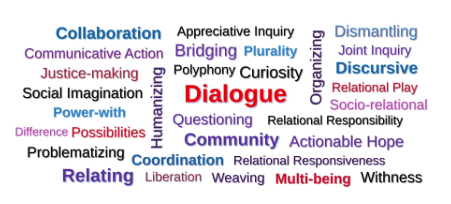
Amid dissonance and division, gather as improvisers of possibility, ensemble players in care, and weavers of bridges toward a more generous world—an ecology of connection where human and more-than-human lives entwine in fragile, co-creative rhythms, reminding us that we belong to a living, breathing assemblage greater than ourselves. Join for a vibrant gathering across disciplines to deepen our connections and spark meaningful collaboration–re-imagining our personal, public, and political lives.

word cloud for Co-Creating Social Worlds

CFP Navigating Afro Knowledges: Exploring Practices and Theories in Digital Diaspora Studies (Germany)

ConferencesCall for papers: Navigating Afro Knowledges: Exploring Practices and Theories in Digital Diaspora Studies, University of Bremen, Germany, 17-19 June 2026. Deadline: 31 October 2025.

In recent years, Digital Diaspora Studies have emerged as a vibrant interdisciplinary field at the crossroads of media studies, migration studies, and postcolonial studies, exploring the complex interplay between technology, communication, arts, culture, and identity within diasporic communities. As diasporic individuals and communities navigate the digital landscape, they engage in practices that not only reshape their identities and the dynamics of belonging1, but also contribute to the circulation of knowledges that have been ignored in mainstream spaces due to systems of domination and hegemonic power relations. However, the internet is also a space shaped by ‘race’ and racialization.

This conference invites participants to explore, challenge and reframe the theoretical and methodological tools currently used in the study of digital diasporas. It foregrounds the lived practices, creative expressions, and activist interventions that emerge from Afrodiasporic cyberspaces, positioning them not at the margins, but at the centre of digital cultural production and critique, with particular focus on Romance-speaking countries.

CFP BAAL Language Policy Forum 2026 (Spain)

ConferencesCall for papers: British Association for Applied Linguistics Language Policy Forum, Universidad Complutense de Madrid, Spain, 22-23 April 2026. Deadline:  27 October 2025.

2026 marks 50 years since Joshua Fishman‘s foundational volume Bilingual Education: An International Sociological Perspective (1976), a cornerstone in establishing language policy as a distinct discipline. 2026 also marks 20 years since the publication of An Introduction to Language Policy: Theory and Method, a collection edited by Thomas Ricento and showcasing the leading lights of what had become by then a flourishing research field.

In his volume, Fishman argued that language policy (or more specifically bilingual education) was good for majorities, minorities, language learning, and education. In this spirit, LPF 2026 invites submissions informed by this disciplinary heritage, and those which go beyond it, to examine language policy across different areas of civic and societal engagement. We take a broad approach to language policy; we welcome any submissions related to decision-making about language use.

The Language Policy Forum is international, affordable, and accessible –a premier international meeting of specialists with extra attention to facilitating access.

CFP ICA 2026: Intercultural Communication Division (South Africa)

ConferencesCall for papers: Intercultural Communication Division, International Communication Association, Cape Town, South Africa, 4-8 June 2026. Deadline: 1 November 2025.

“The Intercultural Communication (ICC) Division welcomes research that applies, extends, or develops theory, method, and analysis to explore how communication intersects with culture in local, national, international, and transnational contexts. We are committed to supporting interdisciplinary research that examines culture, identity, history, and geopolitical relations, and especially invite work grounded in non-Western, decolonial, Indigenous, and underrepresented perspectives from across the globe.

This year’s conference theme, “Communication and Inequalities in Context,” calls on us to reckon with how communication both reflects and reproduces the deep structural inequalities that mark our world. For intercultural communication scholars, this theme underscores the urgency of examining how power operates across and within cultural boundaries through colonial legacies, migration policies, linguistic hierarchies, digital divides, and uneven access to resources. These dynamics are not abstract: they shape people’s lives, sense of belonging, and ability to communicate with dignity and agency.

We therefore invite submissions that interrogate how intercultural communication research can confront, resist, or reimagine these inequalities. What communicative practices foster solidarity, healing, and justice across borders? How do marginalized communities navigate cultural difference amid systemic oppression? What responsibilities do scholars bear in addressing epistemic, material, and institutional imbalances within the field itself? How can our work amplify the voices, languages, and knowledges that are often silenced?

In line with the theme, the ICC Division seeks submissions that ask bold, justice-centered questions and that push our field to think more critically about how we engage difference, power, and global inequities. We particularly encourage contributions that attend to intercultural communication as a site of both struggle and possibility in the face of rising authoritarianism, climate crisis, digital surveillance, and social unrest.”

CFP Media Ecology Association (Canada)

ConferencesCall for papers: Crossing[out] Borders in our Global Village, Media Ecology Association, University of Winnipeg, Manitoba, Canada, 25-28 June 2026. Deadline: abstract only 1 November 2025.

The annual meeting of the Media Ecology Association provides an opportunity for scholars, artists, professionals, educators, and students to exchange experiences and ideas in a friendly environment. They invite proposals for papers and panels related to the field of media ecology.

The conference theme — crossing[out] borders in our global village — is offered as a generative and open cue. Anyone attending the conference will have crossed some sort of border, and many of us do research that considers the power of relationality and purpose of differentiating. Figuratively, many of us cross borders by blending disciplinary interests or research methods. They chose this theme to suggest that all avenues are open, all topics welcome for review.

CFP ICA 2026: Regional Hubs

ConferencesCall for proposals of Regional Hubs to complement International Communication Association convention, Cape Town, South Africa, 4-8 June 2026. Deadline: 1 November 2025.

In conjunction with the 76th Annual ICA Conference (ICA26) on 4-8 June 2026 in Cape Town, South Africa, ICA will once again welcome Regional Hubs worldwide to host events concurrent with the annual ICA conference. ICA’s Regional Hubs offers a window into ICA – its community and scholarship. They provide communication scholars in various regions around the world an opportunity to foster community and build intellectual networks. It reflects ICA’s commitment to welcome and support a broader global community of communication scholars.

While there is no substitute for an in-person experience at an ICA conference, organizers recognize that a significant and growing proportion of current and potential ICA membership resides in the Global South, making travel to in-person attendance inaccessible due to fiscal, political, environmental, health, and other hurdles.

In response to these concerns, ICA’s Regional Hubs Initiative offers a window into ICA – its community and scholarship. The Regional Hubs also provide communication scholars in various Regions around the world an opportunity to foster community and build intellectual networks. It reflects ICA’s commitment to welcome and support a broader global community of communication scholars. Since its inception at the virtual ICA 2021 and continuing at the hybrid conferences in ICA22, ICA23, ICA24, and ICA25, each year, the organization has hosted around 10 ICA Regional Hubs.

Regional Hubs host sessions for regional submissions, with some Hubs receiving over 100 submissions, from which some were selected for oral presentation and others for posters. Most of the Hubs hosted themed workshops and invited lectures from local and global scholars, including some who joined from other Regional Hubs and others from the main ICA Conference location.

Some Hubs live-streamed presentations and sessions from the primary conference location (Paris in 2022, Toronto in 2023, Gold Coast in 2024, and Denver in 2025) and organized local panels to facilitate discussion around them. A few organized Blue Sky workshops or workshops on special topics such as scholarly publishing, submitting grants, and scholarship applications. Some Hubs live-streamed their locally-originated events on platforms such as Facebook and YouTube and often garnered considerable local media coverage. In some cases, the Hubs hosted those presenting papers selected for the ICA conference remotely from their locations. Finally, after the selection of Hubs, some Hubs collaborated on organizing joint Hub-to-Hub sessions.

NCA Pre-Conference: Analyzing Health, Digital, and Intercultural Discourse (USA)

ConferencesPre-Conference: Discourse & Social Context – Engaging with Discourse Data & Methods to Elevate your Current Research, National Communication Association, Denver, CO, 19 November 2025. (preregistration appreciated but not required)

Join a team of leading scholars from the Language & Social Interaction (LSI) Division of the National Communication Association for a special 1 day Pre-Conference: “Discourse & Social Context – Engaging with Discourse Data & Methods to Elevate your Current Research.” Registration information about the pre-conference (and main conference) can be found here. The day’s activities will occur from 9am to 5:30pm at the Gaylord Rockies Resort and Convention Center in Aurora, Colorado.

The pre-conference is centered around a series of data-focused workshops, where participants from a variety of experience levels – from beginner all the way to advanced – can deepen their skills. Our primary focus will be hands-on application using a variety of methodological and analytical tools inspired by the LSI research tradition.

NCA Pre-conference 2025The agenda for the day:
• 9:00-9:30am Welcome and introductions – Stephen M. DiDomenico (West Chester U.) and Nadja Tadic (Georgetown U.)
• 9:30-10:15am Presentation on discourse analysis as an umbrella term for different LSI methods and analytic tools
• 10:15-11:45am Workshop 1: Interactional Sociolinguistics for social media
o Cynthia Gordon (Georgetown U.), Sylvia Sierra (Syracuse U.), and Hanwool Choe (U- Hong Kong)
• 11:45am-1:30pm Lunch & Networking
• 1:30-3:00pm Workshop 2: Conversation Analysis for health communication
o Christopher Koenig (San Francisco State U.) and Grace Ellen Peters (Colorado Christian U.)
• 3:15-4:45pm Workshop 3: Ethnography of Communication for intercultural communication analysis
o David Boromisza-Habashi (U-Colorado, Boulder) and Leah Sprain (U-Colorado, Boulder)
• 4:45-5:30pm Making connections & closing discussion

CFP International Conference on Language and Social Psychology (USA)

ConferencesCall for papers: International Conference on Language and Social Psychology, University of Arizona, Tucson, AZ, USA, 19-22 May 2026. Deadline: abstract only 1 October 2025.

The International Conference on Language and Social Psychology (ICLASP19-Tucson) is a biennial event that brings together scholars from around the world to explore the multifaceted relationship between language and social psychological processes and outcomes. This year’s conference, ICLASP19-Tucson, highlights the ways in which language shapes and is shaped by social interactions, identities, relationships, and societal structures.

They invite submissions that address a wide range of topics, including but not limited to:

Accent and Accent Bias
Aging and Lifespan Communication
Communication Accommodation
Discourse and Rhetoric
Framing
Health and Wellbeing
Identity
Intercultural Communication
Intergroup Communication
Language Acquisition and Learning
Language Revitalization
Linguistic Bias
Multilingualism
Natural Language Processing
Personal Relationships
Social Media
Sociolinguistic Contexts
Stereotypes

CFP SPICE 2026: Intercultural Communication Education (Thailand)

ConferencesCall for papers: Sixth annual conference on the SMILE Project and Intercultural Communication Education (SPICE), Thammasat University, Bangkok, Thailand, 7 February 2026. Deadline: submit between 1 November and 15 December 2025.

The International Conference on SMILE (Students Meet Internationally through Language Education) Projects and International Communication Education 2026 (SPICE2026) will take place on Saturday 7th, February 2026, at Thammasat University, Bangkok, Thailand. Papers are invited to present studies in all fields related to education involving international communication, such as:

Classroom Research
Collaborative Learning
Cooperative Learning
Curriculum Development
Evaluation of Learner Behavior
Foreign Language Education
Information and Communication Technology for Language Education
Intercultural Communication
Language Acquisition and Learning
Learner Autonomy
Teacher Education
and related areas

SPICE2026 is an international conference focusing on intercultural communication and foreign language education, the utilization of ICT, and the development of new educational programs. The main event includes practical reports from “the SMILE project” implemented from March 2025 to January 2026.

CFP U Cambridge: Interdisciplinary Perspectives on Empire, Colonialism, & Anticolonialism (UK)

ConferencesCall for papers: Interdisciplinary Perspectives on Empire, Colonialism, and Anticolonialism, University of Cambridge, England, 17 October 2025. Deadline: 30 August 2025.

Empire, colonialism, and anticolonialism have been central drivers of world history for the past centuries, and they continue to shape present day realities. From ongoing practices of settler colonialism, through to climate colonialism, economic imperialism, and resurgent far-right nationalisms drawing upon imageries of empire, it seems to be obvious that ‘empire’ and ‘colonialism’ have never gone away. At the same time, we are in a moment of history where we are also witnessing a proliferation of resistance against empire and colonialism: from the halls of universities (as seen in the Palestine encampments) through to frontline battles against settlers, militarized violence, and nefarious capital.

Different disciplines across the arts, humanities, and social sciences have highlighted different dimensions of these processes of colonialism and anti-colonialism. At this one-day conference, organizers hope to put these different disciplines in conversation with one another, taking the strongest tools from different disciplines, such that they can produce a truly interdisciplinary understanding of empire, colonialism, anti-colonialism, and decolonization.

With this in mind, they are issuing this call for papers for presenters from across the arts, humanities, and social sciences, open to presenters at all career stages. Expressions of interest in all areas related to empire, colonialism, anti-colonialism, and decolonization are welcome, including (but not limited to):
• Historical and comparative accounts of empire, colonialism, anti-colonialism, and decolonization.
•    Tracing material forms of resistance to empire.
• Conceptual and empirical work highlighting the importance of anticolonial thought and practice.
•  Considerations of the role of universities (and education broadly) in anti/colonialism and decolonization.
•  Tracing links between the social, political, cultural, and economic organisations of metropoles and colonies.
• Provocations and discussions of ongoing practices of colonization / anti-colonialism.