U Sheffield PhD Studentship: Status Conflict in Teams Led by Women & Ethnic Minorities 2024 (UK)

“Studentships“
PhD Studentship 2024-5: Status Conflict in Teams Led by Women and Ethnic Minority Team Members, Sheffield University Management School, University of Sheffield, UK. Deadline: 10 July 2024.

This PhD project will use two secondary datasets and a series of experiments to explore how teams led by white women and ethnic minorities manage status related conflict in newly formed teams. The project will draw on Expectation States Theory which highlights how individuals in newly formed performance-oriented groups are likely to be granted high and low status positions. In the absence of task expertise, diffuse status characteristics (e.g. gender, ethnicity) tend to be used as indicators of high status, meaning that women and ethnic minorities often occupy low status positions in teams. Recent work has found that teams seem to perform ‘better’ when ethnic minorities and women are in low status positions. This is theorised to occur due to the absence of status related conflict among team members, which illustrates the barriers that women and ethnic minority leaders face when adopting leadership roles. This project will therefore explore when and how minorities are able to overcome status conflict in these teams using an interaction process analysis methodology.

Given the quantitative nature of this research, the successful candidate will have a very strong aptitude for research design and statistics and will have a background in psychology or a related discipline. They will be supervised by Dr Sam Farley, Dr Nicola Thomas, and Professor Jeremy Dawson from the Institute of Work Psychology Sheffield University Management School.

The project offers the opportunity to collaborate with Professor Eden King and Professor Mikki Hebl from Rice University’s Department of Psychological Sciences. Professors King and Hebl are experts in Diversity and Inclusion and have a longstanding collaborative relationship with Professor Jeremy Dawson. The plan is for the successful candidate to have a four week stay at Rice University in the final year of their studies, so that they can write up their findings for journal publication under the guidance of Professors King and Hebl, who would feed into the supervision throughout the PhD project.

NY Public Library Fellowships: Middle Eastern & Islamic Studies 2025 (USA)

FellowshipsCall for applications: Middle Eastern and Islamic Studies Fellowships 2025, New York Public Library, NY, USA. Deadline: 5 August 2024.

The New York Public Library is pleased to offer the Middle Eastern and Islamic Studies Fellowship to support advanced research on The New York Public Library’s holdings of materials from the Arab world, Turkey, Iran, South Asia, Central Asia, and their diasporas in the United States. Fellowships are open to Ph.D. candidates, post-doctoral scholars, and independent researchers with projects that would significantly benefit from research drawing on collections accessible at The New York Public Library. Projects requiring access to original materials including manuscripts, archives, books, photographs, prints, maps, newspapers, and journals will be given preference, but all worthy projects will be considered. Applicants studying the humanities as well as those working in the visual, auditory/performing, and literary arts are welcome to apply.

Established with the generous support of Mahnaz Ispahani Bartos and Adam Bartos, the Fellowship Program will support one fellow annually for three months with a stipend of $25,000. Each fellow will have full access to the Library’s collections and staff, as well as a dedicated place to work in the Vartan Gregorian Center for Research in the Humanities.

The annual fellow will be selected following a review of applications by NYPL staff and an external committee of scholars, librarians, curators, and creatives. The Library will also explore how to support international scholars with visa requirements. The Library will continue offering this annual fellowship through 2029. Application information will be made available on this website each year.

Other fellowship opportunities at the New York Public Library may be of interest, if other topics in their collection are of interest.

CFP Journal of Dialogic Ethics: Freedom

“Publication

Call for papers for a special issue of the Journal of Dialogue Ethics: Interfaith and Interhuman Perspectives on Freedom. Deadline: extended abstract, 1 July 2024.

This issue will engage the theme of the National Communication Association’s 109th Annual Convention on freedom. The convention’s call recognizes the relationship between human communication and freedom, inquiring into the meaning of freedom and the role of communication in achieving freedom. In response to this theme, the Journal of Dialogic Ethics invites essays that consider connections between and among freedom, dialogue, and ethics, with a special focus on interfaith and interhuman perspectives.

Topics of contributions may include, but are not limited to, scholarly explorations related to academic freedom, freedom of speech, liberation theology, dialogic perspectives on American democracy, and intercultural/intergroup/interpersonal relations.

​The journal also welcome reviews of books at the intersection of dialogue, communication, and interfaith and interhuman perspectives.


Randolph College: International Programs & Services (USA)

“JobDirector of International Programs and Services, Randolph College, Lynchberg, VA, USA. Deadline: 23 July 2024.

The Director of International Programs and Services provides support, leadership, and oversight for the College’s international engagement, including recruiting and retaining international students and managing and supporting international experiences for faculty and students.

In collaboration and with the support of various campus offices, leads the international initiatives of the institution. Promotes professional development by conducting regular faculty and staff development on a variety of internationally-oriented issues. Advises and coordinates requirements for Randolph students studying abroad, as well as all immigration requirements for F visa international students and J exchange visitors and performs the corresponding reporting functions to government agencies. Passion for supporting international students and international study.

Oversees the College’s study abroad program. In coordination with the Provost’s office and the international and off-campus programs committee, oversees risk management, quality control, and approval procedures for study abroad. Advises students interested in study abroad. Trains faculty-led study abroad leaders. Promotes faculty-led study abroad opportunities and encourages student participation in semester-long exchange programs. Occasional international travel for site visits and study abroad support.

Ensures there is a comprehensive effort to attract, retain, and graduate a diverse international student body. In coordination with other offices at the College, arranges the delivery of key services and support for international students. Coordinates with the DEI office on programming for international students.

UNESCO: National Programme Officer (multiple countries)

“JobNational Programme Officer, Social and Human Sciences Sector, UNESCO, Paris, France (but positions are based in  multiple countries). Deadline: varies.

Multiple positions available in different countries:

Sri Lanka, deadline: 8 July 2024. Must be a national of Sri Lanka.

Interventions for this project will be guided by the data for Sri Lanka from UNESCO’s Framework for Enabling Intercultural Dialogue which shows that whilst many of the preconditions for intercultural dialogue to thrive towards peacebuilding objectives are strong in the country, comparing favourably to the world average – including horizontal equality, freedom of expression, and governance and citizenship – challenges remain in critical areas, including as relates to inclusion and representation, social cohesion, and to a lesser extent leadership and organization.

Tashkent, Uzbekistan, deadline 5 July 2024. Must be a national of Uzbekistan.

Quito, Ecuador, deadline 8 July 2024. Must be a national of Ecuador.

The focus of the Social and Human Sciences Sector (SHS) at UNESCO is to foster inclusive societies and economies, and to ensure the ethical development of emerging technologies, including of Artificial Intelligence (AI). In November 2021, UNESCO’s Member States adopted the Recommendation on the Ethics of AI, a global standard aimed at leveraging the positive impact of AI while addressing its inherent risks. Getting AI governance right is one of the most consequential challenges of our time, and countries around the world are now in the process of implementing the Recommendation, with UNESCO supporting them through various capacity-building efforts. In addition, SHS strives to accomplish its fundamental humanist mission that calls for enhancing the efforts against racism and discrimination, deploying the power of sports for social inclusion, promoting intercultural dialogue and supporting youth empowerment and gender equality. SHS collaborates with Member States to advance UNESCO’s 2017 Recommendation on Science and Scientific Researchers, focusing on the protection of scientists and enhancing the science-policy nexus via the Management of Social Transformation (MOST) programme.

Call for Signatures for NCA African Communication Division (USA)

“Collaborative

Call for signatures for a new African Communication Division, National Communication Association, USA.

NCA Members Godfried Asante, Ph.D. (San Diego State University), Chrindo Kundai, Ph.D. (Lewis and Clark University), Nana Kwame Fordjour, Ph.D. (University of Maryland College Park), Eric Karikari, Ph.D. (Towson University), and Jenna Hanchey, Ph.D. (Arizona State University), Prisca Ngongo Ph.D (Texas State University) and Anna Klyueva Ph.D (University of Houston, Clear-Lake) are leading an effort to propose a new African Communication Studies Division at NCA.

A division focused on communication topics in the diverse African continent is timely and relevant. Such a division can help further NCA’s commitment to diversity and inclusivity, as well as centralize and advance the study of communication topics on and about the African continent. While providing an academic center to those conducting research and teaching about the African continent, a new African Communication Studies Division will highlight the value of scholarship in this region and cultivate more academic interest. This Division will serve as a dedicated space to share and promote the African communication scholarship covering a range of communication subfields. Organizers seek 300 signatures from current NCA members in support of the effort. Please sign using this link.

European U Institute: Fellowship in Political & Social Sciences (Italy)

Fellowships

Research Fellow in Political & Social Sciences: Ethnic Discrimination in the Job Search Process, European University Institute, Florence, Italy. Deadline: 26 June 2024.

For an ERC-funded project (‘TARGETS’), EUI conducts longitudinal research on the impact of ethnic discrimination on the job search process. Ethnic discrimination in the labour market is persistent and pervasive. The job search experiences of ethnic minorities, in particular, are rife with rejections and second tries. On average, they have to apply more often as the majority group to receive an equal number of positive callbacks and face substantial discrimination at the interview and job offer stages. Previous research, however, has paid little attention to the job search behaviour of members of vulnerable groups, and the strategies they may adopt to avoid discriminatory employers. For example, job seekers may conceal ethnic cues in their resumes or target organizations that signal a commitment to diversity in their recruitment material. In this project, researchers rely on experience sampling methods (digital daily diaries) to analyze job search behaviour as it unfolds over time. They will track the type of organizations that job seekers apply to, how they react to the information reported in the vacancies and the feedback received from employers and whether they adapt their job search strategies in response to perceived discrimination or expectations of success and failure. Drawing on sociological and socio-psychological research on stigmatization, social identity and discrimination, they will examine the coping strategies of vulnerable groups as they try to find employment (preferably, the
research will focus on the Dutch context).

Heriot-Watt U PhD Studentships: 2 in Languages & Intercultural Studies 2024 (Scotland)

“Studentships“
2 PhD Studentships with Graduate Teaching Assistantships 2024-5 in Languages and Intercultural Studies, School of Social Sciences, Heriot-Watt University, Edinburgh, Scotland, UK. Deadline: 10 July 2024.

The School of Social Sciences seeks to award a number of PhD scholarships with associated Graduate Teaching Assistant (GTA) positions to outstanding doctoral candidates with clear potential to excel as academic teachers and researchers. The GTA PhD scholarship is a four-year fixed term position: Students undertake a PhD on a 0.75 FTE basis alongside a 0.25 FTE teaching contract. Remuneration consists of a PhD stipend of £14,427 per annum (0.75 of the standard UKRI rate), plus a salary of £7,401. In addition, PhD tuition fees will be covered.

Two posts are available in the Department of Languages & Intercultural Studies. One of the posts will provide teaching support in Spanish, and the other will provide teaching support in British Sign Language (BSL). Under the leadership of the Head of Department, Prof. Jo Drugan, the role-holders will provide teaching support, including large and small group teaching, tutorials and assessment activities.

Aarhus Institute for Advanced Studies: Visiting Fellowships 2025-26 (Denmark)

FellowshipsVisiting Fellowships for researchers on sabbaticals, Aarhus Institute for Advanced Studies, Aarhus University, Aarhus, Denmark. Deadline: 1 May 2025 for fall 2025; 1 November 2025 for spring 2026.

Aarhus Institute of Advanced Studies at Aarhus University offers a number of visiting fellowships to outstanding researchers from abroad who are looking for an opportunity to engage in the international and interdisciplinary research community of AIAS and to collaborate with the research environments at Aarhus University (AU). Visiting fellows will have their daily office space at AIAS, and will have the opportunity to participate in the activities at AIAS and at the relevant research environments at AU. AIAS offers optimal office facilities, and a thriving international and interdisciplinary community with joint social and academic activities.

Applicants must have a PhD and a minimum of two years of postdoctoral research experience at the time of the application deadline. AIAS Visiting Fellowships are without salary, and it is therefore expected that successful applicants will bring their salary with them from their home institution. Applicants should have active collaborations with Aarhus University and have established contact with a researcher or research community at Aarhus University. An open-minded approach and a curiosity to other academic disciplines than your own is a great advantage.

CFP JICR: The Ecological Turn in Intercultural Communication

“Publication

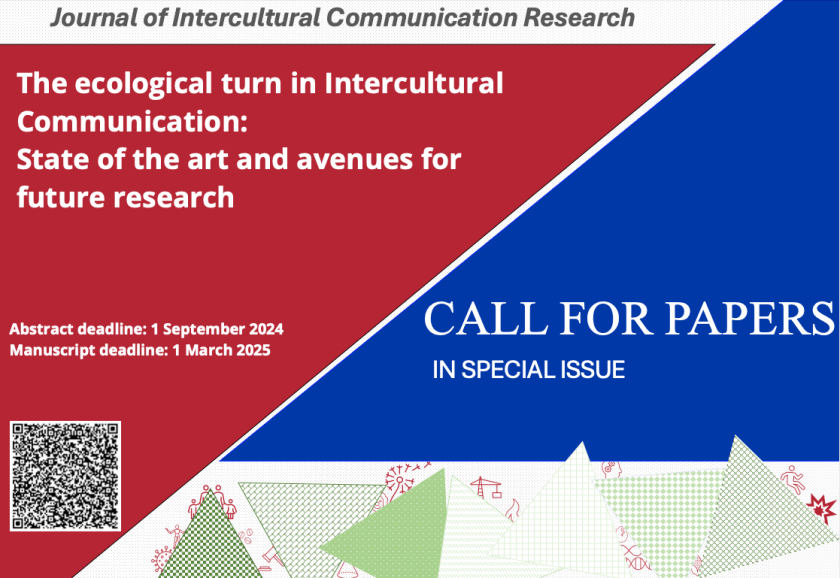
Call for papers for a special issue of the Journal of Intercultural Communication Research on The ecological turn in Intercultural Communication: State of the art and avenues for future research. Deadline: extended abstract, 1 September 2024.

Special issue editors:
Mélodine Sommier (University of Jyväskylä, Finland)
Diyako Rahmani (Massey University, New Zealand)
Alice Fanari (Northeastern University, USA)

Call for papers: Ecological Turn in Intercultural Communication

This special issue hopes to tease out and strengthen the connections between interculturality and ecology by showing what such a dual focus can bring to light. Specifically, the issue editors invite articles engaging with, but not limited to, the following questions and areas of inquiry:

  • How are notions and discourses about culture, identity, community, and borders constructed and mobilized to talk about the ecological collapse?
  • How can a dual focus on interculturality and ecology be used to renew the field of intercultural communication and some of its central concepts such as competence, dialogue or reflexivity?
  • How can a dual focus on interculturality and ecology be applied in research various contexts such as education (e.g. sustainability (language) education), interpersonal relationships (e.g. interspecies dialogue), mediated communication, health etc.?
  • How can the study of interculturality and ecology benefit from and contribute to other lines of work such as decolonial scholarship, environmental justice, pluriversality and post-humanism?
  • What methods and paradigms are particularly useful to explore the interplay between interculturality and ecology?
  • How can the ecological turn in intercultural communication be used to move the field away from the Euro-western-centric production of knowledge and give room to indigenous and marginalized academic voices?