Effective Student Dialogue

Intercultural Pedagogy

Jamison, I. (2016, November 16). Effective student dialogue: Critical thinking and active listening.

This is a webinar presented by Dr. Ian Jamison, Head of Education at Generation Global. The moderators are Scott Chua, a first year student at Yale-NUS College Singapore, and Hailey Lister, a first year student at Occidental College in Los Angeles, CA. It’s made available on edWeb.net, a network serving the global education community. The event is long over, but the webinar is still accessible. The topic suggests that it may be useful as a pedagogical tool in teaching about intercultural dialogue, given that listening is one component of dialogue.

CFP IADA 2020: Toward Culture(s) of Dialogue? (Poland)

ConferencesCall for papers: Towards Culture(s) of Dialogue? Communicating Unity in/and Diversity through Language and Discourse, 22-25 September 2020, Warsaw, Poland. Deadline: 29 February 2020.

Institute of Applied Linguistics, University of Warsaw, and the International Association for Dialogue Analysis (IADA) jointly invite submissions to the international conference on dialogue: “Towards Culture(s) of Dialogue? Communicating Unity in/and Diversity through Language and Discourse,” to be held in Warsaw, Poland, 22-25 September 2020.

Intercultural exchange and integration that are now observed in many regions of the world contribute to an ongoing merger of different fields of socio-political life. The aspirations for tighter and maturer trans-national/trans-regional cooperation, fostered by the focus on pluralistic and democratic procedures, are often paralleled with sustained or growing cultural divisions. They are manifest in various discourse-mediated acts of segregation, marginalization and exclusion. Despite the efforts at orderliness, lawfulness and partnership in the public realm, the latter frequently becomes an arena of communicative chaos, misunderstanding, violence and aggression. In the light of the growing cultural and interactive dissonance in different parts of the world, questions arise as to the role of linguistics, dialogue studies, discourse analysis as well as other related humanities in confronting the various forms of communicative antagonism that penetrates both public and private domains.

The aim of this conference is to approach the observed dynamics in global intercultural communication by tracing discourse strategies of modern institutions. Are there any alternatives to oppressive styles and exclusionary rhetoric, as well as to polarised and confrontational stances emerging from them in public and private spheres? Can the ‘closed’ interactive positions be transformed into substantial, efficient and constructive dialogue? How can the ‘unity’-oriented discourse activities compromise, dismiss or accommodate expressive ‘diversity’ in the interaction game? The above problems pose questions as to speakers’ critical language awareness, communicative competence and responsibility in selecting, rejecting, modifying and creating local and global discourse practices. Reflective choices and modelling of these strategies may be constitutive of ‘culture(s) of dialogue’.

Organizers invite linguists, discourse analysts,  sociologists, psychologists, political and media scientists, law experts, philosophers, anthropologists, culture mediators (translators, teachers, etc.), as well as other researchers from related disciplines to the multidisciplinary discussion of prospects and limits of mediating human culture(s) through dialogue.

KC24 Asiacentricity Translated into Japanese

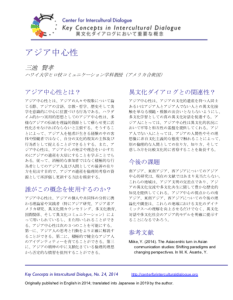
Key Concepts in ICDContinuing translations of Key Concepts in Intercultural Dialogue, today I am posting KC#24: Asiacentricity, which Yoshitaka Miike wrote for publication in English in 2014, and which he has now translated into Japanese.

As always, all Key Concepts are available as free PDFs; just click on the thumbnail to download. Lists of Key Concepts organized alphabetically by concept, chronologically by publication date and number, and by languages into which they have been translated, are available, as is a page of acknowledgments with the names of all authors, translators, and reviewers.

KC24 Asiacentricity_Japanese

Miike, Y. (2019). Asiacentricity [Japanese]. Key Concepts in Intercultural Dialogue, 24. Available from:
https://centerforinterculturaldialogue.org/wp-content/uploads/2019/10/kc24-asiacentricity_japanese-2.pdf

If you are interested in translating one of the Key Concepts, please contact me for approval first because dozens are currently in process. As always, if there is a concept you think should be written up as one of the Key Concepts, whether in English or any other language, propose it. If you are new to CID, please provide a brief resume. This opportunity is open to masters students and above, on the assumption that some familiarity with academic conventions generally, and discussion of intercultural dialogue specifically, are useful.

Wendy Leeds-Hurwitz, Director
Center for Intercultural Dialogue


Creative Commons License
This work is licensed under a Creative Commons Attribution-NonCommercial-NoDerivatives 4.0 International License.

St Louis U: New Media/Popular Culture (Spain)

“Job

Faculty in Communication Studies, Saint Louis University-Madrid Campus, Madrid, Spain. Deadline: December 15, 2019.

Saint Louis University is seeking applicants for a full-time (12-month renewable) faculty position in Communication Studies at the campus in Madrid, Spain. The successful candidate will hold a Ph.D. in Communication Studies specialized in new media, popular culture, and audience research. We seek a qualitative researcher trained in ethnographic methods. Candidates must have experience working with an international student population embedded within a culturally diverse educational environment. The candidate should have teaching experience in undergraduate education, and preferably be acquainted with the U.S. educational system of higher education. Teaching responsibilities include core courses such as Public Speaking, New Media & Society, Communication Theory, and upper-level courses such as Popular Culture and Digital Storytelling. In addition to these courses, the candidate should be able to expand our Communication curriculum with courses grounded in his or her area of expertise, including an advanced qualitative research methods course.

(NOTE: There is also a part-time position in Anthropology – follow the same link to see the description.)

IREX: Program Coordinators, Fulbright Exchanges (USA)

“Job

Program Coordinators, Fulbright Teacher Exchange Programs, IREX, Washington, DC. Deadline: none listed.

IREX has a position posted for Program Coordinators (PC) to support their Education practice in providing administrative support to the Fulbright Teacher Exchange Programs in the day-to-day administration of program activities including logistics, implementation of  initiatives, financial monitoring, and communicating with partner organizations. The PC supports events and management, reporting internally and externally.

NOTE: This position description has no date for when it was posted, or when it expires. If it is already filled, there are many other positions available at IREX, not only in the USA but internationally. IREX started as the International Research Exchange, about 50 years ago. Their current organizational description says: “IREX is a global development and education organization. We focus on people, not on vaccines, roads, or wells. We work in more than 100 countries on issues such as education, leadership, information, and youth.”