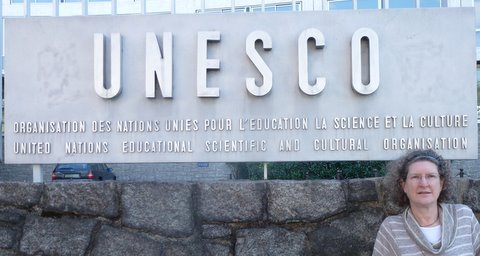
Museums for ICD

UNESCO launches the network of Museums for Intercultural Dialogue

The role of museums as messengers of peace and intercultural understanding cannot be overemphasised, as they stand as major attractions in our globalised world where millions of people travel for the discovery of other cultures.

UNESCO launches an appeal to the international museum community to join its network by contributing to the enrichment of its new on-line virtual museum for intercultural dialogue where invaluable objects and new narratives can be consulted, for the enjoyment of the public and a deeper understanding of the interconnectedness of historical actors, since the early times to present.

UNESCO Museums for Intercultural Dialogue EN | FR | AR

Inauguration of the pilot exhibition in Egypt and Syria (link)

World Heritage site museums project (link)

Contact: Nao Hayashi Denis

Media, Info Lit, ICD

UAC-MILID

UNESCO and UNAOC have created the UNESCO UNITWIN UNAOC Network of Universities on Media and Information Literacy and Intercultural Dialogue (“UAC-MILID”).

UAC-MILID specific objectives include:
*Act as a Observatory for critically analyzing: the role of Media and Information Literacy (“MIL”) as a catalyst for civic participation, democracy and development; for the promotion of free, independent and pluralistic media; as well as MIL’s contribution to the prevention and resolution of conflicts and intercultural tensions and polarizations.
*Enhance intercultural and cooperative research on MIL and the exchanges between universities and mass media, encouraging MIL’s initiatives towards respecting human rights and dignity and cultural diversity.
*Develop within the participant universities educational and media production practices that contribute to dissolving prejudice and intercultural barriers and favour global dialogue and cooperation among citizens as well as social and political institutions around the world. In addition to the international dimension, these practices will be reflected at the local level in the 8 cities or neighbourhoods in which the partner universities are located.
*Promote global actions relating to MIL (including adaptation of the UNESCO MIL Curriculum for Teacher Education and other relevant tools, publications, congresses, seminars, teaching resources, and faculty and students’ exchanges) that could contribute towards stimulating dialogue and understanding among people of and within different cultures and societies.
*Create a virtual centre to research on, and study and develop MIL initiatives aimed at the creation of projects and publications linking universities and research centres.
*Promote and support other global media initiatives that could reinforce civic participation through open, free and independent media and information systems that favour intercultural dialogue and cooperation.
*Encourage and support citizen participation as well as educational and cultural institutions whose initiatives promote media and information literacy, cooperation and intercultural dialogue.

UAC-MILID current universities include:
*The Autonomous University of Barcelona, Spain
*The University of Cairo, Egypt
*Tsinghua University, Beijing, China
*Temple University, Philadelphia, USA
*The University of Sao Paulo, Brazil
*Queensland University of Technology, Australia
*University of the West Indies, Kingston, Jamaica
*Mohamed Ben Abdellah University, Fez, Morocco

For information on UAC-MILID, please contact Jordi Torrent, torrent@un.org and/or see original post.

Fellowships for Japan

UNESCO/Keizo Obuchi Research Fellowships Programme for young researchers from developing countries- 2012

Study Subject(s): Environment (with particular emphasis on Water Sciences), intercultural dialogue, information and communication technologies, and peaceful conflict resolution.

Course Level: Research

Scholarship Provider: Japanese Funds-in-Trust

Scholarship can be taken at: Japan

Eligibility: Applicants, a maximum of TWO from each applying National Commission, must meet the following general criteria:
1. Candidates under this Programme must be post-graduate researchers, already holding either an M.A. or M.Sc. degree (or equivalent) and wishing to pursue research work abroad (preferably in their own region) with a view to enhancing knowledge in one of the four specific fields mentioned in paragraph D.1 below. Thus, those who are in the process of completing their Master’s degree must have completed it PRIOR to taking up their Fellowship.
2. Candidates must be persons of high intellectual promise who may be expected to make significant contributions to their country on return.
3. Candidates must be no more than 40 years of age. Thus, applicants born before 1 January 1972 will not be considered under the Programme.
4. The selected Fellow must carry out the research under the auspices of an academic supervisor in a host institution. Confirmation of acceptance from the academic supervisor is imperative.
5. Priority attention will be given to:
– Women candidatures
– Candidates from least developed countries (LDCs)
– Palestinian researchers
6. Candidates must be proficient in reading and writing the language of instruction in the proposed country of study/research.
7. Applicants must be in good health (both physically and mentally).

Scholarship Open for International Students: Yes

Scholarship Description: The UNESCO/Keizo Obuchi Research Fellowships Programme (UNESCO/Japan Young Researchers’ Fellowship Programme) funded under the Japanese Funds-in-Trust for the capacity-building of Human Resources will aim, in particular, to impact on capacity-building and research activities in the following areas: Environment (with particular attention to Water Sciences); Intercultural Dialogue; Information and Communication Technologies; and Peaceful conflict resolution. No other research topics will be considered.

How to Apply:  by Post

Scholarship Application Deadline: 13 January 2012

Further Scholarship Information and Application

World Forum on Intercultural Dialogue – Report

On April 7-9, 2011, the World Forum on Intercultural Dialogue was held in Baku, Azerbaijan. I gave a presentation entitled: “Dialogue about Dialogue: Taking a (Meta)Communication Perspective on the Role of Women in Intercultural Dialogue.” All presentations will be posted to the Forum site in the near future, and published in a proceedings volume.

The World Forum was supported by the UN Alliance of Civilizations, UNESCO, Council of Europe, North-South Center of the Council of Europe, ISESCO and Euronews. Building on several prior events, the Forum highlighted intercultural dialogue as one of the most pressing challenges that the global community faces today. The forum addressed conceptual, governmental, policy and practical aspects of intercultural dialogue, providing an opportunity for sharing good practices and making new connections. In addition, since the event was hosted by the President of Azerbaijan, we were all treated as guests of the state, and went everywhere with a security escort. Highlights were the formal entertainment and elaborate banquets on both Thursday and Friday evenings. Upon our arrival, we were given not only the usual conference program, small notebook and briefcase labeled with the conference information, but also dozens of brochures and a guidebook about Azerbaijan. When we returned from closing ceremonies, a gift package was waiting, with a small handmade carpet and hand-painted silk scarf (local craft specialties), a mug and local tea, as well as a bronze plaque noting our participation. In fact, there were so many presents that I mailed them back to the US rather than carry them around with me for the next several months.

The Forum was opened by the President of the Republic of Azerbaijan, His Excellency Mr. IIham Aliyev. The plenary panel on which I participated was “Women as Key Agents of Intercultural Dialogue.” This panel was co-chaired by Dr. Katérina Stenou (Director, Cultural Policy and Intercultural Dialogue, UNESCO, and member of this Center’s Advisory Board) and the First Lady of Azerbaijan, Ms. Mehriban Aliyeva (she is also President of the Heydar Aliyev Foundation, and UNESCO Goodwill Ambassador). Rapporteur for the panel was Ms. Pramila Patten (CEDAW expert). The other panelists were: Ms. Hijran Huseynova (Chairperson of the State Committee on Family, Women and Children Affairs, Azerbaijan); Ms. S.Y.Orlova (Deputy chair of Council of Parliament of Russian Federation), Ms. Rachida Dati (Mayor of the 7th arrondissement of Paris), Ms. Concepcion Olavarrieta (Chair of the Mexican Node of  the Millennium Project), Ms. Mbarka Bouaida (Member of Parliament, Morocco), and Mr. Alexander Ageev, (General Director of Institute of Economic Strategies, Department of Humanitarian Sciences, Russian Academy of Sciences, Russian Federation). Respondents to the panel included several ministers of culture, as well as Dr. Ruth Halperin-Kaddari (Director, The Ruth and Emanuel Rackman Center for the Advancement of Women’s Status, Bar-Ilan University, Israel), Dr. Bibi Bakare-Yusuf (publisher of Casava Republic Press, based in Abuja, Nigeria), and Ms. Natalia Molebatsi (performance poet and storyteller, based in South Africa).

The majority of the Forum’s participants were ministers of culture or other politicians (and I did meet a few, including Ms. Irina Cajal-Marin, Under Secretary of State for the Ministry of Culture in Romania, and Mr. Ali Elamin, Director of the Minister’s Office for Sudan). Others were CEOs of NGOs or non-profits (and among those I met were Ms. Wajiha Haris, President of Scheherazade, in Bucharest, Romania, Dr. Catherine Fieschi, Director of Counterpoint, just separated from the British Council, in London, Ms. Lila de Chaves, President of Heritage & Museums, in Athens, and Mr. Peter Gorgievski, CEO of Global Dialogue Foundation in Moonee Ponds, Australia). There were also a number of people connected to one of the international organizations co-sponsoring the event (I met several, including Mr. Hans d’Orville, Assistant Director-General for Strategic Planning of UNESCO in Paris, Dr. Liubava Moreva, Program Specialist for Culture in UNESCO’s Moscow office, and Ms. Neslihan Demirkol Sonmez, representing the Turkish National Commission for UNESCO; as well as Dr. Mir Asghar Husain, of the North-South Centre Think Tank for the Council of Europe). There were even a few other faculty present (I met Dr. Darla K. Deardorff, Executive Director of the Association  of International Education Administrators, based at Duke University in the US). And these are only some of those with whom I exchanged business cards – I am looking forward to continuing conversations with dozens of people as a result of the event.

Two other events occurred simultaneously with the Forum, an academic conference (“Traditions and prospects for intercultural dialogue in CIS countries: culture, education and communication”), as well as the first convention of the Global Youth Movement for the Alliance of Civilizations, and so I met some individuals from each of those events. For example, Ms. Emilia Katosang (Deputy Permanent Representative, Permanent Mission of Palau to the UN) and Ivaylo Stoimenov (a Bulgarian journalist) were both part of the GYM meeting; Prof. Samir Sleiman (cultural anthropologist in Lebanon, and Editor in Chief of Le Debat) presented at the academic conference. I also met several of the many international journalists covering the event, including Mr. Mohammad Malick, of The News, in Pakistan, and Mr. Ghassan Ali Osman, covering the event for Sudan. And, like most of the presenters, I was interviewed for Azerbaijani television. The audience was so large (600-1000, depending on whether participants of the 3 events overlapped at the same event or not), that two screens were used to ensure everyone could view the speakers. Look for images of Katérina Stenou on screen, and then being interviewed in the gallery included below.

Ms. Samaya Mammodova and Ms. Chinara Shakarova, two English majors studying in Baku, were assigned to help the dozen participants from the USA. Since I had a few hours free Saturday morning, after the conference concluded but before leaving for the airport, they took me on a personal tour of Icheri Shekhar (the old city in Baku). A few photos are below, for those who have not yet been to Baku themselves, along with photos of the conference.

My thanks to Katérina Stenou for my invitation to participate in this fascinating event. And thanks to Neslihan Demirkol Sonmez for 2 of the photos included below (the one of the dinner celebration, and 4 of us talking).

Euronews video coverage of the event is now available online. (I’m included, but as part of a conversational grouping, so look carefully!)

Wendy Leeds-Hurwitz
Director, Center for Intercultural Dialogue

This slideshow requires JavaScript.


World Forum on Intercultural Dialogue

The Government of Azerbaijan is organising a “World Forum on Intercultural Dialogue”, to be held in Baku from 7 to 9 April 2011. The initiative has the support of the Council of Europe, including the North-South Centre, UNESCO, the UN Alliance of Civilizations and ISESCO. Building on previous events on this theme held in the Azerbaijani capital – known as the “Baku process” – and on the corpus of work developed by the stakeholder organisations in recent years, the Forum highlights the fact that intercultural dialogue is one of the most pressing challenges in the world today.

The Forum will address the conceptual, governance, policy and practical aspects of the challenge of intercultural dialogue. It will tackle issues such as the barriers to dialogue and the diverse contexts in which it can be pursued. It will also provide an opportunity to share good practice and launch new initiatives. A wide range of practitioners and experts in the field of culture will attend the Forum, from global leaders and public figures to prominent intellectuals and activists. The synergy between political leaders and officials, experts and practitioners will be encouraged by the scope for informal networking organised around the event.”

(Original from http://www.coe.int/t/dg4/cultureheritage/culture/CDCULT/Newsletter/newsletter2_en.asp)

Journalism – conflict sensitive reporting

“A total of 18 journalists, drawn from the 10 states of South Sudan have embarked on a four-day intensive training organised by United Nations Educational, Scientific and Cultural Organization (UNESCO) in the South Sudan capital, Juba.

JPEG - 47.9 kb
Margaret Jjuko, a media consultant conducting the UNESCO-organised training in Juba, South Sudan, Feb 14, 2011 (ST)

The training on conflict-sensitive reporting, according to the organisers, seeks to equip media practitioners with specific skills and techniques regarded as essential in analysing conflict and post-conflict related issues in the semi-autonomous region.

post-conflict countries.

“Over the years, it has been UNESCO’s mandate to support journalists dealing with conflict and post-conflict issues. This may also focus on re-building the various media institutions,” Lukosiunas told Sudan Tribune during an interview at Beijing hotel.”

For further information, see the original article in the Sudan Tribune.

Fellowships to Japan

UNESCO/Japan Young Researchers’ Fellowships Programme (UNESCO/Keizo Obuchi Research Fellowships Programme)

“Reinforcing its belief in “people building the next era”, the Government of Japan offers 20 fellowships per year, for the eleventh consecutive year, to be awarded to deserving candidates from developing countries, especially the least developed countries (LDCs), who are eager to undertake research on one or more of the topics listed below. The aim of the fellowships is to support innovative and imaginative post-graduate research in four areas of development of particular interest to UNESCO. (Deadline for the submission of applications: 7 January 2011.”

Intercultural dialogue is one of 4 specific topics solicited; Peaceful conflict resolution is another.

For details, see the UNESCO site.

Rapprochement of Cultures

2010 was declared to be the International  Year of Rapprochement of Cultures by the United Nations. The following themes were identified:

1. promoting reciprocal knowledge of cultural, ethnic, linguistic and religious diversity;
2. building a framework for commonly shared values;
3.strengthening quality education and the building of intercultural competences; and
4. fostering dialogue for sustainable development.

800 activities have been developed to support these goals.

See the UNESCO website created for the Year for the Rapprochement of Cultures for further details.