Nanzan U job ad

[This is an unofficial English summary prepared from the official Japanese announcement. Please refer to the official Japanese version for clarifications.]

Position Announcement for Specialist in Communication Studies
The Department of British and American Studies, Faculty of Foreign Studies at Nanzan University invites applications for a full-time Assistant Professor/Associate Professor in Communication Studies position as follows.

Job Title: Assistant Professor or Associate Professor
Appointment to: Department of British and American Studies, Faculty of Foreign Studies
Courses to be taught: “Political Communication” and/or “Interpersonal Communication,” “Introduction to Communication Studies,” “Special Topics in Communication Studies,” “Seminar,” and other courses including departmental English language courses and university-wide general courses
Areas of Specialization: Communication Studies
Starting Date of Appointment: 1 April 2014

Minimum Qualifications:
1. The candidate must hold a doctoral degree (PhD) in Communication Studies or related areas as of the time of appointment.
2. The candidate must be able to teach Communication Studies within the framework of British and American Studies.
3. The candidate must be able to teach Communication Studies in English and Japanese.
4. As a regular faculty member, the candidate must be willing and able to assume those non-academic administrative duties normally undertaken by faculty members.
5. Japanese citizenship is NOT a prerequisite. However, the candidate must possess sufficient Japanese skills to fulfill all administrative duties normally undertaken by staff members.
6. After hiring, the candidate must reside in an area within reasonable commuting distance of Nanzan University’s Nagoya Campus.

Application Deadline: 30 June 2013 (All documents must be received by this date.)

Required Documents:
1. Curriculum vitae—Applicant’s education and employment history should be clearly noted.
2. List of published research (papers, books, and monographs, including the MA and PhD theses) and a summary of teaching achievements.
3. Abstract of each publication listed in 2 above. (Approximately 400 characters in Japanese.)
4. Offprints or copies of the three most recent major publications. (In the list of publications, please indicate these with a circle.)
5. Proof of the highest academic degree achieved (Copy of diploma or certificate is acceptable. Please do not send original as documents cannot be returned), or a document indicating the clear prospect of acquiring PhD by the time of appointment (free format).
6. One letter of recommendation. (The relationship between the applicant and referee must be made clear in the reference. Please submit in a sealed envelope.)
Applicants who pass the document screening will be invited to come to Nanzan University for an interview at their own expense. They may be asked to demonstrate their teaching ability at the interview.

Letter of application and accompanying documents should be submitted to:
Communication Studies Position Search Committee
Department of British and American Studies
Office of the Faculty of Foreign Studies
Nanzan University
18 Yamazato-cho, Showa-ku, Nagoya 466-8673 Japan

For further inquiries, please contact:
Professor William F. PURCELL, Chair
Department of British and American Studies
E-mail: purcell AT nanzan-u.ac.jp

Notes:
1. Please note that all submitted documents cannot be returned. Please do not send originals of diplomas, certificates, or documents which cannot be replaced. Originals of papers, books, and monographs will be returned after the final screening.
2. All personal information provided on the application will be handled with utmost care in accordance with university privacy regulations. The information will not be used for any purpose other than screening candidates for the position.
3. In the case of foreign nationals (excluding those with Special Permanent Resident status) employment will begin with a two-year contract, renewable at the mutual agreement of both parties. During the third year of employment, if both parties agree, renewal from the fifth year can include an unlimited term contract (i.e. tenure).

Save

Japan tour 2013

The Committee for International Discussion and Debate (CIDD) of the National Communication Association (NCA) seeks applicants for the 2013 Japan Tour.

Approximate Dates of Travel: Early June to Early July 2013

Eligibility: Any past or present forensic participant who is under 25 and is a full time undergraduate in good standing (juniors and seniors preferred), or who has received an undergraduate degree but is no older than 25, is eligible.  We encourage applications from students active in all forms of forensics, including Lincoln-Douglas debate, team policy debate, parliamentary debate, and individual events.  Students who apply should have (or plan to obtain) a valid current passport.

Evaluation: Students will be evaluated on the basis of their debating skills and their ability to teach debate basics.  Knowledge of political, social, and cultural conditions around the globe is a must.  Students’ ability to represent the United States and American forensics (in all its forms) accurately, effectively, and professionally is a strong consideration.  The ability to educate students about the style and substance of debate in the United States is an important component of the tour.  Personal diplomatic skills are a must.

Tryouts:  Applicants will be notified of their status as finalists by early April. The application process will include a round of phone interviews and a second round of video tryouts in which applicants will showcase their debate skills.

How to Apply: If you are interested in trying out for the tour, send the following by no later than March 22, 2013.

1.  A letter of interest
2.  A copy of your college transcript
3.  Two letters of recommendation that address your skills in debate, your professionalism, and diplomatic skills.  (It is preferable, though not required, that one letter should be from someone other than your debate/forensics coach and focus on aspects of professionalism, diplomacy, presentation, and/or knowledge of the political, social, and cultural traditions of the region.) Please have your letter writers send their letters to nca.cidd AT gmail.com with your last name and “2013 Japan tour” in the email subject line.
4.  A current resume
5.  Contact information (including phone and e-mail address)
Send all application materials to nca.cidd AT gmail.com. Materials received after March 22 will not be considered.

Carly S. Woods, Ph.D.
Assistant Professor, Communication Studies and Women’s & Gender Studies
University of Nebraska-Lincoln
Email: cwoods3 AT unl.edu

Fellowships for Japan

UNESCO/Keizo Obuchi Research Fellowships Programme for young researchers from developing countries- 2012

Study Subject(s): Environment (with particular emphasis on Water Sciences), intercultural dialogue, information and communication technologies, and peaceful conflict resolution.

Course Level: Research

Scholarship Provider: Japanese Funds-in-Trust

Scholarship can be taken at: Japan

Eligibility: Applicants, a maximum of TWO from each applying National Commission, must meet the following general criteria:
1. Candidates under this Programme must be post-graduate researchers, already holding either an M.A. or M.Sc. degree (or equivalent) and wishing to pursue research work abroad (preferably in their own region) with a view to enhancing knowledge in one of the four specific fields mentioned in paragraph D.1 below. Thus, those who are in the process of completing their Master’s degree must have completed it PRIOR to taking up their Fellowship.
2. Candidates must be persons of high intellectual promise who may be expected to make significant contributions to their country on return.
3. Candidates must be no more than 40 years of age. Thus, applicants born before 1 January 1972 will not be considered under the Programme.
4. The selected Fellow must carry out the research under the auspices of an academic supervisor in a host institution. Confirmation of acceptance from the academic supervisor is imperative.
5. Priority attention will be given to:
– Women candidatures
– Candidates from least developed countries (LDCs)
– Palestinian researchers
6. Candidates must be proficient in reading and writing the language of instruction in the proposed country of study/research.
7. Applicants must be in good health (both physically and mentally).

Scholarship Open for International Students: Yes

Scholarship Description: The UNESCO/Keizo Obuchi Research Fellowships Programme (UNESCO/Japan Young Researchers’ Fellowship Programme) funded under the Japanese Funds-in-Trust for the capacity-building of Human Resources will aim, in particular, to impact on capacity-building and research activities in the following areas: Environment (with particular attention to Water Sciences); Intercultural Dialogue; Information and Communication Technologies; and Peaceful conflict resolution. No other research topics will be considered.

How to Apply:  by Post

Scholarship Application Deadline: 13 January 2012

Further Scholarship Information and Application

University of the Ryukyus

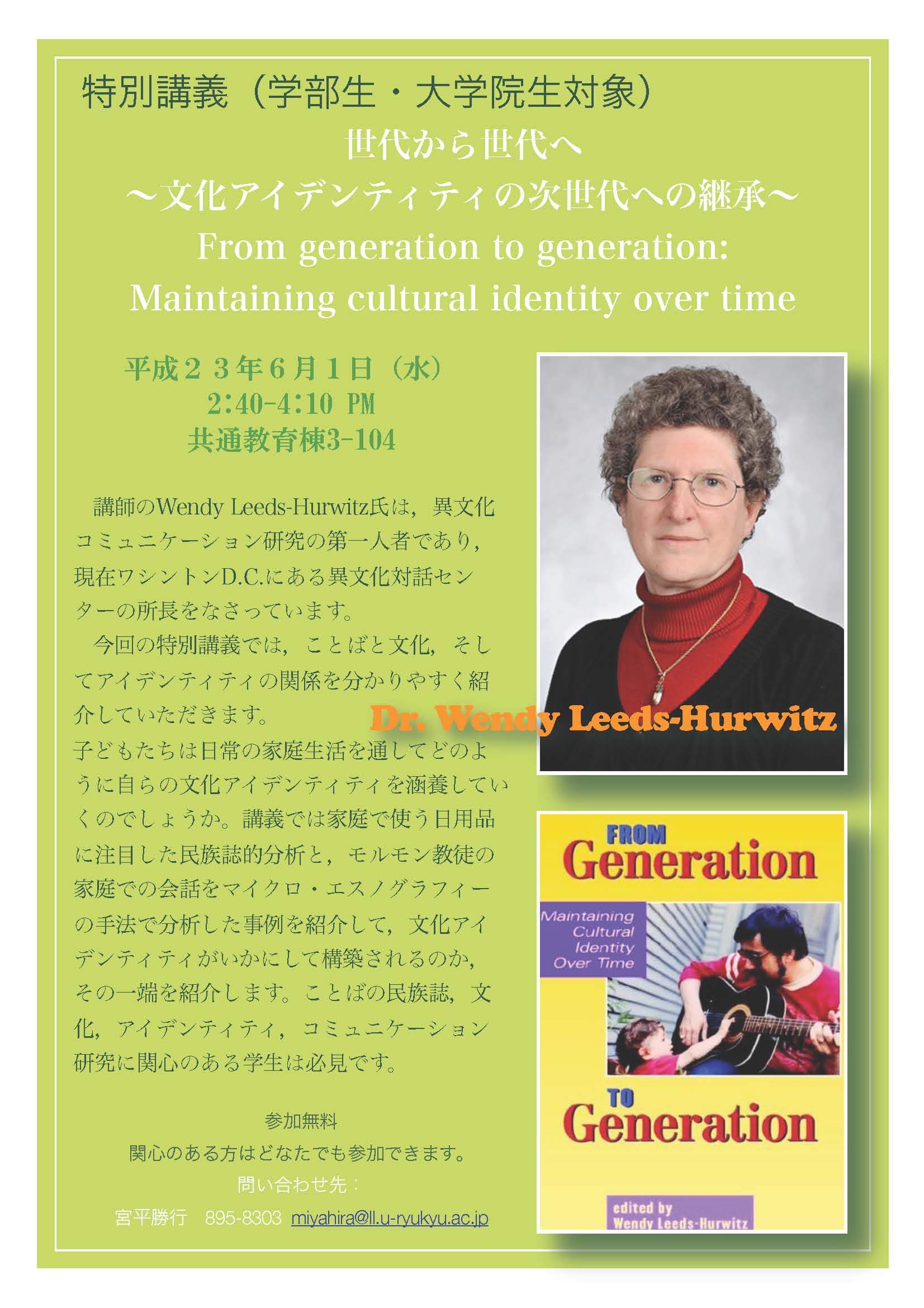
On June 1, 2011 I presented a talk to a large group of mostly students, entitled “From Generation to Generation: Maintaining Cultural Identity over Time” at the University of the Ryukyus, Okinawa, Japan.

Jue 1 Ryukyus

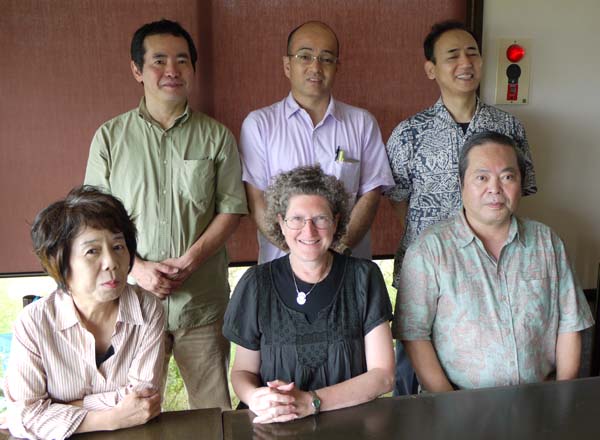
On June 2, 2011 I presented a faculty workshop entitled “Writing the Social History of Language and Social Interaction Research.” Before this event we had a faculty lunch at a local restaurant, where my husband and I were introduced to traditional Okinawan delicacies. Pictured below are (back row): Professors Madoka Kanemoto, Katsuyuki Miyahira, Kenji Yoshida and (front row): Professor Hiroko Onaha, me and Professor Yasusada Uechi , all of the Department of Languages and Cultures at the University of the Ryukyus.

Faculty lunch at University of the Ryukyus

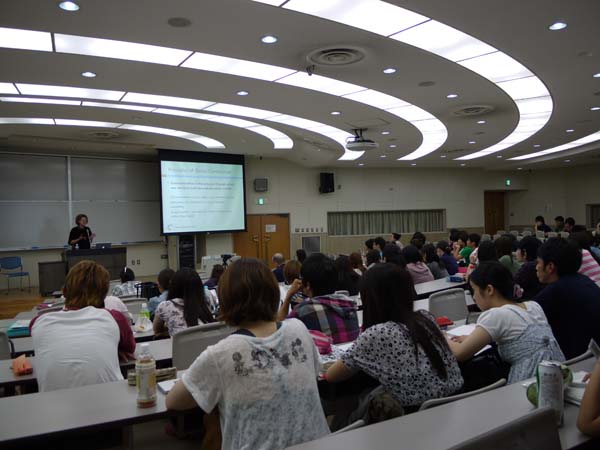
Then, on June 3, 2011 I presented a talk to faculty (although many students also attended), co-sponsored by the Okinawa Society for Foreign Language and Literature, entitled “Socially Constructing Communication.” My thanks to Prof. Yasusada Uechi , President of the Society, for serving as the connection to the group, and to Prof. Masuo Kataoka, Vice President, for making the introduction on behalf of the Society.

University of Ryukyus

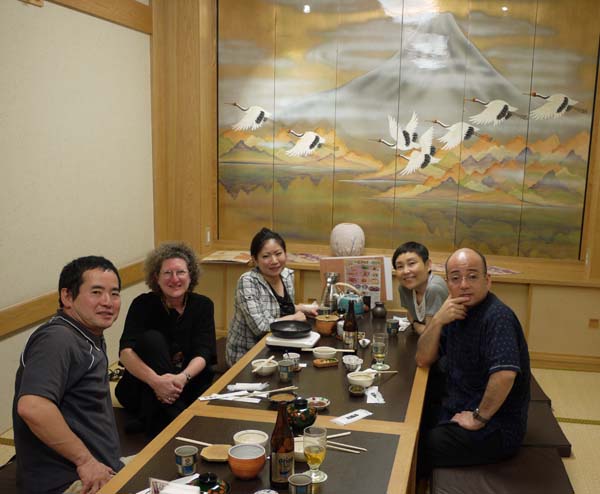
After the talk we had a faculty dinner, including Professors Madoka Kanemoto, Miki Shibata, and Katsuyuki Miyahira, as well as one student representative, Nina Arakaki.

Faculty dinner at U Ryukyus

My thanks to Prof. Katsuyuki Miyahira for organizing all of these events, for inviting my husband and me to his home for dinner with his wife, Yaeko, and son, Yuta, and for the extended day exploring Okinawa, including Ryukyu-mura and the Okinawa Churaumi Aquarium.

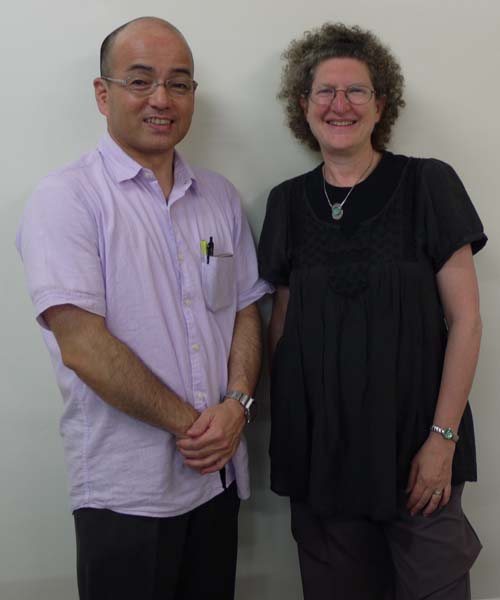
Prof Miyahira, Prof Leeds-Hurwitz

Thanks are also due to Prof. Madoka Kanemoto for a tour on a different day to Shikinaen Royal Garden and Shurijo Castle, both of which are UNESCO World Heritage sites. And to multiple graduate students: Samantha May and Yuko Naka for their guidance to local fabrics and shopping opportunities, and Yuta and Charlie for the airport runs.

Okinawa was the last stop in Asia, and it was a delightful ending. I look forward to continued conversations with many of the faculty and students I met there.

Wendy Leeds-Hurwitz
Director, Center for Intercultural Dialogue

Aoyama Gakuin University

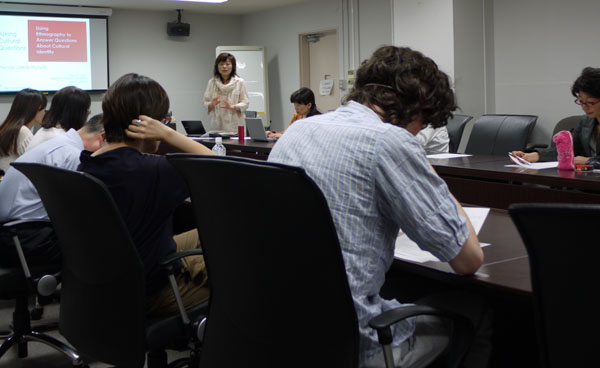
On May 21, 2011 I gave a talk entitled “Asking Cultural Questions: Using Ethnography to Answer Questions about Cultural Identity” to the Department of International Communication, of the School of International Politics, Economics and Communication, at Aoyama Gakuin University in Tokyo, Japan.

Prof KaKai's introduction

My thanks to Prof. Hisako KaKai  and Prof. Kiyoko Sueda, who were the hosts and organizers of the event.

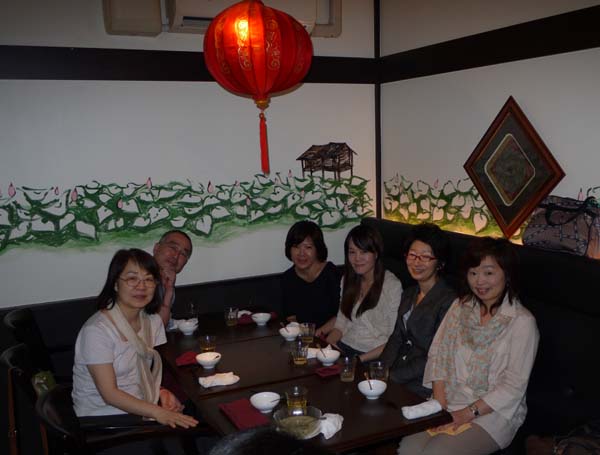
After the talk we were treated to an excellent Vietnamese dinner, well attended by many of the graduate students from the presentation as well as the faculty listed above. To all the graduate students I promised to send citations: I really did mean it, so do send me an email as followup!

Wendy Leeds-Hurwitz
Director, Center for Intercultural Dialogue

Fellowships to Japan

UNESCO/Japan Young Researchers’ Fellowships Programme (UNESCO/Keizo Obuchi Research Fellowships Programme)

“Reinforcing its belief in “people building the next era”, the Government of Japan offers 20 fellowships per year, for the eleventh consecutive year, to be awarded to deserving candidates from developing countries, especially the least developed countries (LDCs), who are eager to undertake research on one or more of the topics listed below. The aim of the fellowships is to support innovative and imaginative post-graduate research in four areas of development of particular interest to UNESCO. (Deadline for the submission of applications: 7 January 2011.”

Intercultural dialogue is one of 4 specific topics solicited; Peaceful conflict resolution is another.

For details, see the UNESCO site.