They are conducting a brief 5-10-minute survey on international students’ experiences in U.S. academia and are seeking participants. Participation is voluntary. Participation Criteria: To participate, individuals must meet the following criteria:
Be an international student.
Be at least 18 years old.
Be enrolled in at least one semester in a U.S. institution of higher education.
Currently reside in the United States.
If you meet these criteria and are interested in responding to the survey, here is a link to the study.
Communications Manager, UK Council for International Student Affairs, London, UK. Deadline: 5 February 2024.
The Communications Manager leads on the delivery of UKCISA’s communications to members, international students, and other stakeholders, across the UKCISA and #WeAreInternational brands. This role is responsible for delivering, shaping and evaluating a communications strategy for the organisation and increasing engagement with key audiences. Additionally, this role will work closely with colleagues across the organisation to ensure consistent branding and communications across UKCISA’s outputs and services. Core responsibilities include: Digital and social media, Website content, Brand, and Marketing.
Loughborough University is looking for an international student experience officer to join their growing International Student Experience team, whose focus is to ensure a sector-leading experience for international students at Loughborough University. This role will provide innovative and creative project support to the team and will work with colleagues across the University to ensure a positive transition and experience for international students.
This is a fantastic opportunity for an individual with a strong background in project and events management and a passion to support the international student experience and help them to feel at home. Applicants should have an understanding of working interculturally as well experience of working with a wide range of stakeholders to ensure successful outcomes of projects.
The Head of International Recruitment provides leadership in all dimensions of University of Portsmouth Global’s international recruitment activity. This includes the nurturing and management of the international recruitment team; the full recruitment life cycle through market prioritisation, acquisition strategies, management of channels, delivery of enquiry and conversion activity, marketing and efficient admissions in partnership with the Head of Global Admissions and the Global Marketing Manager.
The position is responsible for developing and implementing international recruitment and associated marketing strategies, evaluating effectiveness of the strategies and ensuring appropriate market diversification, and for driving UoP Global’s international student recruitment planning process with relevant internal and external stakeholders in order to set and subsequently deliver on targets. The role will require collaborative working, engaging with the Academic departments, central service areas, UoP Global’s agent network and partners, to ensure that the international student recruitment activities are effectively coordinated and delivered, and aligned with the University strategy. The role is expected to manage resources effectively and efficiently, and with a view to maintain quality in service levels and provision.
From All Corners, International House, University of California, Berkeley, CA. Available on Apple Podcast, Google Podcast, and Spotify.
From UC Berkeley’s I-House comes the storytelling podcast From All Corners. Featuring an array of I-House residents, the project was born of the notion that powerful stories can inspire intercultural learning and make friends out of strangers. Each episode is a jolt of empathy—spotlighting true stories about the people we meet, the heartbreaks we suffer, the lessons we learn, those frightful experiences that unravel us, and the moments of wonder that shape us.
Six episodes were produced between September 2019 and February 2020. Due to Covid, in March 2020, the podcast narrowed to a series entitled Under the Dome ” to help us feel the community of being under the I-House Dome — even if we’re now in different places across the globe.” Another 17 episodes were produced through May 2020, at which point the series ended.
“This role will lead on the development and delivery of the Pre-sessional Orientation (supporting the Pre-sessional Programmes) including management of the Student Support team order to ensure the provision of appropriate pastoral support for all pre-sessional students. The role will also work proactively with relevant colleagues across the institution to enhance support for international student induction, transition, engagement and overall experience. In addition, the postholder will be required to develop and deliver some English language support.
The successful candidate will have strong interpersonal skills with a high level of intercultural awareness in order to support international students’ adaptation to a UK university and in collaboration with relevant colleagues. You should be a graduate with substantial experience of providing support for international students, preferably within an HE context as well as having significant experience of planning, coordinating and delivering events and/or projects. You will also hold an English language teaching qualification and have experience of teaching English to speakers of other languages. You must be fluent in English, both written and oral, and have excellent IT skills.”
Study Group is a global pathway provider in International Education. The University of Surrey International Study Centre is a fast-growing centre with a strong record of excellent student outcomes and outstanding staff satisfaction. This is a senior leadership role that reports directly to the Centre Director. The role will take the lead on the provision of a Student Experience Team, enabling students to thrive and study legally, safely and successfully. Through the team, the role ensures UKVI compliance in visa and attendance systems, key quality assurance and enhancement activities are carried out according to Study Group, university partner and regulatory body requirements. The role also oversees the team responsible for the implementation of a progression support and personal tutorage strategy with the purpose of ensuring students are fully supported to maximize student outcomes and satisfaction levels.
The Director for International Students (the “Director”) provides strategic leadership and policy development related to international students and scholars as part of the OIS leadership team. This person is responsible for ensuring compliance with all Department of Homeland Security, Student and Exchange Visitor Program, and Department of State regulations related to international students and scholars, and possessing general knowledge of other government agency rules that are applicable to the JHU international population (e.g., SSA, MVA, etc.).
Collaboration request from Ioana Cionea, at the University of Oklahoma: Participants needed for study on international students’ communication with host nationals
“We are currently conducting a longitudinal study in which we examine the factors that affect international students’ communication with host nationals. If you are an incoming international student (i.e., first semester in the United States) or if you know such students that you could forward this message to, we would appreciate your help with completing an online survey.
The survey has demographic questions, questions about expected communicate with host nationals, and anticipated experiences. Participation is completely voluntary. At the end of the survey, participants can enter a raffle to win Amazon gift cards.
If you have any questions or concerns about the research project you may contact any of the researchers on the team in the Department of Communication at The University of Oklahoma, an equal opportunity institution.”
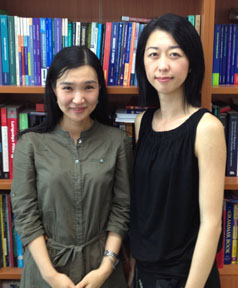
In May 2013, with support from a Center for Intercultural Dialogue micro grant funded by the National Communication Association, I traveled to Seoul, South Korea, to meet with Dr. Eun Sung Park of Sogang University. We are both applied linguists, though we have different research concerns: my interests lie at the interface of language and social interaction while Dr. Park’s work has centered on cognitive aspects of second language acquisition. However, given our professional roles in working with TESOL (Teaching English to Speakers of Other Languages) teachers, we share common interests in second language teaching and learning, and how to effectively educate teachers in both theory and practice. I am currently the Acting Director of TESOL at the University of Pennsylvania’s Graduate School of Education. Dr. Park is an Associate Professor of TESOL/Applied Linguistics and Director of the General English Education Program at Sogang. Although we had corresponded briefly via email about the possibility of working together, we had not previously had the opportunity to engage in an extended discussion. I envisaged our conversation to be an exploratory step to examine an issue that has been of particular interest to me over the past few years: how well do Master’s TESOL (Teaching English as a Second Language) programs prepare international students to teach in classrooms in their home countries that may be very different from those experienced via study and fieldwork in their graduate programs?
My preparations for the trip were fairly smooth. While the micro grant did not quite cover the entire airfare to Seoul, I was fortunate to able to fund the remainder through my faculty conference/travel fund. One of the more difficult aspects of preparation was to find a suitable time to travel given my teaching responsibilities and the fact that I wanted to be able to meet with Dr. Park while her university was still in session. By planning several months in advance, I was able to schedule my summer teaching to fit in with my plans to travel as soon as my spring semester had finished. This also gave me time to track airfares to ensure I found the best price possible (I used a tracking and notification tool available on Kayak).
Dr. Park was very generous with her time while I was visiting. We had broad and informative discussions, ranging from the teacher training and credentialing process in South Korea and the changing environment of English teaching there in terms of a greater emphasis on oral skills, to the career paths of graduates who have studied overseas and returned to Korea. Very interestingly, Dr. Park described how, in her experience, native English speaking teachers are perceived by students at her university to be better teachers than non-native English speaking teachers, but how more often than not, it is the non-native English speaking teachers who receive better student evaluations. This particular theme was not one that I had initially considered, but we brainstormed on the various ways we might go forward with this idea, including accessing and analyzing the available data, and we will follow up our discussion on email and hopefully arrange a meeting at a conference in the United States next year.
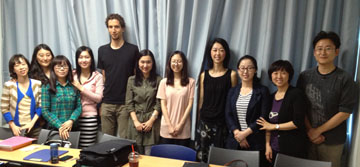
During my time in Seoul, two opportunities arose that I had not originally planned for. Firstly, Dr. Park arranged for me to observe a graduate class she was teaching, ENG 6217: Second Language Acquisition. The class was conducted in English as the program has a number of overseas students. Dr. Park asked me to speak to the students about studying in the United States and to answer questions about applying to doctoral programs there. I enjoyed this experience as it enabled me to engaged directly with the students (and to do some promotion of my home institution’s program!)
Dr. Wagner with students
Secondly, I was also able to meet with a former graduate student from my home institution who was teaching English at Sogang. Our conversation was particularly beneficial as we talked about her experience of a TESOL Master’s program in the US and how it had prepared her for teaching in Korea. Two rather surprising issues arose. One was the unrealistic expectation held by international students on entering the Masters program with regards to the ease of finding a good teaching position in their home country after they complete their degree. The other related issue was the perception of the most significant benefit from obtaining the degree. Rather than improving one’s pedagogy or knowledge about teaching, as I might have posited, the former student pointed to the increase in her authority that stemmed from her students’ knowledge of her educational background. Although my methodology in my original project proposal is centered on the micro-analytic examination of classroom interaction, this meeting underlined the usefulness of such conversations in generating ideas and developing possible themes for further inquiry.
I am deeply appreciative of the time I spent in Seoul, and for the NCA micro grant that enabled me to make such a trip. Although I initially had formulated quite firm proposal ideas, the conversations I had were extremely valuable in opening up my perspective about the possible and effective ways to further my research goals, and possibly expand them to encompass new directions for my work. I feel that the grant’s support of “participation in intercultural dialogue through academic interactions” is especially important in the exploratory stage of research. Dr. Park and I are not in the same sub-fields of our discipline, and so this type of in-depth conversation might be less likely to happen through regular conference or peer contacts. Phone, email, or even video-conferencing would have been poor substitutes for this type of exploratory discussion: I am grateful for the opportunity to meet potential collaborators in person, engage in face-to-face interaction, and establish productive professional relationships.
[NOTE: Santoi Wagner’s original project proposal is available here.]




 Center for Intercultural Dialogue