
 Ali Karakas has a B.A. in English Language Teaching from Uludag University, and took MA courses at Hacettepe University, Turkey. He is also a member of academic staff in the ELT department of Mehmet Akif Ersoy University, which has sponsored his current PhD project at Southampton University, UK.
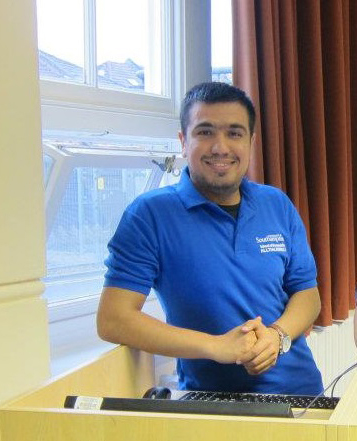
Currently, he is based in Southampton and working towards completing his PhD research, entitled ‘Turkish Lecturers’ and Students’ Perceptions of English in English-Medium Universities’. He is a member of several research centers and groups, such as Centre for Global Englishes (CGE), English Language Teacher Education Research (ELTER) and English as Lingua Franca Research Network (ELF-Ren). His research interests primarily include English as a Lingua Franca, Language Policies, Language Attitudes and Ideologies, Language Teacher Education and Intercultural Communication. He has presented papers and published articles in various journals and magazines on topics of his research interests.
More information on his research and publications can be obtained from his academic homepage: http://abs.mehmetakif.edu.tr/akarakas
Selected Publications
Articles
Karakaş, A. & Karaca, G. (2011). Use And Importance Of Illustration As Materials In Foreign Language Teaching. Balıkesir University. The Journal of Social Sciences Institute, 14(26), 351-357.
Karakaş, A. & Karaca, G. (2011). Yabancı Dil Öğretiminde Resmin Materyal Olarak Kullanımı ve Önemi. Yaşadıkça Eğitim Dergisi. Sayı 110, Nisan-Mayıs-Haziran, s. 14-19.
Karakaş, A. & Sarıçoban, A. (2012). The Impact of Watching Subtitled Animated Cartoons on Incidental Vocabulary Learning of ELT Students. The Journal of Teaching English with Technology, 12(4), 3-15.
Karakaş, A. (2011). Motivational Attitudes of ELT Students towards Using Computers for Writing and Communication. The Journal of Teaching English with Technology, 11(3), 37-53.
Karakaş, A. (2012). English as a Lingua Franca: Practices of Academics in a Turkish University. Uşak Üniversitesi Sosyal Bilimler Dergisi, 5(3), 160-179.
Karakaş, A. (2012). Evaluation of the English Language Teacher Education Program in Turkey. ELT Weekly Newsletter, 4(15).
Karakaş, A. (2012). Foreign Accent Problem of Non-native Teachers of English. Humanising Language Teaching, 14(5).
Karakaş, A. (2012). How to cope with Speaking Anxiety in EFL Classrooms. ELT Weekly Newsletter, 4(28).
Karakaş, A. (2013). Intercultural Attitudes of Turkish Students Studying in a UK University. Journal of Intercultural Communication, 31.
Karakaş, A. (2013). Is Communicative Language Teaching a Panacea in ELT? – Student and Teacher Perspectives. Journal of Second and Multiple Language Acquisition, 1(1), 1-19.
Karakaş, A. (2013). The Expansion of the English Language across Turkey: Threat or Opportunity. Mediterranean Journal of Humanities, 3(2), 159-171. DOI: 10.13114/MJH/201322477
Karakaş, A. (2014). Lecturers’ Perceptions of Their English Abilities and Language Use in English-Medium Universities. International Journal on New Trends in Education and Their Implications, 5(2), 114-125.
Karakaş, A. (2015). Orientations towards English among English-medium Instruction Students. Englishes in Practice, 2(1), 1-38. DOI 10.1515/eip-2015-0001
Korumaz, M. & Karakaş, A. (2014). An Investigation of English Language Instructors’ Attitudes towards Reflective Teaching. Pegem Journal of Education & Instruction, 4(1), 27-46. DOI: 10.14527/pegegog.2014.001
Work for CID:
Ali Karakas wrote KC66: English Medium Instruction, and translated it into Turkish.
 Center for Intercultural Dialogue