CFP: Civitates: Civil Space in Europe

GrantsCall for proposals: Civic Power: Protecting and Expanding Civic Space in Europe, Civitates, Brussels, Belgium. Deadline: 18 August 2024.

Civic Power – Anchor Grantees (Slovakia, Romania, Bulgaria, Hungary, Poland, and France). Civitates envisions democracy in Europe being strengthened by an independent civil society powered with the resources, constituencies and capabilities to protect and expand civic space and mobilise support for democratic principles, particularly at moments of emerging opportunity and threat.

Therefore, Civitates announces a call for proposals open to civil society organisations registered in Slovakia, Romania, Bulgaria, Hungary, Poland, and France. With this call Civitates aims to build the readiness and power of civil society in the selected European Union countries to protect and expand civic and democratic space, particularly at key social and political moments. Civitates seeks to support civil society to anticipate transformative moments which present opportunities and threats for civic space and enable it to develop and implement strategies to address these. Civitates sees a need to support civil society to build the capabilities needed to meet such opportunities. This can help broader civil society to understand the emerging threats to their space but also enable coalitions in countries where that threat has already clearly manifested to prepare for social and political events that help them to push back against the trend.

Civitates would be looking to support at least one anchor group in each country to lead this work. Anchor grantee will be given flexible, core support up to 120,000 EUR over two years.

KC30 Critical Intercultural Communication Translated into German

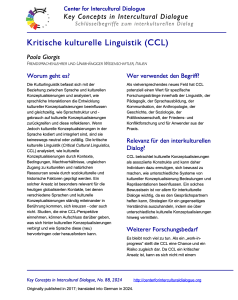
Key Concepts in ICDContinuing translations of Key Concepts in Intercultural Dialogue, today I am posting KC#30: Critical Intercultural Communication, which Rona Tamiko Halualani wrote for publication in English in 2014, and which Marlena Pompino has now translated into German.

As always, all Key Concepts are available as free PDFs; just click on the thumbnail to download. Lists of Key Concepts organized chronologically by publication date and number, alphabetically by concept, and by languages into which they have been translated, are available, as is a page of acknowledgments with the names of all authors, translators, and reviewers.

KC30 Critical Intercultural Communication in GermanHalualani, R. T. (2024). Kritische interkulturelle Kommunikation. (M. Pompino, trans). Key Concepts in Intercultural Dialogue, 30. Retrieved from: https://centerforinterculturaldialogue.org/wp-content/uploads/2024/06/kc30-critical-intercultural-communication-_german.pdf

If you are interested in translating one of the Key Concepts, please contact me for approval first because dozens are currently in process. As always, if there is a concept you think should be written up as one of the Key Concepts, whether in English or any other language, propose it. If you are new to CID, please provide a brief resume. This opportunity is open to masters students and above, on the assumption that some familiarity with academic conventions generally, and discussion of intercultural dialogue specifically, are useful.

Wendy Leeds-Hurwitz, Director
Center for Intercultural Dialogue


Creative Commons License
This work is licensed under a Creative Commons Attribution-NonCommercial-NoDerivatives 4.0 International License.

Debate Spaces: Debate Program Director (USA)

“JobDebate Program Director, Debate Spaces, New York, NY, USA (hybrid). Deadline: 5 July 2024.

Based in New York City, the Program Director will serve two complementary roles: establishing debate teams at local partner schools while expanding and improving virtual programs for the international debate community. Success will require a Program Director who brings a passion for the organization’s mission and an ability to grow and improve debate education in both in-person and remote environments. Reporting to the Executive Director, the Program Director will play a key role in designing, strategizing, and implementing unique and impactful debate opportunities that further Debate Spaces’ mission.

Debate Spaces is partnering with local secondary schools to integrate debate education. Starting in the 2024-25 academic year, this means creating and coaching debate teams at two middle schools: designing and implementing curricula for public forum and parliamentary debate, facilitating practices, collaborating with school staff and parents, and coordinating competitions at local and virtual tournaments. In subsequent years, the partnership will grow to include high school programs, as well as extend debate education into the classroom.

The Program Director would also lead the development of new debate education initiatives that maximize the potential of virtual programs to promote cross-cultural exchanges. The Program Director will build bridges in the debate community through a network of collaborative practices and tournaments. Combined with the increased scale of our weekend Academy programs, these initiatives will extend world-class, cross-cultural debate education to more students in more places than ever before.

This is a hybrid position that requires both in-person and virtual day-to-day work. The start date for this position is mid-August and will continue year-round. Applications will be accepted and reviewed on a rolling basis with interviews likely to begin as soon as possible.

Debate Spaces is a 501(c)(3) nonprofit organization that empowers young people to advocate for themselves and their communities by cultivating critical thinking, empathy, and confidence through cross-cultural debate education. Founded in 2016 to create a space for middle school students to connect across social and economic divides in South Africa, Debate Spaces went global in 2020.

CFP: IN SITU Horizons of Sustainability (Croatia)

“Collaborative

Call for papers, IN SITU: Horizons of Sustainability: The Power of Creative Innovation for Transformation of Rural and Non-urban Futures, Šibenik, Croatia, 25-27 September 2024. Deadline: 8 July 2024.

IN SITU is a four-year project that combines research and experimental actions to advance the innovation-related practices, capacities, and potentials of cultural and creative industries (CCIs) based in non-urban and rural areas of the EU. The project aims to better understand their forms, processes, and governance needs and to advance the ability of non-urban and rural CCIs to act as drivers of innovation, competitiveness, and sustainability. Ultimately, the aim is to contribute to a more informed and sustainable future for practitioners in cultural and creative industries based in non-urban and rural areas.

This first international conference of the IN SITU project will explore the transformative power of innovative approaches of cultural and creative agents in forging more equitable and sustainable communities beyond urban centres.

In this event, organizers wish to inspire new ways of learning from one another. They aim to create an intimate environment that enables meaningful discussions and networking opportunities across research, culture-based creative practice, and planning and policy-making spheres. Therefore, within the conference, they will create different spaces and opportunities to foster exchange and dialogue with non-conventional approaches that fully place participants in the context of the place where the event is located. This also means that the number of presentations will be limited to allow for these other approaches.

They invite proposals for presentations of papers and projects from scholars, researchers, artists, cultural practitioners, activists, policymakers and decision-makers from across the world and a broad range of disciplines. All proposals should make an original contribution to the topic of place-based innovation and the transformative power of the creative and cultural sector in forging more equitable and sustainable communities in rural and non-urban areas.

U West of Scotland Studentship: Politicizing of ESOL Learners (Scotland)

“Studentships“

Ph.D. studentship for The politicizing of ESOL learners: An ethnography of language, migration and politics in the classroom, University of the West of Scotland, Paisley, Scotland. Deadline: 29 July 2024.

The University of the West of Scotland (UWS) is seeking to attract a PhD candidate of outstanding ability and commitment to join its vibrant and growing programme of internationally excellent research. Meaningful participation in society and access to decent work are key tenets of English for Speakers of Other Languages (ESOL) provision in the UK. Despite the increasing demand for ESOL, practitioners have warned of the damaging effects of severe funding cuts and inconsistent policy. Critical scholarship has also highlighted the detrimental impacts of such language education for migrants, including its alignment with neoliberal agendas (Simpson 2015; Flubacher et al. 2018; Allan 2013), the enactment of surveillance of racialized groups (Khan 2016), and the enabling of exclusionary regimes of citizenship (Cooke & Peutrell 2019; Monforte et al. 2019). These critical assessments from both researchers and practitioners have led to a growing movement towards the explicit politicisation of ESOL, through increased engagement with political issues ranging from anti-racism and access to decent housing, to ESOL funding and provision.

Designed as a multi-sited ethnography across Further Education and the Third Sector, including ESOL classrooms and political events, this project seeks to explore the political stances, identities, and actions engendered through ESOL education. Focusing on migrant learners in Glasgow, the project aims to understand how their political engagement, or lack thereof, is responded to in the ESOL classroom. It also examines how the shifting policies, infrastructures, and practices of ESOL teachers and institutions impact students’ political stances within the broader context of migration and inequality in Scotland. Through this comprehensive approach, the project will contribute to a deeper understanding of the role of ESOL in promoting and/or discouraging political engagement and social inclusion among migrant communities.

The successful candidate should hold a Master’s degree in Applied Linguistics, Sociolinguistics, or a related subject and have experience conducting research (e.g., Master’s dissertation). Experience and/or knowledge of qualitative, especially ethnographic methods, would be desirable. A working knowledge of popular migrant languages in Glasgow (such as Urdu, Arabic, Polish or Ukrainian) or professional experience in the ESOL sector would also be advantageous. The successful candidate will be expected to demonstrate an interest in critical approaches to the study of language and society and be prepared to become an active member of the newly established UWS Centre for Research on Migration, Diaspora, Citizenship, and Identity.

U Sheffield PhD Studentship: Status Conflict in Teams Led by Women & Ethnic Minorities 2024 (UK)

“Studentships“
PhD Studentship 2024-5: Status Conflict in Teams Led by Women and Ethnic Minority Team Members, Sheffield University Management School, University of Sheffield, UK. Deadline: 10 July 2024.

This PhD project will use two secondary datasets and a series of experiments to explore how teams led by white women and ethnic minorities manage status related conflict in newly formed teams. The project will draw on Expectation States Theory which highlights how individuals in newly formed performance-oriented groups are likely to be granted high and low status positions. In the absence of task expertise, diffuse status characteristics (e.g. gender, ethnicity) tend to be used as indicators of high status, meaning that women and ethnic minorities often occupy low status positions in teams. Recent work has found that teams seem to perform ‘better’ when ethnic minorities and women are in low status positions. This is theorised to occur due to the absence of status related conflict among team members, which illustrates the barriers that women and ethnic minority leaders face when adopting leadership roles. This project will therefore explore when and how minorities are able to overcome status conflict in these teams using an interaction process analysis methodology.

Given the quantitative nature of this research, the successful candidate will have a very strong aptitude for research design and statistics and will have a background in psychology or a related discipline. They will be supervised by Dr Sam Farley, Dr Nicola Thomas, and Professor Jeremy Dawson from the Institute of Work Psychology Sheffield University Management School.

The project offers the opportunity to collaborate with Professor Eden King and Professor Mikki Hebl from Rice University’s Department of Psychological Sciences. Professors King and Hebl are experts in Diversity and Inclusion and have a longstanding collaborative relationship with Professor Jeremy Dawson. The plan is for the successful candidate to have a four week stay at Rice University in the final year of their studies, so that they can write up their findings for journal publication under the guidance of Professors King and Hebl, who would feed into the supervision throughout the PhD project.

NY Public Library Fellowships: Middle Eastern & Islamic Studies 2025 (USA)

FellowshipsCall for applications: Middle Eastern and Islamic Studies Fellowships 2025, New York Public Library, NY, USA. Deadline: 5 August 2024.

The New York Public Library is pleased to offer the Middle Eastern and Islamic Studies Fellowship to support advanced research on The New York Public Library’s holdings of materials from the Arab world, Turkey, Iran, South Asia, Central Asia, and their diasporas in the United States. Fellowships are open to Ph.D. candidates, post-doctoral scholars, and independent researchers with projects that would significantly benefit from research drawing on collections accessible at The New York Public Library. Projects requiring access to original materials including manuscripts, archives, books, photographs, prints, maps, newspapers, and journals will be given preference, but all worthy projects will be considered. Applicants studying the humanities as well as those working in the visual, auditory/performing, and literary arts are welcome to apply.

Established with the generous support of Mahnaz Ispahani Bartos and Adam Bartos, the Fellowship Program will support one fellow annually for three months with a stipend of $25,000. Each fellow will have full access to the Library’s collections and staff, as well as a dedicated place to work in the Vartan Gregorian Center for Research in the Humanities.

The annual fellow will be selected following a review of applications by NYPL staff and an external committee of scholars, librarians, curators, and creatives. The Library will also explore how to support international scholars with visa requirements. The Library will continue offering this annual fellowship through 2029. Application information will be made available on this website each year.

Other fellowship opportunities at the New York Public Library may be of interest, if other topics in their collection are of interest.

CFP Journal of Dialogic Ethics: Freedom

“Publication

Call for papers for a special issue of the Journal of Dialogue Ethics: Interfaith and Interhuman Perspectives on Freedom. Deadline: extended abstract, 1 July 2024.

This issue will engage the theme of the National Communication Association’s 109th Annual Convention on freedom. The convention’s call recognizes the relationship between human communication and freedom, inquiring into the meaning of freedom and the role of communication in achieving freedom. In response to this theme, the Journal of Dialogic Ethics invites essays that consider connections between and among freedom, dialogue, and ethics, with a special focus on interfaith and interhuman perspectives.

Topics of contributions may include, but are not limited to, scholarly explorations related to academic freedom, freedom of speech, liberation theology, dialogic perspectives on American democracy, and intercultural/intergroup/interpersonal relations.

​The journal also welcome reviews of books at the intersection of dialogue, communication, and interfaith and interhuman perspectives.


Randolph College: International Programs & Services (USA)

“JobDirector of International Programs and Services, Randolph College, Lynchberg, VA, USA. Deadline: 23 July 2024.

The Director of International Programs and Services provides support, leadership, and oversight for the College’s international engagement, including recruiting and retaining international students and managing and supporting international experiences for faculty and students.

In collaboration and with the support of various campus offices, leads the international initiatives of the institution. Promotes professional development by conducting regular faculty and staff development on a variety of internationally-oriented issues. Advises and coordinates requirements for Randolph students studying abroad, as well as all immigration requirements for F visa international students and J exchange visitors and performs the corresponding reporting functions to government agencies. Passion for supporting international students and international study.

Oversees the College’s study abroad program. In coordination with the Provost’s office and the international and off-campus programs committee, oversees risk management, quality control, and approval procedures for study abroad. Advises students interested in study abroad. Trains faculty-led study abroad leaders. Promotes faculty-led study abroad opportunities and encourages student participation in semester-long exchange programs. Occasional international travel for site visits and study abroad support.

Ensures there is a comprehensive effort to attract, retain, and graduate a diverse international student body. In coordination with other offices at the College, arranges the delivery of key services and support for international students. Coordinates with the DEI office on programming for international students.