Maastricht U: PhD Studentship in Sustaining Borders and Displacement Through Refugee Entrepreneurship (Netherlands)

“Studentships“Sustaining Borders and Displacement Through Refugee Entrepreneurship Ph.D. Studentship, Maastricht University, Netherlands. Deadline: 31 August 2025.

The Department of Society Studies is looking for a PhD candidate to undertake in-depth ethnographic research on the bordering practices in entrepreneurship and other life-sustaining programs for refugees in protracted situations in the Global South. You will be part of the Globalisation, Transnational, and Development research group at Maastricht University.

For many refugees, sustaining life is a catch-22. On one hand, refugees living indefinite periods of displacement are often perceived as a burden to their countries of asylum. On the other hand, they are restricted from and can be punished for obtaining employment or other sources of livelihood that would allow them to become self-reliant. ‘Durable solutions’ to manage refugees’ return, local integration, or resettlement continue to be unattainable for the majority of the world’s refugee population. Institutions such as UNHCR and other state and non-state actors have turned towards more ‘comprehensive solutions’ that promote refugees’ self-reliance and economic inclusion in the society in which they live. This research aims to critically investigate how such programmes, in the form of entrepreneurship training and other youth employment initiatives designed to help refugees autonomously navigate the informal urban economies in the ‘Global South’, may also entail bordering practices that shape refugees’ continued experiences of displacement.

The PhD candidate will investigate entrepreneurship programmes and other initiatives that promote refugees’ self-reliance while living indefinite periods of displacement. These initiatives often target young refugees, which make up the majority of refugees, and are promoted as opportunities for refugees to learn new skills, widen networks, and improve future prospects after resettlement, despite declining opportunities for resettlement. The PhD candidate will get an opportunity to develop and undergo in-depth ethnographic research in a refugee asylum country in the Global South, preferably in Southeast Asia, South Asia, the Middle East, North Africa and Sub-Saharan Africa. The research will engage with the following critical perspectives:

  1. A youth-centric perspective to understand how refugee entrepreneurship and other self-reliance programmes shape the experiences of young refugees, surviving and thriving amidst the fraught realities they face during displacement.
  2. An urban-refugee perspective to understand how refugee entrepreneurship and other self-reliance programmes are designed and implemented by state and non-state actors that support refugees in finding opportunities in the underregulated informal urban economies where they live.
  3. A border-making perspective to understand how refugee entrepreneurship and other self-reliance programmes are potentially used as border governing structures by state and non-state actors to keep refugees in protracted situations while not according them status.

The research project will be based on multi-scalar ethnographic research comparing different types of entrepreneurship and other self-reliance programmes in the PhD candidate’s chosen case study country. It will explore how these programmes are experienced by the refugees that participate in them, the trainers that are involved in designing and delivering the programmes, and the international organisations that fund them.
CFP: Mapping the Creative and Cultural Sectors

“Publication

Call for papers: Mapping the Creative and Cultural Sectors: Insights, Challenges, and Democratic Possibilities in Data and Policy, a special issue of Cultural Trends. Deadline for abstract: 18 August 2025.

Editors of the Special Issue:Inge Panneels and Caitlin McDonald (University of Edinburgh, UK)

This Call for Papers focuses on receiving articles that focus on cultural mapping from a Global South, or at least non-Western only perspective. The guest editors also call for papers that offer innovative methodological approaches, including creative approaches to mapping, or radical and alternative forms of mapping, or mapping approaches that don’t focus on physical spaces but are maybe mapping of place-based shifting cultural practices or policy issues.

UNAOC Youth Solidarity Fund 2025

Grants
Youth Solidarity Fund, United Nations Alliance of Civilizations, New York, NY, USA. Deadline: 15 August 2025.

The United Nations Alliance of Civilizations (UNAOC) invites youth-led organizations from eligible countries to apply for the 11th edition of the Youth Solidarity Fund (YSF). YSF supports projects that promote peace and social inclusion by enhancing mutual understanding, respect, and collaboration across borders, cultures, faiths, and beliefs.

YSF provides seed funding of up to USD 25,000 to implement impactful youth-led projects that advance intercultural and interfaith dialogue, and are aligned with the mandate and mission of UNAOC. To qualify, projects must be entirely developed and managed by young people for the benefit of society, especially youth.

Established in 2008, YSF was launched in response to the calls of young civil society leaders advocating for sustainable funding mechanisms to support their efforts on the ground. The Fund is tailored specifically to youth-led organizations and has, to date, invested a total of $2.59 million to support 80 youth-led projects in 43 countries, positively impacting more than 3.4 million beneficiaries worldwide.

Now in its eleventh edition, YSF continues its comprehensive support to youth-led organizations, with a particular focus on the role of young people in promoting cultural and religious pluralism, peace and mutual respect, preventing violent extremism when and as conducive to terrorism, addressing the increased stigma and discrimination, fostering respect for different religions and cultures, as well as tackling the root causes of polarization and identity-based conflicts. Through this support, UNAOC helps implement key global policy frameworks by fostering meaningful youth engagement in building peaceful and inclusive societies.

U Southern Denmark: Journalism &/or International Politics (Denmark)

“JobFull Professorships in Journalism and/or International Politics, University of Southern Denmark, Odense, Denmark. Deadline: 1 August 2025.

The Department of Political Science and Public Management, University of Southern Denmark, Odense, invites applications for a number of permanent professorships in political science and journalism as of March 1, 2026, or as agreed. With this call, the department is looking for strong profiles that can contribute to the department’s research section in either Journalism or International and Regional Politics.

Successful applicants must be able and willing to take a leading role in realizing the department’s four strategic objectives to:

  • produce high-quality and original research
  • build a sustainable portfolio of attractive, research-based study programmes
  • strengthen the outreach of our research and our focus on high societal relevance
  • secure a motivating and inspiring work environment for all employees.The department values a diversity of competences and profiles. The expectations for a full professorship at the department are described in the Scholarly Qualification Matrix – REEAD for the Department of Political Science and Public Management. Based on the criteria in the Scholarly Qualification Matrix – REEAD, the applicants must present a clear academic profile. By academic profile, the department understands the combined quality of research, education, external funding, academic citizenship, and dissemination.

    The successful applicants will be affiliated with the department’s research section for International and Regional Politics (IRP) or Journalism. The applicant is expected to outline how their academic profile and future research plans contribute to the strategy and current activities in one of these units.

U Westminster: Research Fellow: The Crisis of Migration Discourse (UK)

“JobResearch Fellow, School of Media and Communication, University of Westminster, Harrow campus, UK. Deadline: 22 July 2025.

The post holder will be based at the Harrow campus, School of Media and Communication, University of Westminster. However, hybrid working arrangements are supported. The post holder should also be prepared to occasionally travel to locations in the UK as needed for fieldwork, or to other locations in the EU for collaboration with project partners and participation in academic and knowledge exchange events.

A Research Fellow is wanted to join the British-based team of a CHANSE /AHRC awarded research project on “The Crisis of Migration Discourse: Towards a Participatory New Lexicon of Migration” (CMD). CMD engages with the impact of discourses and policies that construct migration through the lens of crises on people using unauthorised routes to enter the EU and the UK and are as a result illegalised. To do so, CMD posits illegalised migrants as agents of change working with them to impact the current narratives on migration and related practices and to enhance intercultural exchanges. The project is carried out in three successive modules across five European countries (Italy, France, Denmark, Spain, and the United Kingdom). Part of the project is to develop, test and disseminate educational resources in the form of a toolkit for action and a training programme to enhance the intercultural competence of stakeholders working in the above-specified fields.

The role offers an opportunity to work in an interdisciplinary, international research environment, contributing to innovative approaches in migration discourse analysis and participatory knowledge production. The post holder will be part of the UK based team and their work will focus primarily on working with researchers in the UK and in Italy.

The ideal candidate should have a strong academic background in migration studies, with expertise in critical discourse analysis and participatory research methods. They should be proficient in analysing migration narratives, policy and public discourses through a critical lens. The postholder will be able to take the initiative to develop research objectives and to collaborate with principal and co-investigators in ensuring that research activities and research goals are carried out according to the aims and objectives of the project.

In addition to these core requirements, desirable skills include proficiency in languages other than English (such as Italian or Arabic) which would enhance engagement with diverse communities and sources.

CFP A Sociolinguistics of Islam

“Publication

Call for papers: A Sociolinguistics of Islam: Exploring Multilingualism & Meaning in Faith, A Special Issue of the Journal of Multilingual & Multicultural Development. Deadline for extended abstract: 22 August 2025.

Special Issue Editors: Ibrar Bhatt (Queen’s University Belfast, UK); Othman Barnawi (Royal Commission for Yanbu Colleges and Institutes, Saudi Arabia); Rizwan Ahmad (Qatar University, Qatar)

Across the fields of sociolinguistics, applied linguistics, literacy studies, and linguistic anthropology, the role of religion has been present yet marginalised, and often subsumed under broader categories such as ‘identity’, ‘ideology’, or ‘cultural practice’. Despite this presence, scholarship within linguistic and cultural studies, broadly speaking, has not fully capitalised on the onto-epistemic
potential of how language and society intersect in contexts where the Islamic faith serves as a defining worldview. Engaging more deeply with such contexts offers valuable opportunities to advance research on religious multilingual and multicultural development, particularly when grounded in Islamic historicity, theology, and the distinctive features of Islamic knowledge traditions.

This special issue seeks to redress this imbalance by exploring a ‘sociolinguistics of Islam’, a conceptual and empirical orientation, as defined by Bhatt, Barnawi and Ahmad (2025), that foregrounds contexts of linguistic practice shaped by Islamic traditions, whether in Muslim-majority or Muslim-minority settings, as deserving of dedicated scholarly attention. The sociolinguistics of Islam refers to the exploration of how language and society intersect within contexts where the Islamic faith is a defining worldview shaping language, literacy, and other processes of semiosis. Building on foundational work in the ‘sociology of language and religion’ (e.g. Fishman 2006; Omoniyi 2010), and drawing inspiration from sociolinguistic analyses in religious communities (e.g. Spolsky 2014; Shandler 2006; Fishman et al. 1966), this special issue invites critical, theoretical, and empirical contributions that advance the study of language within Islamic sociolinguistic ecologies.

Oxford University: Rhodes Scholarship (UK)

“Studentships“Rhodes Scholarship for either MA or Ph.D. Studentship, Oxford University, Oxford, England, UK. Deadline: 1 August 2025.

The Rhodes Scholarship is a fully-funded postgraduate award which enables talented young people from around the world to study full-time at the University of Oxford. The Rhodes Scholarship is merit-based, with the purpose of developing public-spirited leaders, and to promote international understanding and peace through an international community of Scholars.

Applying for the Scholarship is a challenge, but it is an experience which has helped generations of young people to succeed. They encourage applications from talented students everywhere.

Rhodes Scholars go to the UK for two or more years and can apply to study most full-time postgraduate courses in almost any field offered by Oxford University. (Available for those wanting a PHD, an MA, or even a second BA.) If your country is not listed, you can apply for a Global Scholarship if you meet the eligibility criteria.

CFP: Pathways to Global Competence

“Publication

Call for chapter proposals: Pathways to Global Competence, an edited collection. Deadline: 31 August 2025.

Editors:
Soyhan Egitim (Toyo University, Japan)
Seiko Harumi (SOAS, University of London, UK)

The editors are pleased to invite chapter proposals for an upcoming edited volume that explores interdisciplinary approaches to fostering global competence through a practical, research-based framework. This volume brings together scholars and practitioners from diverse fields to share empirical studies, pedagogical innovations, and theoretical insights on cultivating global competence in educational and professional contexts.

In today’s globalized world, the ability to navigate cultural boundaries is an essential skill for success. Engaging with individuals from diverse linguistic, cultural, and social backgrounds requires more than language proficiency alone; it also demands a deep understanding of cultural nuances, empathy, and adaptability. As internationalization accelerates across educational and professional domains, there is a growing need for a structured approach to fostering effective
communication and building meaningful intercultural relationships. In response to this need, the editors have developed a global competence framework tailored specifically for educational contexts. This framework emphasizes four essential components: linguistic proficiency, cross-cultural knowledge, adaptability in communication styles, and adopting values beyond our horizon. Far from being solely theoretical, our framework is grounded in empirical research as well as the lived experiences of educators and students navigating diverse cultural environments.

U Leiden: PhD Studentships in Interpersonal Conflicts & Violence (Netherlands)

“Studentships“Interpersonal Conflicts and Violence, 3 Ph.D. Studentships, University of Leiden, Netherlands. Deadline: 18 July 2025

(If the topic interests you, but you already have a PHD, there is also a postdoctoral researcher position available with the same team.)

Why and how do interpersonal conflicts turn physically violent? What are the turning points towards the beginning and ending of violence in encounters between civilians and between police and civilians? If you want to work on these questions, have a master’s degree in communication science, social science, or psychology, and would like to conduct qualitative video analysis, this may be the position for you.

The main aim of this ERC TURNING VIOLENT research is to identify turning points towards one-sided violence in interpersonal conflicts. Projects will focus on conflicts between civilians or between police and civilians in Berlin, Paris, or London. The team will be using publicly available video data, complemented with video elicitation interviews. They are seeking candidates who are interested in learning or who are already experienced in video based ethnomethodological conversation analysis and multimodal analysis and who are comfortable working with qualitative research methods and video annotation tools (e.g. ELAN, NVivo, or similar).

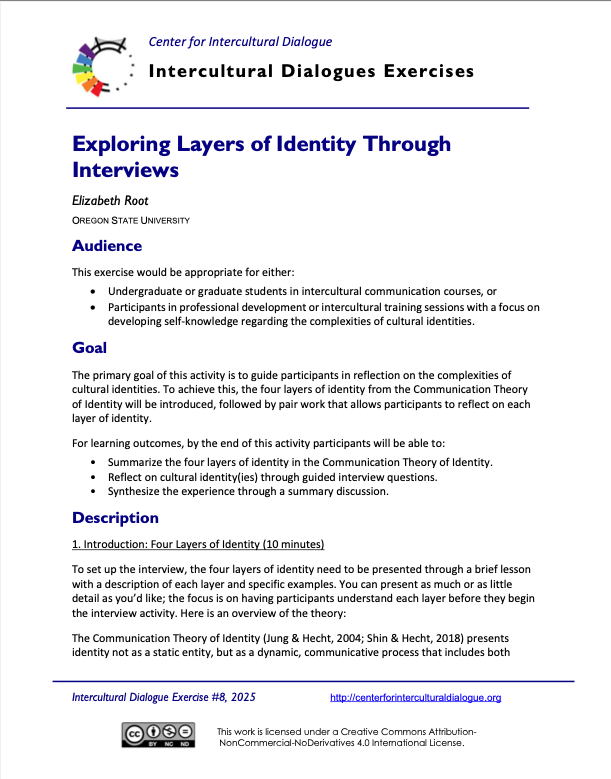
ICD Exercise #8: Exploring Layers of Identity Through Interviews

ICD Exercises

The next ICD Exercise is now available. Elizabeth Root describes an exercise she has successfully used with students, Exploring Layers of Identity Through Interviews.

The primary goal of this activity is to guide participants in reflection on the complexities of cultural identities. To achieve this, the four layers of identity from the Communication Theory of Identity will be introduced, followed by pair work that allows participants to reflect on each layer of identity.

As with prior publications, ICD Exercises are available as free PDFs; just click on the thumbnail to download.

Intercultural Dialogue Exercise 8 by Elizabeth Root

Root, E. (2025). Exploring layers of identity through interviews. Intercultural Dialogue Exercises, 8. Available from: https://centerforinterculturaldialogue.org/wp-content/uploads/2025/06/icd-ex-8-root.pdf

If you have an exercise you’ve used that works, and you would like to share it, please submit it. All authors will be asked to answer the same set of questions, and to make the exercises available for others to use, thus these are being published with a Creative Commons license (as is the case for all CID publications). If you are new to CID, please provide a brief resume. This opportunity is open to masters students and above, on the assumption that some familiarity with academic conventions generally, and discussion of intercultural dialogue specifically, are useful.


This work is licensed under a Creative Commons Attribution-NonCommercial-NoDerivatives 4.0 International License.
Wendy Leeds-Hurwitz Director Center for Intercultural Dialogue